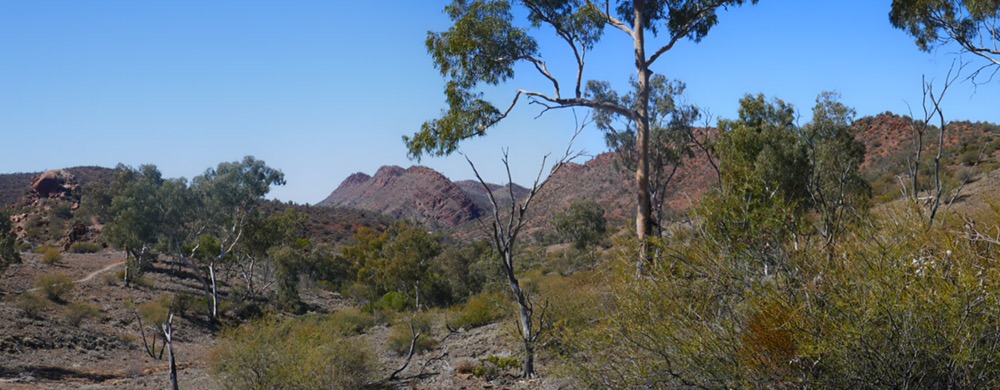
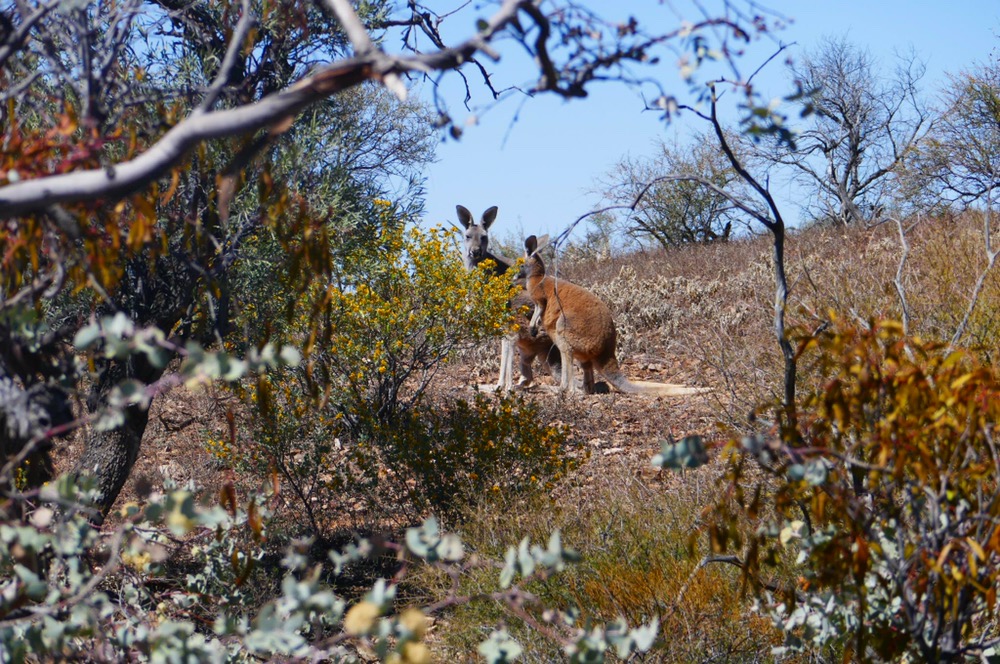
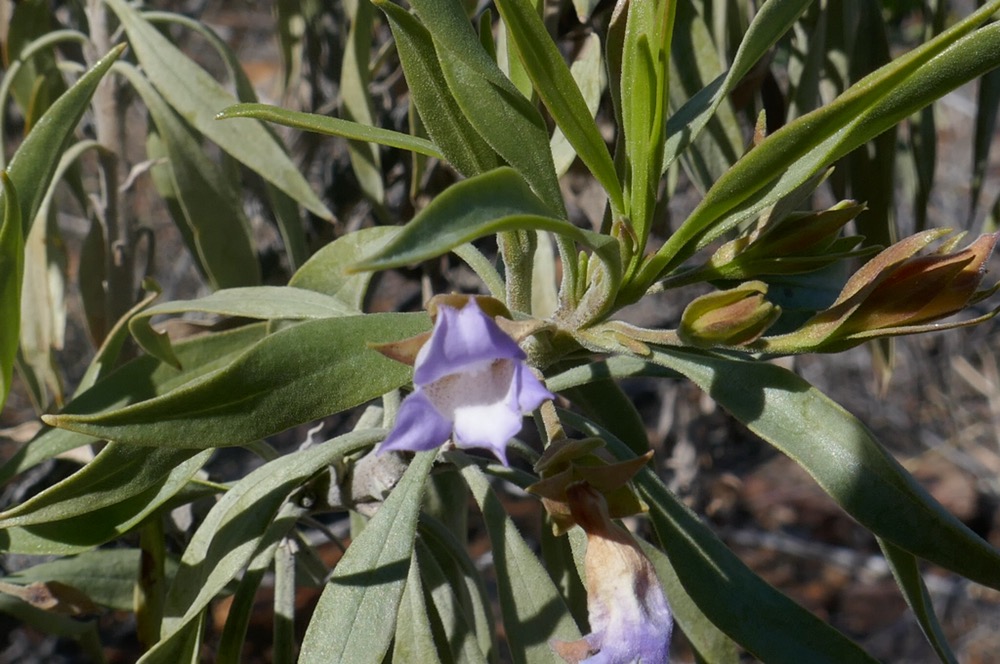
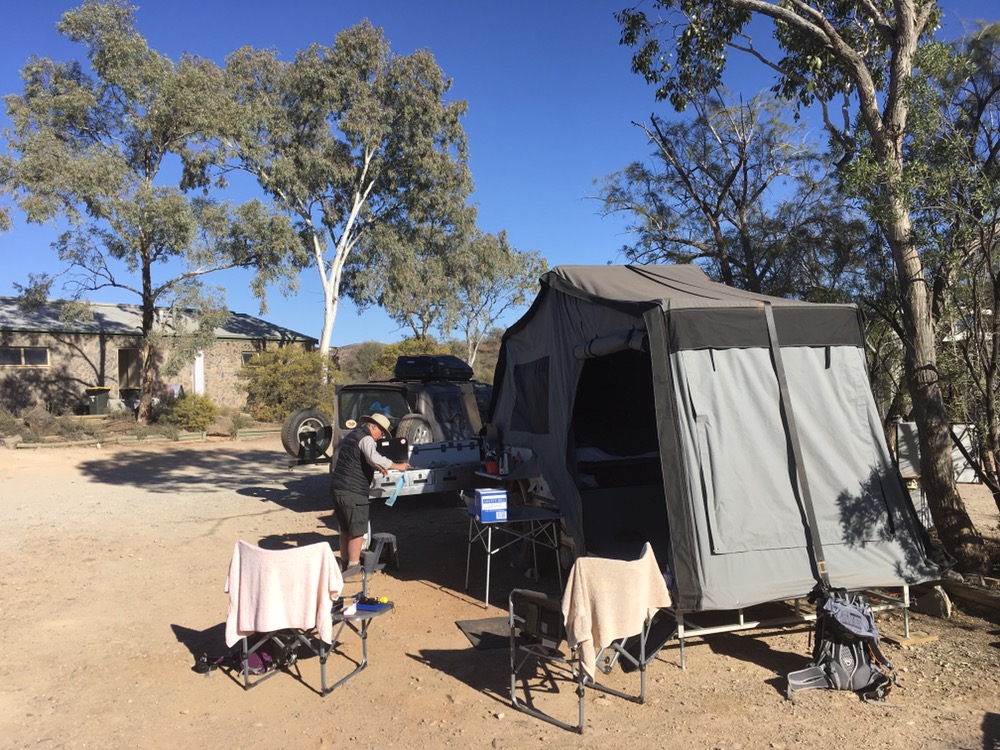
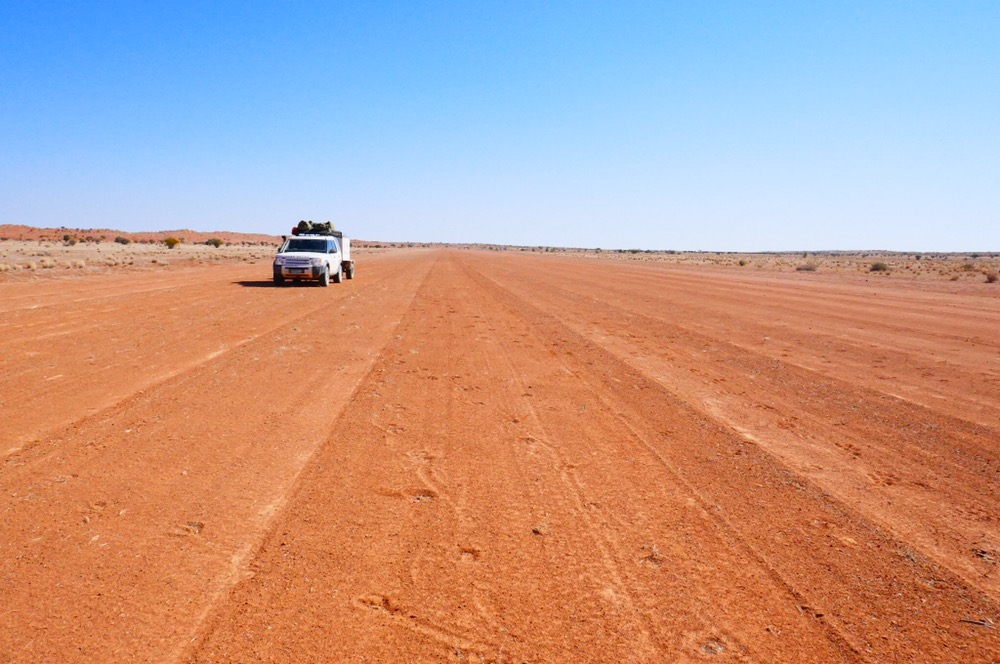
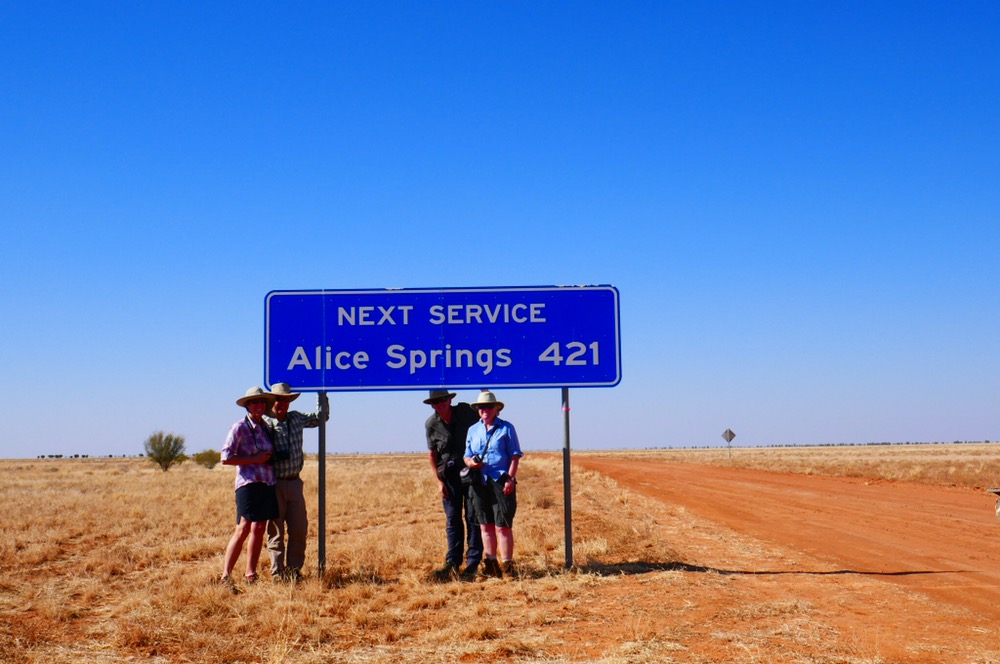
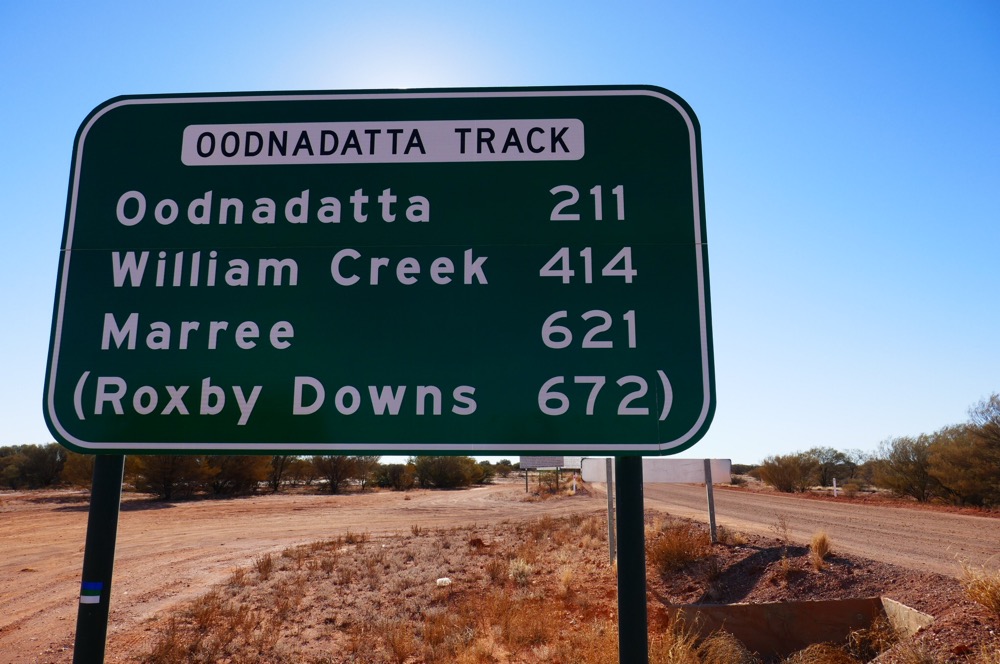
Well we have done it. Jennifer drove the Oodnadatta track over three days beginning on Saturday morning and finishing today here at Marree. We began the trip from Marla which is on the Stuart Highway after driving south from Alice Springs on Friday. We have done quite a bit of preparation for this trip, it’s nothing hard, well nothing compared to the ultimate one which is the Canning Stock route but it was the first remote drive we have ever done.
Marla is pretty basic. A fuel station to fill up. A minimart. And a Caravan park where we stayed overnight. We set off the next morning. We lowered the pressures in both car and trailer and we noticed immediately how much smoother the car was on corrugations. But the corrugations at Marla are nothing compared to the bone jarring at the south east end of the track.
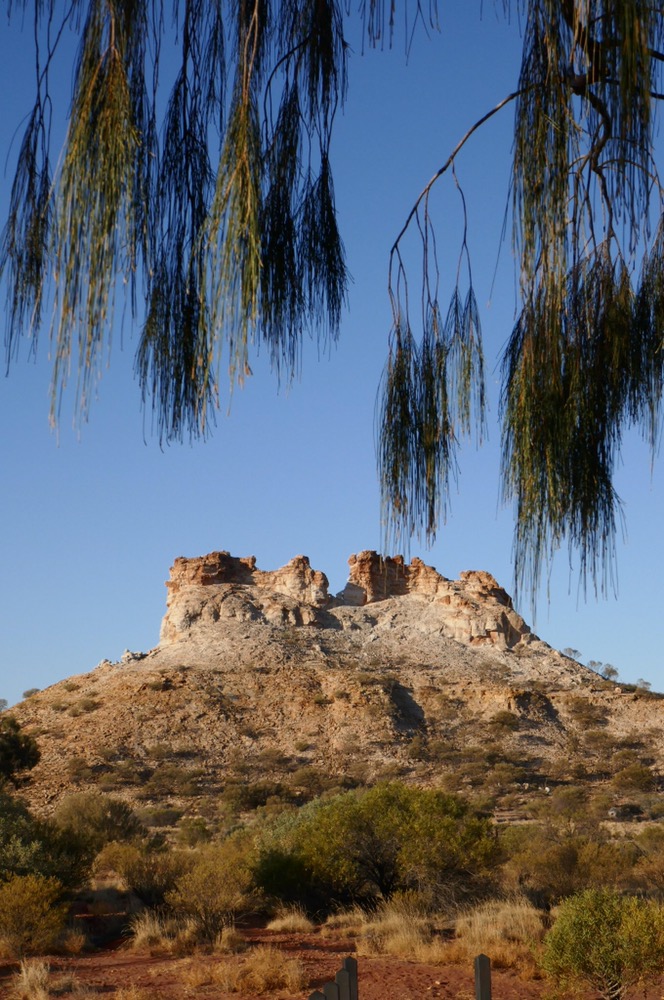
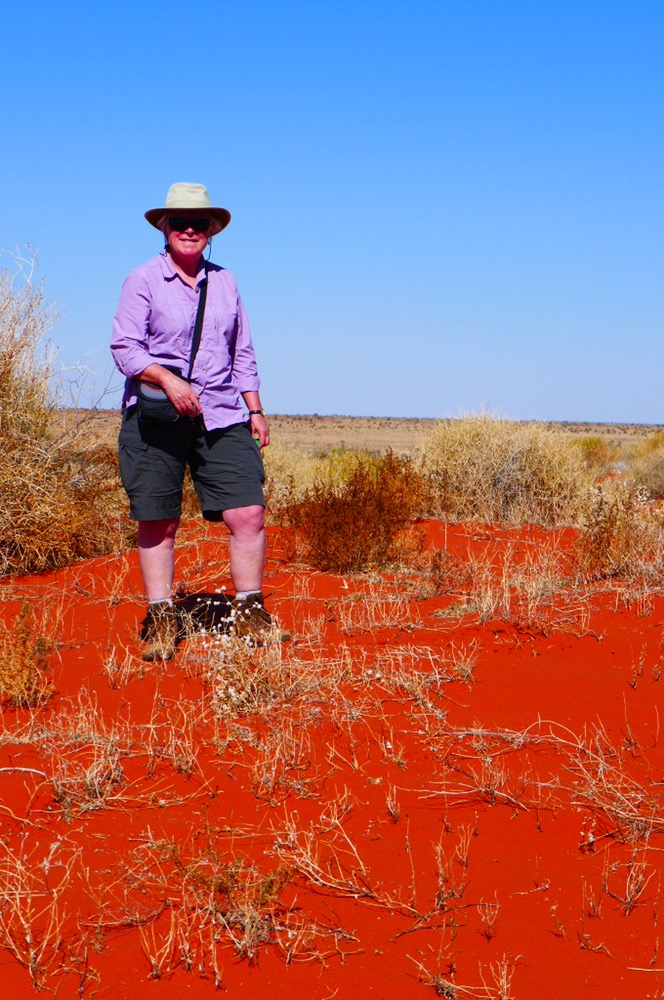
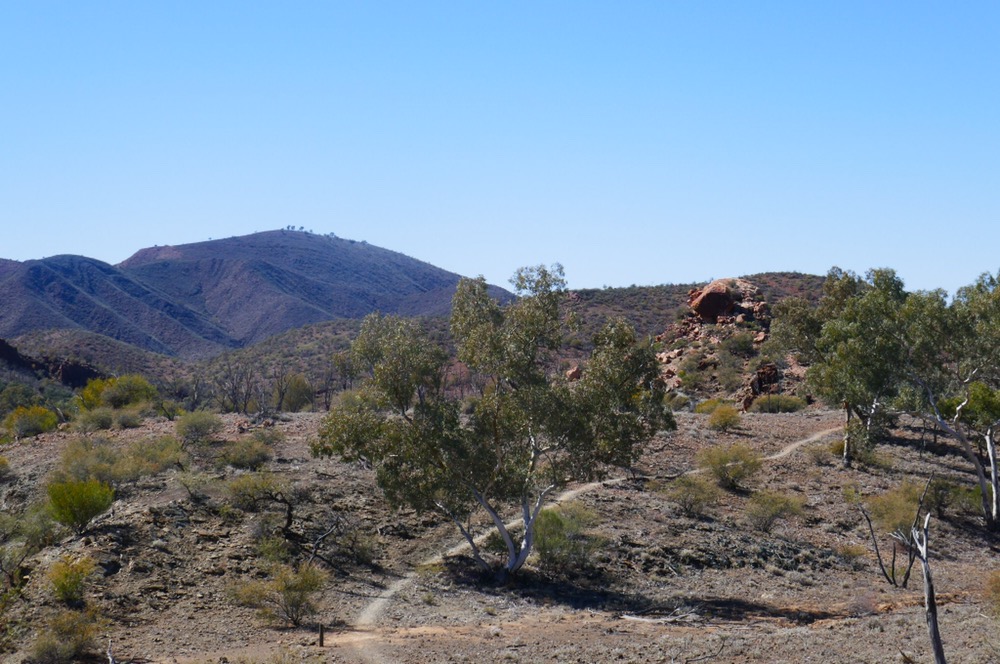
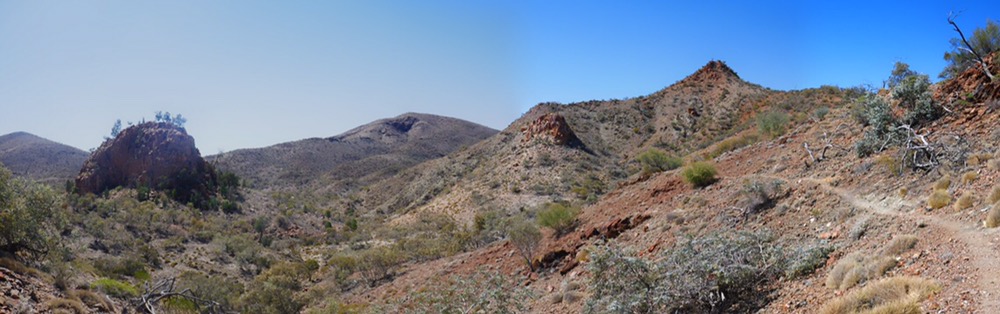
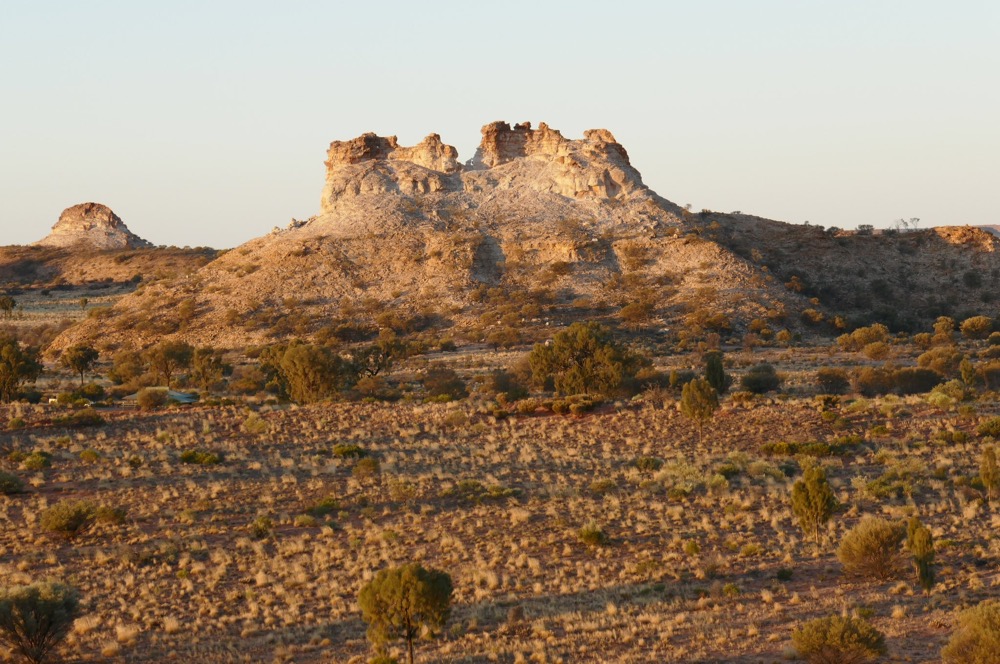
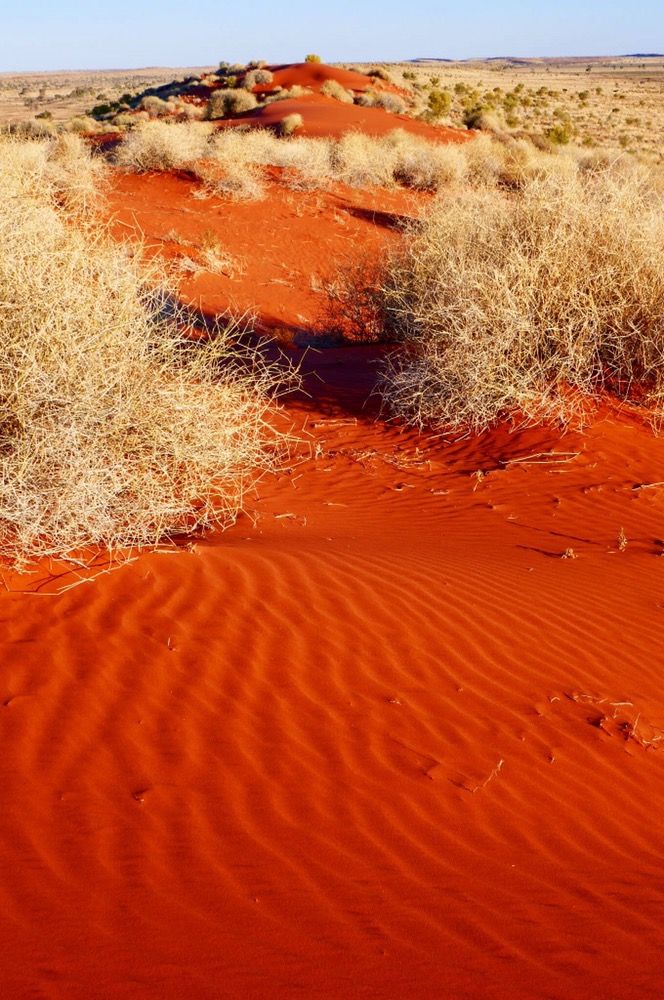
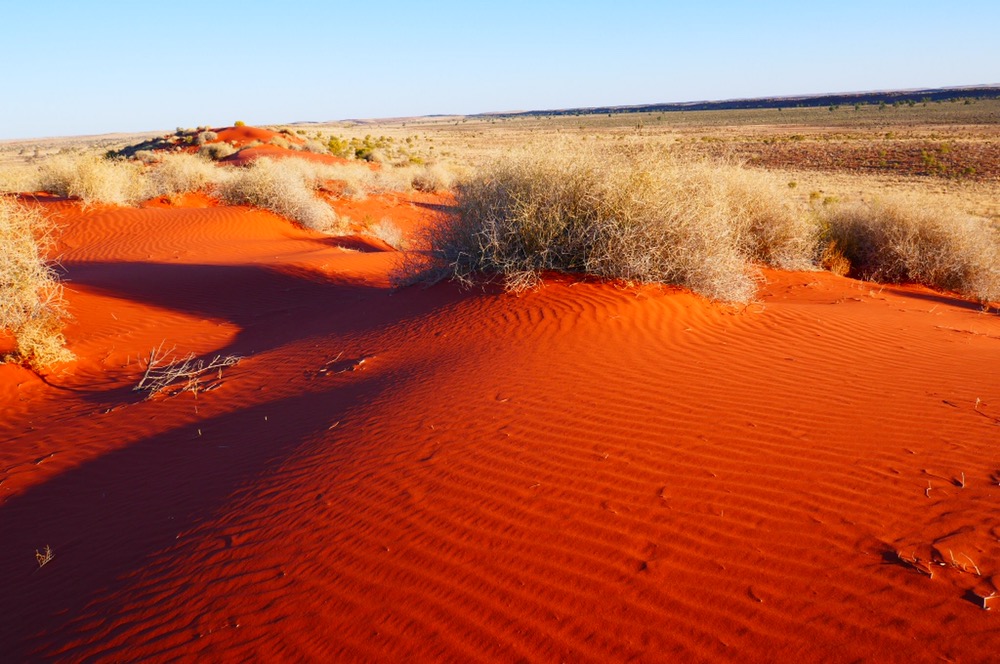
Our target destination for day one was Oodnadatta. The track is pretty good with dips and corrugations aplenty but not much sand to speak of. The scenery is not overwhelmingly beautiful but it’s tough, dry and plants and animals here have to struggle. The Sandhills are impressive , long lines of sand lying kilometre after kilometre in length, and generally lie east west due to prevailing winds. There are pale yellow ones just south of Oodnadatta, and then big red ones near William creek which to be honest, does not have a lot else going for it.
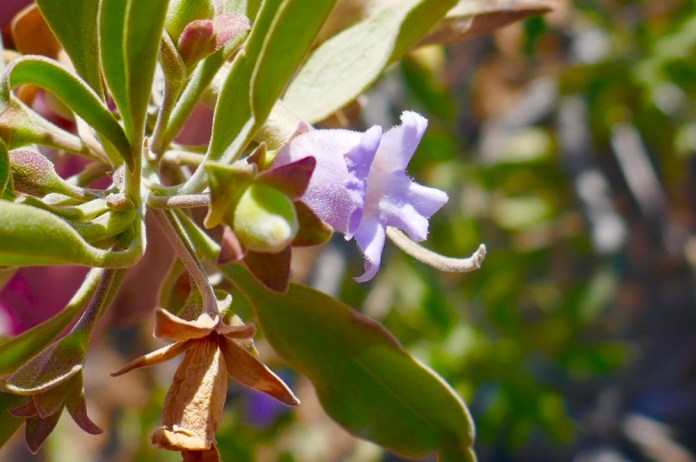
Oodnadatta means myrtle flower. I don’t know if it’s a blossom pink but it should be, as Oodnadatta boasts the quirky Pink Roadhouse. This is a great place, the staff are terrific but the decor is Pink upon pink. They do meals, mostly burgers! The kitchen closes for meals at six so we visited the Transcontinental Hotel to see about dinner later in the evening. No luck there, as they are closed for renovations. So Jennifer cooked a meal for us. The caravan park is a bit sad, three trees, and yet the amenities were very clean, water was hot and there was a shelter to escape the wind. It’s been really windy all three days of our trip. Jennifer is feeling a bit troppo with it. Oodnadatta is well worth exploring. The terminus of the Old Ghan ended at Oodnadatta for fifty years before the extension was built to Alice Springs in 1929. That was a sad day for the town as up until then it had been a very busy place. There was lots of work for the cameleers, the shopkeepers and publicans. But somehow it carried on and how it did is documented in the museum ( previously the railway station) in the middle of town. The building is in excellent condition and each room has displays about different aspects of life here. There are photos and displays about the Aborigines, the Chinese, the Afghans, the farmers, the railway men and their wives and their families. There are other presentations on the Old Ghan, the natural history of the area and the present efforts of the local people to make a living in Oodnadatta. We spent an hour there looking at all these interesting photos and documents.
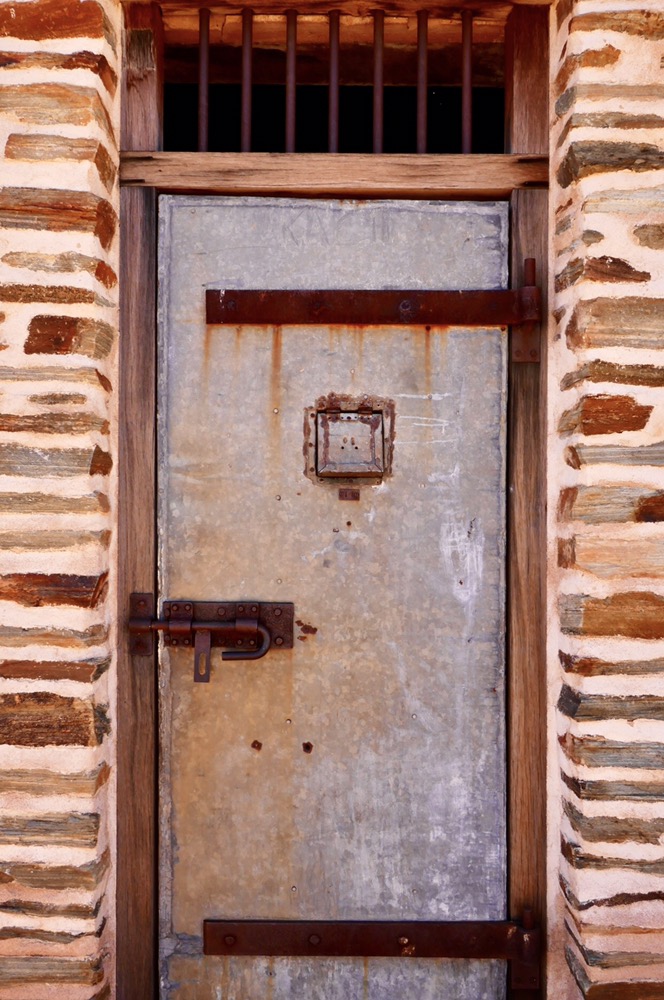
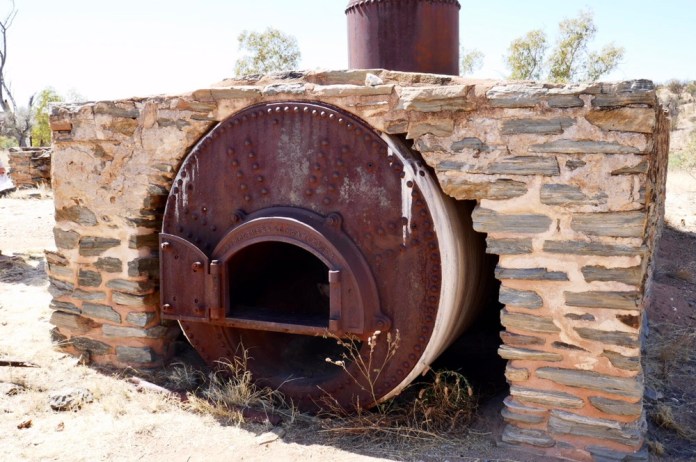
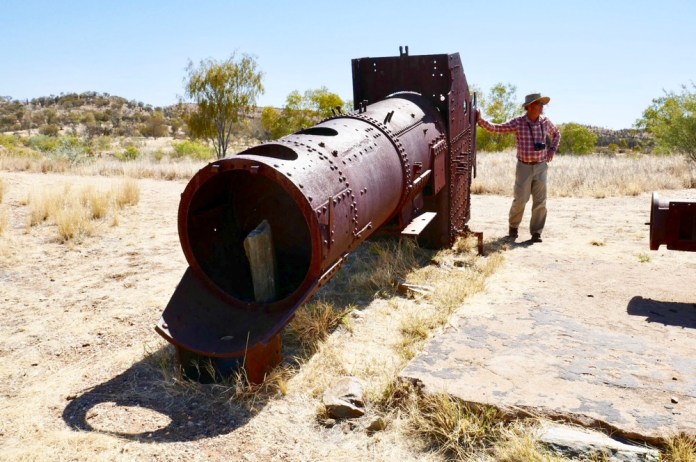
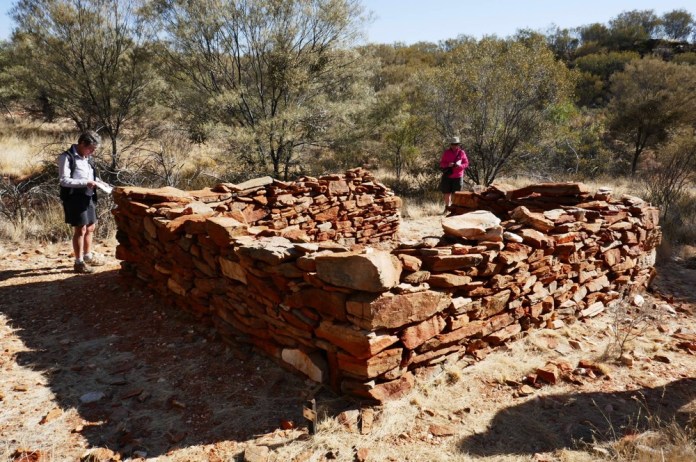
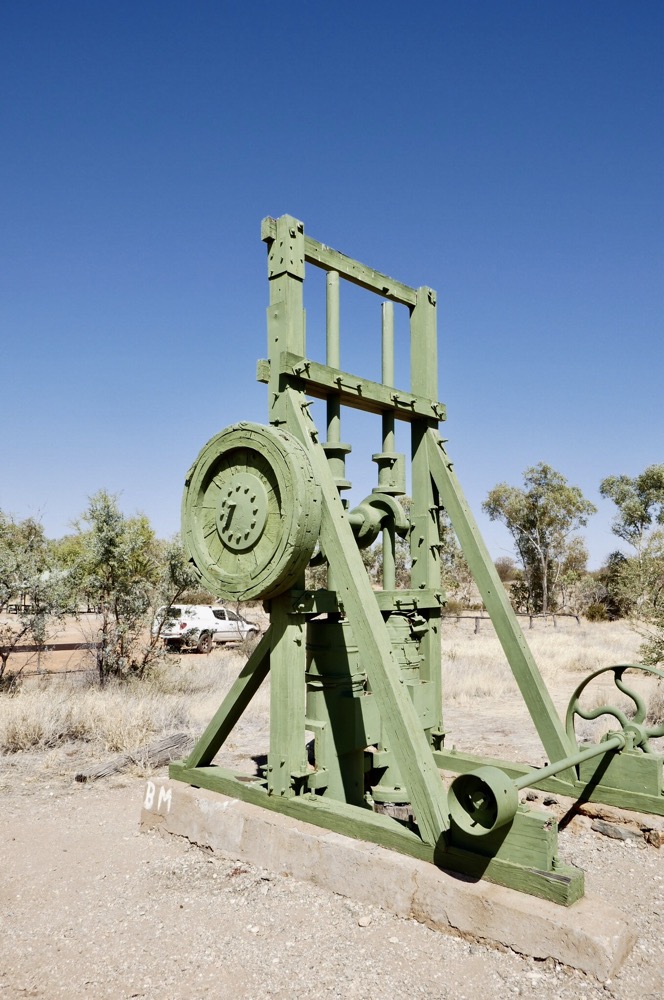
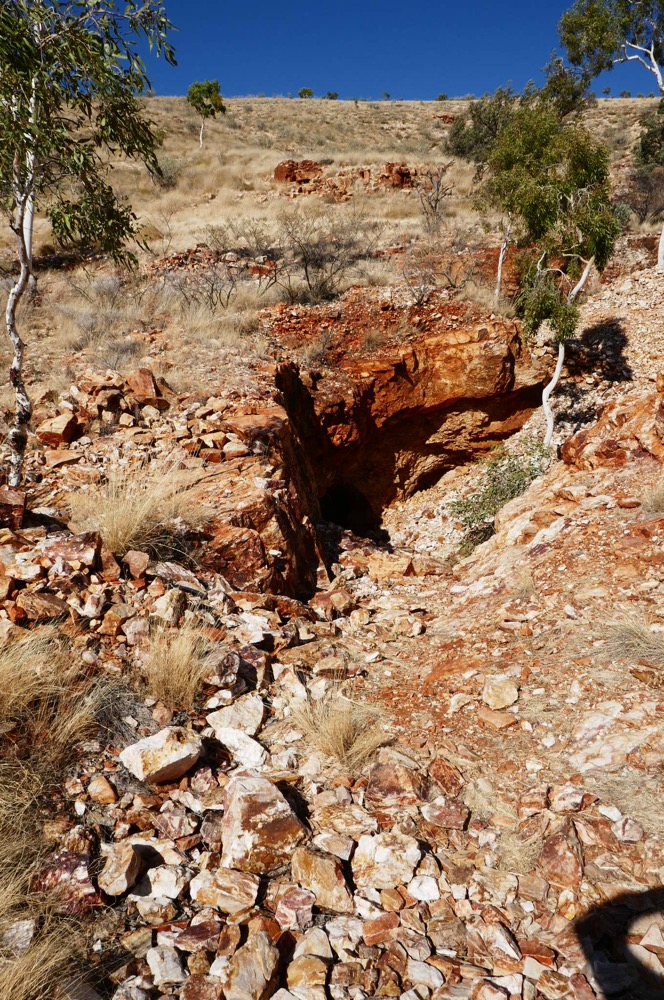
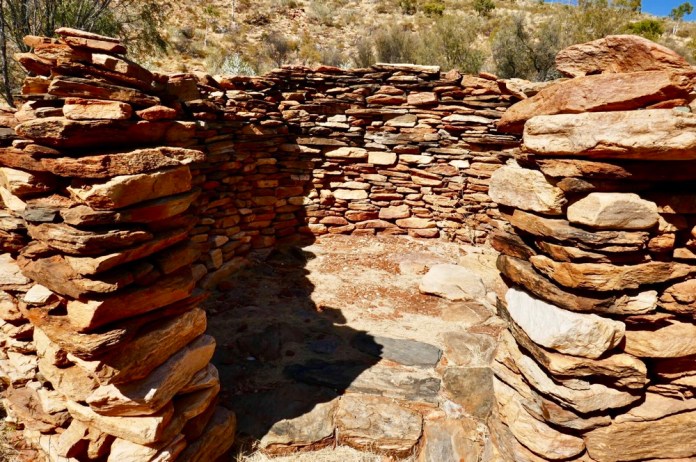
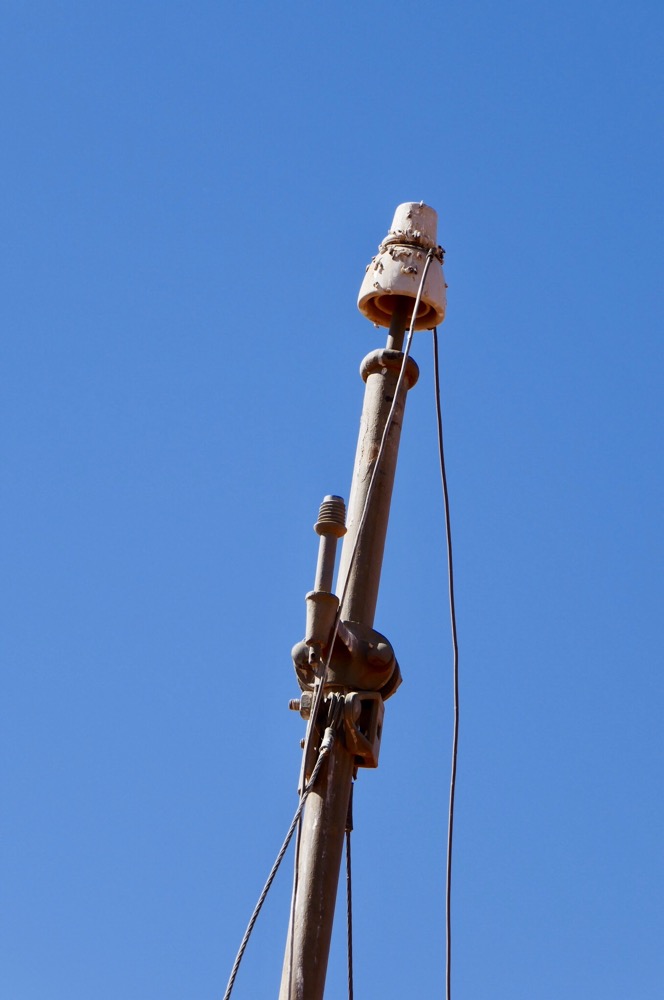
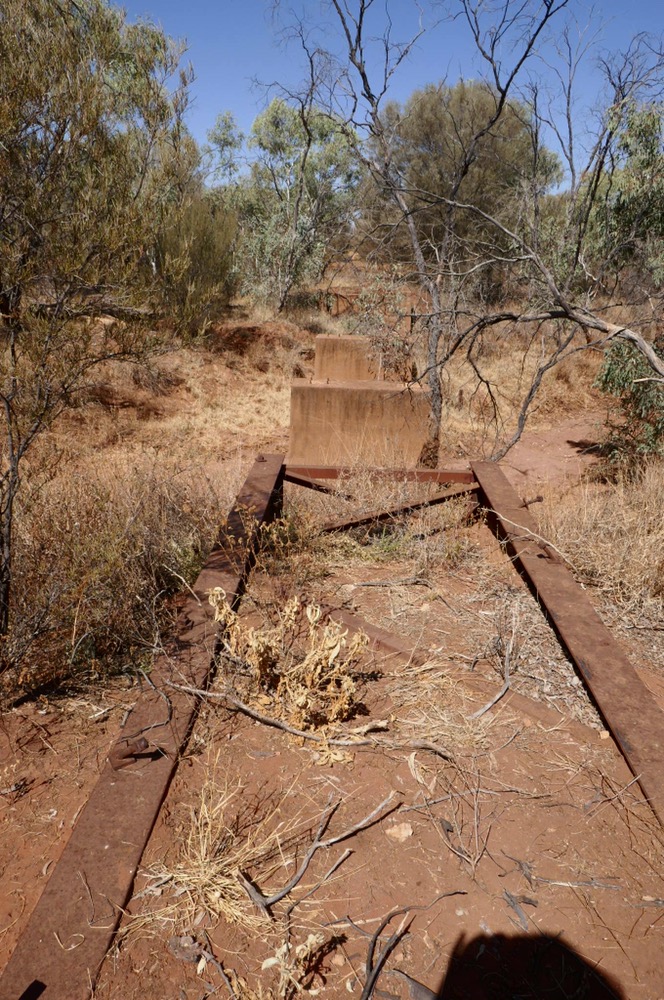
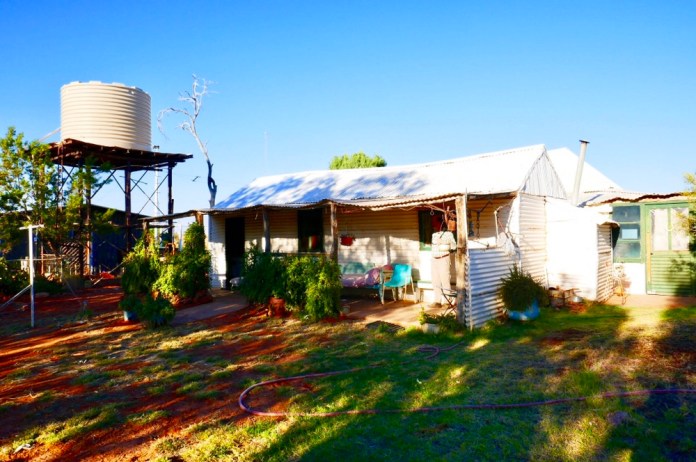
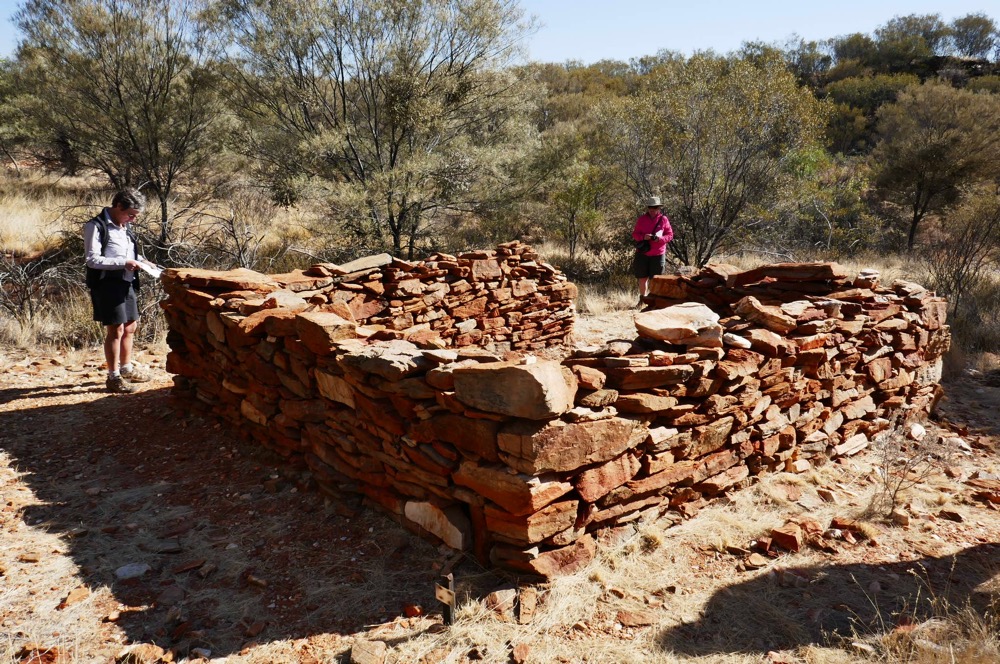
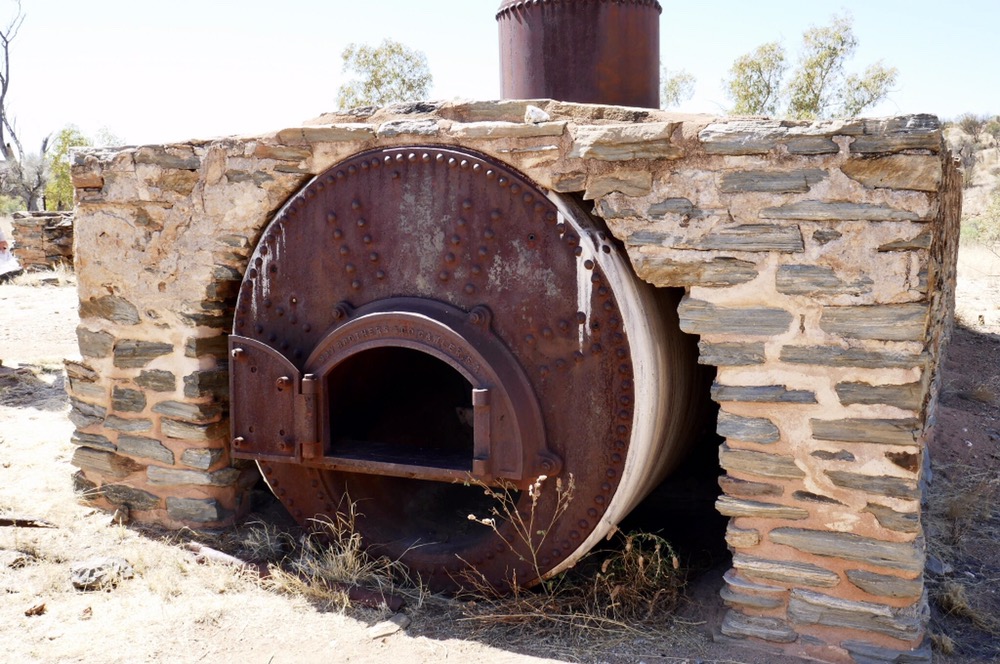
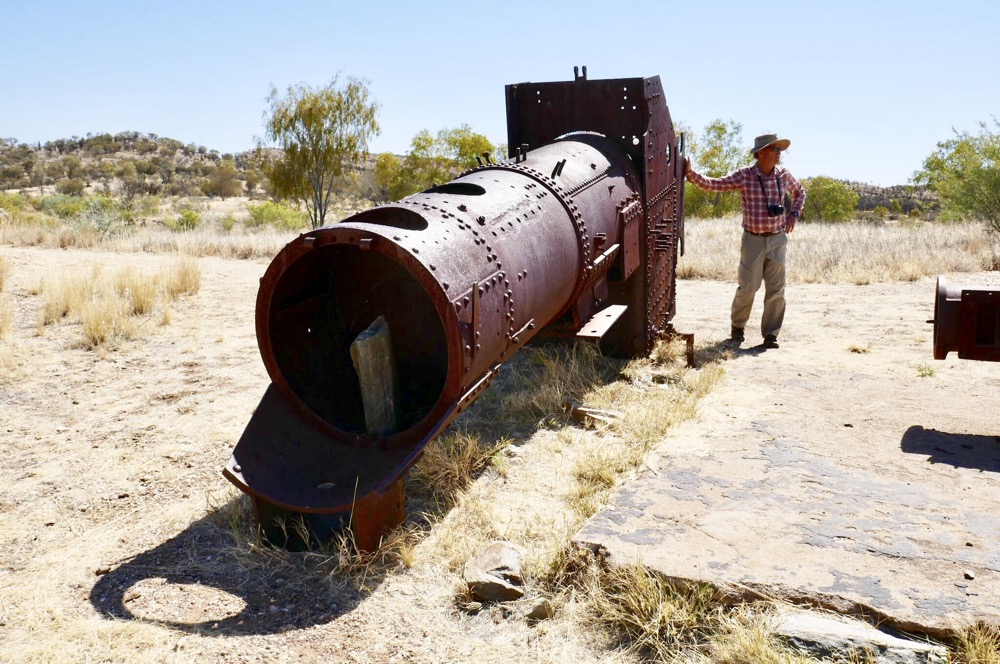
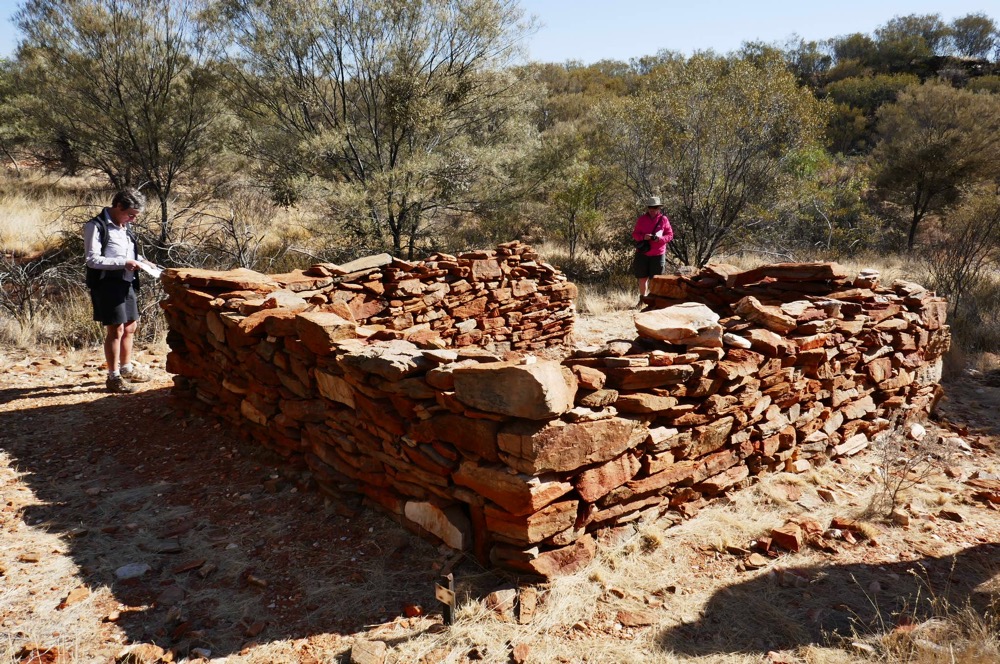
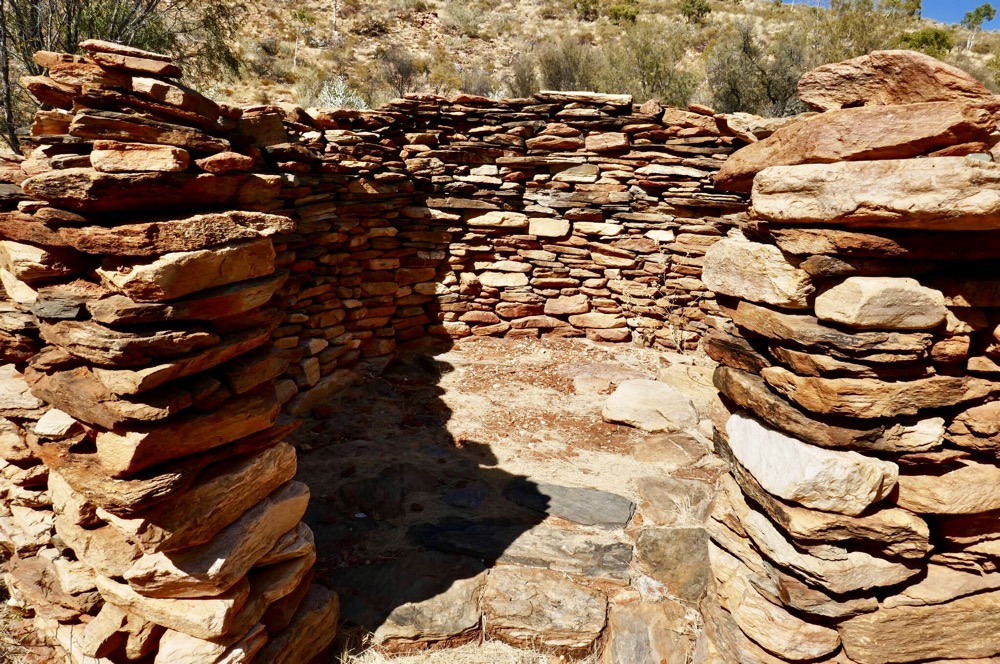
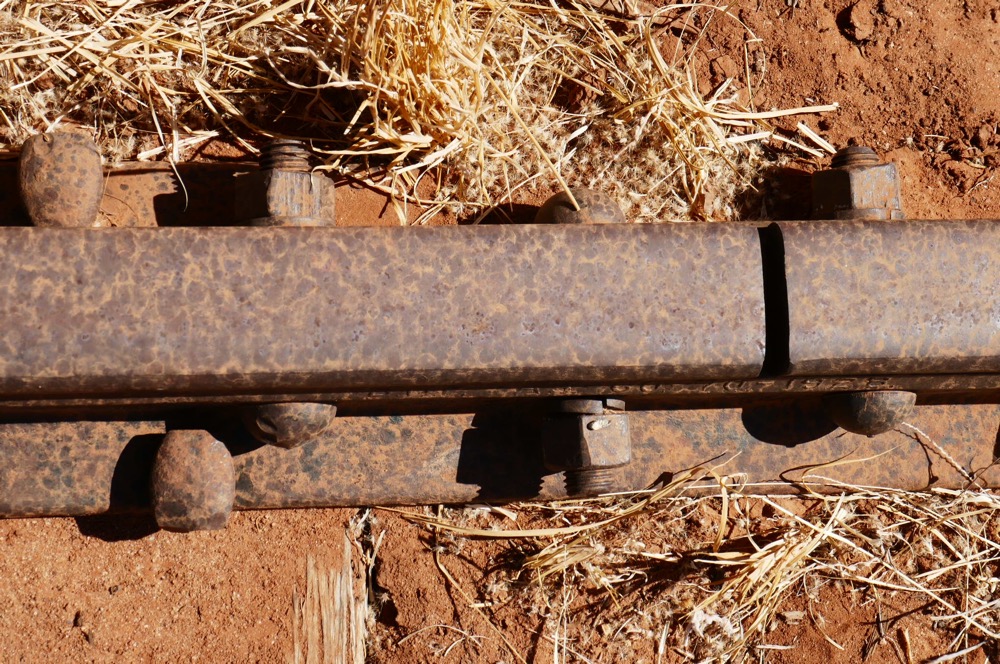
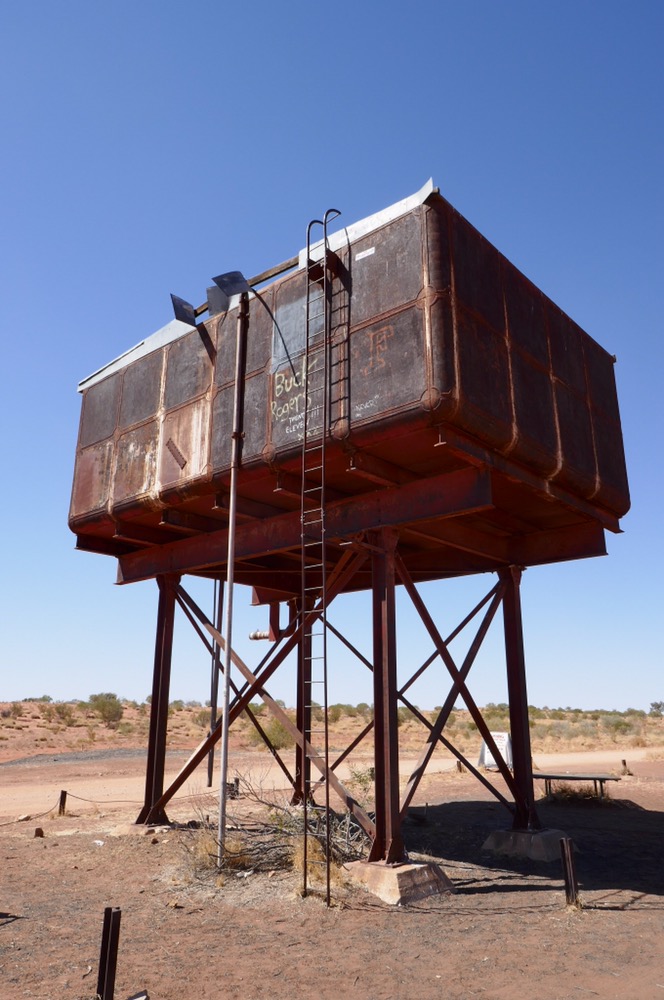
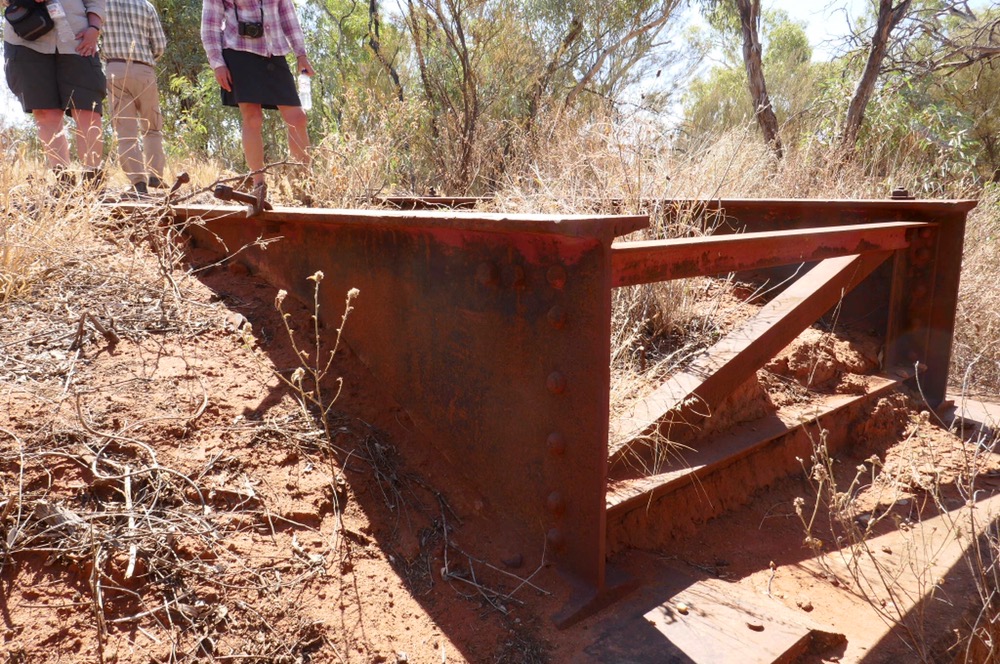
After leaving Oodnadatta, we planned on stopping at Algebuckina Bridge. However we arrived there so early we were just too tempted not to carry on further. We visited many of the old Sidings and stations that used to provide the services and stopping points for the train. Some of them are piles of stone and rubble while others are substantial buildings and facilities. They are are all made of local stone, mortared in place, with timber lintels. Galvanised steel roofs are now often replaced by fresh air. The stone walls are in two layers. In the railway buildings which are intact , the temperature is a pleasant twenty degrees despite much warmer outside temperatures. The lintels are timber for the windows and doorways. Near the railway tracks are the bore, a tall steel chamber and pump that taps up water for the train, and the water storage tower, a huge rectangular steel box an outlet to go to the steam locomotive. There are three or more steel rails at right angles to the tracks which are the remnants of the coal loaders. There is often a lot of coal fragments on the ground. There are often overland telegraph poles, with their ceramic cream insulators standing askew nearby. The only glass is not in the windows but in the piles of broken bottles that litter the surrounds ( railway men were solid drinkers). One station has been well restored, its nearer Marree and it’s called Curdimurka Siding. Every two years there is a hugely attended outback ball at this station. Most of the left over sidings and stations are pretty sad spots, the sole grave was a suicide at the first one we visited. Hmmmm. They are incredibly isolated in many instances with little opportunity for the fetlers ( track maintenance) to see other people or even escape their hot dry dusty work.
After Oodnadatta we stopped at Algebuckina Bridge. There are many bridges on the Old Ghan and many are still there. The longest on the railway and it’s still the longest bridge in South Australia. It’s way off the ground, about thirty meters and it’s long, at least five hundred meters. You can walk a short distance on the bridge today. The engineering is in the finest nineteenth century traditions of solidity, strength and a hint of real daring. The solid steel spans are supported by a crisscrossing of steel girders, with huge rivets. The forest below growing up in the creek sits well below this fine span. We carried on through to William Creek. We did stop briefly at the hotel there. There is really not much there. Downed a can of xxxx each then drove. We decided to camp at Coward Springs. And we are so glad we made the effort!
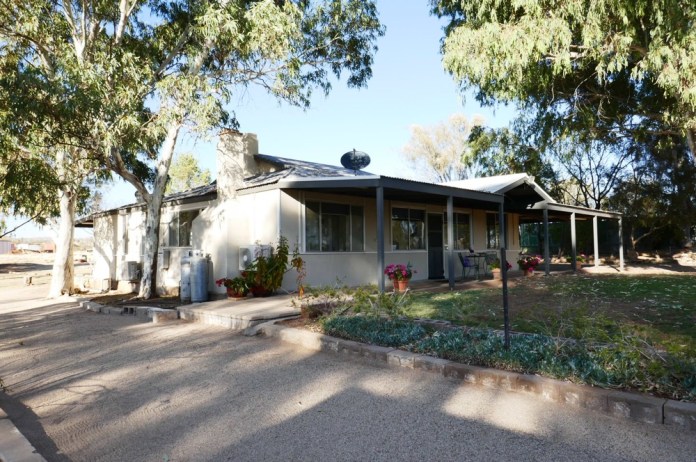
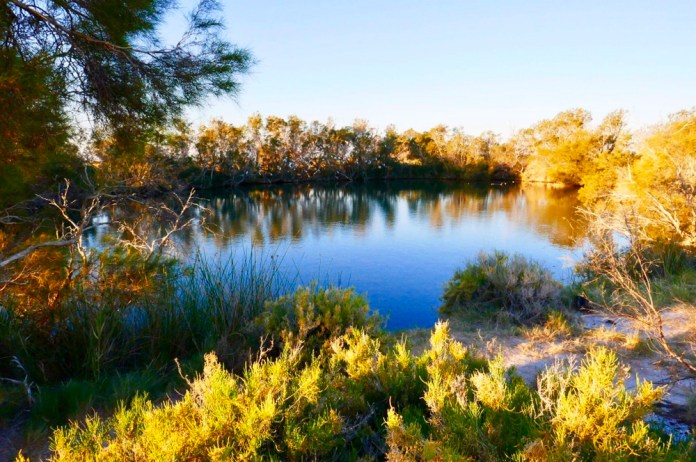
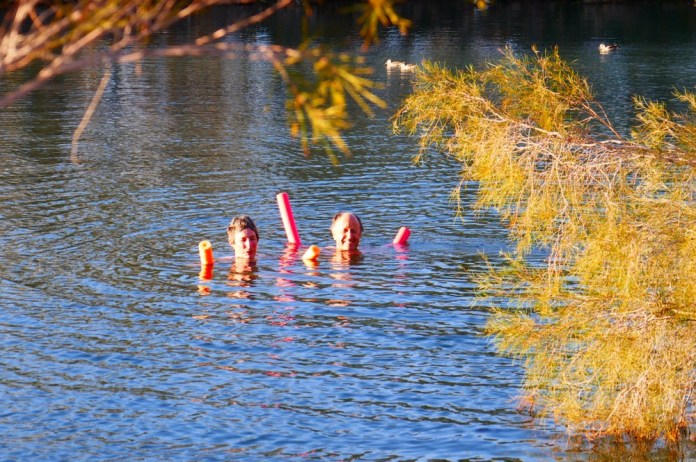
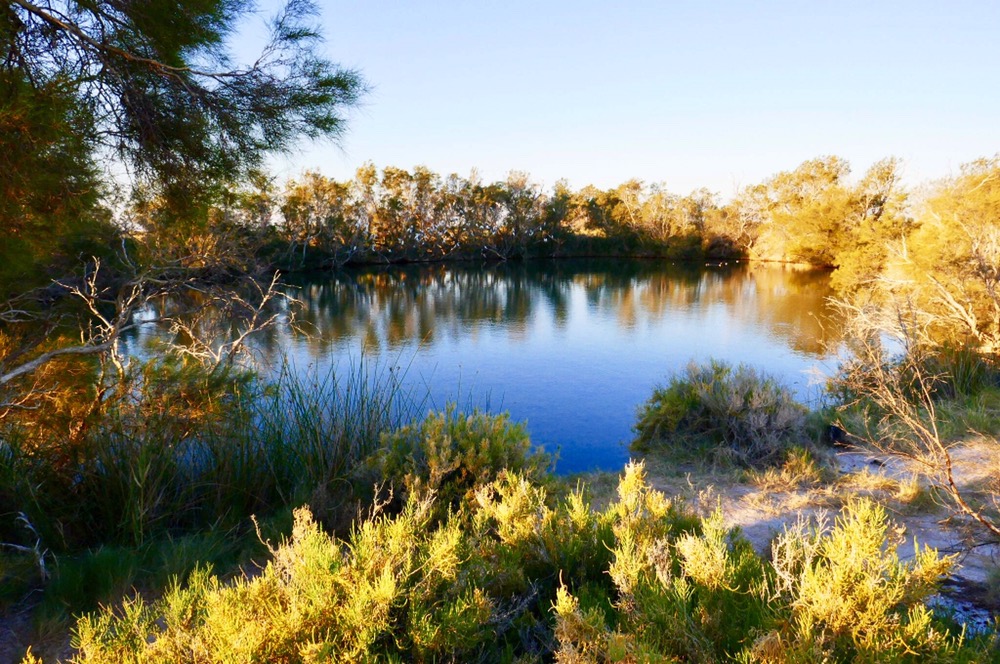
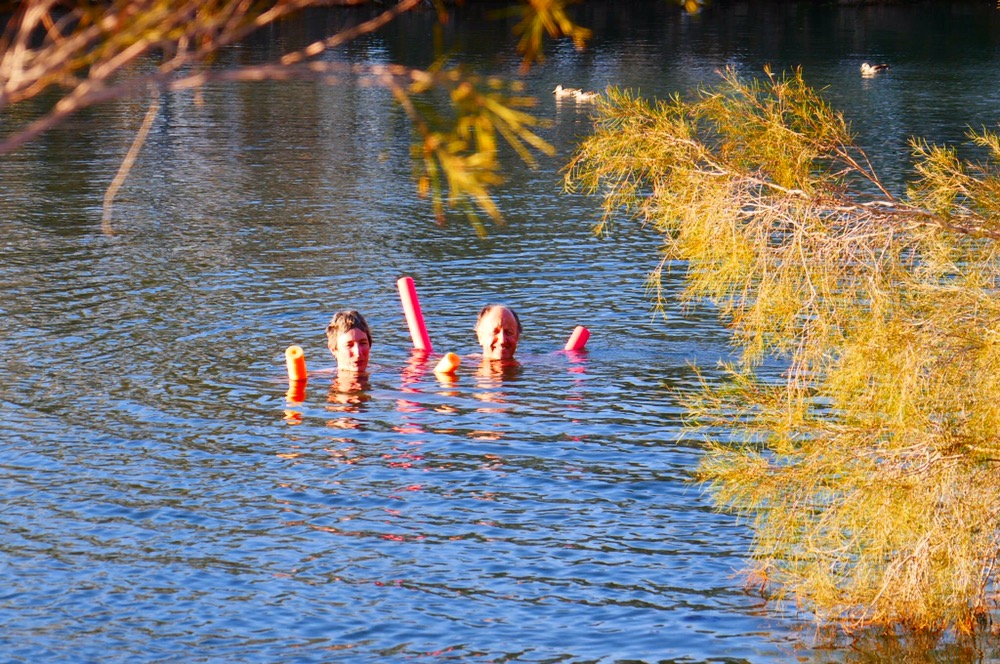
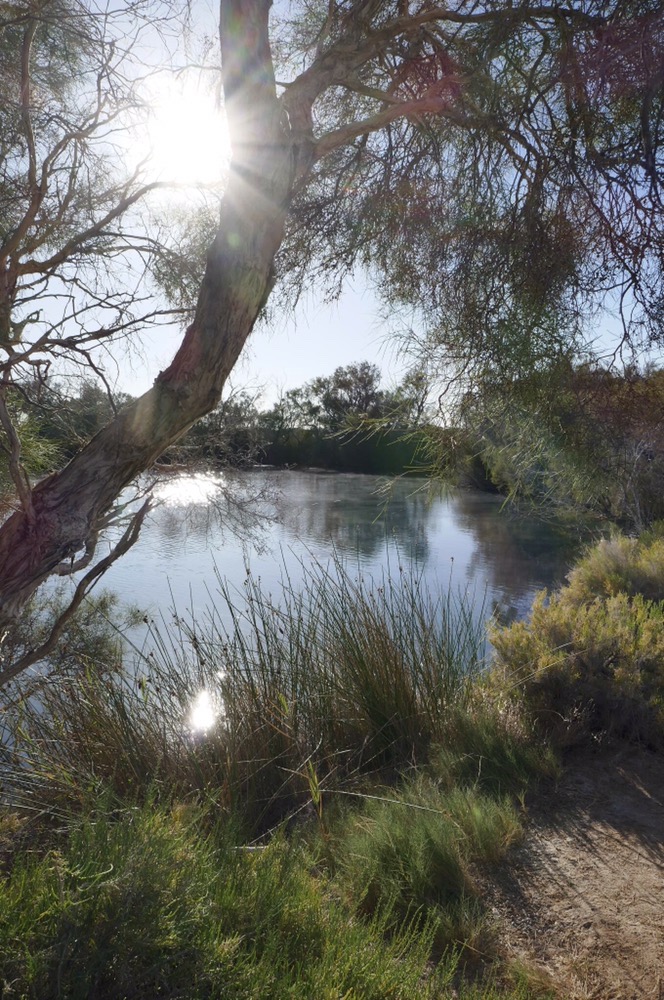
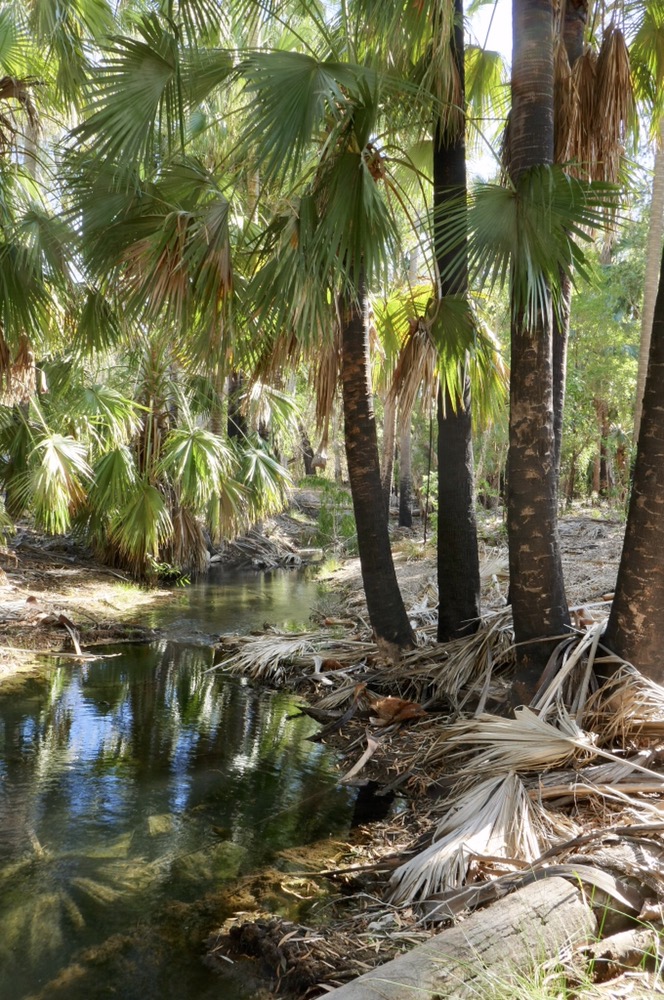
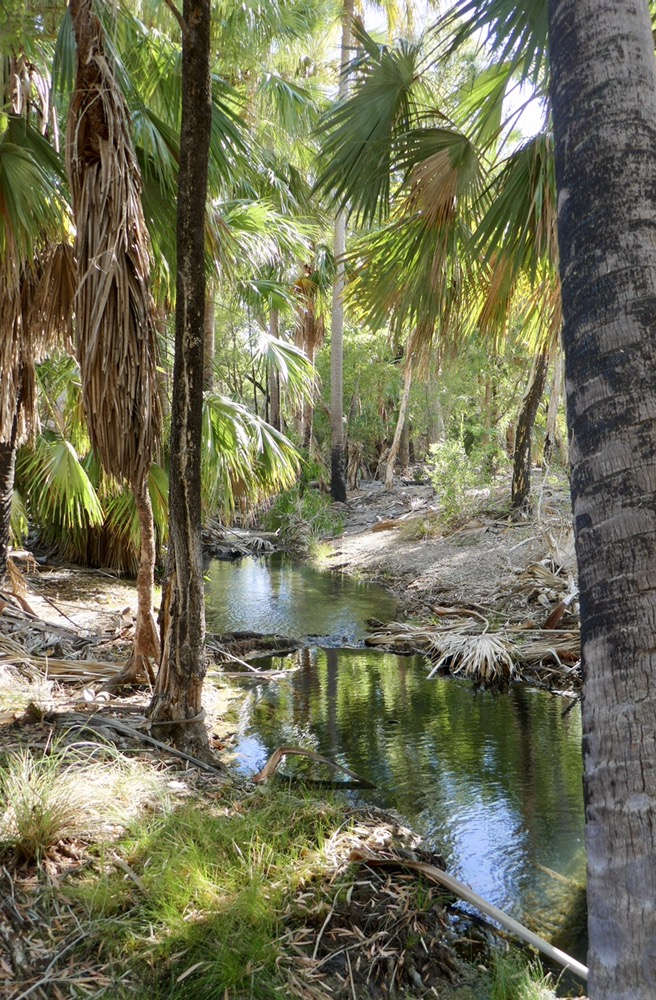
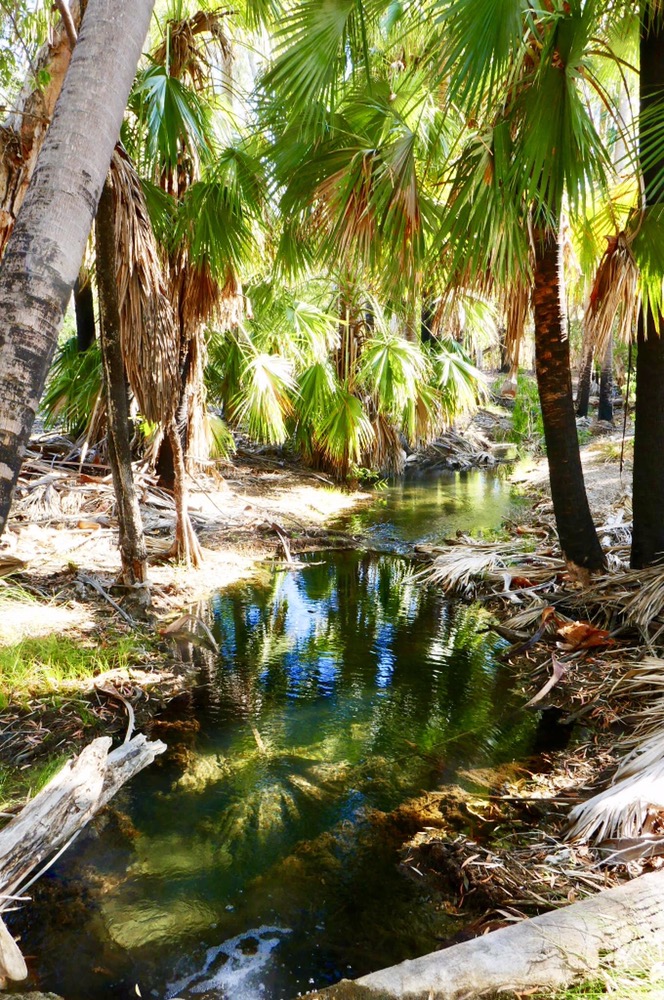
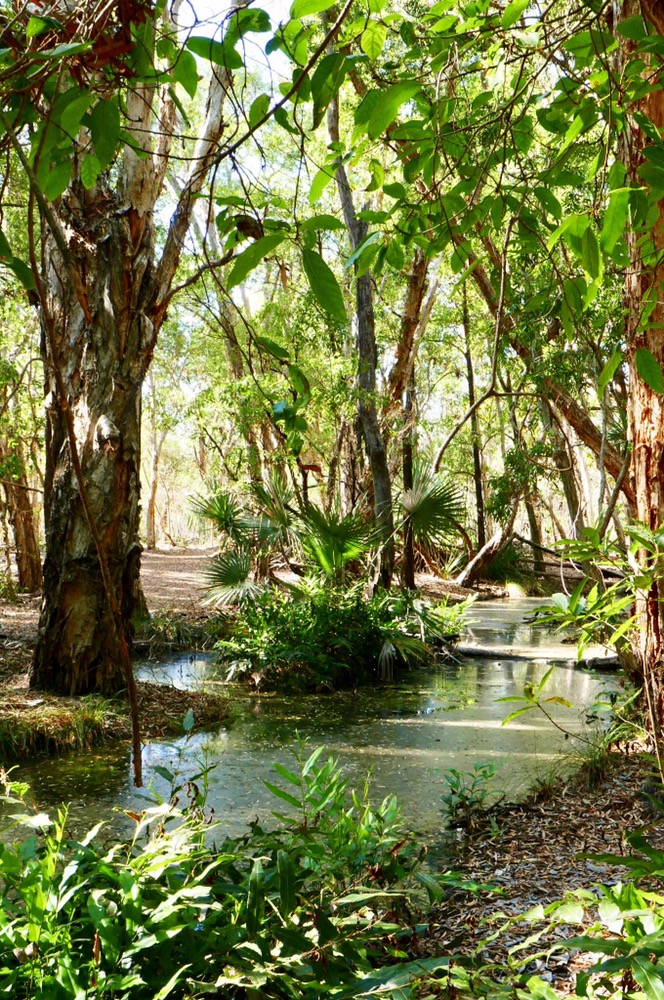
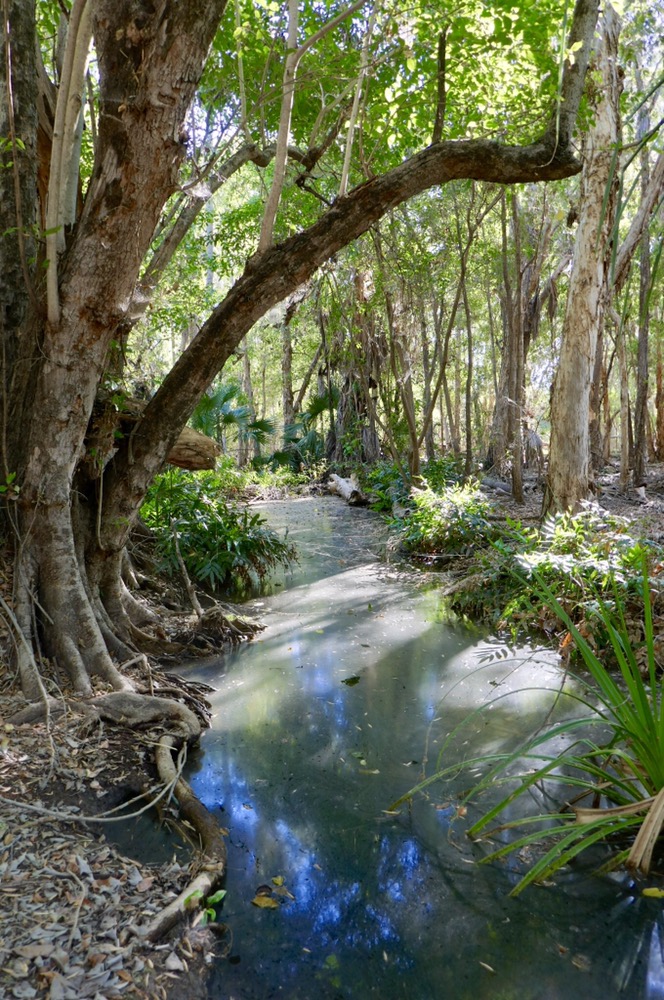
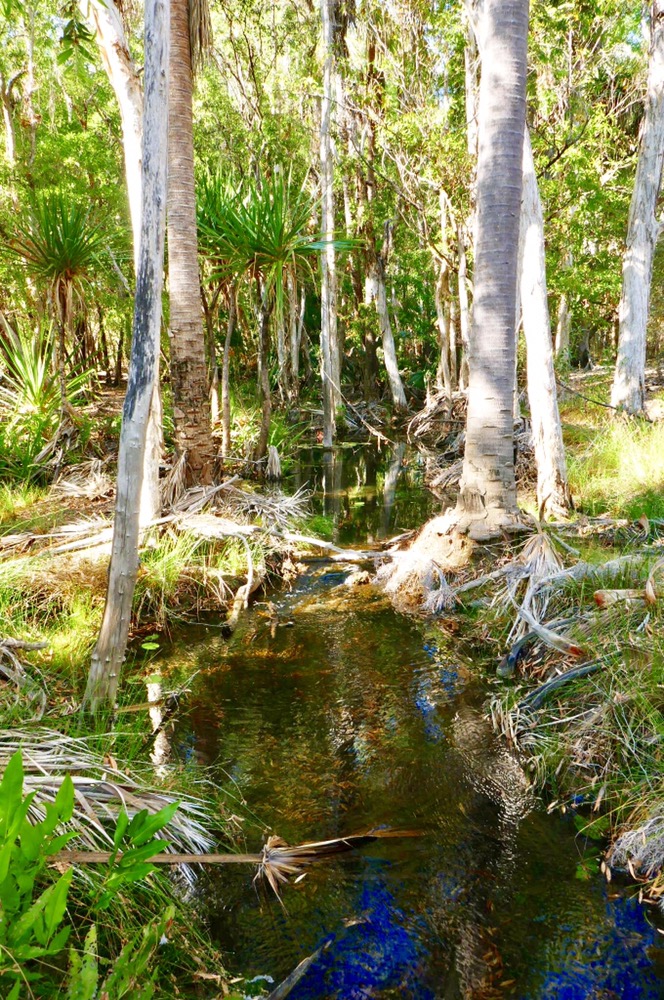
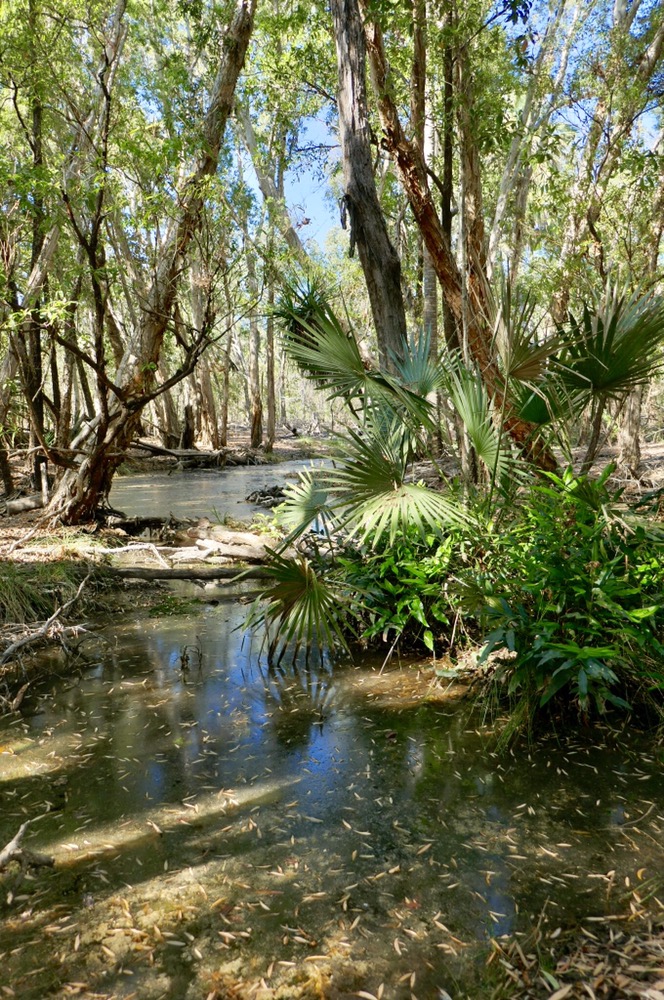
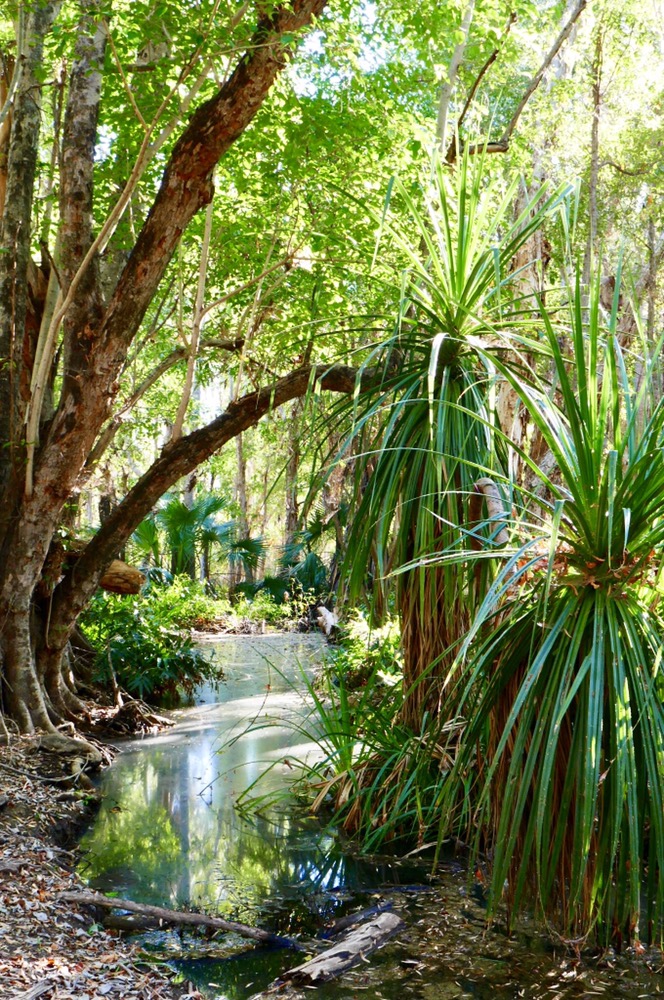
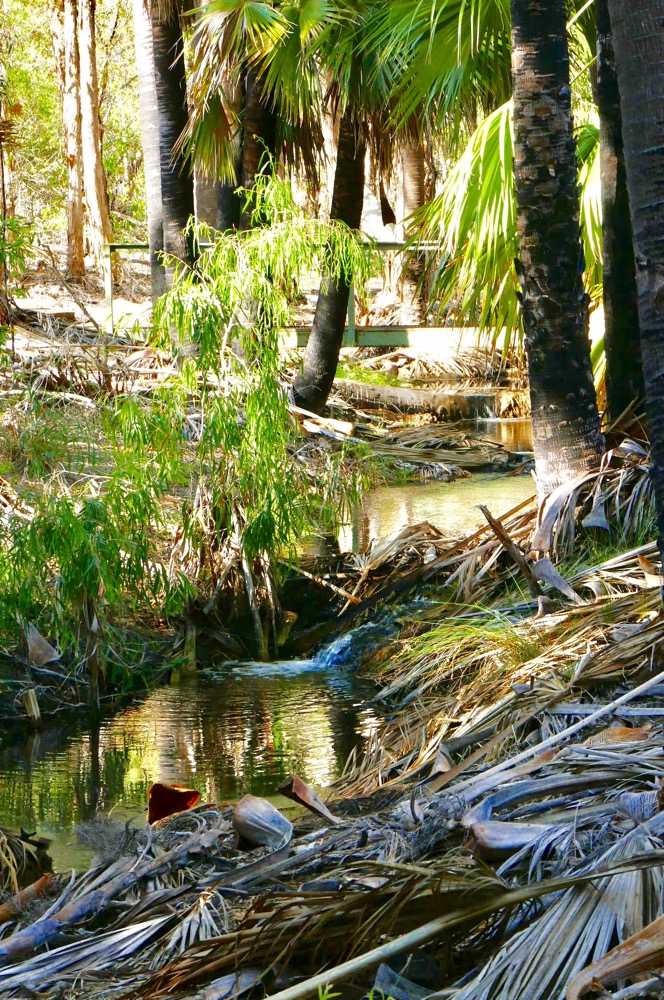
Coward Springs still has a lot going for it. When the Old Ghan was operating, it was a destination in its own right. There was a hotel, which only closed in 1962 and there were hot springs. Coward Springs resulted from a mound spring, that when it punctured the artesian basin in 1879 made a huge outflow creating an instant oasis for birds and people. Now there was not only water enough for the thirsty steam engines but more than enough for dusty hot railway men, and holidaymakers from Port Augusta, to bathe in the hot (29 degree c) springs. The camping area / springs are nestled adjacent to the conservation park, and its on private land. The new owners have done a fabulous job, of getting the bore working again, reestablishing the wetlands, replanting the trees, bringing back the birds and creating a soaking pool for us ageing boomers to relax in. They have also restored the engine drivers cottage, which is now used as an excellent museum that tells the story of Coward Springs. They have restored the station masters cottage into their own home. And except for the bristling satellite dishes, it looks brand new and totally like it would have appeared in the springs heyday.
We went for a warm swim this morning, and a kite flew just above us, hovering as we floated in the water.
We left Coward Springs and visited some other springs nearby. These are Mound Springs and the build up takes place over hundreds of years, forming a small hill, with a bubbling lake on the top. The water spills over, and as it is loaded in minerals, it coats and colours the mound. We saw Blanche Cap and the Bubbler. These springs are quite natural, and are simply areas where water under the heat and pressure of the artesian basin, bubbles to the surface. What I found truly amazing is that this water is millions of years old, it has percolated through rock for all of this time, before finally emerging in a rock fault to return to the surface but not as rain but as aquifer water. A notice board near Lake Eyre said there are 130,000 Sydney Harbours of water, in the Great Artesian Basin. How on earth can they know that?
Any way, I’m sure it’s a lot because all of central Australia is utterly dependent on this water. The route of the original Ghan was chosen because of the presence of reliable bores. Steam engines are very, very thirsty. All of the appalling problems in building and then maintaining the railway, were necessary because this is where the water was. Once diesel replaced steam, the game was over, and in only a few years, the Ghan was rerouted from Tarcoola well away from the difficulties of the old route. But for all that it was an incredible railway, full of stories, full of adventures and had far more charm than the smelly modern diesels that replaced these plucky narrow gauge steam engines.
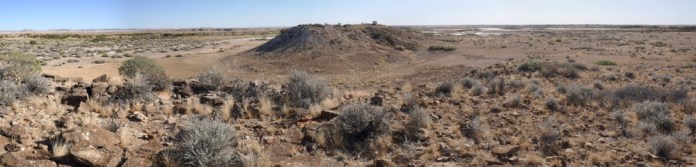
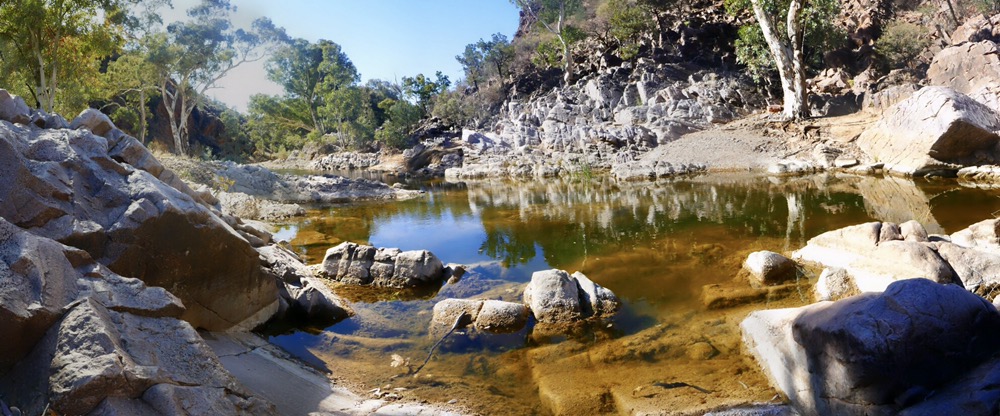
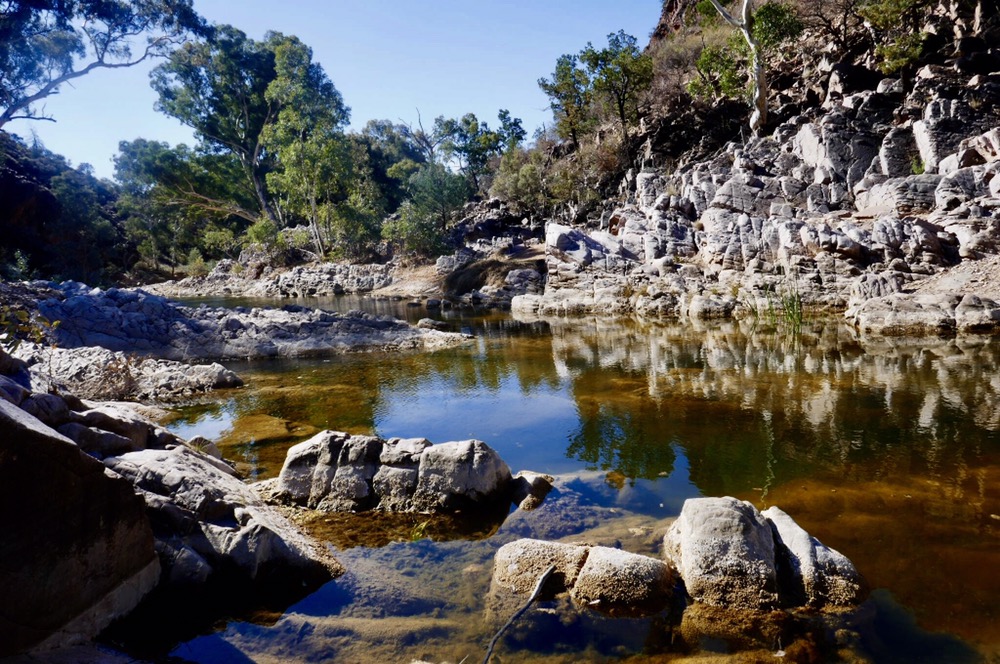
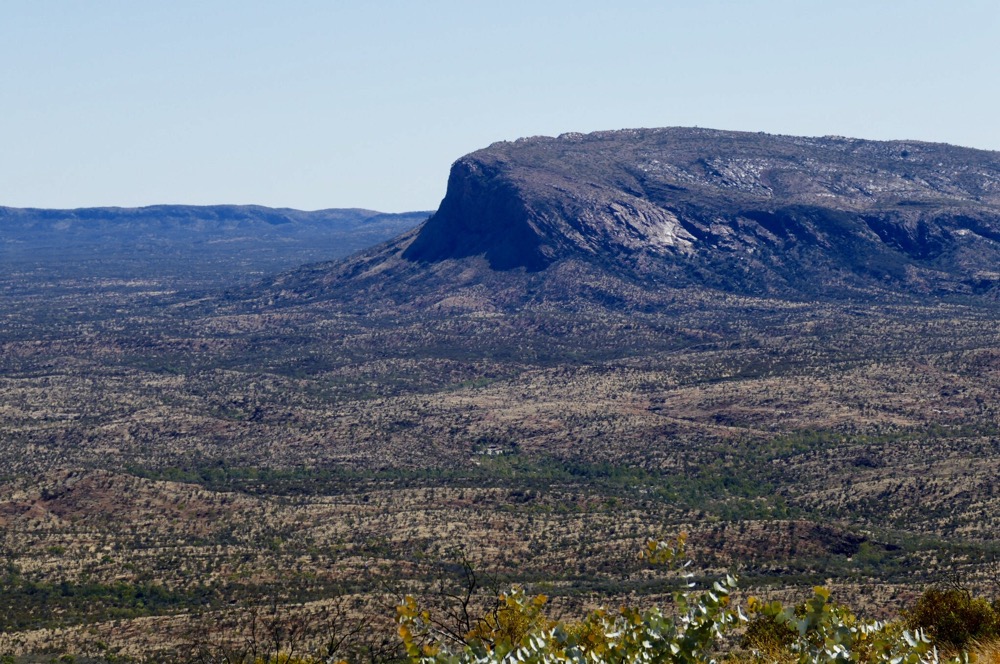
We visited Lake Eyre today. We walked down from the lookout, to Lake Eyre South. The water is gone, at least for now. The soil was crusty and orange. The pure white salt filled the horizon. There is a blue mirage, a horizontal band that looks just like a vast lake but in truth, it’s not there, not today. In many spots along the Oodnadatta track we saw vast salt lakes, dried and flat with sand dunes abutting them. They are startlingly white, and not much will grow. Salt bush is the nearest inhabitant to a salt lake. Lake Eyre has a magical, perfect beauty, it tricks the eyes, and seems to abolish distance as you gaze over it.
We arrived at Marree, at 2:45 today and enjoyed some sparkling wine at the local Marree hotel. We drove around to the caravan park up the road and have settled in nicely. The owner, also called Jen, does dinner as well. So tonight, after sitting around the fire in a cradle, we had dinner of beef curry and then yummy trifle. Jen ( not JB) sang some songs and we all had a super evening. Tomorrow we are off to Arkaroola.
This morning we spent some time exploring Marree. The wide railway station platform has broad/ standard gauge on the right and narrow gauge on the left. Marree was the spot where goods, people and well just about everything, had to swap from the standard gauge train from Port Augusta to the narrow gauge train which took you to Oodnadatta till 1929’ then after this time, all the way to Alice Springs. There is a small museum in the old station office. A lovely Aboriginal lady showed us around. There are old posters for the Central Australia Railway, announcing holiday options. There are many old photographs showing the pitfalls of the Old Ghan. It was truly a modern adventure.
The timetable was the roughest of estimates and could be weeks or as much as three months late getting to Alice. Trains were derailed. Sand hills covered the tracks. Trains crashed into each other. Rivers washed away the bridges. It was quite amazing it ran at all. The local Aboriginal people worked not only building the old Ghan but also worked as fetlers. It was an extraordinary time in Australia’s history with some rough customers working with no questions asked on the remote sidings isolated from their sometimes murky pasts. Afghan cameleers running hundreds of camels out of the main stations to supply pastoralists, but later the miners in the Kimberly Gold rush, and the scientists like Madigan who took off from Marree to cross and explore the Simpson desert. Wow! On the top it off we saw an actual emu chick wandering with his Mum in the streets at Marree.
Next stop is Arkaroola, the private sanctuary in the northern flinders region.
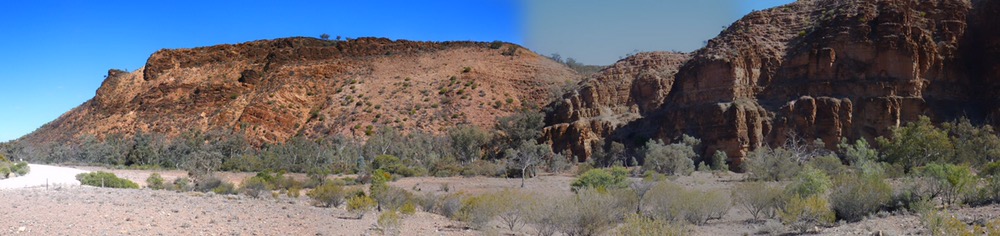
Jennifer and I are sitting in the shade of the tent. It’s about three thirty and I’m tired after a terrific walk that took most of the morning. We are camped in the Gorge Campground at Trephina Gorge. We arrived yesterday afternoon after an overnight stay at Rainbow Valley.
![]()
![]()
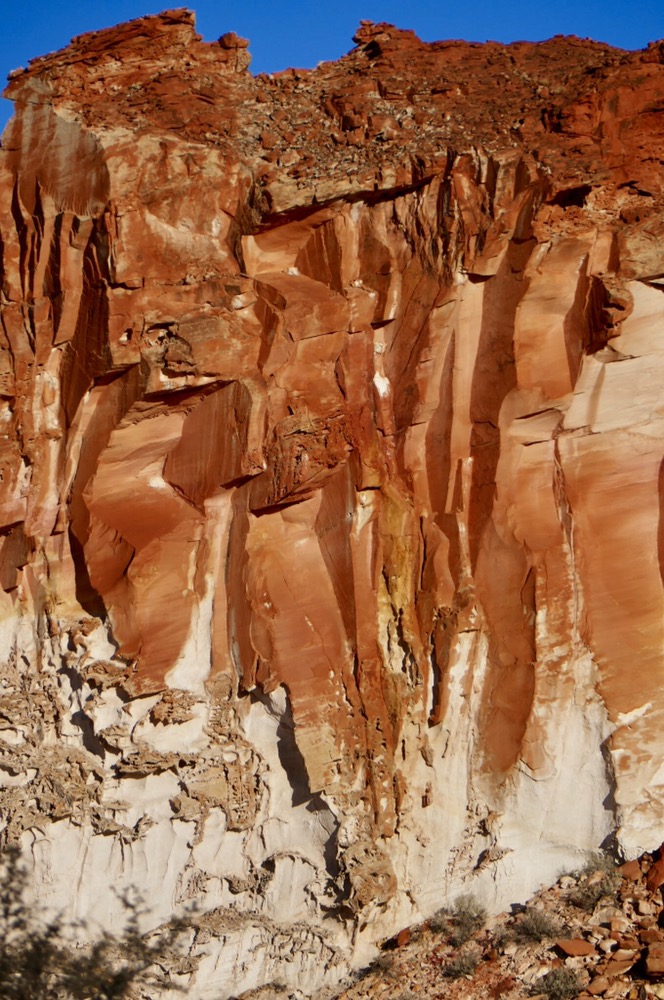
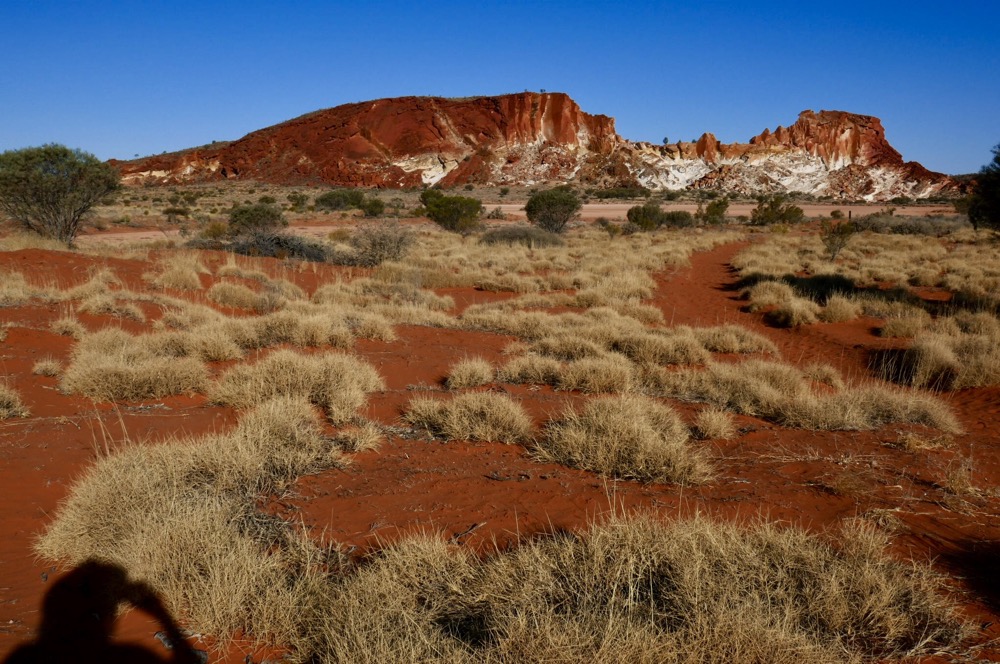
After leaving Redbank Gorge, Jen and I did not meet up with Dave and Di in Alice Springs. We did some shopping and had lunch at Red Sands, Todd Mall. Rob, the owner, thinks we must live there. We then did the short 68 km drive to Rainbow Valley. It’s south of Alice Springs and about 12 km north of Stuart’s well, roadhouse. We turned off into the 4WD track to the campground. It’s twenty km along a very sandy road. Jen had some fun, twisting and tailing along. We camped at the first, larger campground. Then walked over a hill to take in our first proper views of the rock formations for which Rainbow Valley is famous. A wall of orange capped rock, lies beyond a clay pan. Even this early in the afternoon, there is a rich glow to the formation. There are two short walks, the first was along the clay pan, to see the flowers and plants that lived here. The sand dunes and tracks are all a dusky red and yellow and show the markings of wind, repeated ripples, and also the trails of insects, snakes, dingos and lizards. Then we walked the Mushroom rock track. This is the prettier track, winding its way to near the base of the formation. It’s rugged prow resembles an old dreadnought. The track ends at Mushroom Rock, which is an eroded artefact that resembles, well, no surprises here, a Mushroom. Fairy martins have mud daub nests on the cave walls, it is a very beautiful area, and Jen and I spent an hour taking photos. After we walked back to the camp site for wine and biscuits, Jennifer said in a loud voice “it’s going red”. So I rushed up to the top if the hill, and took a few photos of the red glowing light on the formation. It only lasted a few moments, so Jen missed out, as she put things away while I just abandoned the camp site. David and Di had arrived only a half hour before sunset, so were able to get lots of photos too.

That evening, we set up in adjacent tents. Dave and Di in their mesh tent, and we two in our camper. We’d spent the evening, looking at the stars, identifying constellations and features in our great southern sky. Dave indicated the Corona Borealis and Corona Australis, these rings of stars are clearly visible here in outback NT but I’ve never seen them before even in Tasmania.
In the morning, we all did some more walking at Rainbow Valley, thoroughly enjoying our stay. It had been a very cold night. I will give a quick run down in the geology. Twenty to eighty million years ago, Rainbow Valley was tropical, and has a high rainfall that leached silica and iron to the surface. This made the surface stones, orange but very strong too. The underling rock became paler and more fragile, as water percolated down creating caves. As time went by, the caves caused collapses, tumblng the surface rock down,. The softer rock was quickly eroded, creating the sand we walk in today. This process us called laterisation.


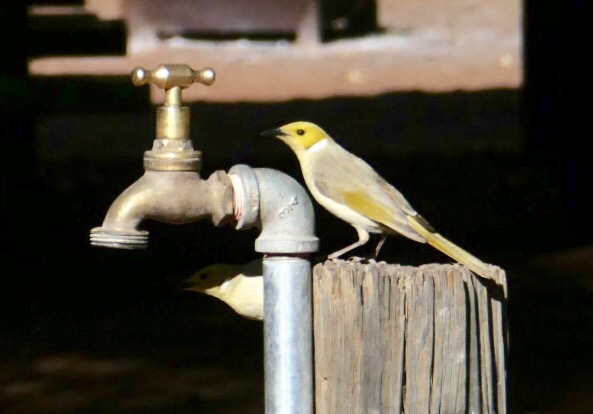
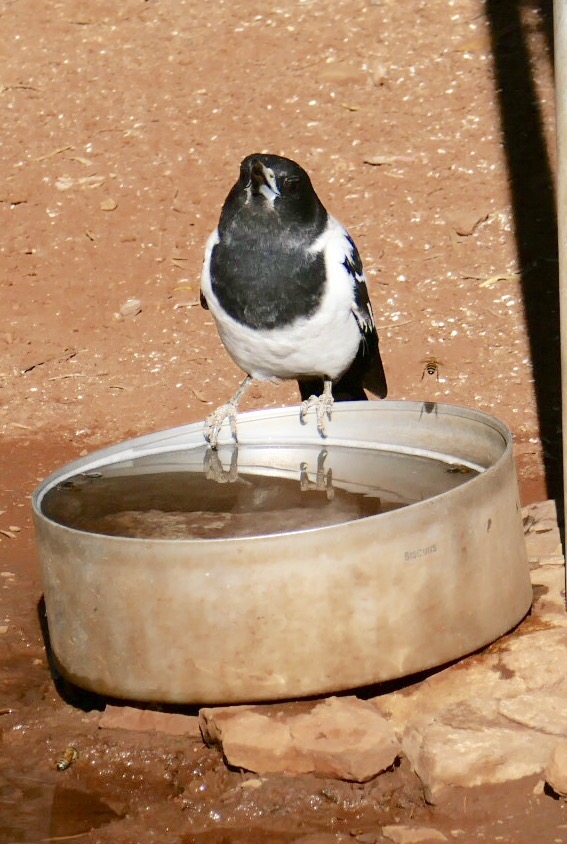
We drove back to Alice, then took the Ross Highway to Trephina Gorge. This was the item dropped from our tour with a Mark. It actually deserves more than one day. It’s physically very beautiful, it’s quiet, it’s got splendid spacious camping areas, and the geology is truly fascinating. Where we camped there us a tap, and birds come to visit. Pied Butcher birds, honey eaters to name just two.


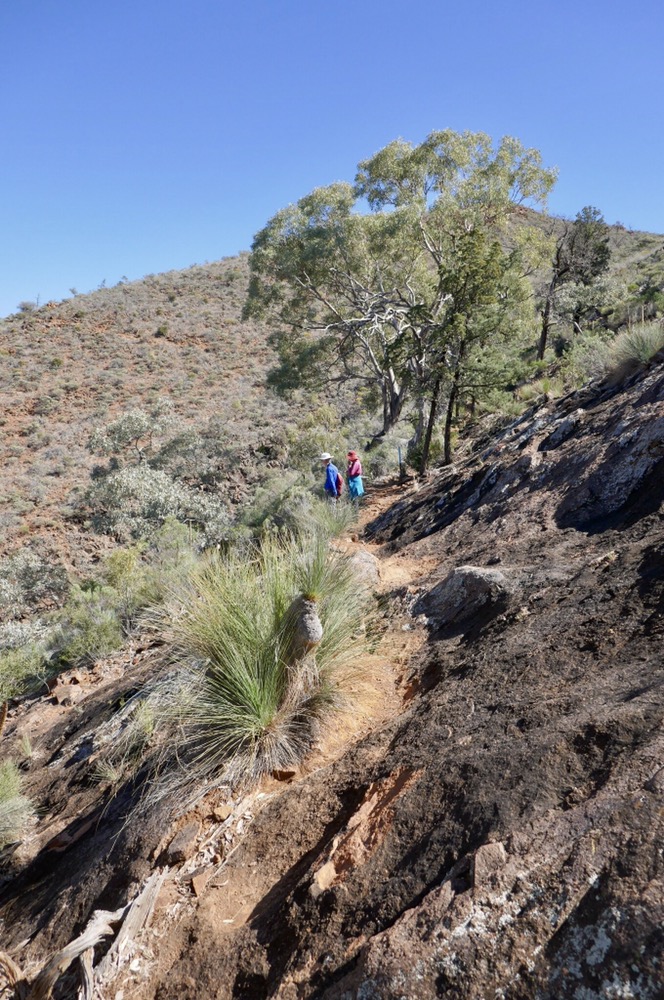
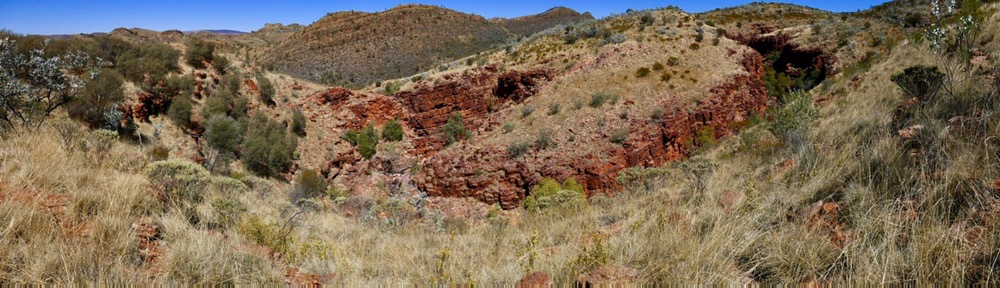
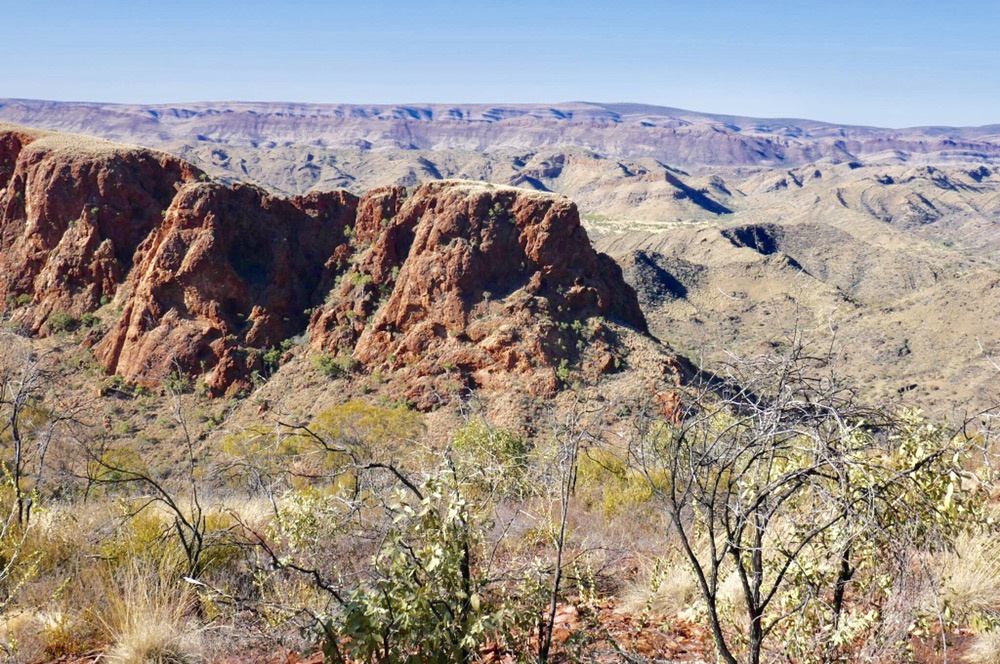
This morning, Jennifer and Dave did a car shuffle, leaving his car near to John Hayes Rock Pools. The track was rough requiring a high clearance 4WD. As he drove back with Jennifer, Di and I set out on the Ridge Top walk. This begins with all the other walks at the start of Trephina Gorge, but then heads off, on and up along the ridge that leads to Turners lookout. The track is rated as difficult but the cool wind and early 8am start made the trip easier. The track is rough, but safe to follow with many signs a long the way. There are stupendous views of the East MacDonnells and Trephina Bluff in particular. We could see for many miles, across the repeating ranges. There must have been a considerable fire as there was a lot of damage to trees and spinifex plants. However, soon we walked steadily up. Turners look out is on the edge of a vertical bluff. We had morning tea here, enjoying the very elevated views of the hills and ranges to the west. The track de steeply just after we rejoined the main track, bringing us to another Gorge, called the Chain Of Pools. We opted for the easier descent here, and we were all very glad we did as the views of the gorge were excellent. It forms a huge horse shoe bend in the mountain. I’ve never seen anything as striking as this before in Australia. We had lunch in the gorge. The rock pool was not all that inviting, but it was cool and shady beside the rocks. Dave, Di and I walked a short distance on the road to find the parked car. We drove back the eight kilometres to the camp site to meet Jennifer at the tent.
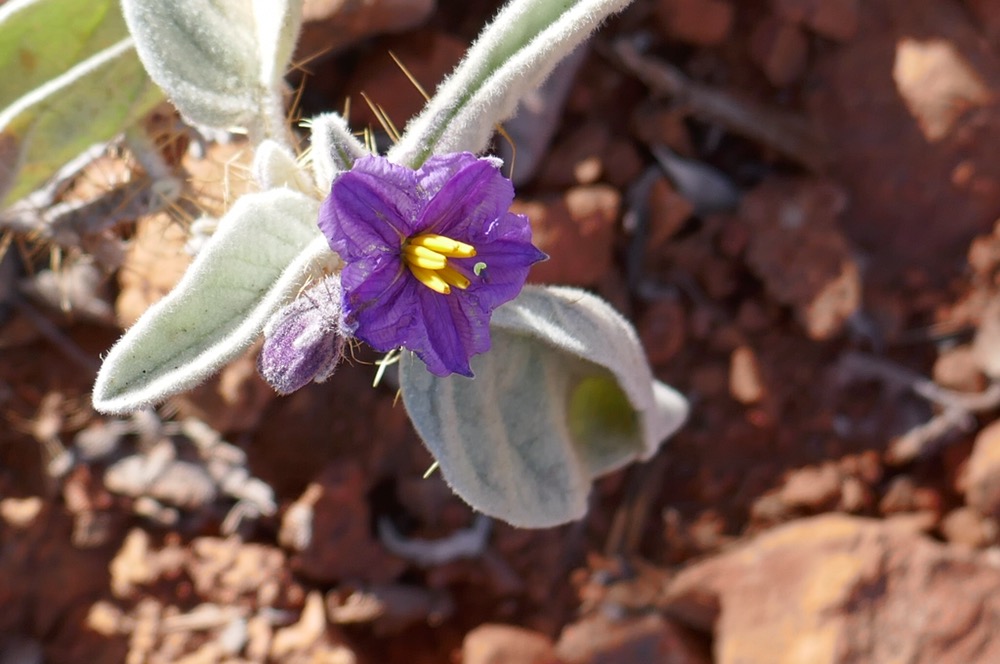
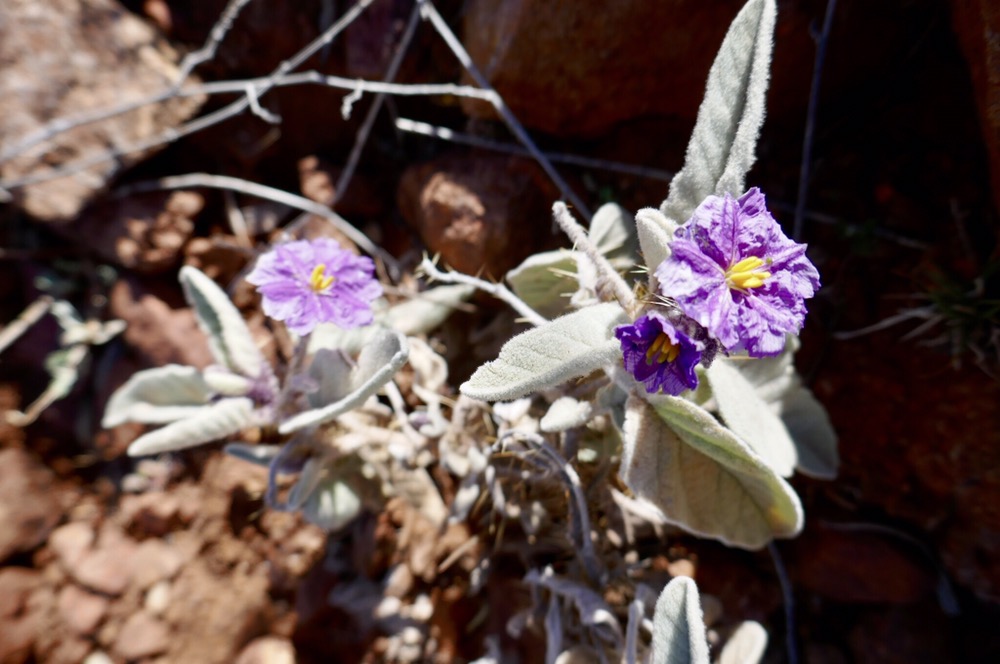
It’s 11am Sunday morning. A disturbed night from some Millennials playing music too loudly and too late. Anyway, we awoke to a peaceful morning and started packing up. We left for walk at 8 am, Panoroma walk. This goes steeply up from the gorge and offers terrific views of Trephina and the nearby hills. It’s only an hours walk. However, it’s very pretty. From the top it winds its way gently down, and back to the start. Di spotted some blue fuschias. After chai we folded the camper down, and began the drive back to Alice Springs. We stopped off to visit an immense three hundred year old ghost gum. It’s been a super stay here at Trephina, as was our short stay at Rainbow Valley. We bid adieu to the Seatons tonight as they will be flying back to Launceston early on Monday morning. It’s been really great to have them along to explore this beautiful part of the world.
Is a warm Tuesday afternoon, bees are buzzing around us and in particular our water desperately in search for fluid( one has climbed in and blocked our campers water pipe!) Dave and Di have driven off to camp at Serpentine Gorge, and to do some walks. Jennifer and I are relaxing in the warm haze of a Larapinta afternoon, enjoying the first of the cool breezes that will build up overnight.


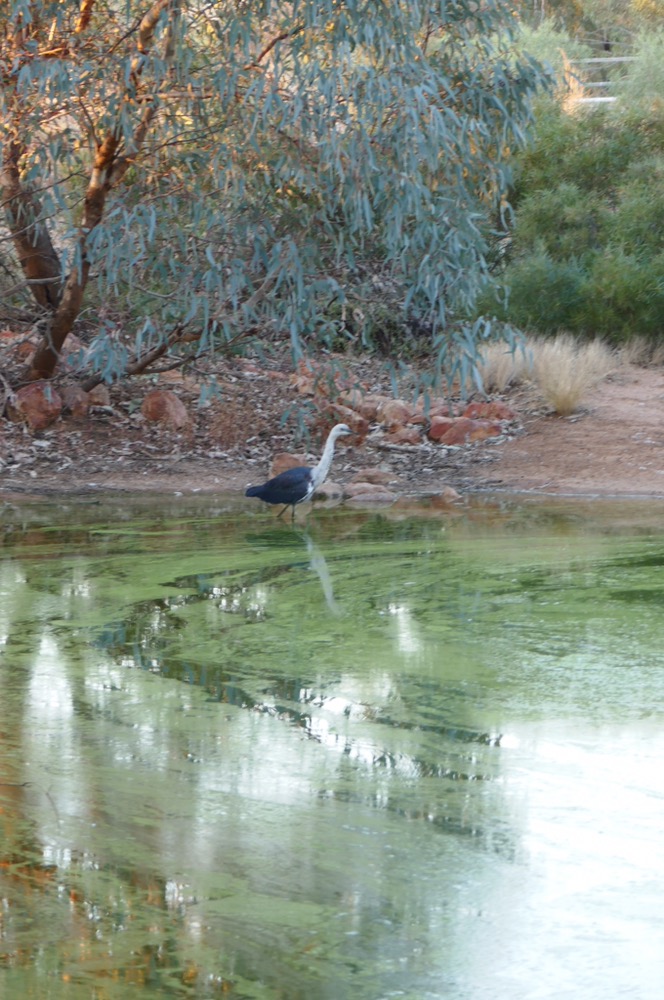
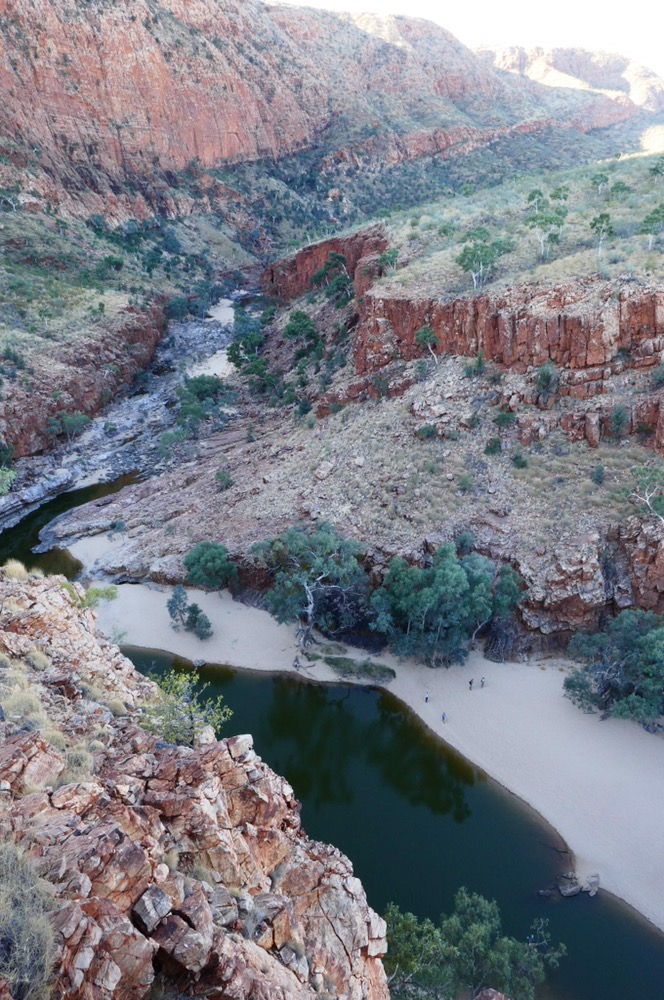
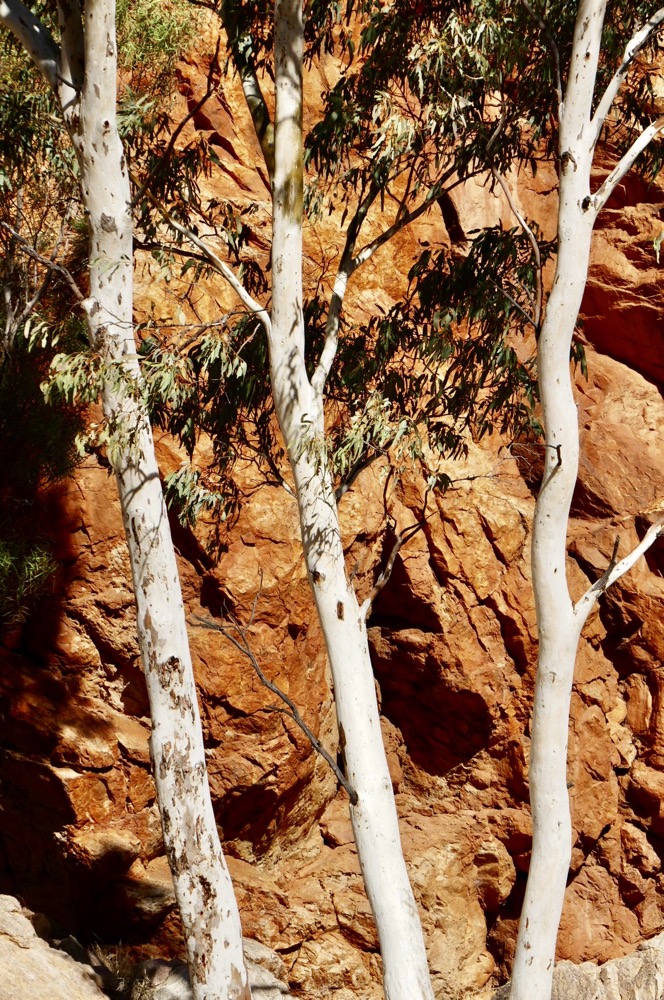
Yesterday we spent the night camped at Ormiston Gorge. There are excellent camping facilities. The Seaton’s tent ( minus fly) was on the site adjacent to ours. David, Di and I did the Ormiston Pound walk on Tuesday afternoon. I had done it with Jen about six weeks ago but I was keen to do it again. We began early, at first light, to minimise the time in the daytime hot weather. We walked along the river, then followed the outside of the pound to a Gap, one of three gaps in this pound. It’s a nine kilometre walk but the last two involve a lot of boulder scrambling. Poor Jen has been suffering with a knee problem and so had to miss out on this walk. It really is a terrific walk, wonderful views of the edge of the pound, the headwaters of Ormiston creek which when they join the waters of Redbank Gorge, are the beginning of the journey for the Finke River. Now there is no flowing water but there are several rock pools. They are green in colour due to a naturally occurring algae. It does not look very savoury for swimming but the cafe owners assured Jen it was safe. The rock pools vary from small to Olympic pool sized. They provide artistic reflections of the surrounds. Within the gorge itself, ghost gums and cliffs provide the source of these reflections. The rich colours and hues combine as precise reflections in these dark, still mirrors. The second part of the walk occurs after entering the pound, and the track is an easy one that undulates gently through plains and over udry rivers, until you enter the gorge itself. There is an abundance of wildflowers despite the dryness of the current winter. There are white, yellow, purple and blue ones to discover. Entering the gorge, the path is crowded with boulders and rocks, shattered off the cliff walls; there are an incredible variety of colours in these stones including purple, blue, grey and cream. Sometimes the colours are mixed together in the same platform of rock. Two herons hunt in the rock pools. When one sensed my presence it took to the air in long languid strokes , flew briefly then alighted, balanced with supreme poise, on a ghost gum branch.
When we got back to the campsite, Jen told us about her walk to Ghost gum Lookout. This walk provides aerial views of the gorge. After lunch, we showered, packed up the camper and drove to Redbank Gorge.
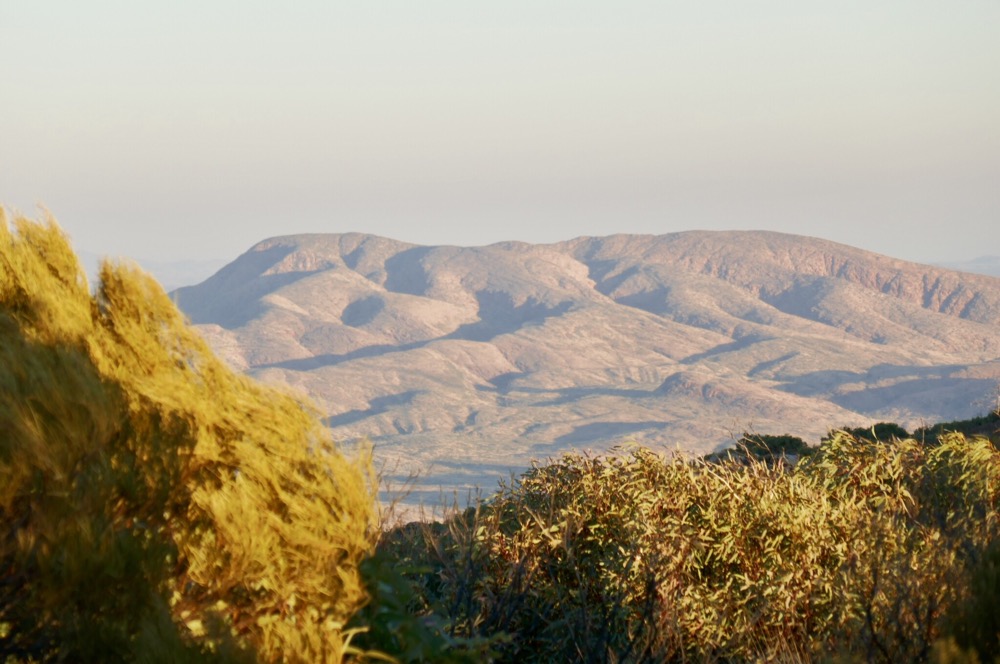
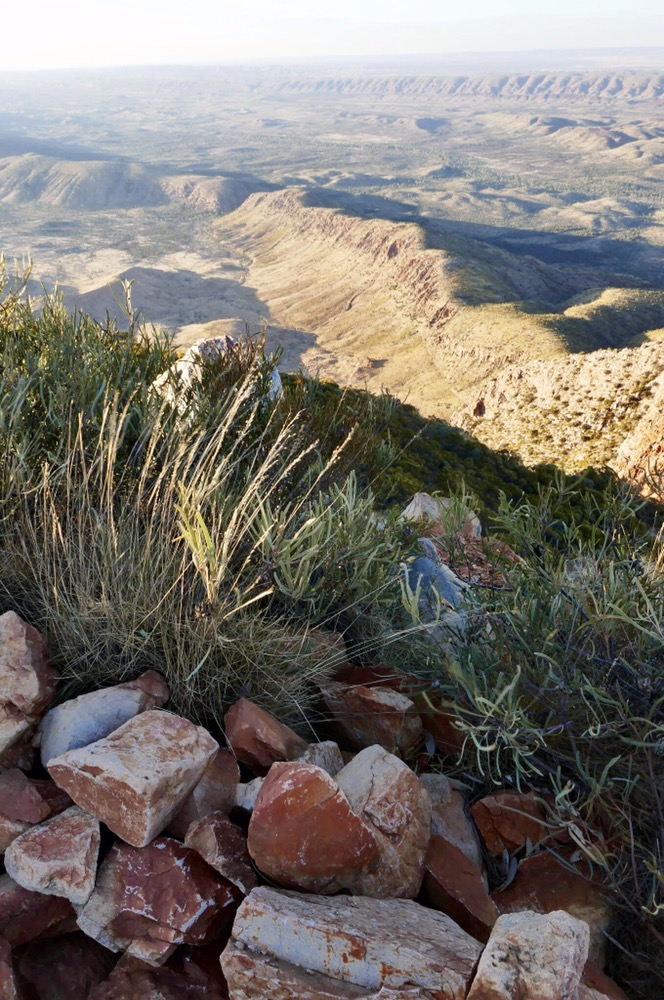
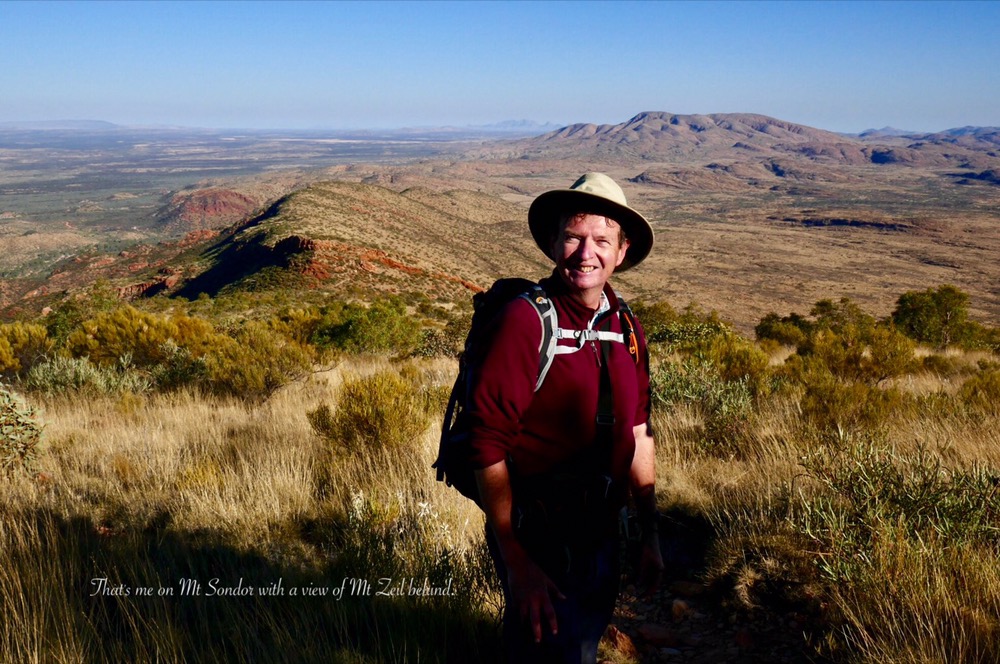
The Redbank Gorge “Woodland” campsites are large, with tables, a gas cooker already installed, and all this for five dollars per adult per night. Jennifer cooked a terrific dinner of chicken and bok choi, followed up by teddy bear biscuits. We had an early night as the three walkers planned to do the hike up Mt Sonder. At 3:30 am the alarm went off, I grabbed my bag, water, apples and my very powerful head torch. David, Di and I drove the four kilometres to the start of the walk. It was very dark, the stars were glorious as not even the moon had woken up. Mars sat low in the sky, so low I thought the light was another walker on the track. It’s 8 kilometres to the summit. Well, sort of. There is actually another summit but that involves hours of extra walking, dropping down to a saddle then clambering up a trackless peak. We are all quite happy with the standard peak as used by 99% of hikers and all sensible ones. The early start was to skip the heat of the day, and enjoy the sunrise. I did not turn off my headlight until meters from the end of the climb. The track is easy to follow, it’s clearly defined and track markers are abundant and well located at any sudden turns. The stiffest, steepest, roughest part of the track is the first two and a half kilometres to the lookout. It was not much of a look out on the way up. All any of us could see was that bright puddle of light at our feet. Yet, we often stopped, turned off our lights and looked up. There was Orion, and eastwards there was the faint orange glow on the distant hills presaging dawn. There are some steep pinches with sharp drop offs I did not see coming up. I think this is for the best. We arrived at the summit at sunrise. David boiled water for coffee and tea for me. We spent about forty minutes there, with no one else in sight, taking photographs, sipping our drinks, and rugging up against the wind. Then we began the eight kilometre descent. The trip up took two and half hours, the descent took an hour longer. There were some wonderful things to record on our cameras. Mt Zeil in the distance. The ranges on both sides of Sonder. The interesting geology of this quartzite mountain. The paths were rough, consisting of broken rock, sand, and occasional platforms of stone. It was a very pleasant walk and only got too warm for the last kilometre when at last, I could take my jumper off.
Jennifer cooked up a storm, a brunch of eggs, spinach, tomatoes. It did go down well. After lunch, Di and Dave went to do the short walk into Redbank Gorge while Jen and I drove to Glen Helen Station, basically to use their wi fi to check how Hilary is going. We will catch up with the Seaton’s tomorrow at Rainbow Valley for more walking and photography and laughs.
I’m lying in a tent, no fly, in the campground at Dalhousie Spring in South Australia. I can only see a brilliant half moon high in the eastern sky, all the stars dimmed to disappearance by the orange glow of imminent sunrise. Each night of this trip, all of us try to look up frequently to enjoy the multitude of stars in a cloudless sky. The great wheel of the Milky Way turns slowly and majestically in our southern sky.
Jennifer and I had driven back from Wauchope after our second two week stay in Elliott. The stay at Wauchope was quieter than our trip up. The park filled up at 8pm rather than 3pm. We met David and Di Seaton who had flown up from the Chilly bin ( Launceston) a few days before,. They were staying at Desert Sands. It was great catching up. In the evening we all had dinner at Hanumans Restaurant, and shared a terrific meal. Jennifer and I were staying on Sunday evening at Doubletree. At six pm, Jennifer had driven the car and trailer around to Mark’s place. Mark is the guide and driver for our trip.
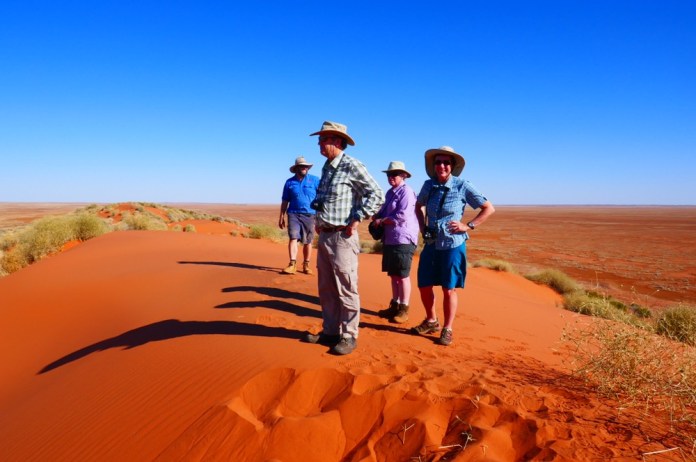
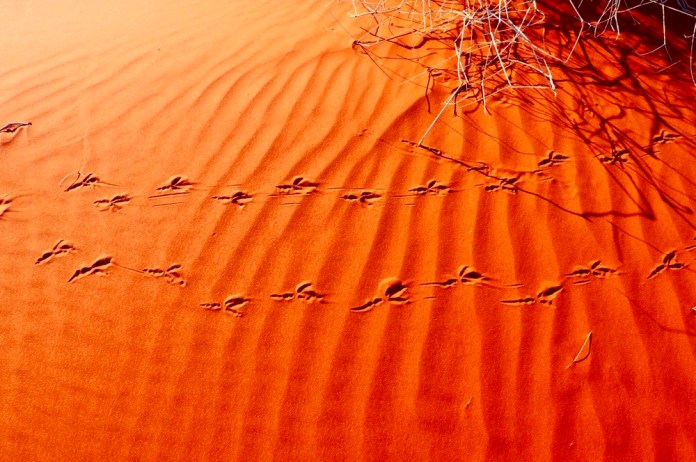
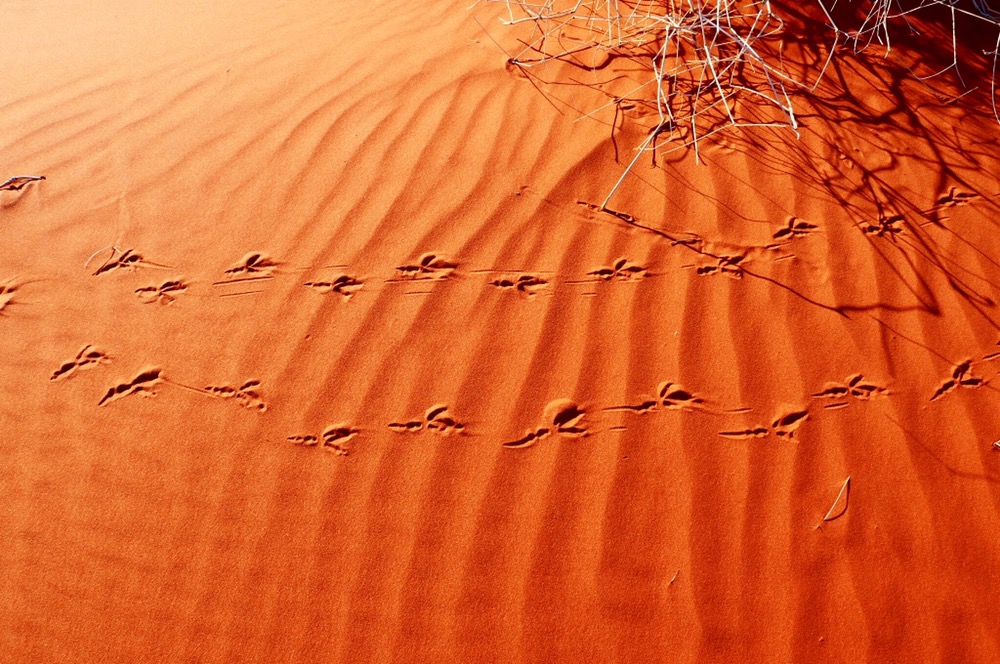
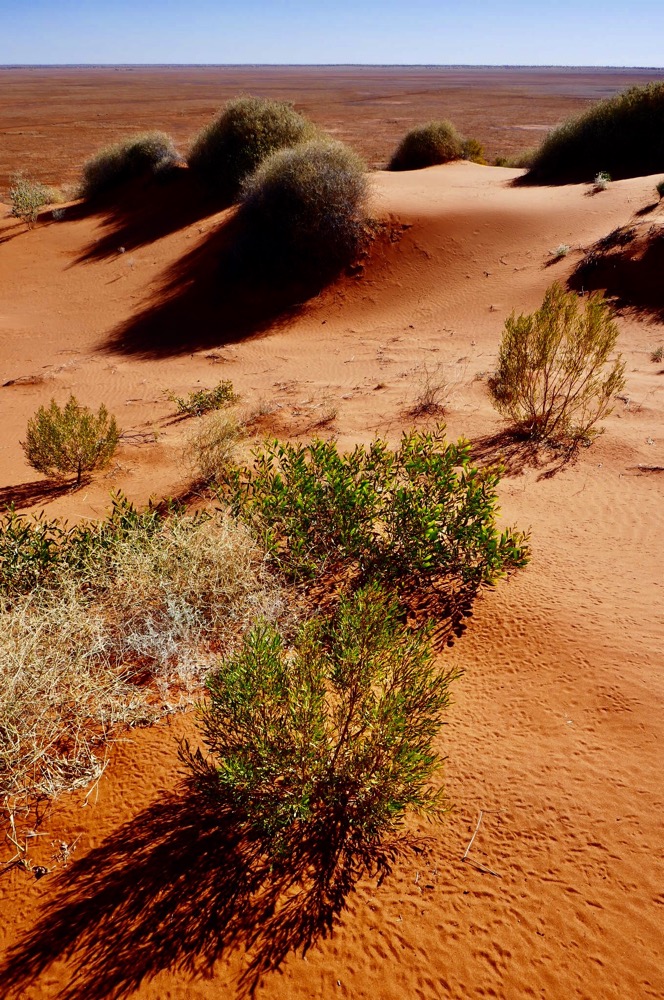
On Monday morning, we all went in the Seaton’s rental car to the airport, then waited for Mark to collect all of us there. His trusty Range Rover arrived and Mark loaded our bags in. We drove east, skirting the community of Santa Teresa, then through plains and hills. The Train range to our east. We pulled over a few times for tea and biscuits, and to take some photographs of the ranges near the road. We had lunch at the last tree for many kilometres. There were great views and a cool breeze. The temperature is warmer than is usual for winter here in the centre. It’s about thirty five Celsius after a cool morning and overnight temperature of about ten degrees. It heats up over the two hours after sunrise. We carried on the drive, to the edge of the Simpson desert. At last, here were the famous Simpson sand dunes, stabilised to an extent by spinifex, woolybutt ( a grass here) and shrubs. The sand is a rich red, the grasses are in tufts, are a washed olive green. A beautiful blend of colours. We trudged up them, one step up and forward then two steps back and down, but we got there. Looking down at the sand shows the sand dunes are more like an apartment block than ones idea of a desert. Instead of animals struggling for life, there are many holes of different sizes that would house desert mice, small marsupials like bilbies, goannas and lizards. In the sand were veritable tram tracks, busy, busy, busy creatures bustling amongst the spinifex. Hopping mice, lizards and snakes all leaving tracks. There was the swish of a perenties tail, here was the lopping stride of a sand goanna and at our feet there was the madcap hopping of marsupial mice, all clearly visible in the sand until the afternoon wind wipes the sand clean to make ready to record the next nights adventures.
We camped out in swags of Mark’s design, no zips to get jammed on inner sheets or sleeping bags. I lay back my head and looked up at the stars. By 2 am the moon was up, so I had to to pull my beanie over my eyes from its brightness, and later on pulled over the swags lip to shield my face from the early morning breeze.
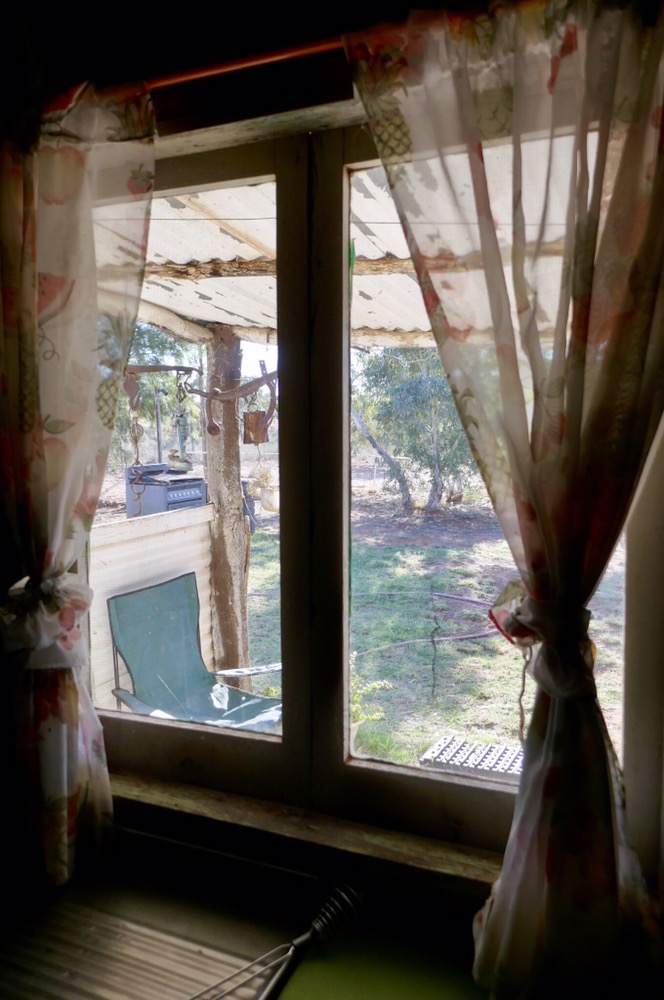
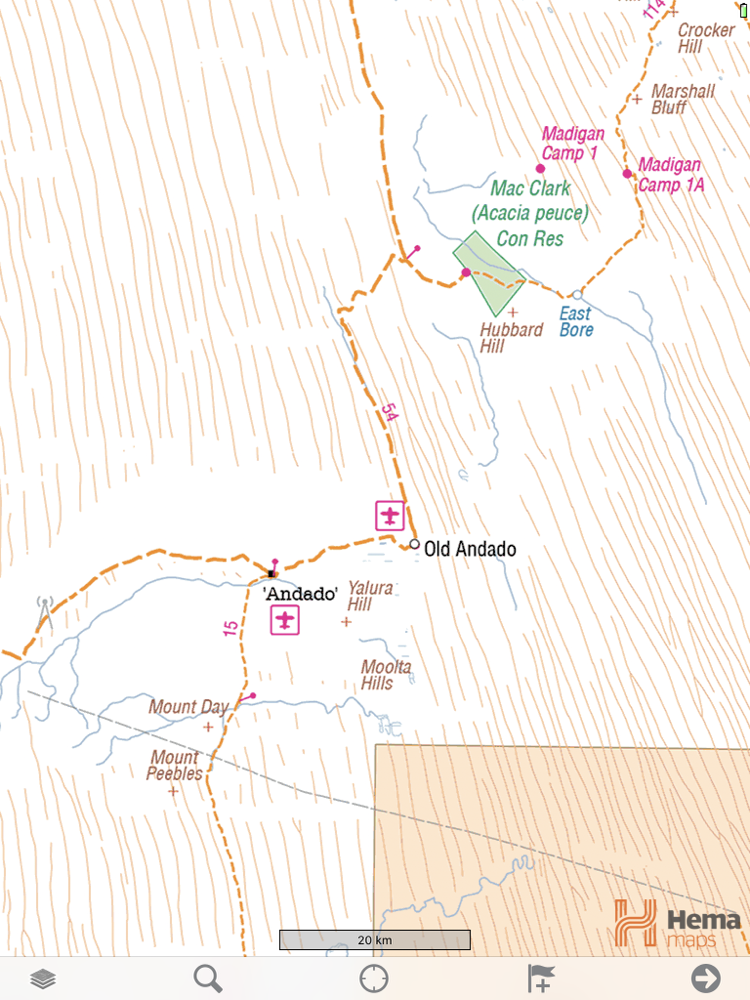
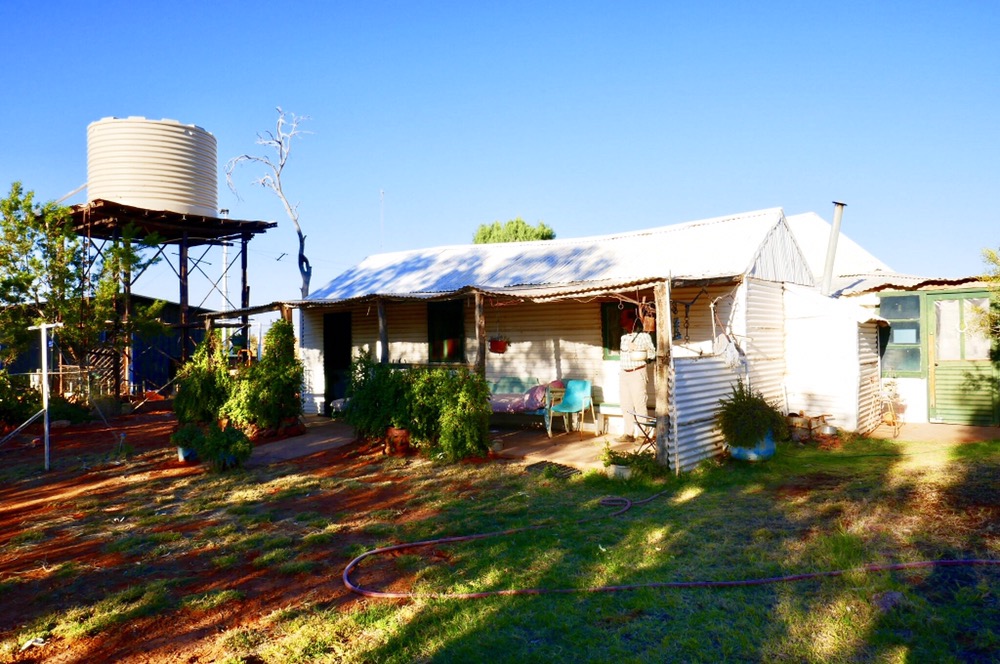
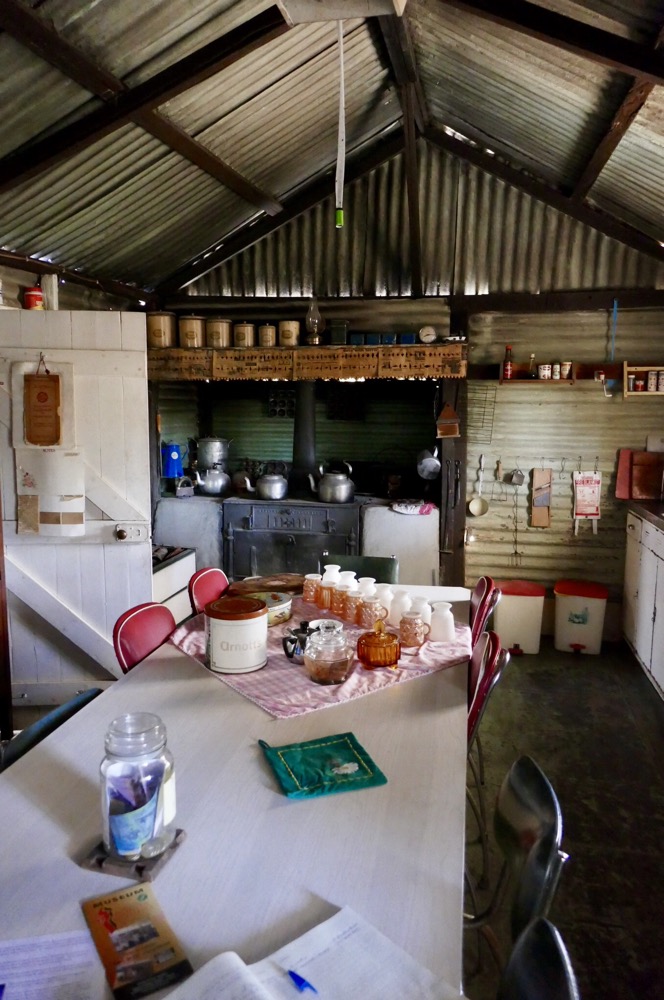
Next morning, our project was to explore the station. The original station built here in the 1880s is long gone, it was constructed of mud bricks. The newer station was built by Mac and Molly Clark in the 1950s. Molly and her husband, and eventually her three boys worked the cattle station. Then in short succession both her husband and a son died in separate accidents. Soon after the cattle were destroyed because of suspicion of bovine TB. It was a very difficult time but Molly persisted at the station, surviving fifty degree days under the corrugated steel roof and walls. She made curtains for the windows, stacks of books and National Geographics for reading, a portable organ for music, and eventually when diesel generators were installed, refrigerators complemented the foolhardiness, warm showers replaced cold ones but the beloved wood stove was not replaced and still features in the kitchen. When Molly finally left the station in 2006, and then died in 2012, the whole place was locked up. Molly had been taking guests in to raise some income, as well as cooking meals and entertaining the campers for several years. The national trust now owns the property, and a caretaker is there to mind the bathrooms and keep an eye on the place and its contents. The house was never cleared out, all the utensils, medical kit, Traeger radio, furnishings, well in fact everything. It is like taking a step back in time, to see the things we were used to as kids. We enjoyed a cup of tea with the caretaker’s wife, in Molly’s kitchen, before heading off to our net stop, Mt Dare.


We stopped for lunch adjacent to the headwaters of the Finke River. This ancient river peters out into salt pans north west of Lake Eyre. Until that time, when it flies it’s a mighty river. We drove through a now dry swamp, filled with coolabahs, and a floor of dried baked clay, this swamp goes for a hundred kilometres and can be filled to a depth of up to three meters. Its exit into the Finke bloats and enriches the river. We walked along the dry white sandy river bed, admiring the old, immense river gums. Some had dead branches and then a robust trunk almost two meter in circumference. Other trees showed the damage to roots and branches caused by flotsam in the river. Now it was quiet, the clay of the riverbank scoured into patterns by branches washed down in summer. There were trees, blown apart by dry lightning, black and charred ruins with surrounding ash. We had wonderful lunch of pickles, roast beef and chicken. After lunch we drove to Dalhousie Springs.
Mark cooked beef stroganoff and then a pudding for desert. Yummy as always. It was getting dark, and the mozzies and gnats were buzzing around feasting on Jennifer and Di. We sat around our camp lights, talking and laughing about the day and life in general. Di and David are retired and Jennifer and I are semi retired, and so we have a lot to talk about. It was quiet overnight until the wind picked up at 2 am, and was quite wild for a few hours.
This morning at five am, a woman with a voice like a motorised cheese grater started talking to a friend. She had the same idea as a one year old, which is” if I’m awake, everyone else should be awake too”. She told the locals about the sad state of her bum which had been savaged by mosquitos in the toilet while hovering over the long drop. Anyhow, I did have enough sleep. After breakfast of pancakes, bacon and fruit we all did a 700m walk that wound its way around the springs and to some of the nearby hills. It was a great chance to see the escarpment to the east, the salt pans surrounding a stony hill nearby. The plants are fascinating, many of them are green but all seem to be flourishing in this salty soil. Amazingly some resemble our Tasmanian cushion plants.
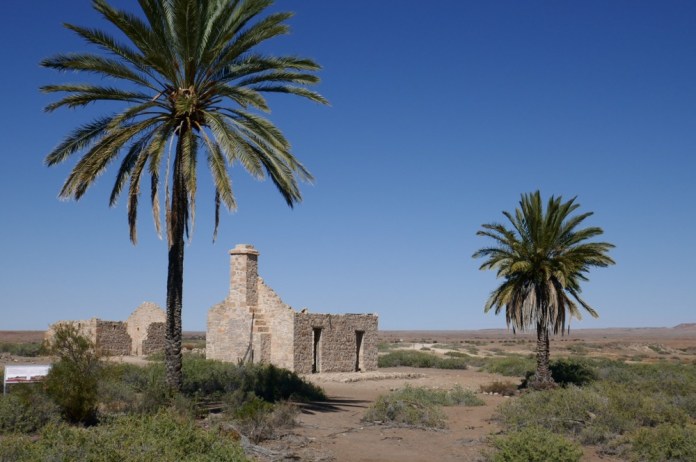
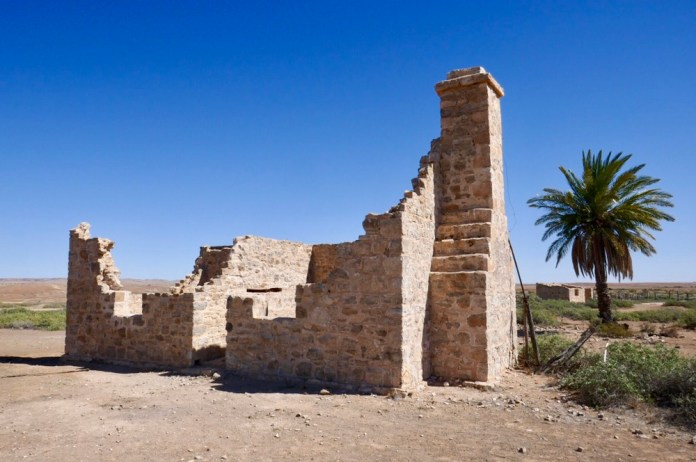
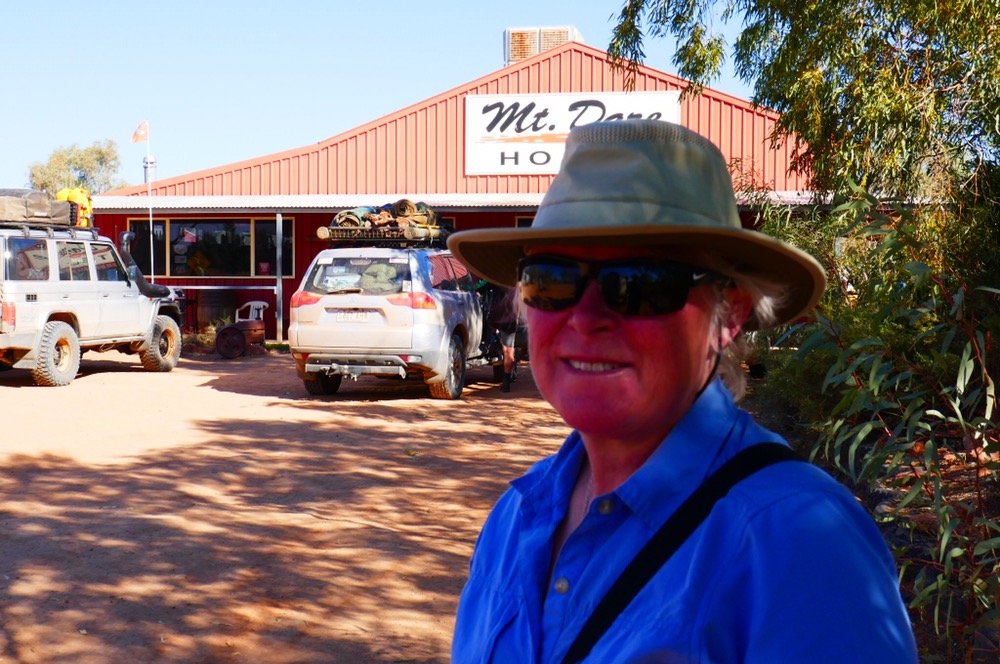
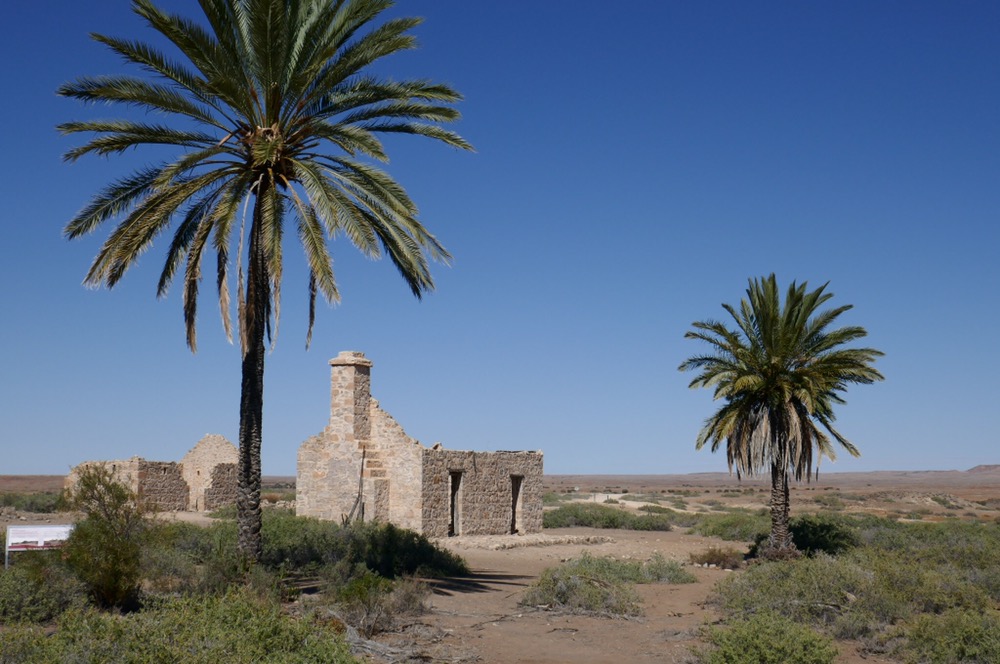
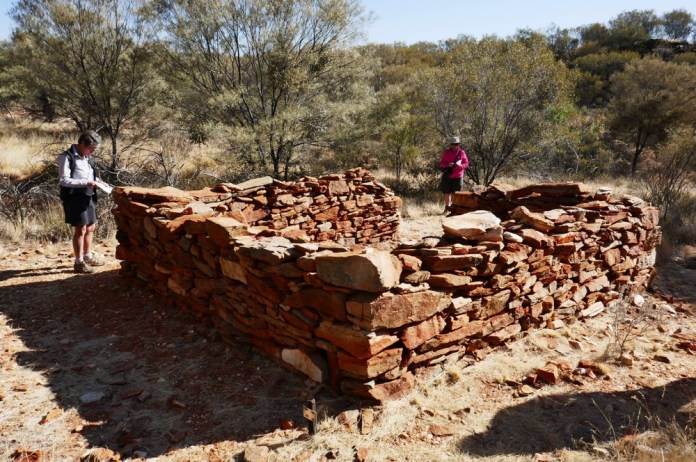
We then drove to Mt Dare. This took most of our Day, as we visited lookouts, Opossum Waterhole, Bloods Creek, but our first stop were the ruins of Dalhousie station. This was built in the 1880s and they tried to run cattle, sheep, and other animals . Dalhousie had its own spring but droughts, influenza and amalgamations of stations left Dalhousie out in the cold. They planted date palms which choked the spring located there. The ruins remaining are the Homestead, the workers cottage and the blacksmiths forge and hut. These were fashioned from blocks of local stone still firmly mortared by limestone. The roofs are gone but the buildings ( at least three of them) are still recognisable. It’s impossible to begin to imagine the isolation, and remoteness of places like this. For the Aboriginal people this was home but for the Europeans who decided to live there, many would die there, buried in their now forgotten graves. All their efforts yielded very little, their relics are ruins, not working farms. It’s all national park now in SA, and has been so since 1985 when Witjara national park was declared. Dalhousie had ceased to be a going concern for decades before that.
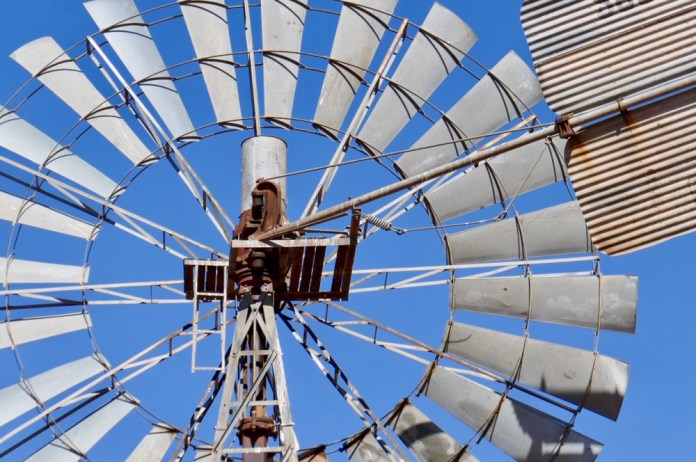
We visited Blood creek, which is not named after a conflict but the first owner, a man with the surname Blood. There’s very little here now, but nearby is a windmill for the bore that was constructed in 1885 and was over 600 meters deep. It would fill huge water tanks, with an output of 4,200 litres of fresh artesian water in any 24 hour period. This allowed cattle to water while on the move to Birdsville. Blood creek had a hotel for the drovers, the railway workers ( the line was barely a kilometre away) and the travellers in this part of the Simpson. Giles was an explorer who on his way to Alice Springs in the 1920s, visited this hotel and thought it wretched and the publican and patrons equally drunk. In the 1950s the then owner was Ted Colson, who was the first white man to cross the Simpson Desert. Other people have crossed the Simpson in those early days a crossing which is established now as the Madigan line and another route is the French line.
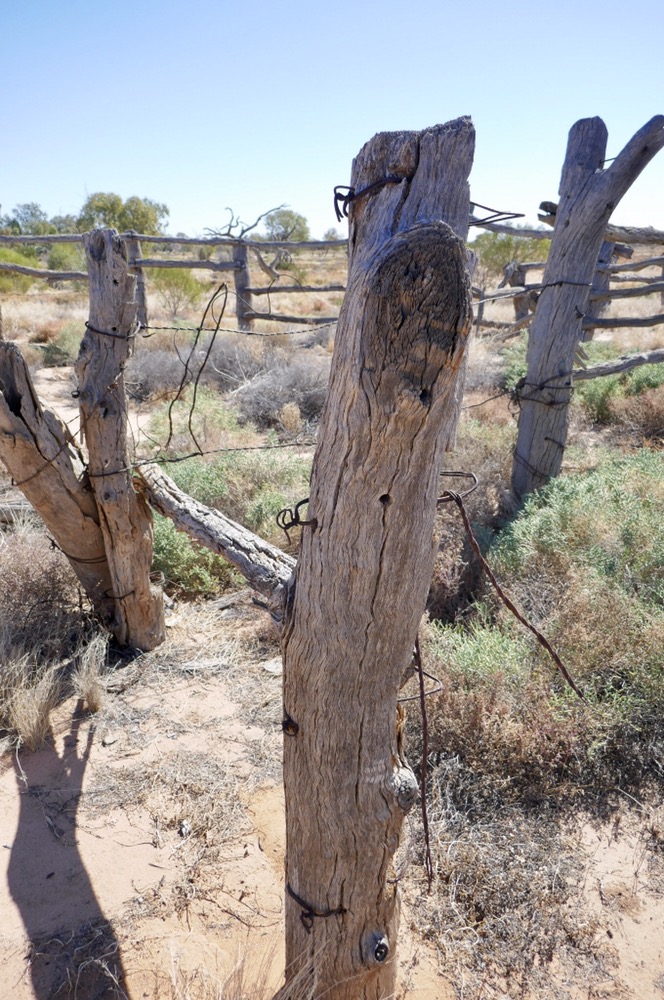
We visited Federal station. It’s not even a ruin, just a few broken bottles remain of a once substantial building, but in its day it was a happy place, with loads of fresh vegetables and fruit grown by the owner. Aborigines built the cattle yards nearby which are still there today. These huge wooden posts connected by this black wire provided a set of vast pens for travelling cattle on their the way south.
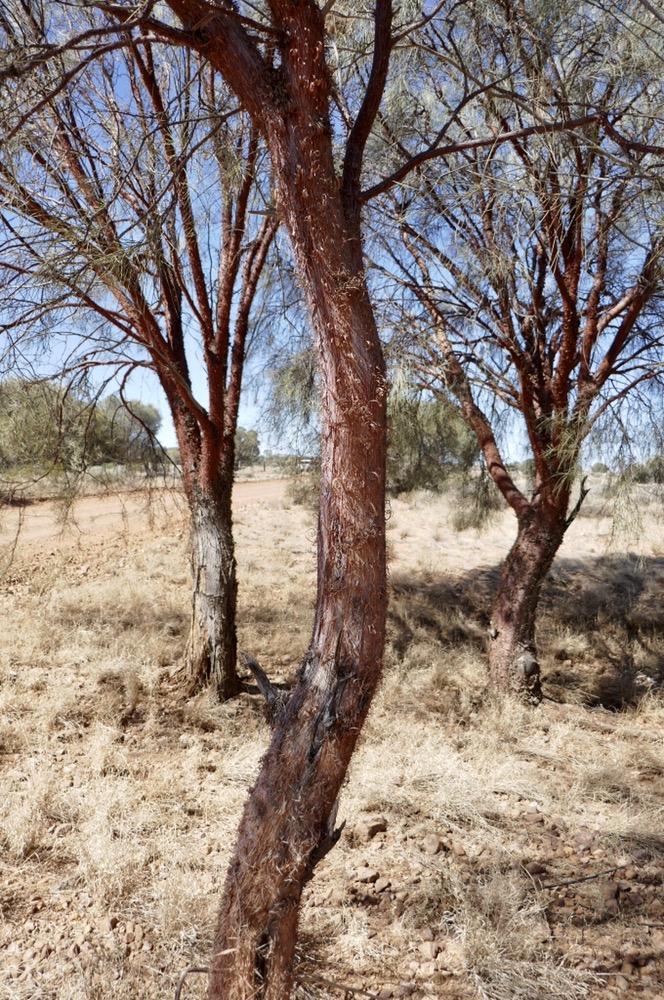
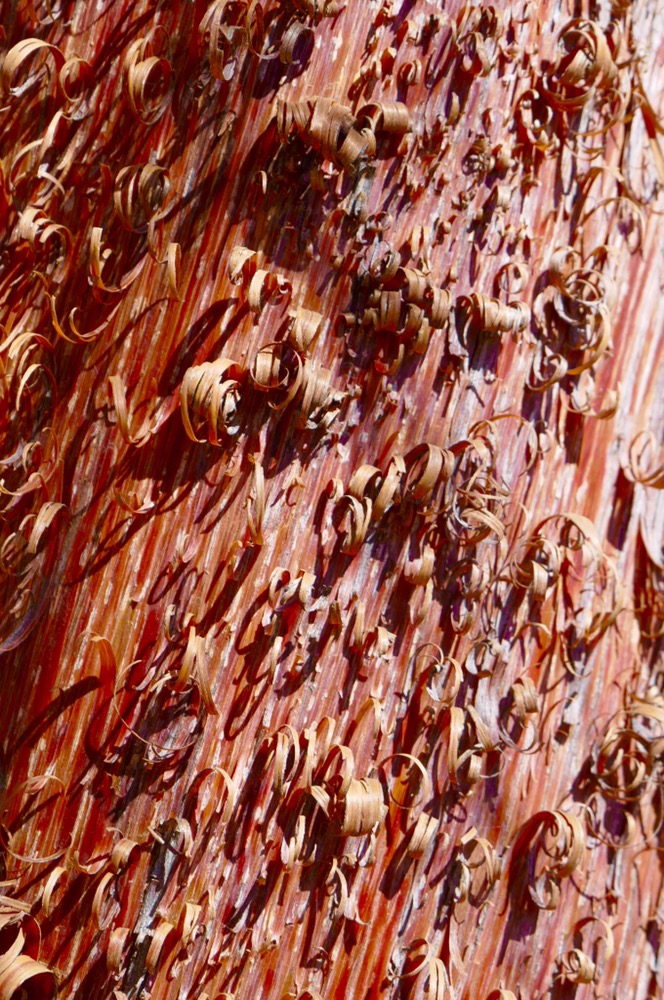
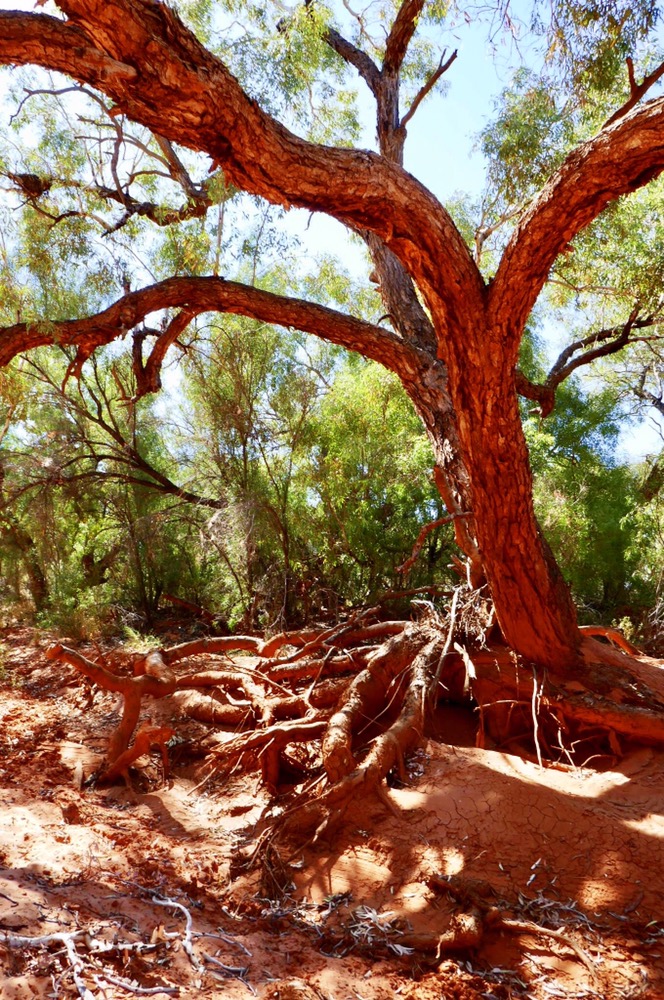
We had lunch at Opossum Waterhole. It’s pretty low now but it’s still very pretty. A falcon is nesting in a tree. On the other side of the road we had out first look at Red Mulga. This is only found in a few locations, it’s a beautiful tree with the most unusual red bark. It looks as if someone had used a wood plane lifting up curls of red bark.
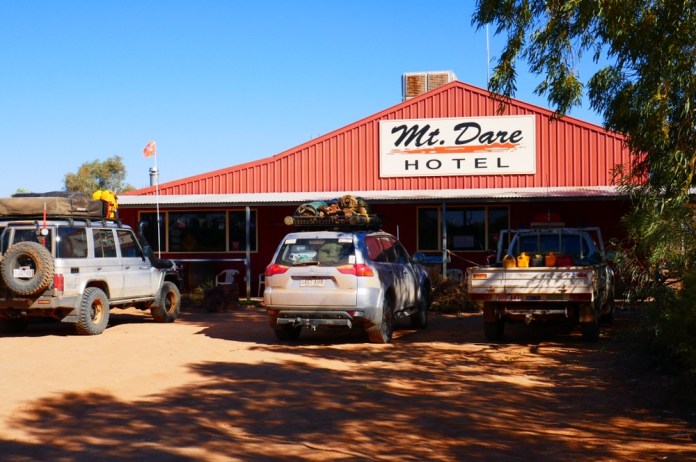
Mark was concerned at the rear shock absorbers as they were not working as well as they should. When we got to Mt Dare, he pulled apart the compressor and pretty well got it going again. We helped out by setting up camp.
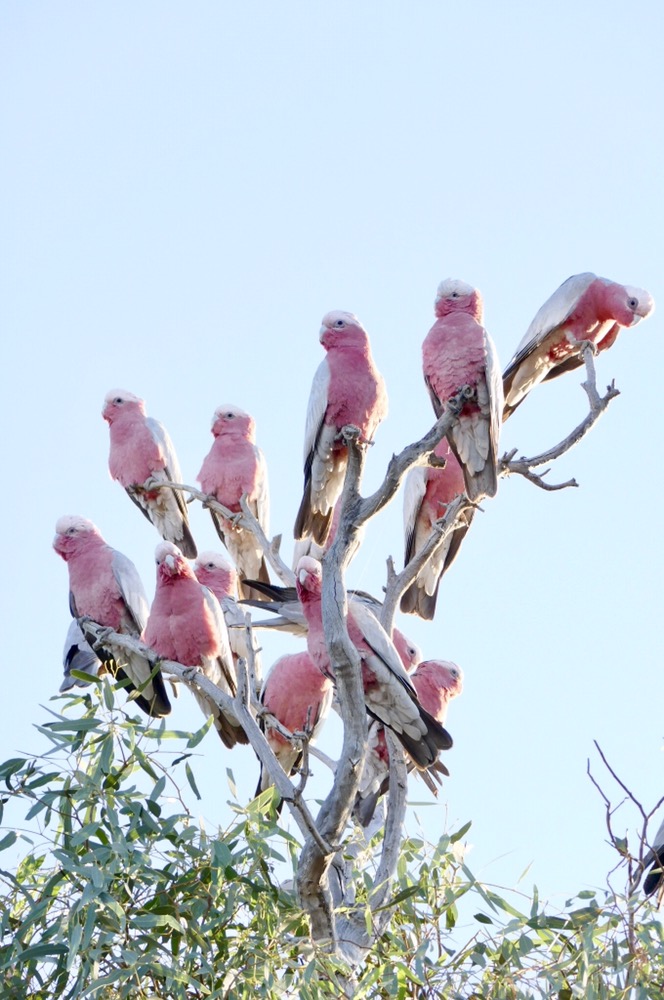
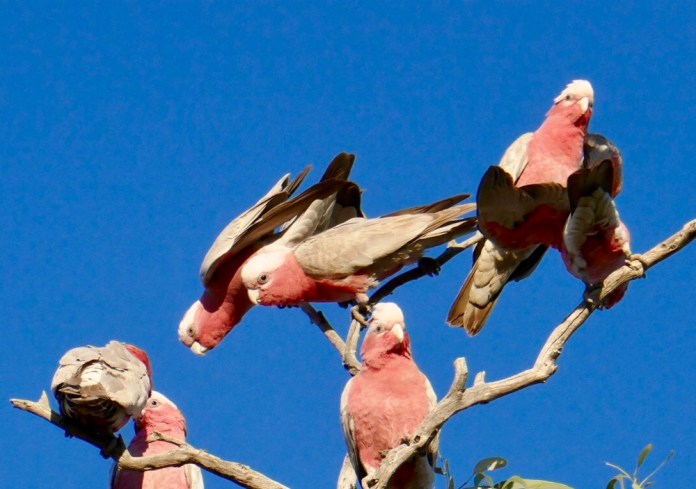
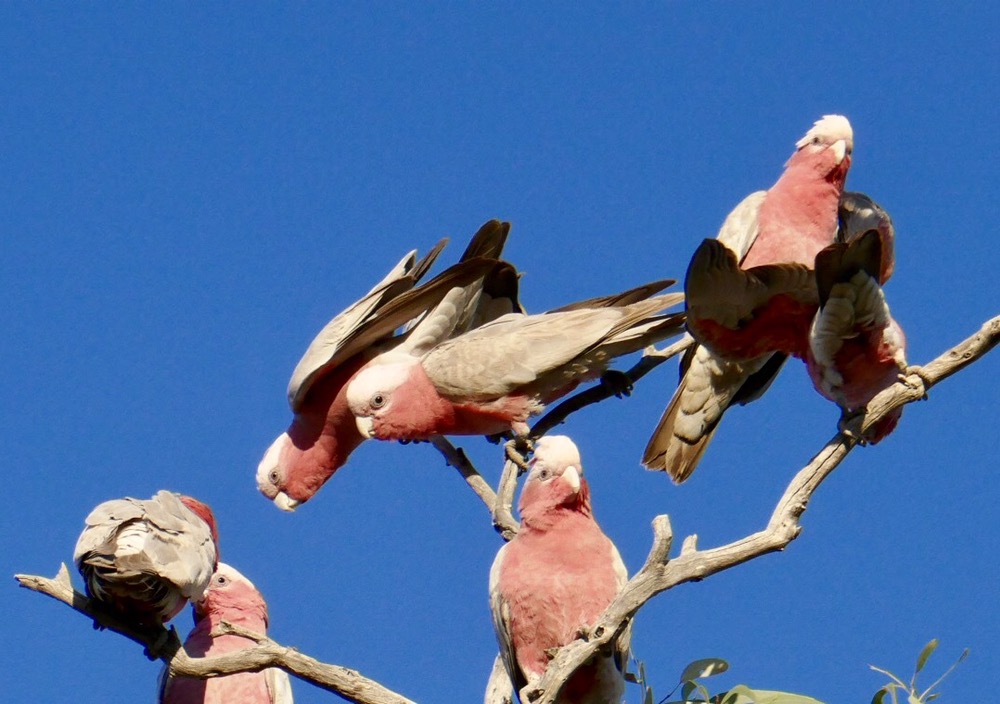
I’m now sitting in the dining room at Mt Dare hotel. We ordered our dinner for tonight yesterday. Outside there is a pond, where we watched a heron hunting. Galahs high up on branches above us. I’m looking forward to my steak and chips!!
………………………………………………………………………………………………………………………
I’m sitting under the stars at the Chambers Pillar camping ground. It’s been a super day. We were woken up by a flock of corellas erupting out of the trees at Mt Dare. Galahs settled into the same branches to enjoy the sunrise. We all helped pack up then began the drive to Chambers Pillar.
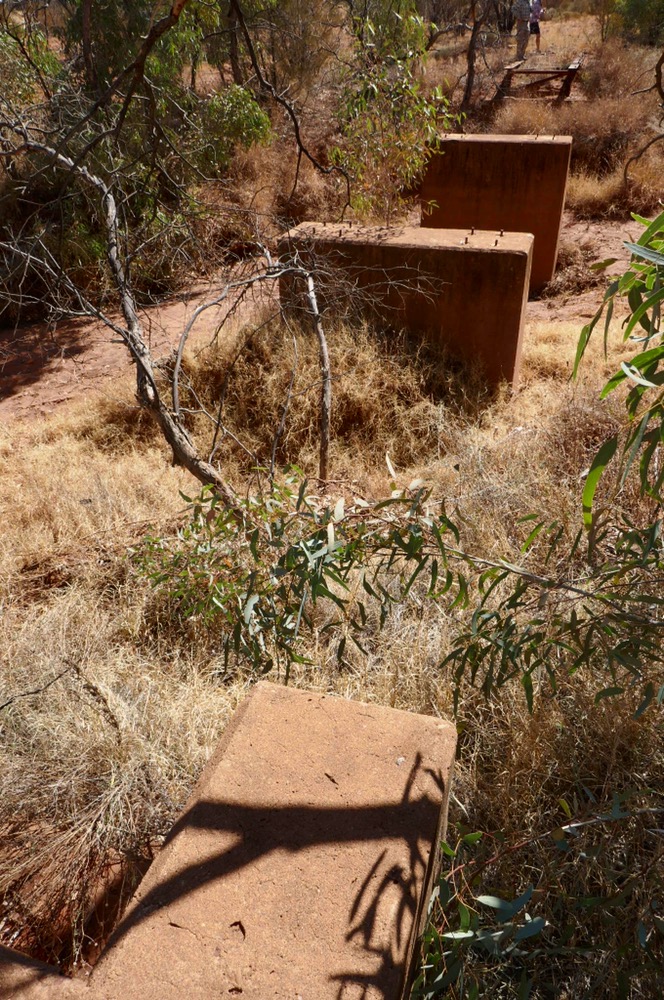
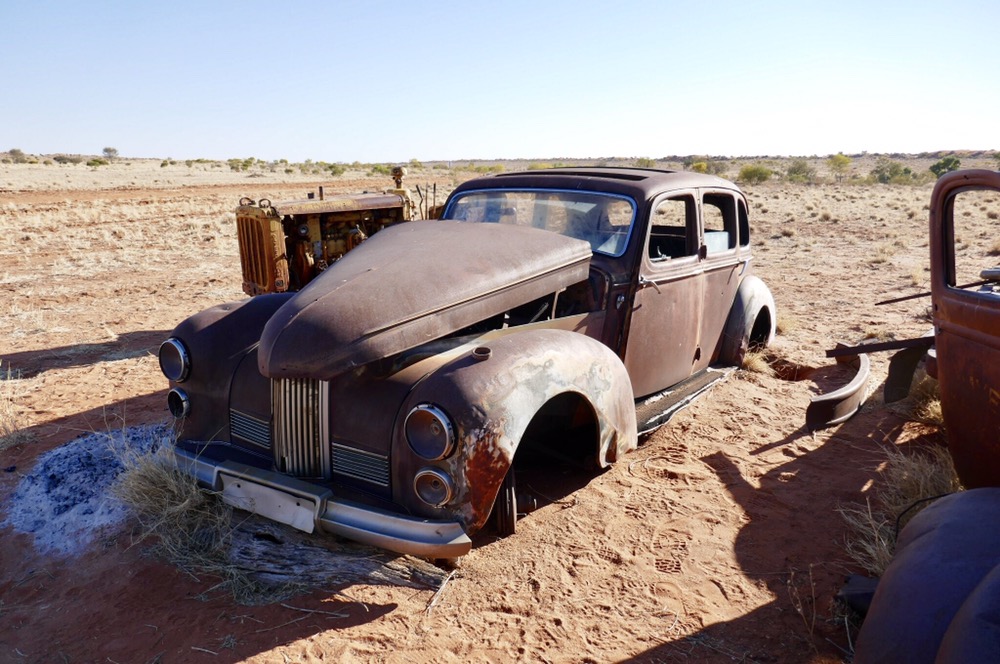
We stopped for morning tea at Goodyer River. When we started again, great clouds of bull dust billowed up and over the car. Di told me to open the window to let some pesky flies out, the cabin filled with sand but the flies had andoned the car. We carried on over the actual route of the old Ghan railway. The original rail line began as a standard gauge line from Port Augusta to Maree. The first proposal was for a connection to Birdsville for the cattle transport to the coast. However, the second proposal to build a narrow gauge line eventually to Stuart ( old name of Alice Springs) was accepted. This wound it’s way near bores and waterholes, over sandy country to Oodnadatta. Thus is where it stopped from 1889 to 1929, when it was finally connected to Alice Springs. This section of the line was the most problematic. Land subsided, waterholes were variably filled, rivers washed away bridges, sand dunes covered the tracks and trains were delayed for weeks due to overflowing rivers such as the Finke or even Alice Creek. A steam locomotive could cross a flooded river but the later Diesel engines could not. Once materials arrived at Oodnadatta, it was the Afghan cameleers who arranged carriage north in camel trains. The delays, the damage became so troublesome that a new line was built 250 kilometres west if the old Ghan. Today we visited the Finke River, Boodamun siding, an old bridge, and saw many interesting things. The immense elevated steel water towers that provided water for thirsty steam trains, the piles of coal left over from the heyday of steam and the ruins if an old bridge across Alice Creek, its concrete pillars as strong as the day it was made.
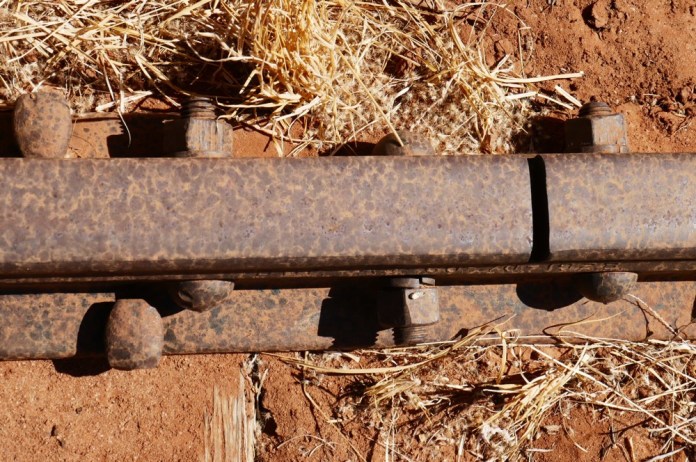
Along the road, you can see old rail spikes lying about. It must have been a tremendous site to see these steam engines of the old Ghan, risking passage through a flooded river, blowing its whistle outside Boodamun siding or steaming past desert oaks and through deserts, gibber plains and beside immense sand dunes.
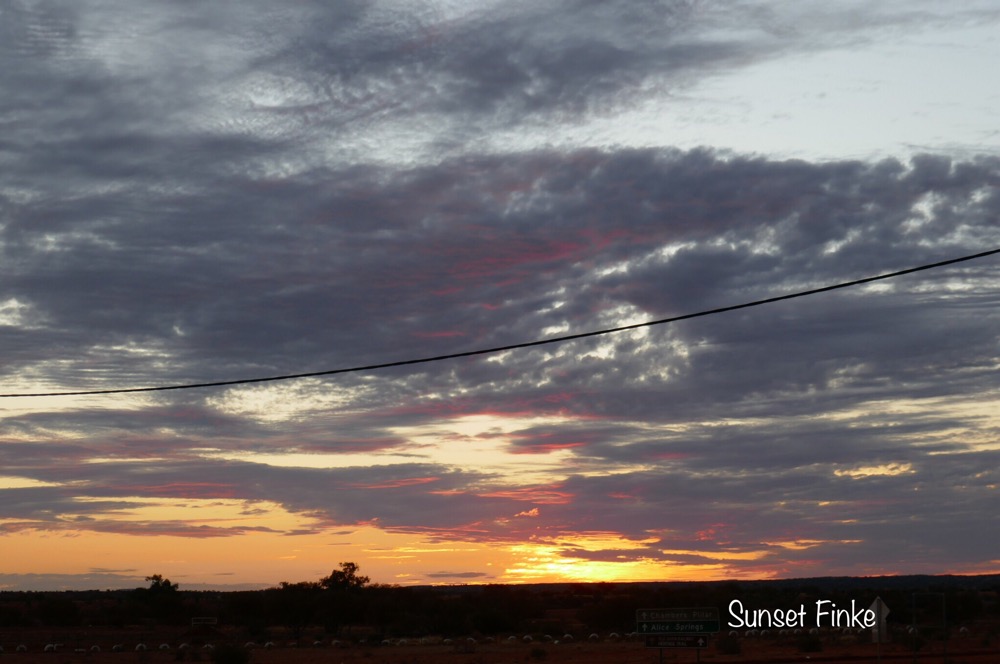
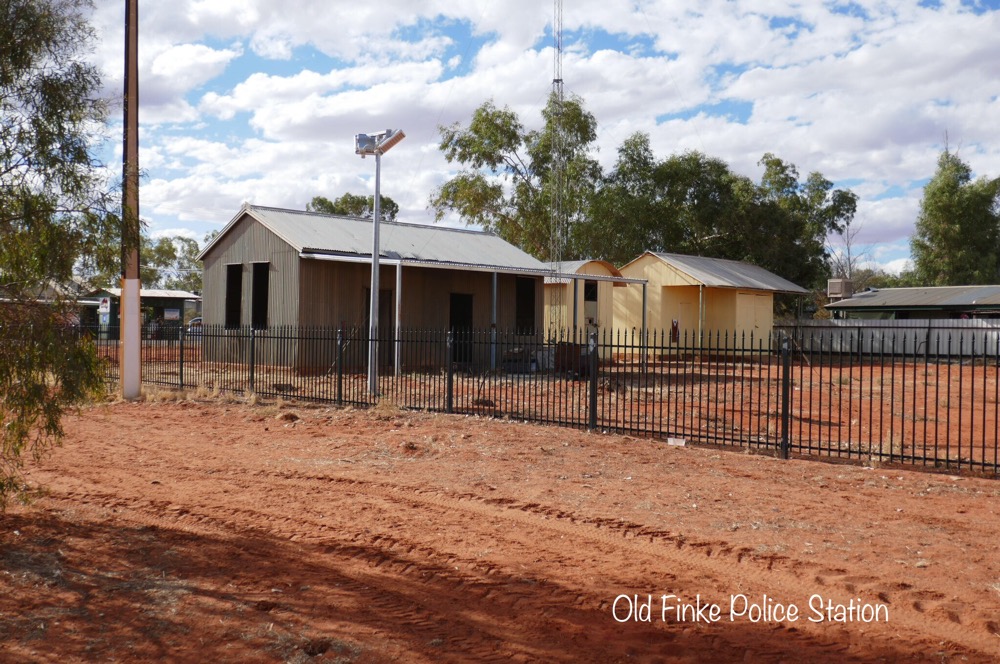
I photographed the old police station and the old hotel at Finke. They are closed now but could provide a venue for tourism based on the Ghan. The Ghan is a magical and exciting story, of floods, gangers, soldiers moving north, and train wrecks with lucky escapes.
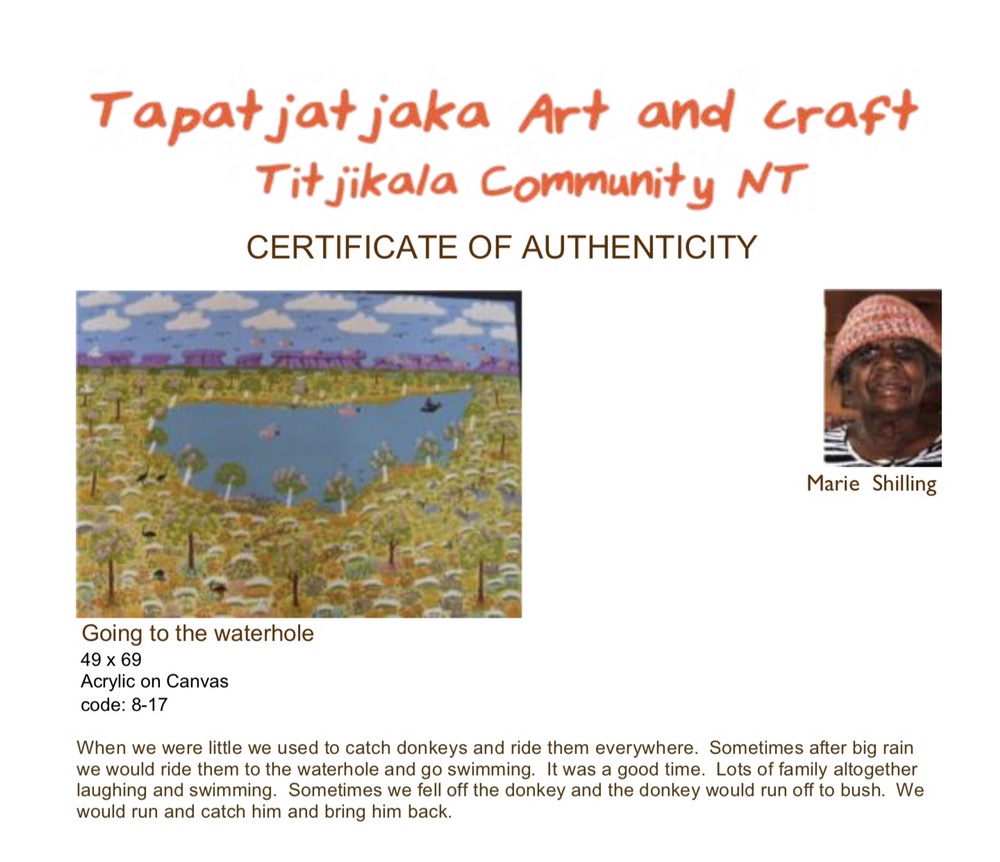
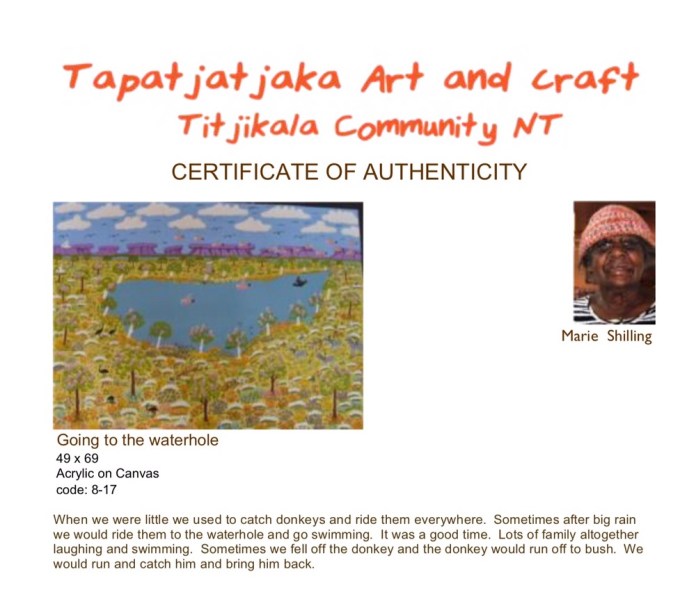
We stopped at Titijilka ( Maryvale). This Community was first established as a limited settlement at a Telegraph station. Later it became an Aboriginal community. I met Jane who runs the art gallery located in the centre of town. It’s a large cheerful space, with much coming and going. I bought a painting by Marie Shilling, of forest, waterholes and galahs on a canvas. I will find a place for this at home. The only downside of the day was poor Mark, who was terrorised by a mouse when he dozed off in his car, he found it munching our scroggin supply. Then in the afternoon, the compressor for the left back wheels suspension was struggling, dropping the wheel down on that corner. Mark pulled it apart, but there seems to be a crack of hole in the air chamber. Mark borrowed Janes car and drove us all along the challenging road to Chambers Pillar, set us up , made dinner ( chicken stir fry) and then headed off back home to fetch a new car for the rest of the trip. It’s about 150 kilometres from here, which is a great deal less than the 700 kilometres from Dalhousie Springs. When we started the troopie, a splendid gust of red dust blew into the cab courtesy of the air conditioner.
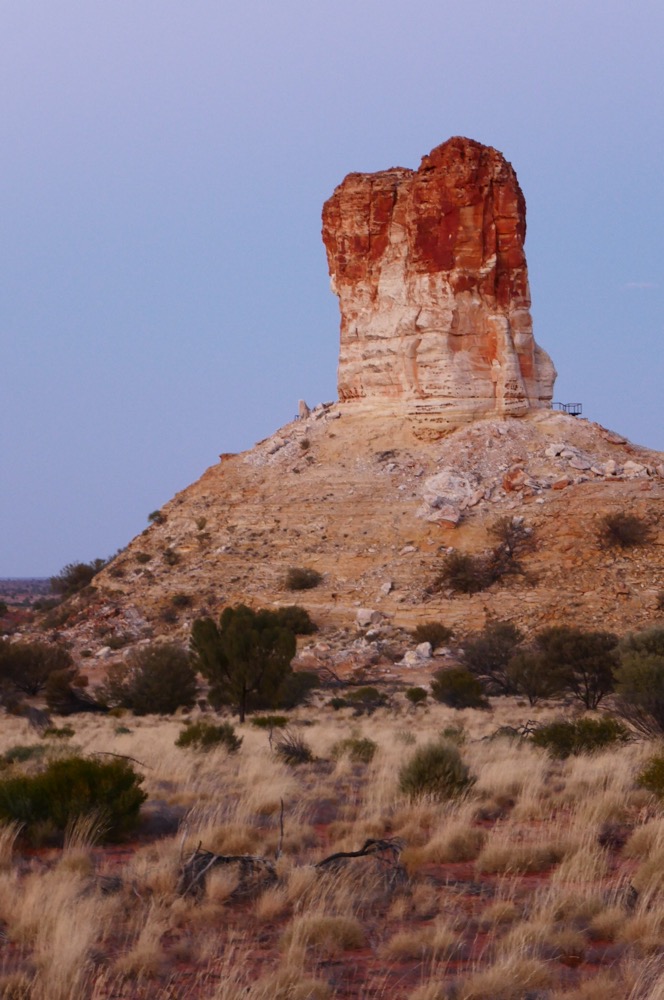
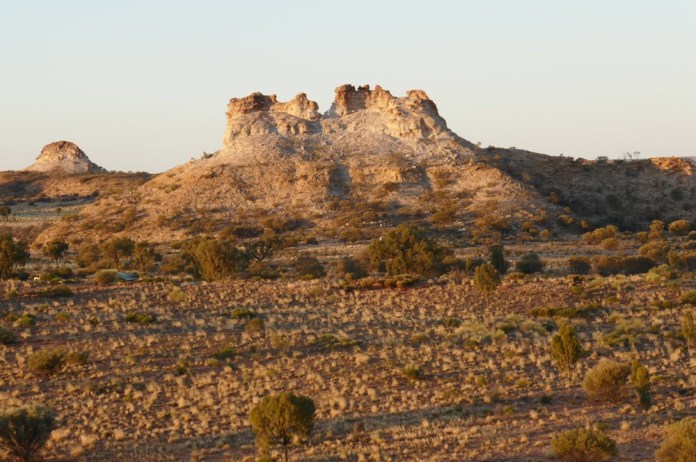
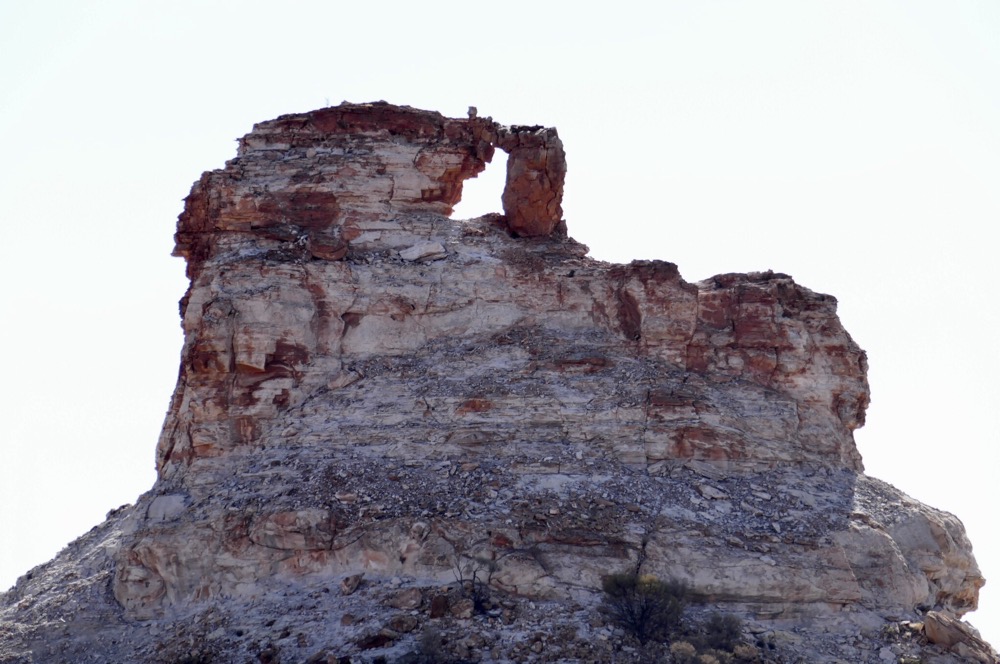
We arrived at this campground at about four thirty pm. And headed off to visit the Pillar. Chambers Pillar is a significant remnant of the original iron rich sandstone formed beneath the last great sea located here in central Australia, that’s about about twenty to thirty million years ago. All the rest of the ancient sea flood was worn down to firm the red sandy dunes, soil and roads of the Simpson desert. Why it remains is a mystery? But there is no mystery about how beautiful it is. The trick is to see it at sunset and sunrise, to see it’s two splendid faces lit up red and golden above the flat plain. There are other similar geological features here, including Window rock. Chambers Pillar was originally a bad man, who seduced other men’s wives, until two women used magic to convert him into the Pillar we see today. Unfortunately, the magic made them into stone as well. These two pillars are nearby and are just as impressive as the better known Chambers Pillar. It’s dark now, and the campfire coals are cooling. I’ll be off to bed soon, tucked up in my sleeping bag and swag, my Beanie keeping my head warm. The stars have faded now as high level cloud has come over and obscured them.
Near our tent is a tall desert oak. They have this magical property, they magnify and sussurate the gentlest of wind, giving it a soothing quality as well as amplifying it. Incredibly peaceful.
……………………..
It’s late on Friday afternoon, and I’m lying down on a comfy bed in the main cottage of Hale River Homestead. We are about 26 kilometres from Arltunga, and about 140 from Alice Springs.
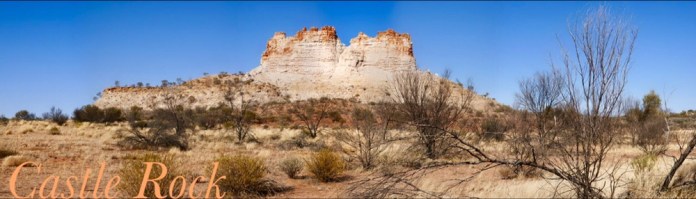
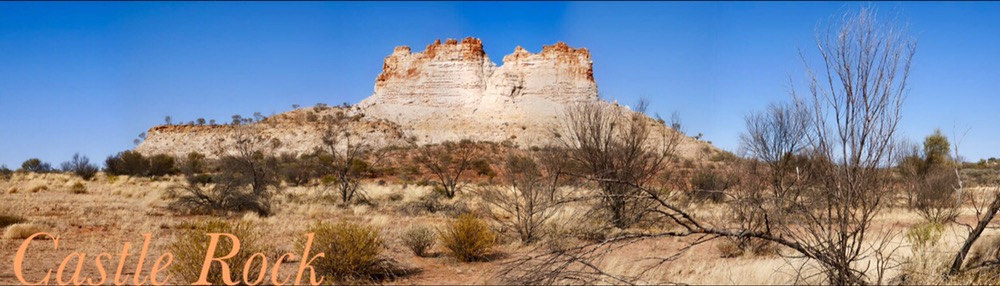
This morning we all got up before sunrise, and took photographs of the sun lighting up the western flank of Chambers Pillar. It was cold in a biting wind. The sun eventually peered over the eastern horizon, sprinkling light on the grass waving in the wind and the white and orange rock of the Pillar. After breakfast, Mark arrived back with another car. He made us a cooked breakfast of what he calls fluffy eggs with chopped up bacon, tomato and spinach. It was very good! After breakfast, Jennifer and I walk around Castle rock, to see it’s now sunlit side. The track was sandy, with sparse scrub and occasional desert oaks. We helped Mark connect the trailer as the tow ball was much higher than on the land rover. Up she went and it kept going, well that can’t be good with the trailer bar near vertical.
We then drove back to Titijilka to collect a red kelpie. On the way back from Alice, just near Oak Crossing, a red kelpie darted in front of Mark. When he stopped it leapt into the car. He left it at Titijilka and let people know what he’d found. Eventually the owner located us, and Mark was able to return the dog.
We had lunch at Omarrina Hotel. This is an old venture given new life by fresh owners. It’s only 23 kilometres from Alice Springs. It’s an interesting place. It was used as a location to build film sets. So there is western style hotel, pioneer cottage, a windmill. However, because they were built for the movies and not for actually living in, they were constructed very poorly. One house fell over last year, and the whole top of the windmill blew off a month ago. There are private cabins nestled in the rocky valley of the Homestead. The restaurant is large and has a wonderful view from full length windows. Mark was able to relax thinking his worries were over, little did he know, fate had saved the best for last!
After lunch, we drove back to Alice Springs, with the intention of skirting it and heading off to Emily Gap and then to Hale Homestead. We stopped to see some extant sections of the old Ghan and of the telegraph line. Both were in excellent condition. Mark told us that up until a few years ago, a train would go on this track with some of the Ghans old timers to explain the story of this great steam train trip. While this was happening, Mark had a phone call, to say the wife of his bus driver was in hospital. So Mark had to drive this drivers bus home and we had to drop the bus driver into hospital. Well, it all went to plan but when we went to fill the car with fuel. Ooooops, where is the lifter. A fellow customer, grabbed a spanner and gently popped the fuel lid.
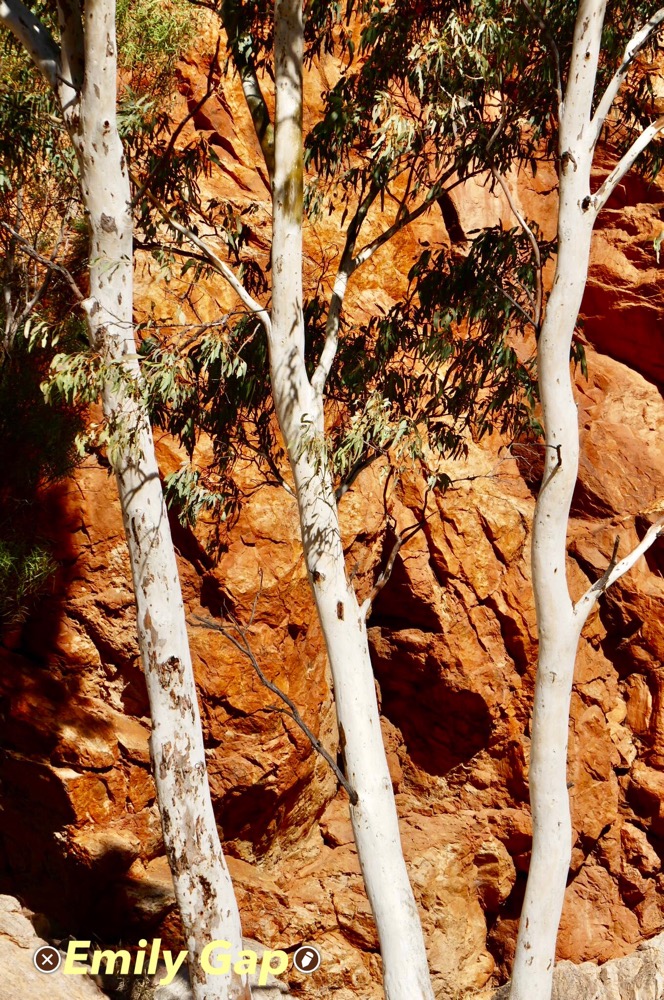
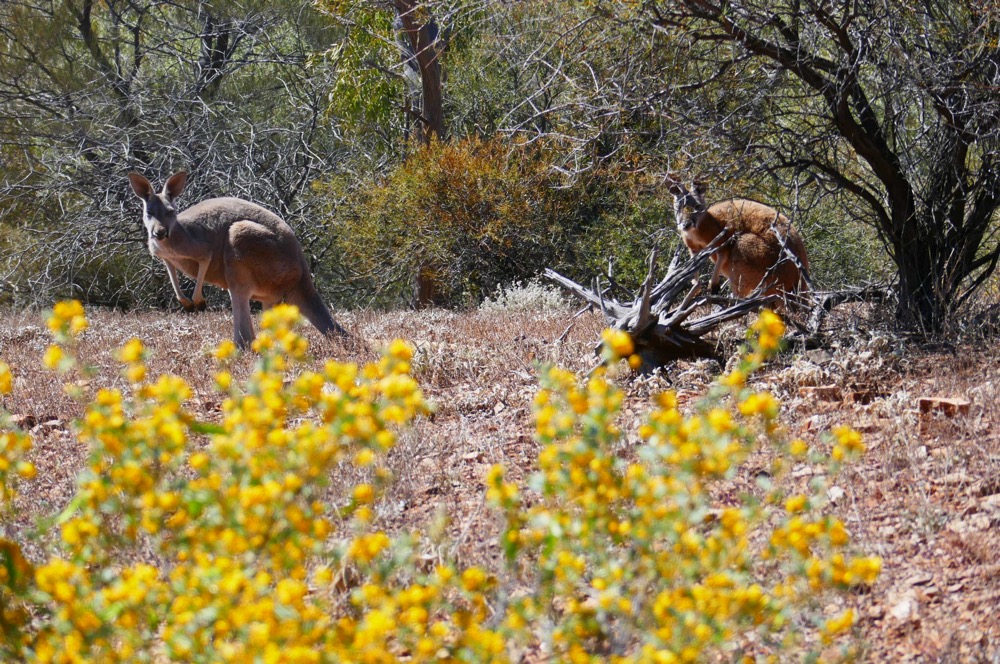
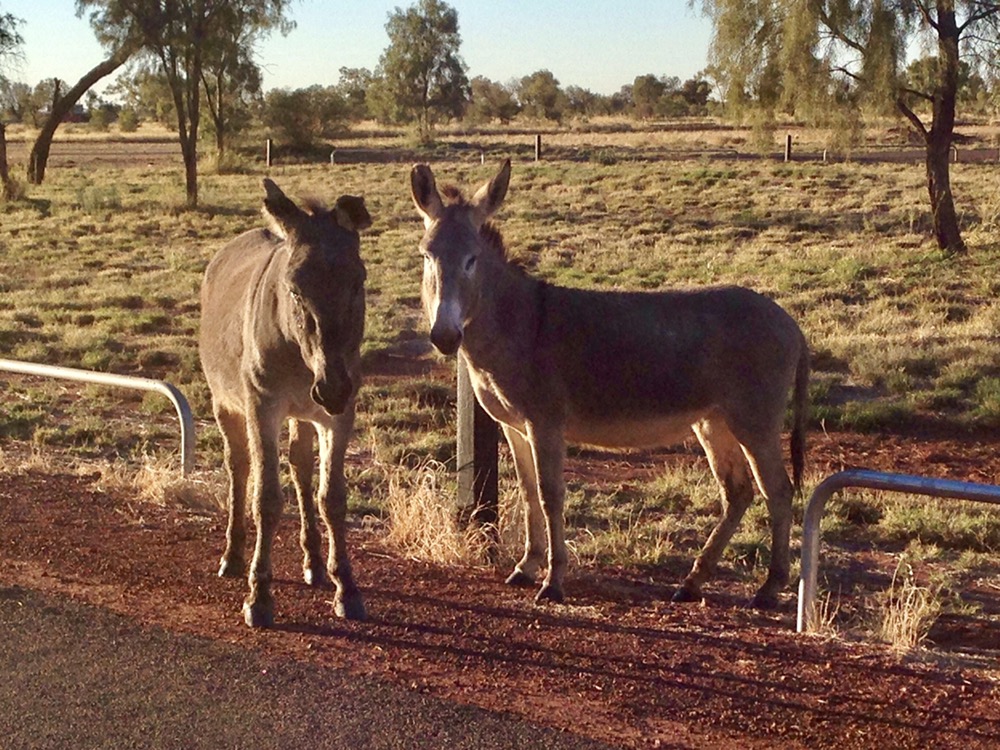
Jennifer drove the car all the way to Hale River Homestead. We stopped at Emily Gap and Jessie Gap. We decided to leave exploring Arltunga till tomorrow. The scenery at both gaps as well as the whole drive is spectacular. Massive red ranges, many creek crossings, kangaroos, donkeys and wonderful views made it a very enjoyable drive. Hale River Homestead is as welcoming as ever, and we are all looking forward to dinner tonite. (Spaghetti Bolognese and birthday cake!)
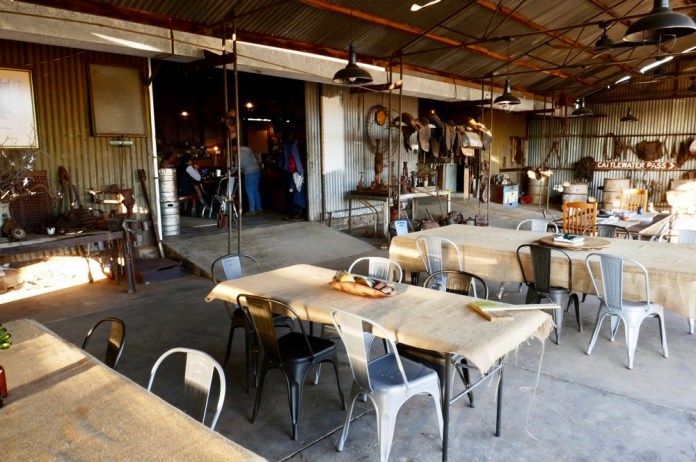
Jennifer and I are sitting in shade at the Joker Gorge car park. Dave and Di gave gone off track and are exploring the mine here. Breakfast was great, poached eggs, yummy muesli, a generous serve of yoghurt. Sophie made coffees for all of us. The restaurant is the old workshop, but in one corner, Nathan who is Sophie’s Dad, makes leather goods including traditional bull whips and belts. Hale River Homestead is a great place to stay. We four shared the cottage. There are three spacious bed rooms, numerous sitting areas, no wi fi, and so it’s easy to relax. The building has been well restored, but still retains a strong flavour of the 1940s and 1950s. The black round power switches, the paintings and pictures on the walls, the decor all harkens back to a less sophisticated but less demanding time in our history. The dining area is open, but it wasn’t cold or windy, there are books and newspapers to read while sitting in comfy old leather armchairs. The dinner was excellent, a scrumptious spaghetti Bolognese, with salad, and a stir fry as well. Desert was a piece of six year old Davids birthday cake. He’d spent the day creating this layered work or art. We chatted amongst ourselves, with Sophie, with Lyn and with some other guests who told us about their experiences in northern NT, and also about their adventures travelling the Canning stock route in 1995. A very convivial evening, indeed…………………………………………
I’m sitting at McDonnell Caravan park, it’s 6 pm and Jennifer has driven to the supermarket to get supplies. We have spent a wonderful day exploring Arltunga. We began with A small cemetery, near Joker Gorge, then a mine, then the gorge itself. It was a cool morning, and this made for very pleasant walking. The gorge is rough, and involved a lot of boulder clambering. The cemetery was small, only four graves but it had a beautiful view of the surrounding hills. Another much larger cemetery we visited later, included the epitaph “ he was a good mate”. I hope someone can say that about me one day. We explored the police station which had been restored to much of its former glory in 1984, the government works with many restored buildings, assessor, assayers, manager, and even the old battery and its engines to crush up the quartz ore to relieve it of its burden of gold. This area produced many millions of dollars in gold, in today’s terms, and made many people rich. However, many died of lung disease due to inhaling ground up quartz. The post office processed mail every two week in 1910, which was a lot quicker than the camel trains which brought supplies every 2 months. The camels trekked up from Oodnadatta, crossing the sand hills, and rough scrubby country in terrible heat and dry conditions. We spent a fascinating four hours there, including walking beside the miners cottages, which were only four foot high walls, as the rest of the structure was made up of timber supporting a canvas roof. Other miners buildings were just a fireplace today, as the walls were of timber and daub, and have succumbed to weather, fire and termites. Near to most cottages were simple, dry stone forges, where the miners would sharpen their picks and shovels. It’s an inspiring place to visit, to see where they lived, the tools and machines they used, their simple, tiny houses, and to realise that they survived and made livings in the harshest of environments. The last (open cut) gold mine ceased production in 1990. Most of the mines had closed down by the 1920s. We visited the tourist information centre which gave in depth information about Arltunga, and described their lives. The ongoing feud between the local policeman and the local publican. The embezzler assayer who got caught. The 600 kilomters trek of each miner, who pushed their laden wheelbarrow all the way from Oodnadatta. Some miners had come even further, in one of the graves rested a miner who’d come all the way from Boston, USA. What a story he would tell if he could.
After lunch we started our drive back, stopping briefly to circumnavigate Corroboree Rock, which is a striking stone piece of strata lifted into the vertical by titanic natural forces 800 million years ago and coloured by tropical seas 60 million yrs ago.
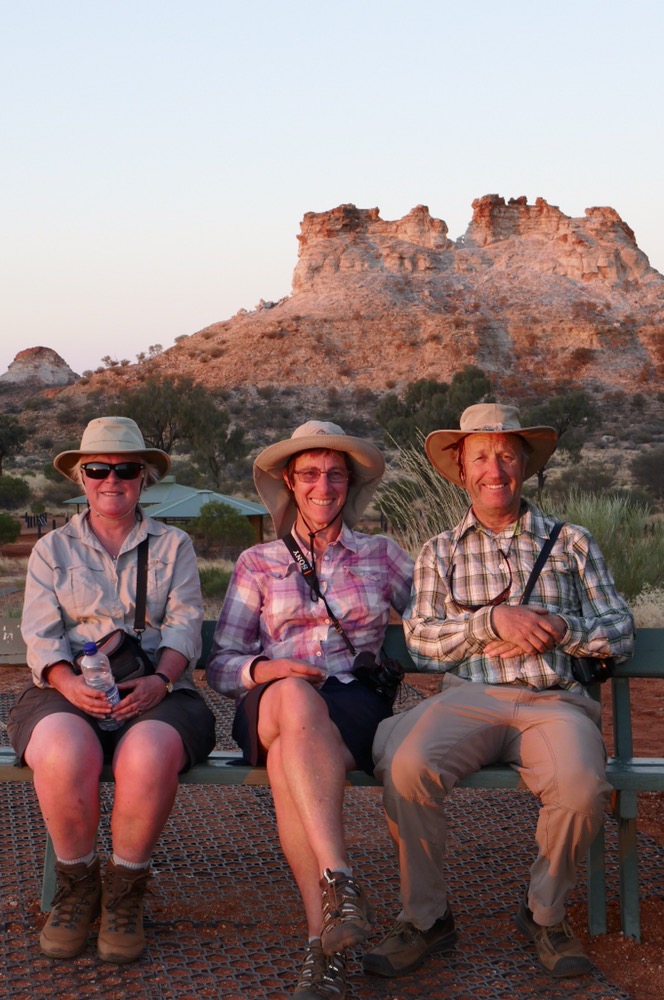
It’s been a terrific day, and a wonderful holiday. We’d like to truly thank Mark of Sandrifter Safaris, who coped with all sorts of disasters and still delivered a great adventure as far as we are concerned. We always felt safe, superbly looked after and valued as people and clients.
One final reflection. Much of the history of central Australia has been a story of struggle, painful failure before later generations finally succeeded, the harshness of the deserts and country but our painting we bought from Marie Shilling, gives another kinder view of this beautiful country. In her painting, the skies are blue, the waterholes are full, the flowers have opened and bursting with colour beneath the trees, emus and kangaroos are moving in the forests and the people are playing, dancing and singing. For her, this country is her playground, a place where she can enjoy life to the fullest. Because the wants of many Aboriginals are few, there is enough water, there is enough food and there is enough time to enjoy playing, hunting, and dancing in this country we seem to struggle in.


Elliott is a town on an ancient land, the Pre Cambrian Shield, this vast stable platform has meant that relatively little geological change has taken place compared to most other places on Earth. There have been three seperate seas, their sediment is the basis of the sandstone of the Ahburton Range that divides the Barkly Tablelands on the east from the Tanami to the west of the highway. The soils are generally very old, and infertile except for parts of the Barkly, where the ongoing pastoral heritage relies on those richer soils deposited from the retreating ancient seas.
Aboriginal people have been here since the Dreamtime, surviving on the native bush foods available. The spirit ancestors gave them rights and responsibilities for this region, over which they moved with little envonmental impact, farming the bush, studying the game hereabouts, and learning the stories of place and of lore. Newcastle creek and it’s headwaters are the country of the Jingili people. Nearby live the Wambaya, Yangman, Mangarrayi, Mudbara, Gurindji, Warlpiri, Warlmanpa, and Warramungu. Lake Woods and Woods Waterhole, were places of refuge in this dry land as well as the venue for meetings and ceremonies between the mobs.
The first white man to visit the location of the future Elliott was John McDouall Stuart in 1861. It was not his first time in the future Northern Territory ( of South Australia), in 1860, he was forced back after a battle with local Aboriginals at Attack creek, that’s about 200km south of Elliott today. His third trip north was not to discover new pastoral areas but rather to establish a feasible route for the Overland Telegraph planned from Adelaide to northern Australia, which would then join the undersea cable crossing the Indian Ocean. It was Stuart who named Newcastle Waters after the Duke Of Newcastle, the Colonial Secretary in far off London. And it was here at Newcastle Waters, only 30 kilometres from Eliott that he turned south again, after four fruitless and exhausting trips north east and north west. On his return to Adelaide he learned that Burke and Wills had failed to return from their expedition. So. He began his fourth and final, and ultimately successful trip north. This time he discovered the waterholes that allowed his horses and men to get to Daly Waters from Newcastle Waters, then on to Mary River and then the sea.
The rough route beside the new Telegraph line ( 1870-1872) was called “ The Track” and it guided men north, to look for gold, move stock, and then allowed entrepreneurs to set up pastoral leases along its length. In 1883, Newcastle Waters Station had its beginnings. Now Stuart had linked north and south, but little was known of the lands to the west and east of Newcastle Waters. The explorers Ernest Favenc and Nat Buchanan, rode into the Barkly and Tanami respectively. The Tanami was unsuitable for pastoralists but the Barkly was a possibility. Spin doctors of the time published glowing reports of this country. The Telegraph station at Powell Creek, 60 kilometres south of Elliott, was the connection to the world for this area.
Overlanders regularly began moving stock, sheep and cattle, north using the reliable water holes of this area for their animals. Even though most were just passing through, there was still early conflict and deaths on both sides. But by 1885, Not only Newcastle Waters, but Brunette, Alexandria, Walhallow and Eva Downs stations were all established in the Barkly Tablelands. All of them still exist today, and you may visit them if you do the Barkly Run, our air plane ( RFDS) based clinics run about monthly.
Eliott is famous for being at the junction of two of the most famous stock routes, the Murranji track from the northwest , and the Barkly track which takes off just south of Elliott. Then as now, it was the availability of water which permitted a station to be established and allowed stock to travel thousands of kilometres. These routes were often desperate affairs, with scurvy and disease, death from injury, and dehydration. The Murranji track was the most brutal of all Australian stock routes, with waterless intervals of up to 115 miles! There is a terrific book on this track by Darrell Lewis that is well worth reading. Many Aboriginal men became legends on these stock routes, and their descendants still live in the Elliott community.
Newcastle Waters became the hub for many great stock routes and was a community long before Elliot or indeed even before the Stuart Highway (1943) was built. You can drive out to see the old buildings at Marlinja ( the settlement adjacent to Newcastle Waters station) and walk through the old pub ( Jones Hotel). Don’t forget to check out the old petrol station and houses. It’s a fascinating study but the town withered and died as a commercial hub with the foundation of Elliott 35 kilometres south. The station still exists as does a small Aboriginal community called Marlinja.
In 1940, War had come to Australia, Darwin was bombed, Japanese soldiers had captured the impregnable Singapore, and were moving south at a blistering speed. It was a military imperative that Darwin with its access to Indonesia, New Guinea and South East Asia, be accessible not just only by water (a route too vulnerable to submarines and air attack) but by land. A highway was needed. The main roads only went to Alice Springs from Southern Australia. American Engineers built a Northern road in a matter of months. It was described as having an “all weather “ surface. Now there was access north but towns were needed along the way. Then in 1942, it rained, and rained, the “ all weather Road” was now 1500 kilometres of impassable quagmire. The road had to be sealed properly. By October 1943, the road was indeed sealed and all the way from Alice Springs to Darwin. Goods and personnel could be moved by rail to the Alice then to Larimah ( the nearest railhead) , then by truck from there, all the way to Darwin. Convoys of troops and supplies all stopped at Elliott. Every effort was made to make it a comfortable stop off. Soldiers could visit a cinema, go for a swim at Woods Waterhole, enjoy fresh meats and vegetables grown in Elliott or from one of the huge vegetable and fruit gardens established along the Stuart. Actually, it was not called Elliott then, it was called Number 8 bore.
In 1941, Lord Gowrie, the Governor General at the time, was so impressed with the courtesies extended to him and indeed all the soldiers who stayed at number 8 bore by Captain Robert Elliott, that he decided the camp be called Elliott after his host. Captain Robert ( Snow) Elliott ran the camp for the war years and later was involved in rehabilitating returning prisoners of war. He gained a MBE for his efforts as early as 1942. He died tragically only a few years later.
Elliott had the Highway, the facilities, and it was inevitable the township at Newcastle Waters suffered. The drovers were gone by the 1950s, the stock routes now were rarely used as fast road transports ( 1949) thundered along the roads to the eastern markets. They no longer needed a pub at Newcastle Waters. Elliott had businesses and hotels for the passing trade, and to service the the many stations located “near” the town before reliable air travel.
In the first of May, 1966 things suddenly all changed. 19 Aboriginal workers on Newcastle Waters went on strike over pay and conditions, it was the first of the “ walk offs” that took place all over central and northern Australia. A hundred Aboriginal people moved onto land adjacent to Elliott, and set up camp. Wave hill is the most famous walk off but Newcastle Waters was the very first. Other Aboriginal people from seven other stations joined the original settlers in the camps. North camp and later South Camp were here to stay. Diverse tribes were thrown together by circumstance into camps and western style houses. Tribes that had rarely worked or lived together now had to do so, and it’s not always been easy.
Until 1966 for the previous eighty years, stock had run wild, and it was Aboriginal musterers who gathered them together before passing them onto drovers. The musterers lived man and boy at the stations, and their families and dependents formed camps on the outskirts of the stations. Living conditions are described by present day historians as “appalling”. They scavenged offal for food, money was merely credit in the stations store and by the end of the year, there was nothing left. Even industrial awards as late as 1953 permitted lower rates of pay to an Aboriginal worker and many were not paid at all. An outcry from southern unions, lead to an epic decision to make equal pay for equal work, binding on all employers even the station owners. Then what set off the strike was that under pressure, the court ruled that the law would not come into affect for nearly three more years. Australia had to wake up to its somnolent racism in the 1960s and Elliott was a flashpoint.
This is merely the background of Elliott. I have used a beautifully presented book called “ the middle of everywhere” by Peter and Sheila Forrest which I can recommend. Another fine book is “Jones Store” written by a descendent of the hotels founder, his grandson, Peter Jones. This fine hardback book is all about the settlement at and around Newcastle Waters.
Have a walk around while you here, and see the relics and memorials of WW2, visit the Golf course, and relax in the park. It’s a place with ongoing challenges surrounding work, education and health and is not immune to any of the problems affecting Australia including drugs, domestic violence and alcohol abuse but on the other hand you will meet many wonderful people here with generous smiles and abundant kindness. I’m sure you will enjoy your stay.
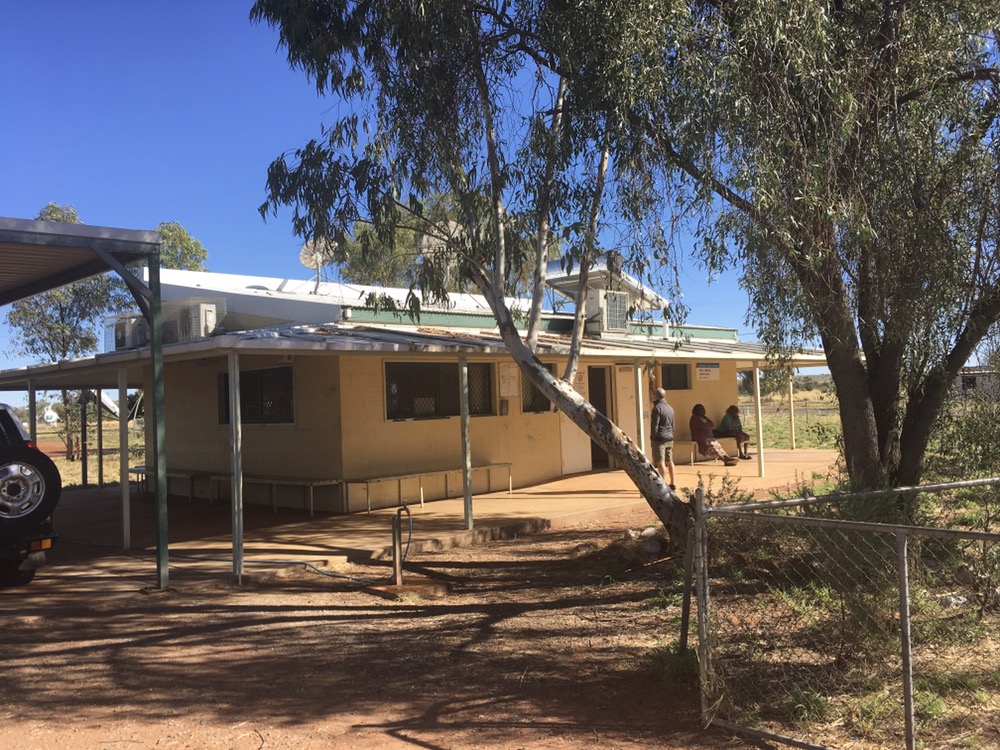
It was Wednesday afternoon. Three of us had spent the day at a remote clinic seeing patients, checking their blood pressures, reviewing any medications, discussing the implications of pathology results with them, and exhorting most of them to eat properly and exercise. Meeting some terrific local people from the community. I even met a few locals who had taken medical advice onboard and had really improved their health parameters. They had lost a lot of weight and improved their diabetes by eating Aboriginal style; plenty of bush tucker, going out into the bush to gather it and avoiding the soft drinks and take aways. Health Parameters are sorts of KPIs ( key performance indicators) doctors use to get a handle on the risk for a patient. HBA1c readings are useful in determining not only the presence of Diabetes but gives a good idea of the average blood sugar over a few months. The simple premise is the higher this reading, the “worse” the diabetes, and generally a persistently high reading despite prescribed medication means a person is not taking their tablets or having their insulin. It’s pretty obvious when a person is taking their treatment which of course includes not just medication but; eating sensibly, avoiding Coke, and exercising more; then HBA1c is suddenly ( well over three months) lower.
( For the medical readers among you, a drop from HBA1c from 14 to 11 is pretty impressive over three months. For non medical readers, 11 is still way too high. It needs to be at least 7. )
At 3:30pm the Nurse took a phone call in her office. She was told that there had been a case of domestic violence a short time ago. The police had already been informed by the local school mistress, which saved us a call. A woman had been struck and might have a broken arm. I saw her only a few minutes later. My first view of her was her walking calmly along the red dusty road from the school, she was flanked by the nurse and our Aboriginal Health Worker. Her grown up son had struck her with an iron bar. She had tried to protect herself, by holding up her arm. Her ulna was fractured, possibly shattered. She would not talk about why her son had attacked her. After the attack she had fled to the local school where the school teacher would protect her. In the meantime, the son left, driven off with some friends to another community. With the help of the nurse, I organised pain relief and bandaging and we transferred her to another larger clinic, and then by air to Alice Springs by RFDS. She will need plating or at least a plaster for several weeks.
Early on in my remote work, actually it was my first clinical day. I entered the Resuscitation room of a remote clinic. An Aboriginal women lay propped up on the trolley, her hair matted with clotted blood. Her blood pressure and pulse were abnormal, early shock due to blood loss. She needed 2 litres of fluid IV. She too was a victim of domestic violence. She had been sitting in the back seat of the commodore as her husband and brother in law sat together in the front. They had been driving back from Alice Springs when the husband took exception to something she said. Now, he was drunk and she was drunk, and in fact no one in that car was functioning at 100 percent. Still this could never excuse what he did, shattering a beer bottle and jamming it into her head. There was torrential bleeding from the scalp. Its a part of the body with a huge blood flow and lacerations here can be lethal without being all that deep.
These are the most florid examples of violence I have personally been exposed too. There are other aspects of violence in communities that are intolerable particularly surrounding the neglect and abuse of children. Child protection is a very busy service! In one remote community we know of, mothers and grandmothers commonly bring their daughters into the local clinic requesting Implanons ( long term contraceptive device implanted under the skin of the arm) for their youngsters.
As in big cities and towns, some areas are functioning well as communities and some are just not. I see young Aboriginal kids with their white foster parents playing in Todd Mall and realise these could well be the next Stolen Generation. NT Government child protection try their best to keep kids in their own community, often with capable grandparents, but it’s not always possible as there may simply be no functional adults in that child’s wider family. It’s sad that a minority of Aboriginal families are so badly damaged by illicit drugs, child neglect, foetal alcohol syndrome, abuse of alcohol, domestic and inter family feuding and violence, and poor, erratic education. However, It’s important to remember that the communities scattered through Australia are as different in their language and attitudes to women as is Greece to Belgium. Australia in the Aboriginal sense is over a hundred different countries so it’s impossible to make dogmatic statements which apply to everyone. My overall experience is that though the vast majority of kids grow up in loving, supportive families, there is still a significant minority that keep child protection very busy.
However, right here and now many central Australia’s remote Aboriginal kids have to grow up way too fast. In some communities, the situation for girls is dire where sex between older boys and younger girls ( especially 15-19 years) , has contributed to our current Syphilis outbreak and widespread incidence of early pregnancy. The current outbreak, which spans from 2011 to the present, the peak age incidence of new cases spans from 15 -19 years. And children as young as twelve have tested positive for Syphilis. There have been at least three cases of death from congenital Syphilis last time time I heard. It plays with your head, to think, a disease like Syphilis, a disease of the debauched and poor in the Europe of the Fifteenth century, can be inflicted on modern children.
In any case, whatever career or study prospects you may have had as a young woman of thirteen or fourteen, they will be completely trashed by child bearing in these isolated communities. In a major centre maybe you can piece together a life and go forward but in these remote communities with no access to courses or study opportunities, any further education is incredibly difficult. Any Aboriginal girl who is isolated or cannot protect herself is at risk of rape or violence in many communities. But is this so different from a white girl walking in Brunswick or Darlinghurst? The sad fact – Women of any colour are an endangered population wherever they are. It’s tragic that young women of enormous promise, who are intelligent and have potential to be leaders not only in the wider aboriginal community but in any of the professions or as academics, are stymied by pregnancy at too young an age.
Talking about these very personal topics with young aboriginals is incredibly difficult. Their language skills in English and my non existent skills in their language, make sensitive discussions challenging. The brevity of my stays in each community are a problem too. Most young people are very shy, very private. They are culturally reluctant to risk losing face or even worse, causing someone else to lose face. This is why Aboriginal Health Professionals do not criticise white health workers or even question them. They can see the problem alright as not much gets passed them, but they will to their best to avoid confronting the other person.
The power of magic pervades everything, the forces underlining human affairs, including disease, are frequently magical for Aboriginal people. So it’s a big intellectual jump to believe that taking a tablet would alter anything, when the reason you have the disease is due to a curse or upsetting a ghost or spirit. This is where an Aboriginal healer could help. There is a wonderful book about Arrente Medicine by a healer which explains which diseases are spiritual and which diseases are not.
Many Aboriginal people are just so busy with work, family affairs, and cultural requirements like Sorry business, Men’s business, and ceremony like corroboree, that can not only forget their tablets but even forget to collect them at their local clinic. Aboriginal people are wanderers, travelling for weeks or months to other related communities where the local nursing staff won’t necessarily know them or can chase them up for appointments and to give them their medications. It’s frustrating that needed medications are not taken regularly and lifestyle changes are not persisted with. Patients get a bucket of education about why take tablets but there are all the above issues that make compliance difficult to realise. I think part of the answer is establishing a personal connection between carer and patient, that you actually do care about them as people. In every study ever done, the main determiner for compliance with medication and lifestyle prescriptions, is the quality of the relationship between doctor and patient, and compliance has nothing to do with education. It’s a trust thing. As Jennifer and I are seeing patients a few times, we can both see improvements, sometimes phenomenal ones. Real change stems from real relationship, not filling in KPIs.
An Aboriginal clinic worker arrived after me at a clinic. I’d gone in early, made a cup of tea and gone into my office. He did not realise I was there, when he came in, felt the water boiler. It was warm. His first assumption was not that someone else had come in early rather he was alarmed that a spirit creature, a ghost was in the building playing with our domestic appliances.
The gulf between me as a white English speaking doctor and an Aboriginal woman or man, are not just education, wealth, and health but forty thousand plus years of cultural divide, a chasm which extends back into a completely different experience of the world for all of that time. So much of what I value and accept is not necessarily the same for my Aboriginal patients. It does not mean they are wrong or I’m wrong, we are just different. This is something I have to understand and accept if I’m going to be able to help them. It’s an enormous challenge but an exciting one that demands constantly learning about their world.
Imagine a primeval landscape, a forest all around you, but the trees are not the eucalypts and flowering plants of today but instead you are painfully brushing away the stiff fronds of brilliant green cycads, while ramrod straight palms tower over you and then suddenly there is the roar of a T REX. If you can picture this, you can pretty well visualise the scenery of Palm Valley.
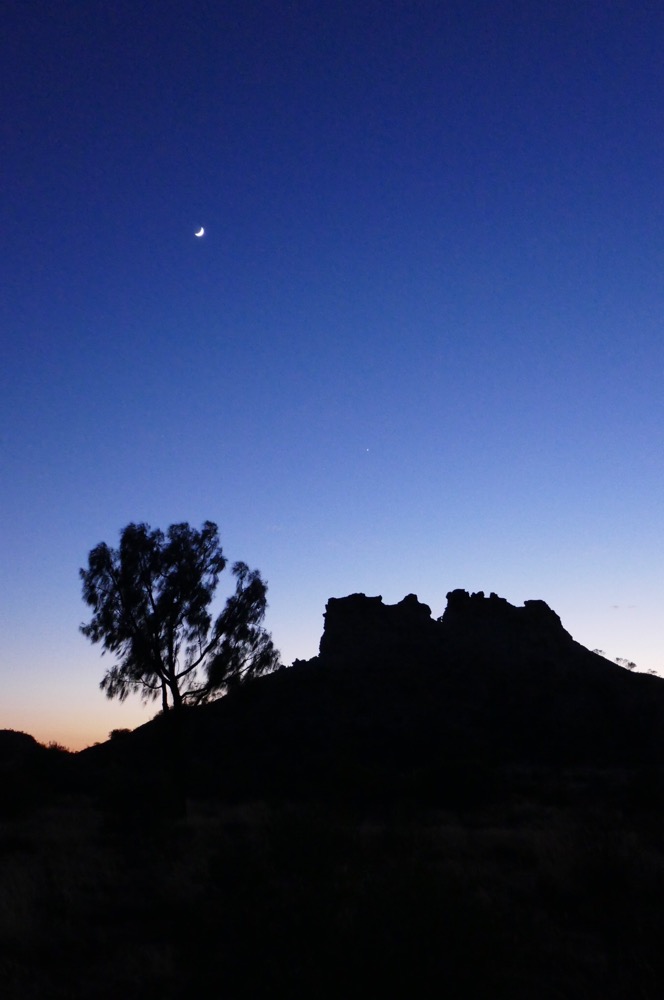
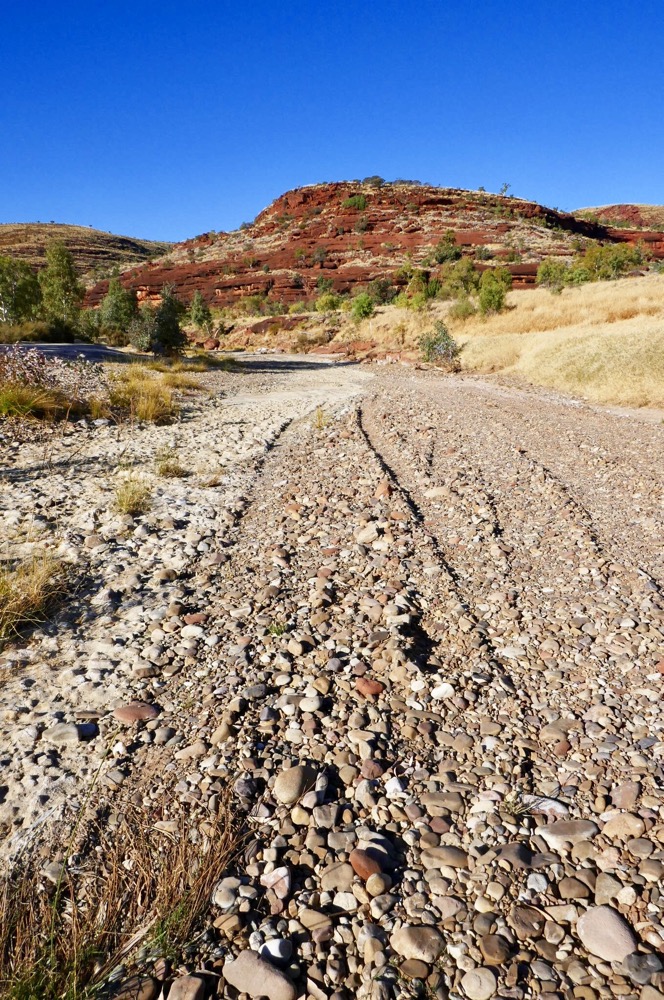
Mark of Sandrifter Safaris collected us at 6:45 this morning from outside our townhouse. The new moon was low in the pre dawn sky. It was chilly as we waited just off the road. Our first stop was on Larapinta drive, just as the sun rose over the gap, and the range before us immediately lit up into brilliant orange. While watching, we all enjoyed munching a fried egg and bacon rolls with some Australia Afternoon tea steaming away in our metal mugs. Yummy. Then we were on our way to Palm Valley. It’s about 120km from Alice and most of the trip is on bitumen but the last bit is a challenging 4WD including climbing over boulders, sand and river beds. There is precious little water around now but the Finke River is still very impressive. Firstly it’s wide, wider than the Sandover. Mmmm perhaps that doesn’t help. At least a 100 meters wide with immense red river gums scattered in the river bed. We cross confidently if not easily tailing briefly in sand before climbing up and out. The Land driver is a terrific car, comfortable, good take off angles, and air suspension which produces a prolonged fart when the car is stopped after a bumpy section.
We turn off from the road adjacent to the Finke , now along the road beside Palm Creek. There are some wonderful views to be had and we frequently pulled over to take photographs of the hills and river below us. The creek has carved out the granite, sandstone of this area into weird formations of abrupt stone, they stand stark and orange in the morning light.
Mark dropped us of to walk along the beautiful Cycad Gorge. It is a space, silent and still, the cycads visible on the rock face. Pillars and immense blocks of rock, had split out from the cliff and lay shattered on the valley floor.
We arrived at the parking area situated at Palm Creek.. There are four walks we could choose from. We opted for a five kilometre walk that went up onto the escarpment, along the cliff with views into Palm Creek , then turning southwards across the plateau, then dropping down along a narrow rocky track back down to the creek bed. We followed this circuit track with Mark, chatting as we do about all sorts of things. By now it was warmer so we had tucked away our jumpers as we walked along. It is a very beautiful walk but with slight squinting and a liberal dose of imagination, you can almost hear the dinosaurs that walked this same area, between the same species of palms and cycads we are seeing right now. The creek bed is rocky not sandy or of loose stone, it’s granite and then sandstone, the fine beds are twisted or more accurately tortured into swirls and folds by the geological forces that have made this place. Yet despite all this geological tom foolery, the Finke River and Palm Creek have had unaltered courses for 190 million years, simply eroding the rocks and even mountains that had the cheek to appear.
After our walk we had a splendid lunch, sitting on the rock, smoothed by eons of water and tumbling stones, we each had a wrap of corn beef and salad, followed by carrot cake and monster strawberries. Above us, the palm trees, livistonias, shimmered in the sunlight. Magic.
After lunch, we drove back to the main highway, turning off to Owen Springs. This is a fascinating relic of early NT history and business enterprise. First built in 1869, it was the first homestead built in Central Australia. Early explorers had fired up the imagination of some men to become pastoralists. Gilbert built a timber structure on the Hugh River, just north of Laurence Gorge, and grew wheat on the rangelands hereabouts. He had three wonderful years, glowing reports from explorers such as Giles, seemed confirmed by the rain and resulting crops. Then ten years of drought. This was not a successful venture so the property was sold to Thomas Elder. Yep, Elder of Real Estate fame. But is wasn’t real estate Elder was primarily interested in, it was transport. The Ghan train connected Port Augusta to Oodnadatta by 1891 but would not be extended to Alice Springs until 1929. So for nearly thirty years, here was a situation when transport was up for grabs between Oodnadatta and virtually everywhere in the centre. The government was encouraging entrepreneurs to enter the field. South Australia still had a lot of camels left over from the ones used to explore the centre. Elder put it together, and bought a vast number of camels and used his properties to service transport needs. The camel trains went from Oodnadatta to Curtin Springs to Owen Springs, then on to Stuart ( Stuart was the name of nowadays Alice Springs until 1939)’ then everywhere else including Hermannsburg and Arltunga. There was absolutely no connection between Darwin and Alice till 1942 when American military Engineers constructed the modern extension of the Stuart Highway northwards for the relief of Darwin.
Owen springs passed to various owners, including Kidman for a time, until in 1999, the property was acquired by the NT government. Though it was a ruin, it’s roof long gone, it remained of great interest to history buffs, and so by 2002, it was repaired and its walls resurfaced to protect them. And so it stands today, with the Hugh River behind it, and the range terminating briefly at Laurence Gorge. This route pioneered by McDouall Stuart, remained the main path for not only Elder and his camel trains, but motor cars beginning the journey in 1929. And in 1957, the first tourist bus to Alice Springs. This route to Alice via Owen Springs continued until the construction of the current Stuart highway.
Elders camels were instrumental in supplying the construction equipment and supplies for the original old Ghan railway. It was only in 1929 that the Ghan finally was extended to Alice Springs ( then Stuart…. Confusing isn’t it). The camels were also used for building the overland telegraph. No wonder Elder grew wealthy from his transport empire.
After our exploration of the old homestead, we carried along the Owen Springs road all the way to Stuart Highway, then back to Alice. What a fabulous day, full of history, nature, landscapes and great company.
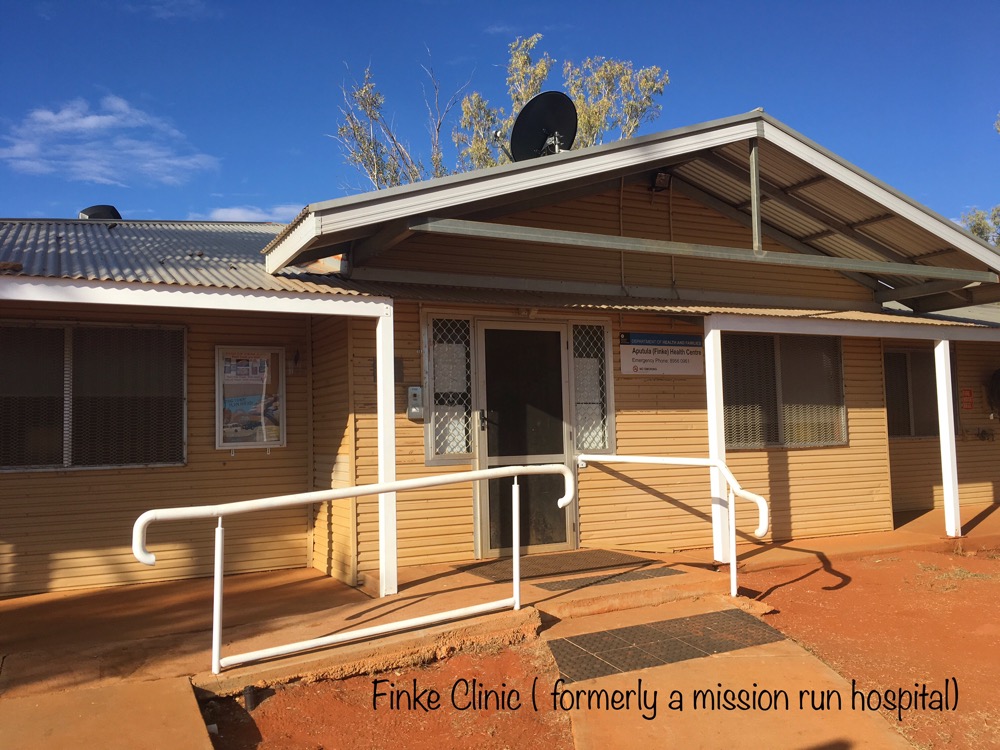
It’s 3:40 pm on Thursday afternoon and I’m sitting in the RFDS turboprop as it starts its propellor. We are on the way back to Alice Springs after a stint at Finke. Jennifer drove to Papunya, arguably the capital of the modern aboriginal art movement. We have kept in touch each evening by phone as there is no mobile cover or internet here at Finke. I’m looking forward to seeing her photographs of Haasts Bluff which is on the way.
Finke was originally built to service the construction and later imagined as a base for the ongoing repairs required for the original Ghan Railway. It fulfilled its function and grew, acquiring churches, police station, post office, a hotel, and many houses for the workers and travellers. Many of these buildings are still here but used but not for their initial purpose. Darren is a white fella who runs the local store and is absolutely passionate about Finke, it’s people, history and possibilities. He accompanied Lana ( nurse manager at Finke) and I into the old Hotel. After opening the front door we walked past the old serving rooms and bars, into the large hall at the back of the building. On display are many of the local artists works. Its planned that this will be an art gallery, a dedicated space but a commercial one where tourists and art lovers can buy local creations.
I have had the great good fortune to meet many of these artists in my short stay in Finke. Kevin makes wire sculptures, he firmly weaves and twists, wire, into horse and rider, then clothes and paints them. These are tremendously realistic sculptures. I met a lady, who makes tiny coolamon. You would know the coolamon is the food and carry all wooden bowl, aboriginal women carry when gathering bush food, filling them with witches grubs, bush tomatos, and other yummy foods. Her tiny coolamon are beautifully engraved with hot wire, she creates complex designs by burning them into the curved wooden surface.
Many local painters are also represented, one particularly fine young female artist, who has two delightful young children, produces paintings of bold, confident design and rich, “ in your face” colours. She has he own version of the “ seven sisters story “ which I’d like to see if I have the opportunity to come back.
Many of the paintings are full of story. Stories of movement through the land, of encounters with dreamtime and bush creatures and of the relationships between tribes. Stories of forbidden love and the consequences of going against law.The Aboriginal people who now live in Finke were not the first inhabitants of the town. However, they lived in the lands far and all around Finke but as time went by, they moved into the houses here, and now the local Aboriginal corporation owns the town. The Aboriginal corporation aims to fully realise the potential of this settlement.
The hotel will become an Art Gallery and a place where artists can actually work, making it a living breathing art space. The police station and post office will be restored and be reborn into new uses. There is a plan to create a museum about the Ghan. The building of it, its maintenance , and its many characters both black and white who worked on the line. Legends about the two floods in 1973 and 1974 that put paid to having the Ghan in its then location, and then getting the line moved eastwards. The floods washed away the railway bridge over the Finke River….. not once, but twice! Darren told us that there is a ton of memorabilia, old photographs and loads of stories that should and could be housed for tourists to look at and experience. This will provide job opportunities and a chance for white and black fellas to be together.
The Finke River is the oldest river in the world and there are plans to make one of the restored buildings into a natural history museum devoted to this awesome waterway. Jennifer has seen it in full flood while I could only imagine what it might be like as I drove over it’s now dusty river bed. It would be a hundred meters across. A few hardy tall river gums are spaced it, gnarled and twisted by loss of branches in previous floods.
There are serious moves afoot to build a a camping and accomodation area outside the town because as the town itself is “dry” alcohol cannot be served or consumed here. There will be a lot to do for any future visitor. One activity mooted is to walk out in the bush with the old ladies, as they gather bush tucker. I met a wonderful young woman who has turned her health around big time. She decided to live and play and eat, Aboriginal style. She spends her weekends walking in the bush with her mums, hunting for bush foods and meats, camping out in the desert with them, sharing stories and time together. There are enough older ones doing this sort of thing here that the prospects for strong transmission of culture to younger one will occur. I was impressed with the health of many people I saw, slim and strong and exuding warmth and confidence.
I have thoroughly enjoyed my week at Finke. I have met some terrific Aboriginal people who are also artists and strongly cultural. A truly cheeky sense of humour. I renewed a friendship with Lana and Ross with whom I’d previously worked at Laramba. It’s always a pleasure to work with them. Nicole is an agency nurse who is moving north to work long term with her partner a German man called Nikko. He loves the bush and the desert as much as she does. There are some very competent and friendly Aboriginal guys working at Finke Clinic, including Stanley and Rodney. A great team!
My only concern with realising tourism here is the threat to everyone’s ( including locals) safety from unrestrained dogs. They can move freely around and even a long stick won’t discourage them. I had real problems walking even a tiny distance from the clinic but felt very safe walking kilometres in the early predawn along the roads directly out of town. Tourism will require some changes be made to the freedoms the locals now have. Look, Finke is a great place to visit in a car but the danger from dogs mean I could never live there long term. Walking around is the way to meet and talk to people and it would be a shame if it cannot happen with confidence about ones personal safety.