Central australia, Central Australia Work

Vignettes from the desert

I am lying down in our cabin on the “Spirit of Tasmania”. It is just past 8pm and a nearly full moon is sitting amongst clouds in the sky. The engine is throbbing the superstructure. The ship horn sounds from high above me. To the south I can see land, green, flat and dark inching out of the water.

I have not written much about my work in the last few months and feel that omission is overdue for correction. My previous blog described my walk in the South West. This narrative will leap frog that with stories, impressions and photos spanning the last few months.

Flying

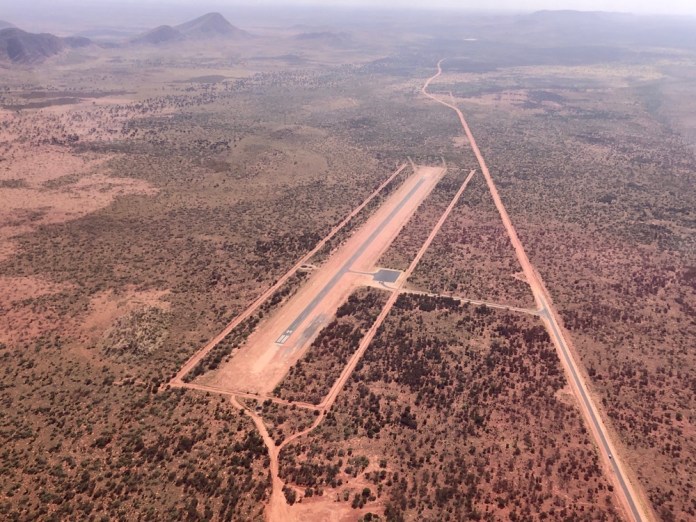
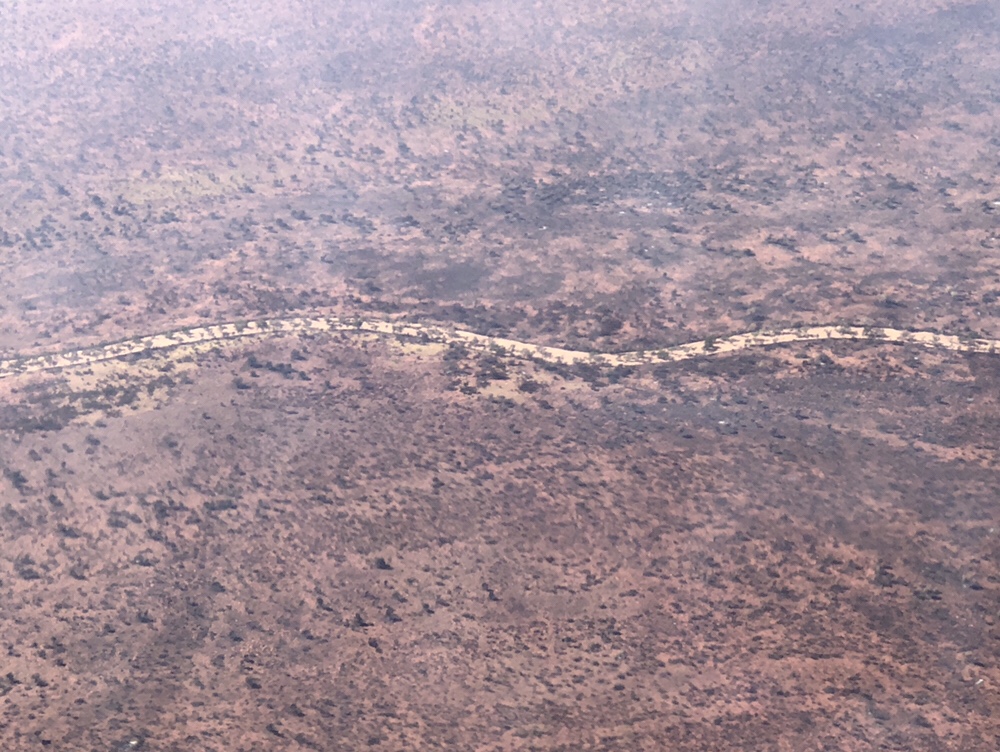
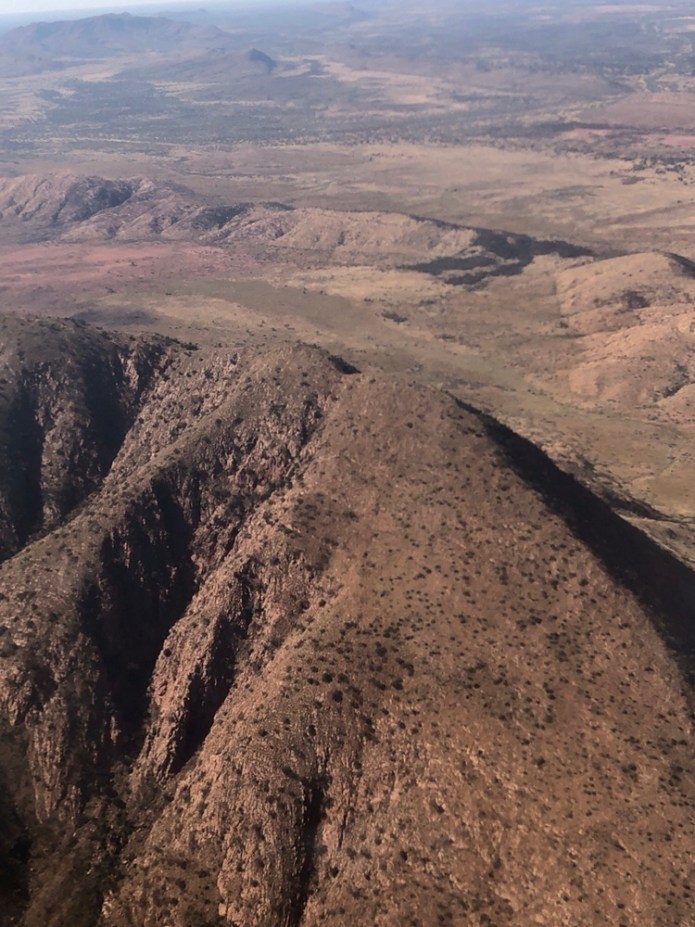
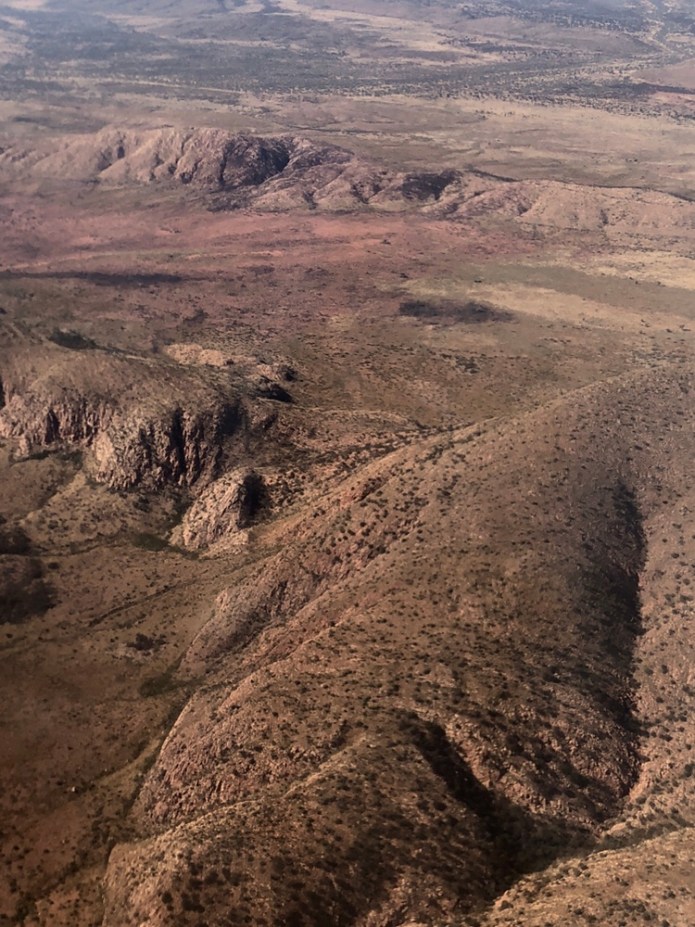
I am minutes from landing at the airstrip at Docker River. I am in a Cessna. I cannot recall the actual designation but it has six seats and two engines. The land beneath us is hot and has been hot for the last three months. For December and January the temperature has been regularly over forty Celsius. The air above the red sand of the arid zone swirls upwards in invisible thermals. These small planes pivot and twist in the cavorting air giving their pilots plenty of work. The plane bucks like an angry brumby as we encircle the strip far below. We almost hover over the several curving ranges which surround Docker River. As the plane drops, the hills, steep and worn, rich browns and reds, rise up to span the vista around me.

Then, one wheel touches the tarmac; the velocity of the plane had seemed slow relative to the landscape but with landing the true speed became fully apparent. The slowness of flight moments before was an illusion that collapsed on reaching the ground. Now trees rushed past, fence poles blurred where they had been so distinct and studying them down below me through the planes window had been a leisurely process.

Walking

I like walking, walking without people swerving in front and behind me. I walk early in the morning to complete several kilometres before I need to get ready for work which starts at eight o’clock. It’s dark, most dark when clouds blot out the stars and the moon has set. I wear a small rechargeable headlight which illuminates the ground I front of me. At Docker my small flat is on the outskirts of the community so walking does not rise much interest in the local dogs. There are only a few scattered barks from a fenced but open gated property fifty meters down the road and opposite me. I make sure my light is turned hard down and walk quietly and quickly in the other direction. This road is made of bitumen not dust, and therefore provides a smooth surface. It’s also very new and therefore lacks the potholes and cracks as the road is flexed by the repeated heats of summers.

It’s still hot, about 25 degrees and will climb to 45 degrees by lunchtime. This is the other reason for walking before sunrise. Even a short walk to and from the clinic back to my flat at lunchtime is exhausting, the power of the sunlight assaults my bare arms and it’s heat is felt through my shirt. Noon and afternoon do not make for pleasant walking.

The air is still which is unusual as cyclones far away in Queensland have created a torrent of wind that has buffeted the community for several days. It is pleasant walking into a cool breeze but not when the wind hurls the western dust against my skin and eyes. Motionless dead air is acceptable at least until the temperature begins its ascent with sunrise.

I walk carefully. If I am going to meet a snake it will be now. The high temperatures of desert daylight are as uncomfortable for the snakes, lizards and native animals so they do their hunting and scavenging in the dark. My narrow beam of light guides me along the road. It’s illumination keeps me on the road and avoid the sharp edge to red dust. It’s not the dust I fear, it’s ubiquitous, it’s the edge itself. A serious fall has consequences that don’t exist in the city or town. It can be hours before some vehicle travels nearby and mobile phones usually do not work so even calling for help can be impossible.

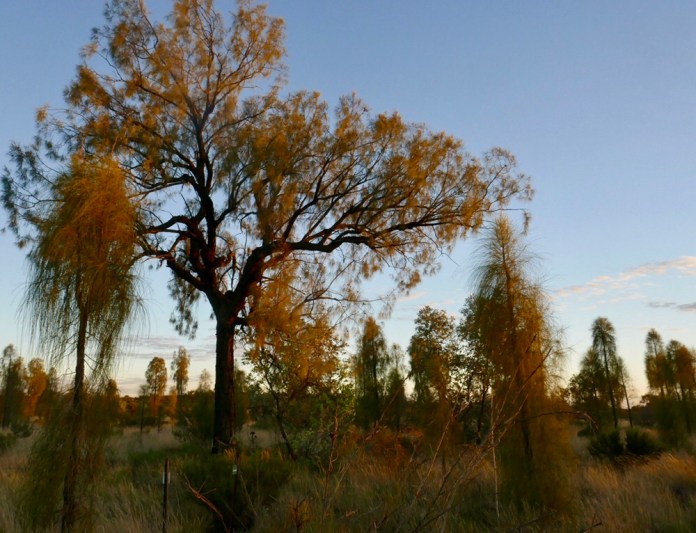
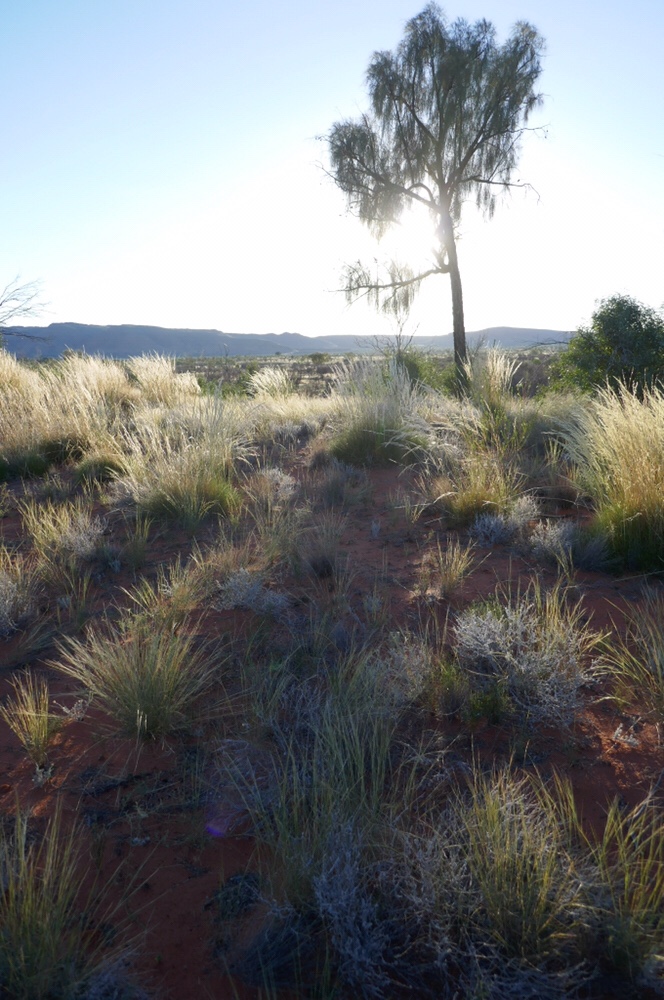
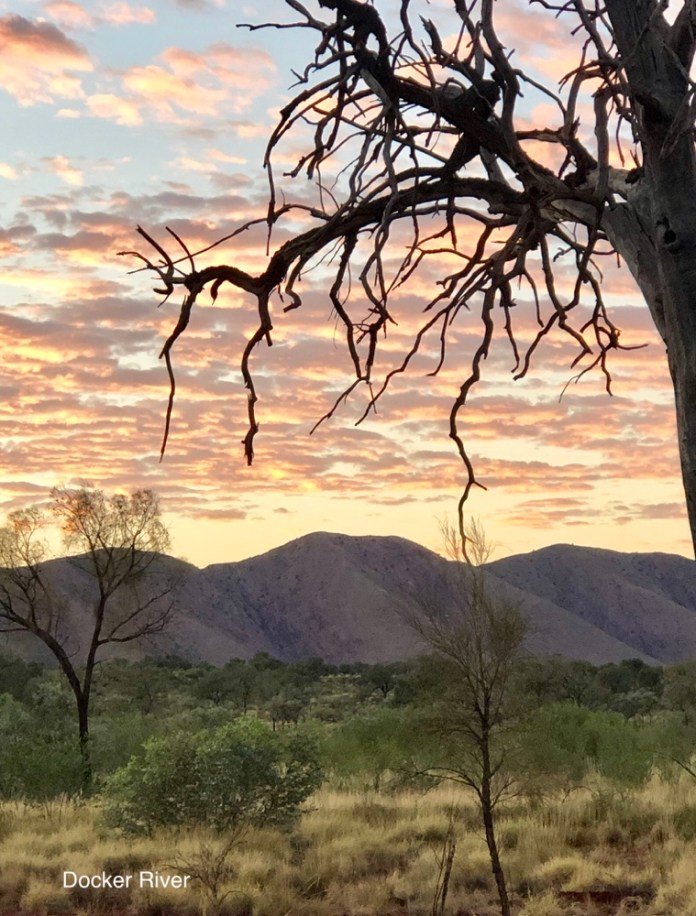
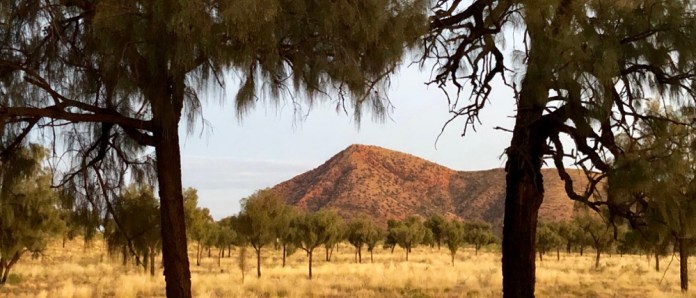
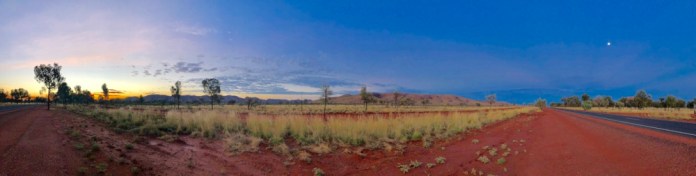
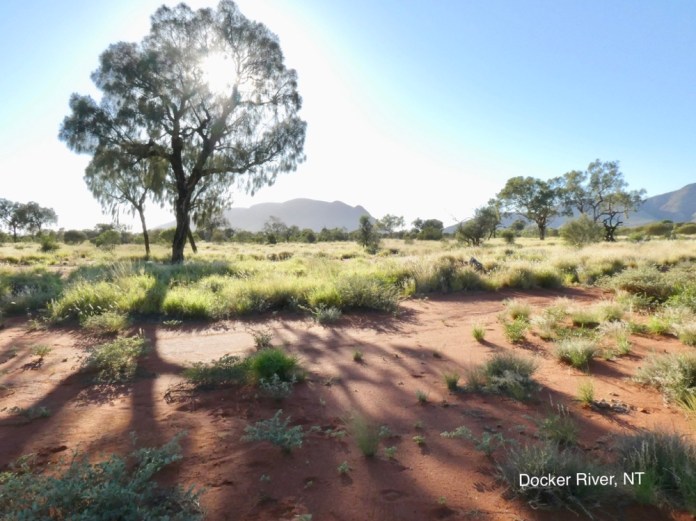
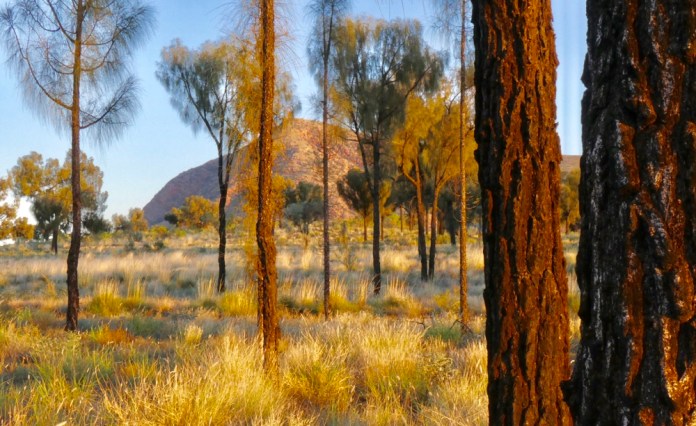
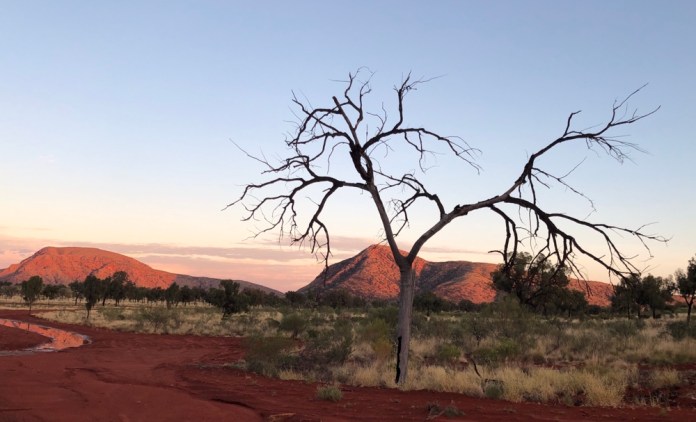
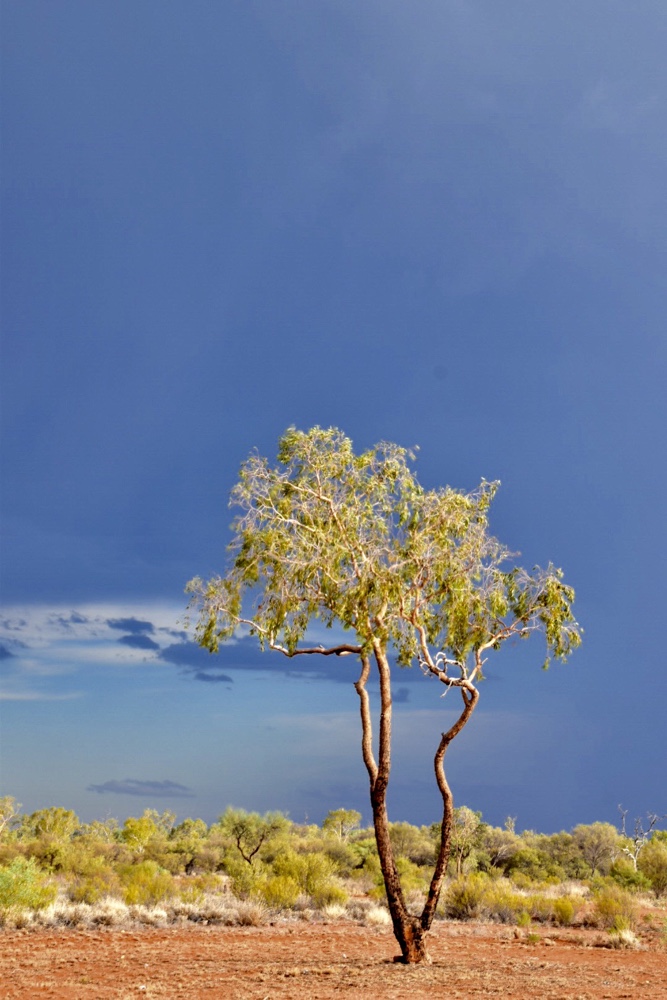
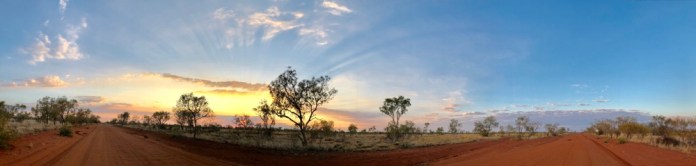
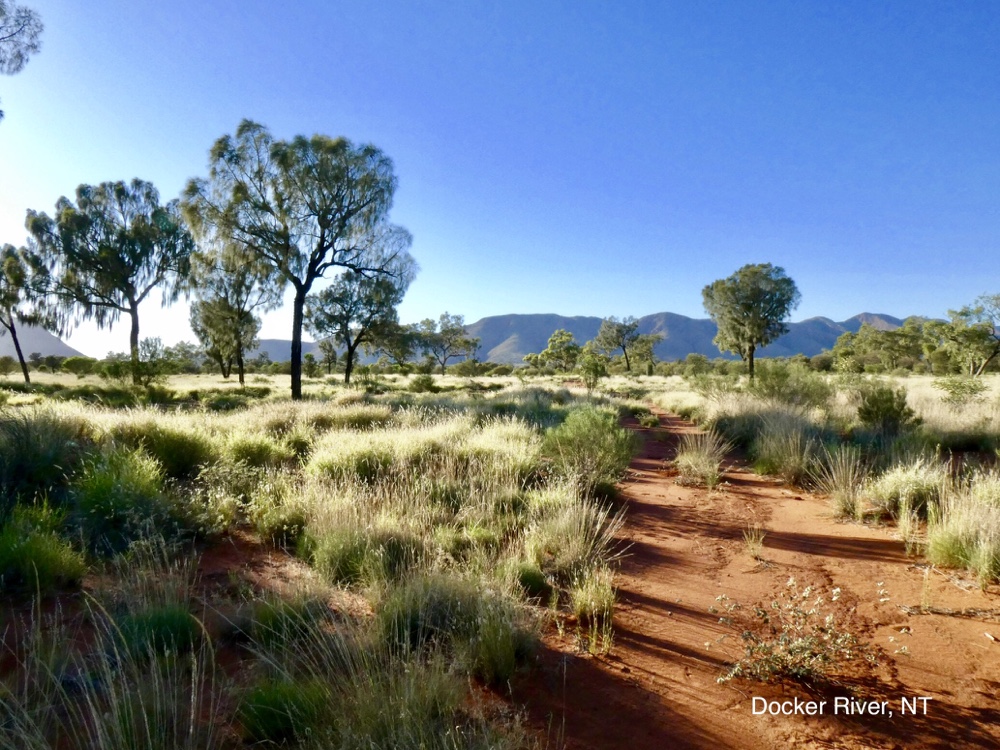
The tall grasses are dry and fill this narrow plain from the community to the highway and beyond that to the ranges. There are old desert oaks aligning the high way. On this walk, there is a kilometre Walk north then I turn west on the highway. This highway is bitumen from just before Docker and much of the distance to the West Australian border, near a town called Giles. When the sun rises and I walk along the highway I can look to every cardinal and see pink stained hills rising out of red dust plains, spotted by groves of desert oaks. These trees are impressively vertical with none of the twisting boughs typical of gum trees. They are dark grey green with a rough, deeply corrugated and ridged bark on their trunks. On the ground are dark brown discarded seed pots, split along their flanks to all the fine seeds to disperse in the summer wind.

It’s still to dark to see this as I walk along. I hear a low throbbing sound and to the right of the road I can see something moving vertically. My appreciation of colour is still poor in this light but it seems to be washed out yellow, a bump of matter lifting from the ground to the air. To my left I see a large male camel bare its teeth at me from twenty metres away. There are trees behind me I get get to if I moved quickly but I do t move fast, I move deliberately avoiding sudden movements, avoiding any motion that would signal me a predator or prey for that matter. I cannot outrun a camel but I was far enough away to get to shelter amongst the trees. It turned its head away and wanders away from me but still paralleling the road. It’s lost interest but I abandon that route for this morning. One of the great dangers of outback driving in the Western Desert occur at night; a dip in the road, a dip sheltered by desert oaks is a favourite place for camels to sleep overnight.

Brumbies, especially the stallions, can be very threatening. I cannot deny how beautiful they look, the lean, well flanked mares, shiny new colts beside them and the tall, powerful stallions standing guard over them. Both camels and brumbies are more common than is usual near this community owing to the lack of water. I saw two donkeys trapped in the local teachers yard, this vertical huge ears studying me above their black eyes.

I walked back braving the brumbies that had walked into grazing near the highway. I got as far off the road as I could as a white stallion watched me out from the red dust; it flicked its head and mane as it snorted before losing interest and cantered back to it small herd.

People

I like meeting people and I want to connect with them. It’s not enough to provide the consultation. I want to try and make a positive change for them possible by talking and relating to them in some way. This positive action can be a judicious medical decision about treatment or a test. That’s perfectly valid and in fact why I am paid to do this job. However, I want to make the encounter positive in a more fundamental, human sense. I want to show I believe they are important, that this doctor believes their human experience is valuable and that their efforts to survive in these isolated places is appreciated.

I don’t think I can truly understand their experience, I have had not my culture besieged by another one; all its values and structure undermined or just plain torn apart as theirs has over the last century. Young people are so different from the Elders. They have grown up with easily available alcohol even in dry communities, they have money to gamble with, DVDs to watch at all hours and have too abundant time on their hands. Elders can survive in the country in which they live but most of the younger ones here in the Centre would struggle to do so. All that knowledge, all that culture, all those stories are under threat. Some of it is spread at cultural gatherings such as Men’s Business but the attitude to the old ways is often pretty lackadaisical. I asked one young man what he did to pass the time, thinking it would be doing cultural stuff, making spears or boomerangs, preserving the bush skills that connect him and enable him to survive in his country, but no it was watching DVDs.

I can understand that many of the skills and knowledge and stories may seem irrelevant if you have a modern car, can just buy food in a store, or watch TV for entertainment. I talked with a 40 year old Indigenous professional man who admits he ignored the old songs and stories his parents wanted to teach, preferring to listen to Pop music on the transistors popular when he was growing up. Now he is very interested in obtaining many of the stories and traditions but it is a race to do so before the old ones pass on. What makes his connection to his country strong is knowing its stories, knowing where the soakages are, knowing which foods are available, where and when and just being here. As a white person much of the world has become homogenised by our culture of industrial capitalism, exploitation of poorer peoples over the entire world and the adulation of celebrities, and I don’t want that to happen to my Aboriginal patients and friends. It’s not my decision what a people do but I want to make clear in my encounters that I admire their achievements as a people and as individuals. I believe this is the most important thing I do here.

Thunderstorms

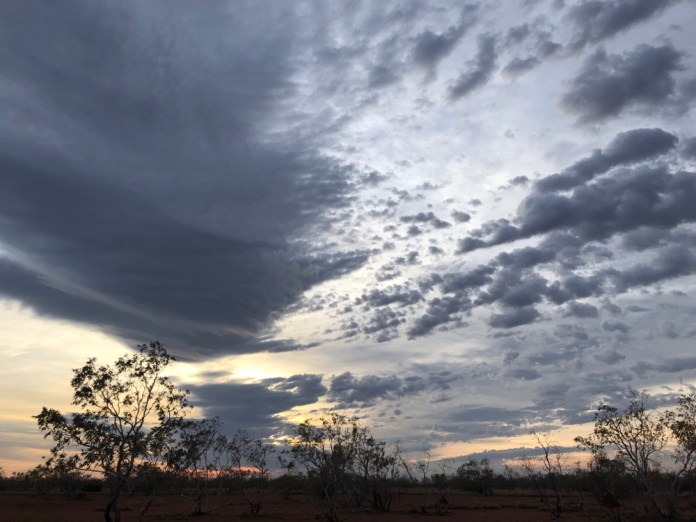
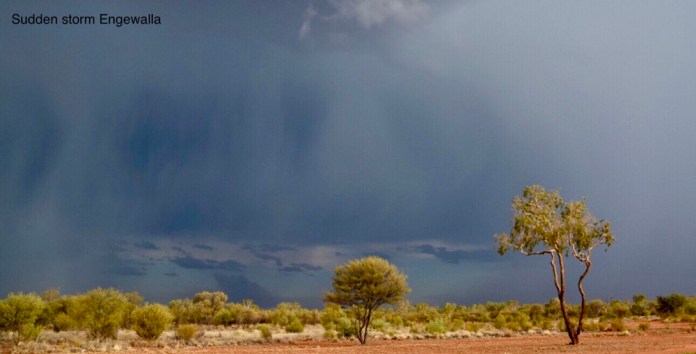
We were at Lake Nash and it had been hot, that dry, furnace like heat which assaults you as you leave the air conditioning in the clinics or houses. To the north east, great bundles of grey clouds were lifting off the horizon. We had been watching the news reports of a cyclone over North Queensland including the flooding of Townsville. We are about 10 kilometres from the Queensland border with the Northern Territory so its not a surprise to get some spill over here. The clouds had that grey sheen beneath them descending to earth; a tell tale sigh of rain. Then multiple streams of lightning formed a wall to the east, at least four almost simultaneous strikes. It was at least a minute before the thunder reached us.

By now we were sheltering under the carport attached to our donga, not that that would be any protection. The wind rose up, wafting clouds of red dust off the roads and desert, sending it into our eyes and faces. Now at last there would be rain. The need for rain is an almost visceral physical sensation; at last something to end the heat if only for a while, the heart of the land and the people beats differently, faster and lighter.

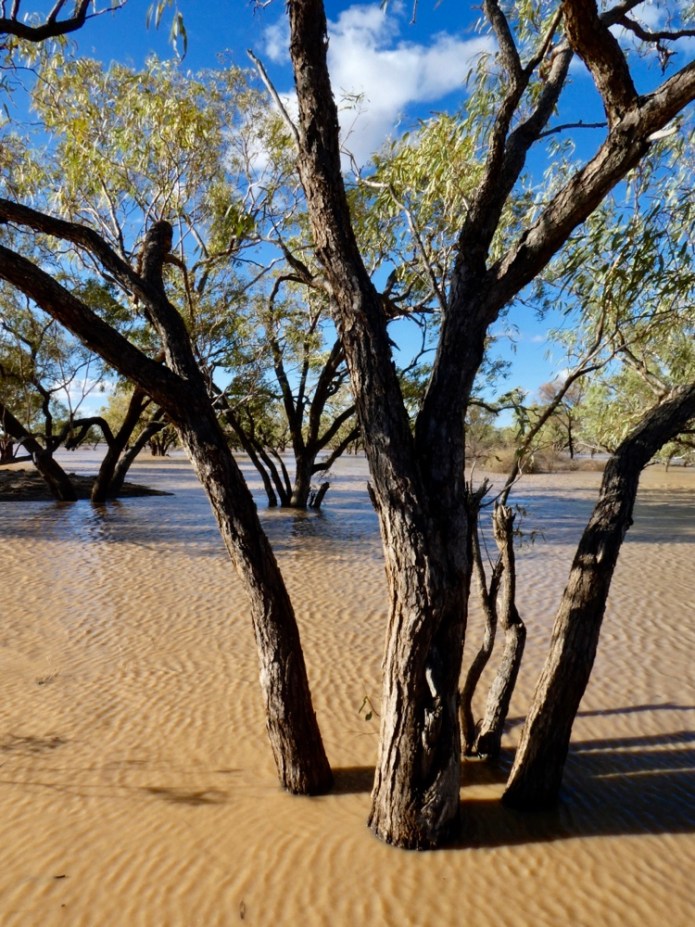
But it never came, well not from the sky but from the north. The rain fell abundantly in the catchment of the Georgina River. Two days later, we drove with Adele to the river where the Mt Isa Road crosses it. The river was flowing with water not sand. The local children were playing in the river-water covering the road. Infants with paper nappies were splashing in the brown liquid. Other children bent down to pick up stones and toss them into the water. Adults stood around talking, an older lady sat on the new bank and her grand children dug channels in the mud making new routes for the rising water.

The water swirled around the tree trunks as three young Aboriginal teenage boys jogged into the water, then swam the deeper midstream until they could reach the bottom again with their feet. A group of three sat on the opposite bank, some 100 metres away from us on our bank. They were sitting patiently in the sunshine. They had crossed earlier today and were marooned as the water level quickly rose. The local station owner was going to bring a motor boat down from his property to ferry them Homeside.

This water is destined for Lake Eyre where it will glisten over the salt until it fills the Great Basin and then pelicans and other sea birds will come to breed and nest in their hundreds and then thousands until the central desert sun dries the lake and recreates it’s salt plain, with a residue of sludgy, salty mud beneath the surface.

Standard
Central australia, Central Australia Work

Our trip so far

It’s a Sunday, the end of our second week in Alice Springs, and the beginning of our third. I’ve been remiss in not writing down to record everything which has happened since we left Launceston nearly four weeks ago.

In Melbourne we stayed at the Quality Inn at Mickleham, it’s comfortable, close to Hilary and has a large area to securely park the camper trailer. We spent a lot of time at Hilary’s place, enjoying our time with Isla and Lauren. We took the train into Melbourne CBD so Jennifer could buy some walking sticks and even more importantly have brunch with James. We sat inside at Mr Tucks with the traffic noise beyond the windows and busy pedestrians passed us by.

We had a wonderful afternoon and evening at Oshi and James place, readying the penthouse entertaining area for their engagement party. The function proceeded very well, with Oshi’s parents, Anoop and Richa, my sister Coral with Buzz, Hilary, Michael and the girls, and lots of friends.

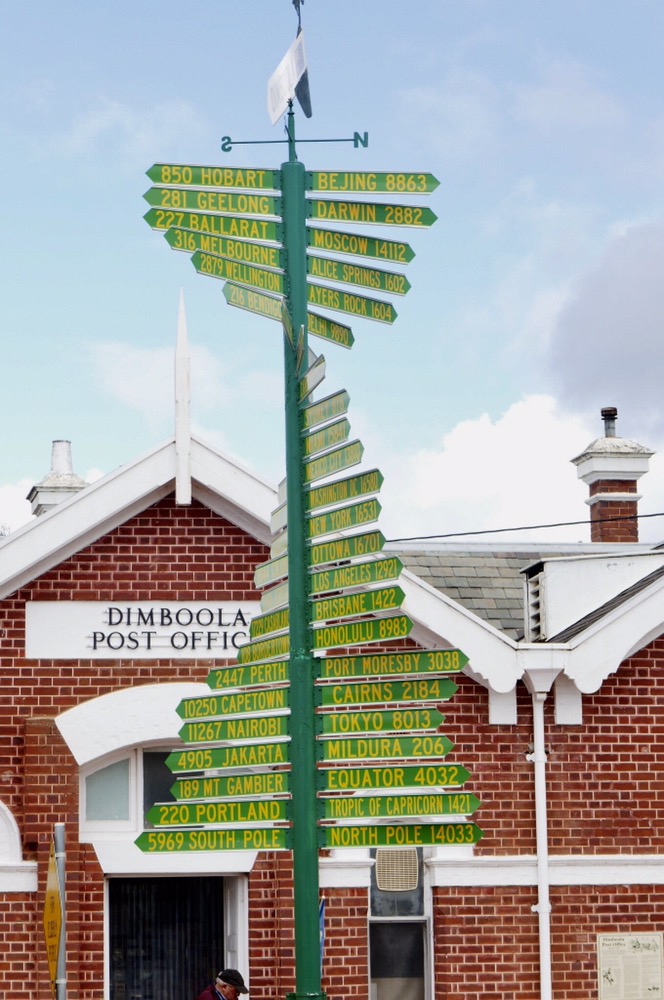
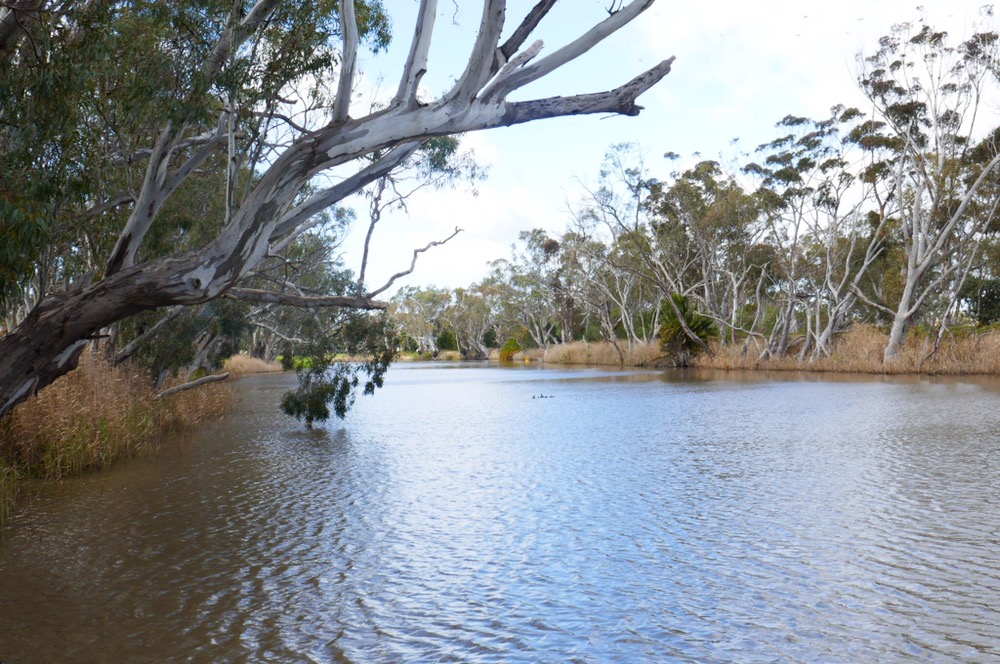
We set off from the motel, early in the morning, driving to Ararat for lunch, then to Dimboola. It was overcast and the weather looked threatening as we pulled into the caravan park located next to the Wimmera River. We had to camp that evening. However bad the clouds appeared, there was only a tiny sprinkling of rain. After we arrived and set up, we walked to the Dimboola Hotel for dinner. A charming, classic early 20th century pub which had been built by the Ballarat Brewing Company. A couple now run the hotel. Their small three year old daughter jogged through the lounge, first with wet pants, then no pants at all. Goodness knows where were her trackies were.

From Dimboola, we drove to Adelaide, our destination was the Levi Caravan park to the north east of the CBD. This is a very pleasant caravan park, with easy bus access to the centre of town. The sites are spacious and the park was quiet at night. At the rear of the park, just past the original colonial residence which still remains, is a gate and a short, downward flight of steps to the Torrens river trail. The day after we arrived Jennifer caught a bus while I walked into town. It’s a scenic, easy trail, with cyclists, walkers and dog walkers all enjoying it. River gums and wattles, skirt the rivulet. A painter or two, were doing art at some locations as it really is very pretty. I walked past the zoo, then into town, meeting Jennifer outside the South Australian Gallery. As we climbed the steps to the main entrance, another couple asked if we were going to the Impressionist exhibition. We stated that we were, then they offered us their tickets, as the husband explained, they had been given tickets as part of their accomodation but did not have t8me enough to go. We thanked them, and were soon in the exhibition after having our free but valid tickets scanned at the doorway to the show.

The exhibition is made up of numerous works brought exclusively to Adelaide from the Musee d’Orsay in Paris. The mild numbers of visitors made it possible to enjoy each work without being jostled but in fact to spend as leisurely times as we wanted to admire them. What struck me most was the interest of these artists in the lives and residences and locales of ordinary people. Bar maids clutching pitchers of ale, a farmers wife sitting in an orchard, another painter pausing before his own work, and dark silhouettes of travellers along a river side with Notre Dame in the distance and the grey brown buildings of early industrial Paris. Well worth visiting and for once the catalogue is well done with very faithful colourings in the reproductions. The views of yachts languid in the water, of a well to do man with his pockets thrust into the silvery suit we sort, and the beautiful paintings of flowers, marked by delicacy and an almost translucent light.

The next day was beautiful, a dusting of high clouds, we had breakfast at the caravan park, then walked to the visitor parking area by the front gate. At nine o’clock we met Innes who was our driver and guide for our tour to the Adelaide hills and Hahndorf. Top wine and food tours. We sat in a very comfortable Mercedes van and headed out of town. We stopped to take in some great views, then visited wineries. Not very many. We had a wine and chocolate adventure at Hahndorf Hills winery. Three small serves of wine, three matching serves of speciality chocolate which put the old deep fried mars bar to shame. The wine tends to German varietals and are excellent, very different to our Tasmanian wines. We visited the Berenberg showroom at their factory. I always thought berenberg jams were imported but they are not, there are all made in the Adelaide Hills. We bought some jars of pickle we had not seen before. We had a late lunch at another winery, overlooking their paddocks of grape vines, just turning red and yellow with the hastening of autumn. We spent some time walking and shopping in Hahndorf itself. It is pretty touristy even mid week but on the weekends, well I hate to imagine how busy it would be.

Hahndorf is named after Dirk Hahn, he was the ship captain who brought out the poor Lutheran settlers destined for this part of the Adelaide hills. He negotiated for their land and for very favourable borrowings on their behalf to begin their farming. Then it was mainly cereals, grains and only later with the introduction of heavy corporate, highly mechanised farming which made hilly country unsuitable for crops, that they turned to wine, berries and fruit trees. The women of the township would carry their produce, the thirty five kilometres in the market in Adelaide, beginning at three am. Rather than walk back unhindered, they each carried a stone. These stones were used to build their Lutheran church in Hahndorf and it stands in the main street to this day.

We bought some tasty delicacy’s including mushroom pate, crostini and local cheeses in Hahndorf as well as a miniature illustrated beer mug which Jennifer thinks shows an appalling lack of taste. At least I did not buy a cuckoo clock!

We visited a now fixed water wheel in a park on the outskirts of town. It was once the powerhouse for grinding most of the wheat and maize. It’s now a silent but very large feature of a park, with families enjoying picnics and strolls by the river than once drove the wheel

The next day, I again walked into the CBD, and again with the intention of meeting Jennifer for an adventure. I had visited Adelaide Zoo, twenty years ago, and had fond memories of my visit. Well, we were going there together today. The large animals are mostly at a second free range zoo, while only the big cats are still housed here. Most of the animals here at the city zoo, are smaller and happy to inhabit a smaller area. The pandas were in good form, one lolling about on a rock and the other munching bamboo and peering over at us beyond the fence. We visited a sleepy red panda, and anything but sleepy Koala, a sea lion, and a Sumatran tiger sitting then skulking through the jungle. It was a very enjoyable day, but the high point was without doubt the pandas.

The next day we packed up and began our drive north in earnest. The weather reports were pretty awful which only doubled our intentions to be one our way. We drove though heavy rain, through port Augusta, then onto Woomera. Woomera is the worlds largest testing area for rocketry. It’s operations commenced in the late 1940s after being surveyed by the legendary Len Beadell of outback road building fame. The town was established in early 1950. It’s in a time warp. Neatly laid out streets, a mid20thC cinema. And in the Centre a host of rockets. There is a mixture of military and research rockets to look at. Some of them, more than capable of putting a satellite in orbit. The place has an odd affect. Two Olympic size swimming pools. Multiple mess rooms. All this plenty. And Maralinga , not far away. Before the nuclear tests conducted here, rangers went out to warn indigenous people who lived there that they had to move. Well sometimes, this did not happen and Aboriginal people were lethally exposed to radiation and fall out. This is hardly mentioned on the displays for tourists to read and so many would never realise what had happened here in the 1960s, not once but several times. It’s a pity the technology is talked about but not its effects.

Even before we arrived in Woomera, great storm clouds were pursuing us. I phoned ahead, upgrading our camp site to a cabin. I’m glad we did, overnight it poured. A lightning strike took out a nearby service stations electronics. A third of the annual rainfall in one night.

The next day, after exploring Woomera, we carried on north to Coober Pedy. We had booked an underground motel. Yep, a motel room, dug out of the rock. Our next door neighbours were noisy, till Jennifer asked them to be quiet. Middle aged bikers heading up to Katherine for the cross Tanami motorbike ride. After that we fell asleep. Very wary of banging our heads. Limestone is much less forgiving then a timber wall.

In the morning we detoured to the Breakaways, taking some wonderful photographs of the fascinating geology hereabouts.

Then we carried on to Erldunda, at the beginning of the Lassiter Highway. This was out take off spot to Yulara. We had booked a campsite at Yulara, and were delighted with the size of it. It was a large site, double in area compared to many other camping grounds in NT. We were on the edge of the camp, and looked over orange red hills spotted with spinifex mounds, buffet and scrappy acacias. The next morning we drove to Uluru and because we have both been carrying injuries decided to walk sections of the rock. The first thing that impressed me was how bloody big it is. It’s really enormous. It actually extends down another six kilometres. It like Kuta Juta nearby, is the rock formed by compression under ancient seas then twisted upwards by the movements of the Australian plate. It has many interesting features, it’s not just smooth rock. There are areas of cracking, caves, water carved dry waterfalls, creeks, mutated rock such as the brain. The brain looks consulted and ridged, just like a brain in fact. We spent a few hours taking photos and taking in the sights. In the evening we booked the Uluru field of lights. There was a chance to take sunset shots of Uluru, a wonderful dinner under the stars, an introduction to southern astronomy then a concluding walk through the field of lights. This vast display of LED lights was very beautiful, it’s colours changing from blue to red to pink. Well worth seeing.

Next morning it was off to Alice Springs. We went via the Ernest Giles track. This is a reasonably rough road but it was worth it to get away from the caravans sprawled along the Stuart. We met a herd of camels who watched us for a while before heading off north into the scrub.

We arrived in Alice mid afternoon on Friday and spent the weekend getting cleaned up. On Monday I drove to Yuelamu and Jen flew to Lake Nash.

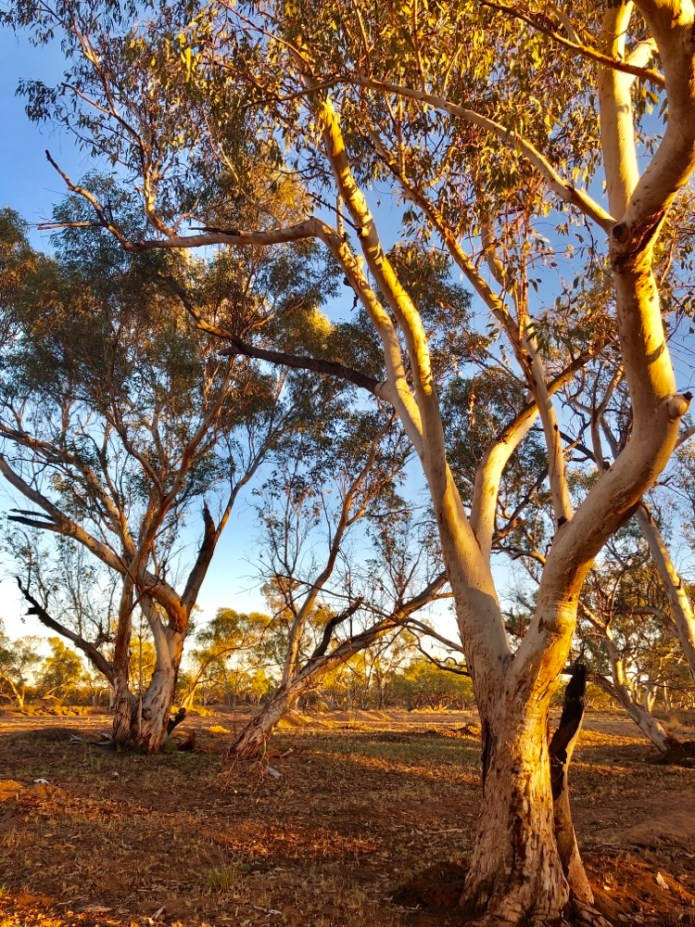
In the afternoons after work I drive to explore some rock formations near the community. The orange stone and ghost gums wee beautiful in the fading light particular poised against an azure sky. There was hardly any wind or dust until passing vehicles threw up the brown cloud over and beyond the road. I watched for snakes in the undergrowth and kept good track of my bearings. It does not pay to get lost here. Jason McBride is the painter I asked to do a portrait of a rainbow bee- eater, actually two. The first is finished, it’s stunningly beautiful, absolutely faithful colours. The other will come, probably in August. It’s a portrait of the same bird, but in flight. Not a demure gazing over a contoured shoulder but a sudden leaping and wrenching into the air, one static and the other dynamic to the n-Th degree.

On Thursday afternoon I drove back along the Tanami Highway to Alice Springs. Friday was spent at the office reading and attending an afternoon meeting. This one was on midwifery care in the centre. A great chance to discuss this vital aspect of women’s care.

On the weekend, a long weekend thanks to our Queen, we booked a stay at Hale Homestead. It’s about 140km from Alice, and not far from Arltunga. We arrived Saturday morning, and met Sophie and her new baby, Cooper. Sophie showed us to a powered site. Under the gum trees, beneath the birds that nested and hunted and rested in its branches. I have a a bird guide beside me so I will try and work out what they were. Well I know the silly wagtail. There was a plump butcher bird. And the guide is very helpful here, a pair of masked wood swallows ( I think!). Quiet, relaxing, a great place to chill out. We had dinner at the camping kitchen, Sophie, Lynne ( her Mum, who still looks younger than me!) and staff cooked up hamburgers and with salads, chips and onions. Yummy. We chatted to Katie who helps look after David, Sophie’s older boy. After wards we tried to use our telescope but it was somewhat frustrating. Ditto Saturday night, but I have worked out what was wrong. Principally I could not control it due to a software conflict between two rival programs on my iPad. Well now that sorted. None the less, I had terrific views of Saturn and Jupiter, including four of its moons.

We slept very soundly in the camper trailer and on the next day, after breakfast, we drove to Arltunga. This is one of the most interesting places in the Centre. It’s full of the tragic stories of remote mining, of disease and of enormous effort for inadequate return. This gold mining area was so lacking in water, new technology using air blowers to waft away the lighter rock and dust and leave the gold, was developed. We visited the government works where there has been restoration work done on the buildings left behind. It was eerie and beautiful walking around this little township. Supporting this community was a big reason for the establishment of Alice Springs. We spent the afternoon relaxing and reading back at the station before a wonderful roast dinner. I talked with Colin who is from Launceston and very much involved in supporting men in the community. It’s called “ men connect” and it’s a venue for men to make acquaintances and maybe friends in the launceston region. It’s great meeting people.

The next morning after a chat with Sophie we headed back to Alice Springs, this time by the shorter route into the east McDonnell’s. What tremendous views!

Last week I was at Finke. Gee, it was a busy week. Jennifer was at Willowra.

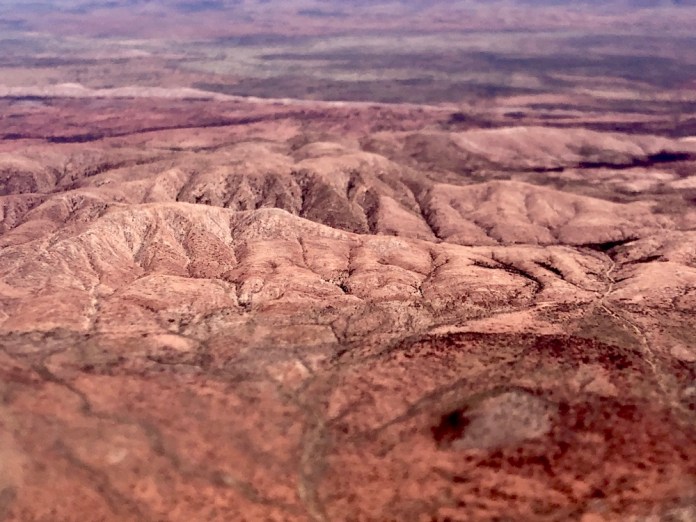
I flew back on Friday afternoon by Cessna. The geology and views between Finke and Alice are magnificent. Some areas are very like the painted desert near Kulgera, with a rich palette of golds and whites falling away from the mesas, the well forested Finke River, the ancient through which the river has passed for forty million years. A spectacular flight to end the week.

This weekend, we have been relaxing and went out for breakfast this morning after a short five kilometres walk around the Todd river. Next week I’m driving to Kings Canyon while Jennifer is going to Ali Curung.

Standard
Central australia, Central Australia Work

Western Desert low altitude Photos

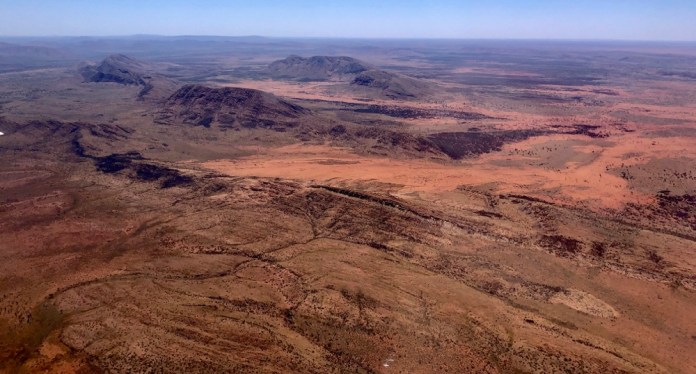
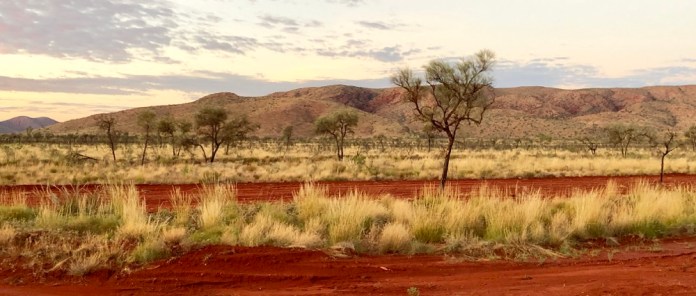
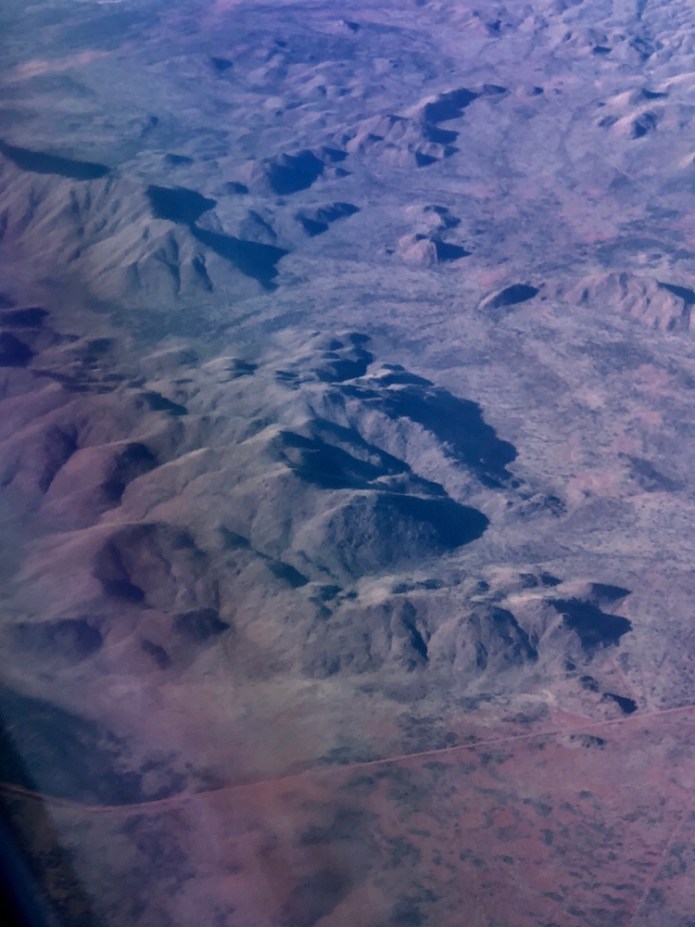
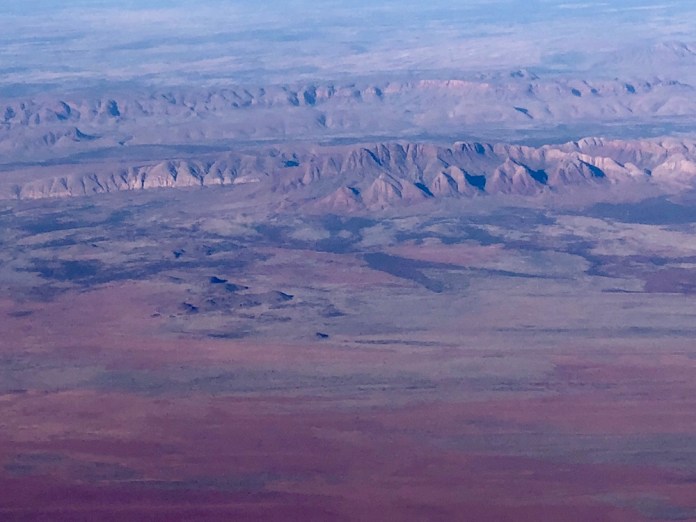
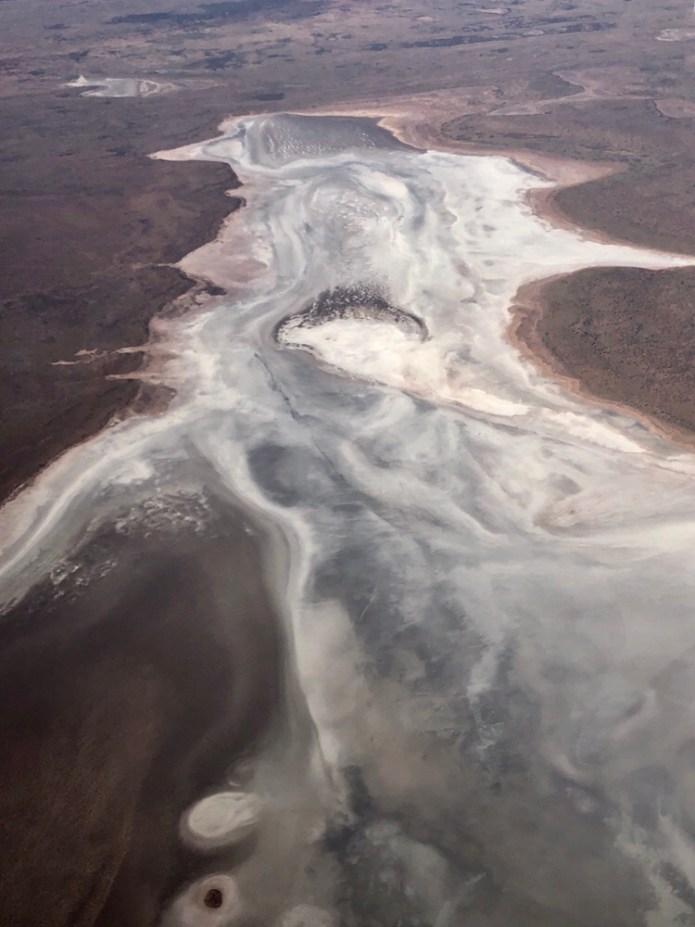
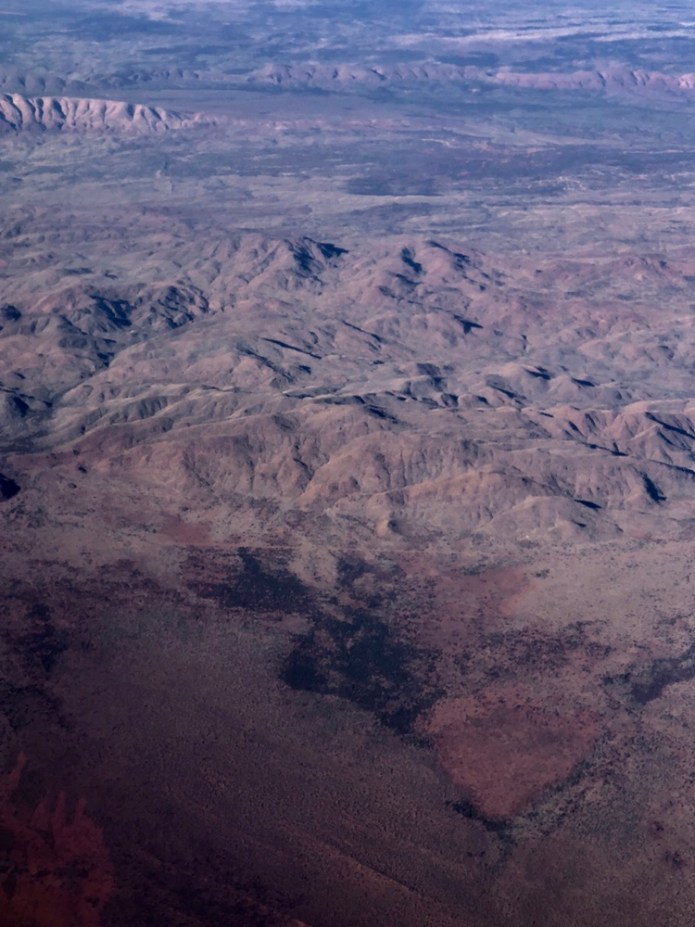
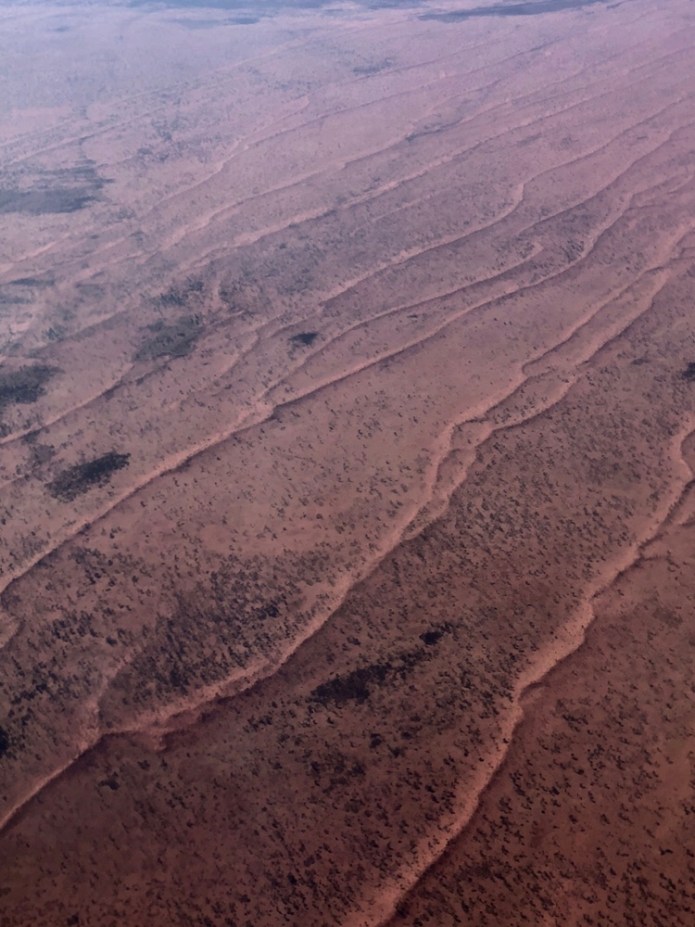
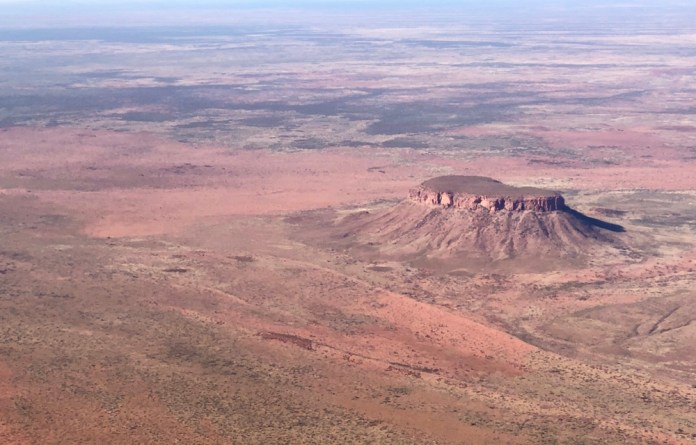
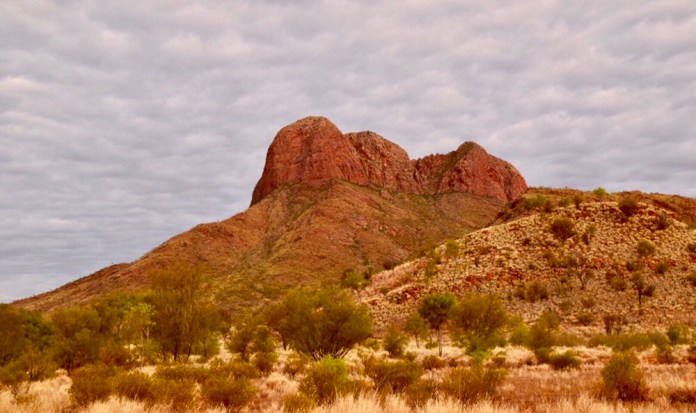
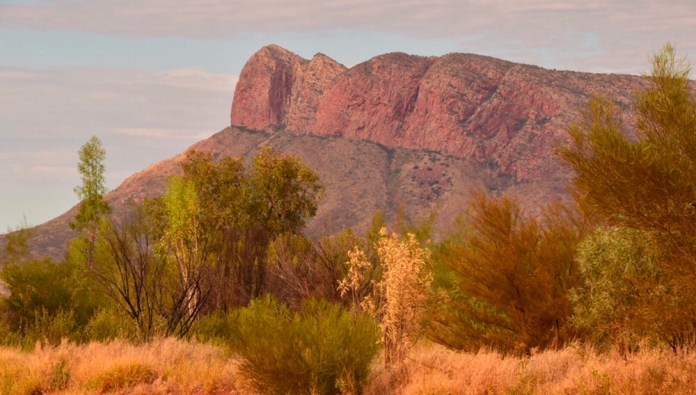
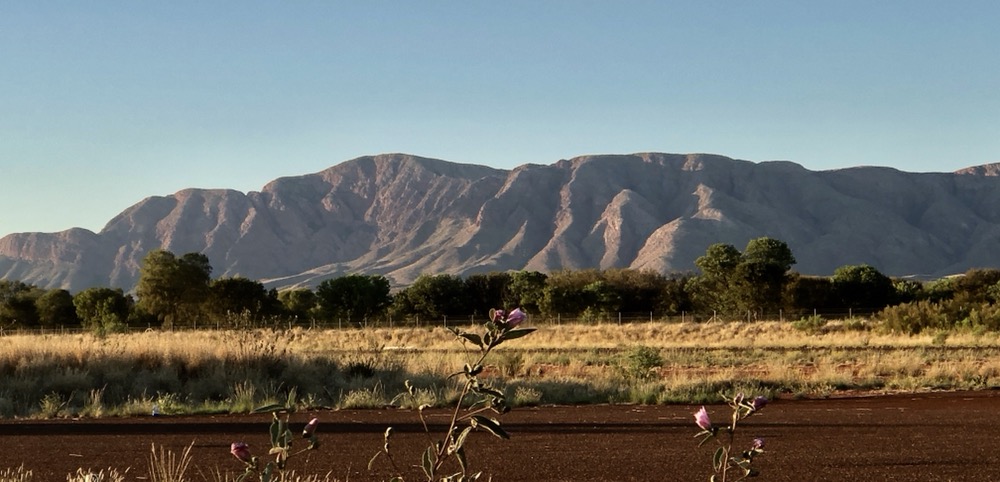
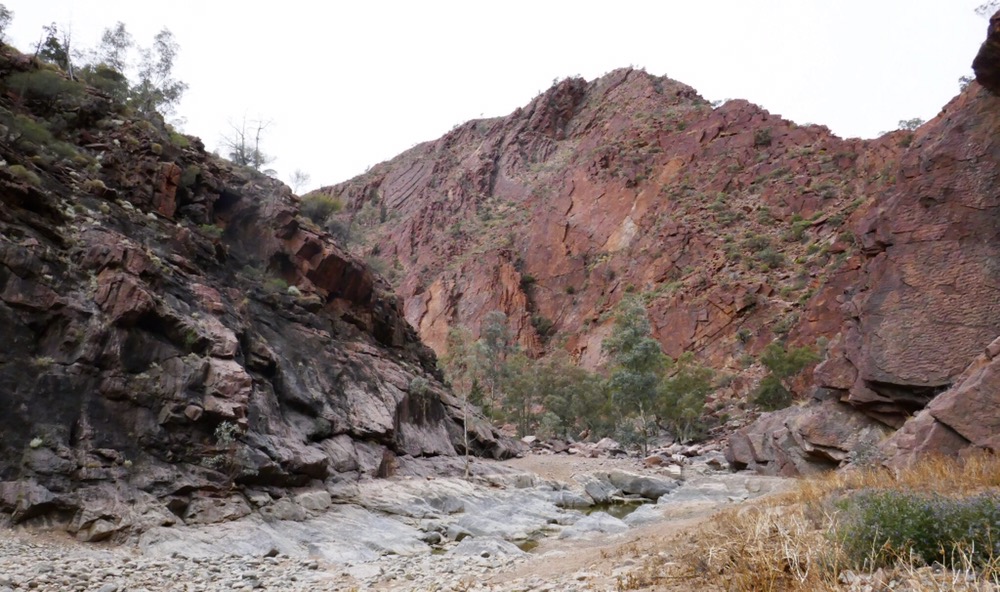
The west in the Central Australia refers to the country beyond and surrounding the West McDonnell ranges and extending as far as the West Australian border. I flew west from Alice Springs to Nyirripi, northwest of Yuendemu. I looked out the window and watched the ground beneath me. First there are mountains, some grouped in clusters some as part of long ranges, they all rise abruptly from the desert and are almost bare of vegetation. It was early morning and the shadows cast on the western slopes makes that part of the landscapes invisible but the obliquely of the light highlights the jagged ridge lines. In the valleys between the high ground are sparse acacias and gum trees, they all rely on the rare flows of water down these mountainsides to survive. The mountains and hills give way to swathes of red sand, rich in iron, a memory of the ancient sediments of great seas that covered this land. A time so lost in deep time, that nothing but insects crawled on its beaches, and fish with armour plates swam in the water and trilobites scurried on the sea floor. Now, dunes extend for hundreds of kilometres laid in long parallel lines. Yet, in some places this pattern is broken, the dunes interweave as if engaged in a timeless conversation leaning against each other.

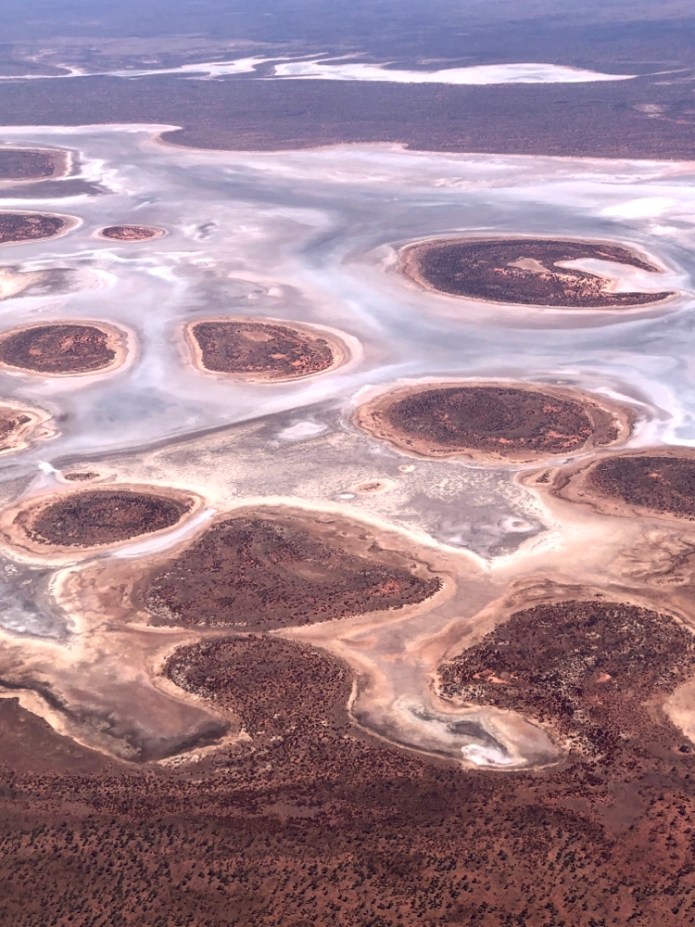
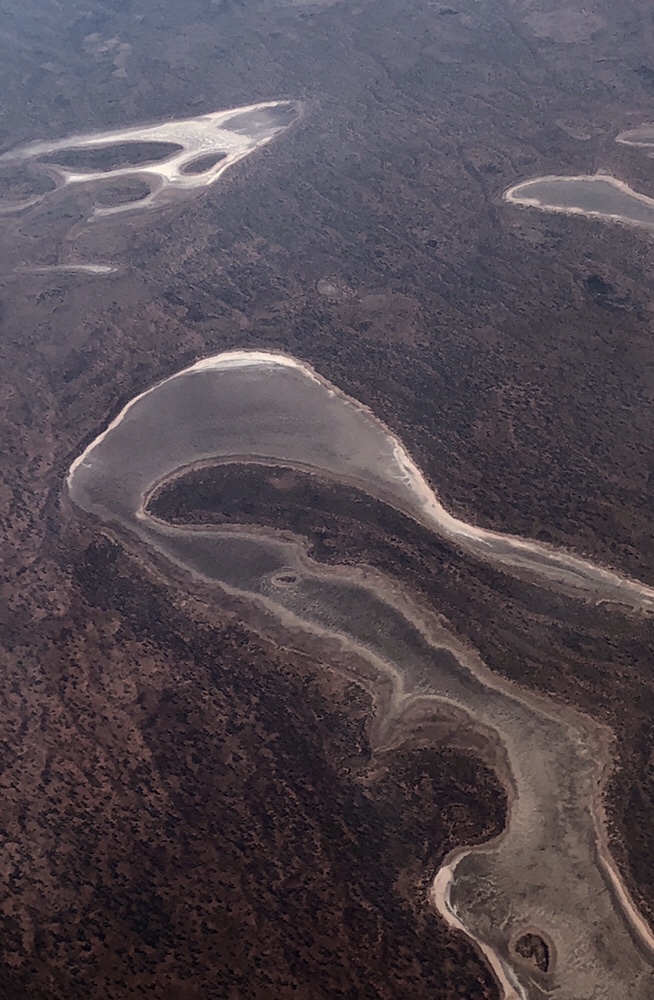
There are more echoes of the seas, salt leached out of the earth by summers evanescent lakes are left behind by fierce evaporation.They can form simple circles, dead spotty soakages and in other places, weirdly tentacled ghosts haunting the earth.There is an incredible diversity in the topography of the desert. This mountain range plows into the desert, leaving a bow wave of green spreading over the sand.

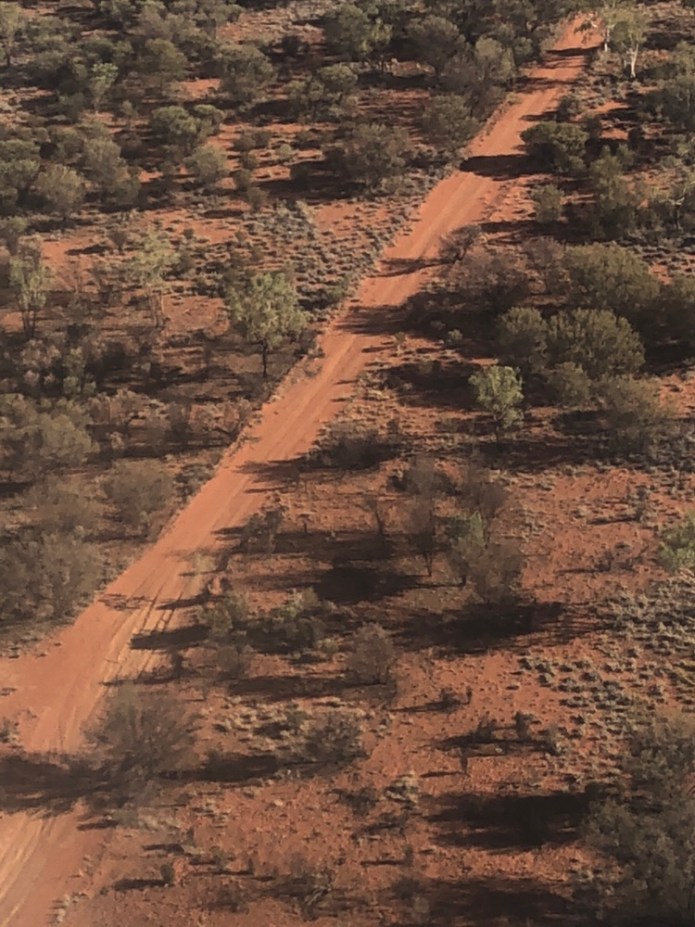
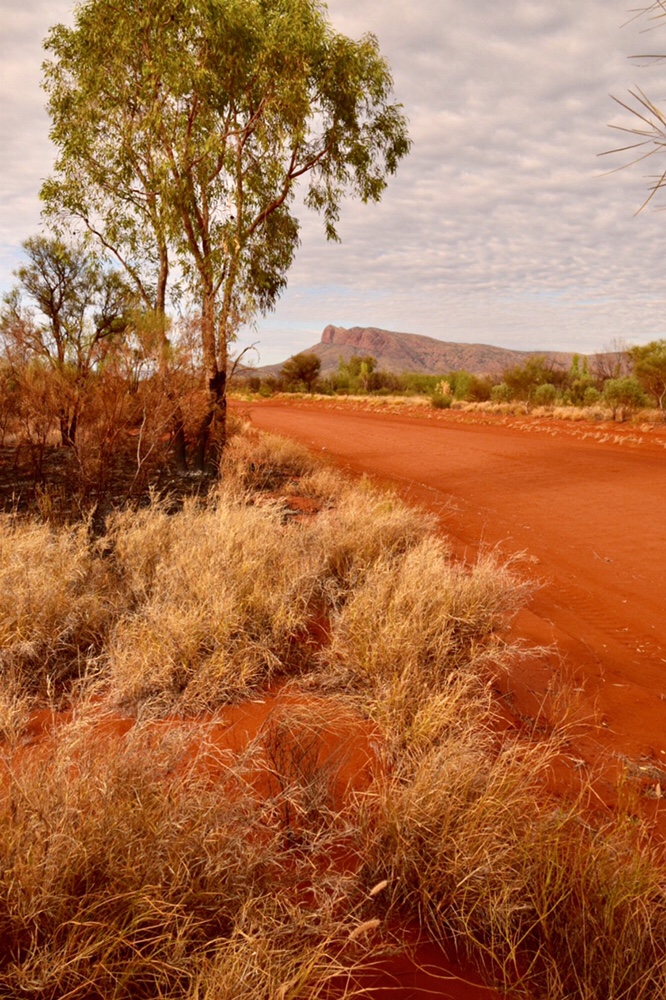
Most of the roads are glorified tracks, some are of stone and gibber, some are rutted, punished clay and others yellow sand with sand pits and washes filling the deeper corrugations. They cross rivers, gorges, passes and all the empty miles between the remote settlements of the outback.These tracks and highways, are as necessary as water and as dangerous; tourists cars get flipped by deep sand or when young men play chicken on them and lose.

Every aspect of the desert must be treated with respect and caution, it’s beauty, it’s variety is amazing but in its immensity are the dangers of isolation, heat, thirst and fire. This place suffers no sentimentality, possesses no cruelty but nor has it any love for us that will protect us from folly or the perils of ill luck.

Standard
Central australia

Papunya, Epenarra and Fred Astaire

Central Australia April 2018

It’s mid trip with 2 weeks to go.

I’m sitting at the NT Writers seminar listening to Kim Mahood.

She is a successful writer whose most recent book “ Position doubtful” has done three print runs already. The seminar is about doing creative, non fiction that is enjoyable for writer and reader, learning the processes and techniques which can facilitate this type of writing. We all wrote some short pieces, and critiqued them being especially interested in identifying repetition, pesky adverbs, and not getting preachy. Basically, Let the story unfold, by using observation, then insight then reflection. In short, show, don’t tell.

As I said, it’s been two weeks and Jennifer and I have been apart except for the weekends. My first week was spent working at Papunya. I could not go out much at lunch or after work because it’s not only hot but the flies are very annoying. Those creepy little ones that crawl up under my glasses. Eeeech. At Papunya, I stay at a unit. If I turn left, I can quickly reach the airfield road. I enjoy going for a run in the morning, it’s 3.5 km of good bitumen. I’ve gone beyond it, but the road gets difficult to run on. The bush tracks are very corrugated, throwing me off balance and the sand makes it hard to push off, difficult to get traction. At my age, I don’t want a repeat of my previous Achilles strain so Im happy to accept shorter distances.

As I run south, I see the vast span of ranges start to glow from the crests down to their flanks, a coating of morning light. What could a light beam see as it passes over this sparsely treed plain? It would see the dilapidated houses of Papunya, some blue, some green, rusty cars perched on blocks, dusty bush tracks circling the town then radiating like spokes for hundreds of kilometres to Kintore or Glen Helen and if it paused right above the community, there are roads with deep craters in the bitumen.

My metaphorical light beam would see nobody standing outside but me. My run starts before dawn, before the flies and the heat. There is only the sound of dogs barking on the far side of town. Otherwise the air is very still, with a soft warmth, it’s the gentlest time of day. A few donkeys lift their heads up as I jog slowly past.

In this first week I worked with three nurses, I’d driven to Papunya on Monday morning with the clinic manager as passenger. We chatted about all sorts of things, stopping at Glen Helen for coffee. She told me about a camping trip she had done with a few friends. They drove along the Tanami Road to you-have-to-know it turn off then carried on to the old, the original Glen Helen Homestead. It’s a ruin. She obtained permission for the visit from the owners, now based at the new resort. On the way, they crossed a beautiful, wooded valley. She described how they assembled tents, and settled in for the night. Early in the morning dingos walked warily amongst the tents, emitted a few brief barks, and then vanished into the forest.

This last week has been at Epenarra. It’s not far from Canteen Creek, and about two hours from Wauchope. It’s pronounced Walk Up. The roads are particularly rough right now, no grader has gone over them for months. I flew in early Monday morning. I left Alice before dawn. Soon I could see this pink ball of light to the east, long before it lit up the ground. As time passed, the rays of sunlight cast long shadows, the real trees and hills were dwarfed by these silhouettes. I waited at the airstrip for the ambulance to collect me, then headed back the short distance to the clinic. Sue is the nurse and manager and cleaner and receptionist. The clinic normally has two nurses . There are two very reliable, aboriginal drivers, who look after the clinic with Sue. Another nurse soon arrived to help.

These clinics run on minimum staff, a lot of them are agency staff. Agency nurses keep the remote clinics open in vast parts of NT. Typically they are very experienced, usually older and work for a few weeks to a few months depending on need and availability. It is always fun to talk to the staff here, both the nurses and indigenous personnel. Sue is a keen, widely published landscape photographer so it was great to talk cameras and technique on our breaks. Works was quiet. Sadly a young man had died on the Sandover, and because many locals in Epenarra were family, most of the population took the long, dusty drive to the funeral at Ampilitwaja ( pronounced Ambladderwatch). Sorry business can be necessary activity for weeks, visitor numbers considerably expanding one community by depleting others. Other community members will be out of town this current week, including our drivers because of a big meeting about mining royalties.

I could not go for a run at all due to cheeky dogs situated in houses all around me. I’ve been bitten before and I’m nervous about any repeat performance. The other thing that sapped enthusiasm for walks or photo sessions in the surrounding country, were the flies. Everyone who lives here has said that this is an unusually bad fly infestation. Even the local Aborigines are seen sporting fly nets. As I said earlier, they are the tiny black flies, that crawl under your glasses, or climb into my ear canals. Yeeech!

I returned on Thursday afternoon to Alice Springs, dropped off the weeks pathology then crossed the road for an early dinner at Montes. I ordered Mexican chicken Parma and indulged in a kit Kat brownie. Gosh it was big but yummy. I did not see anybody I knew around me so I read some medical articles for a talk I planned to give on Fridays regular clinical meeting. I’d spent my downtime at Epenarra scouring the online NT health library for definitive information about bronchiectasis. While I was at Papunya I had had to evacuate a five year old boy for an exacerbation of his condition. Presenting case studies with references to the medical literature is a great way to learn. It makes it real and not theoretical when it resides in a textbook. When I think of that medical problem, I will remember him. All the time at Montes I was sipping a Tar and Roses Pinot Grigio, so the clinical details in my case were getting progressively more fuzzy at the edges. Luckily I’d finished writing it on the plane earlier.

Jennifer arrived back from lake Nash after five, so I was already home. I’d booked dinner at Humuyans. It’s the principal dining venue at Doubletree Hotel. It’s easily the best restaurant in Alice Springs. It was A soft, warm evening, and spent the time at table telling each other about our week away.

I’ve already described the writing seminar I went too so I won’t go over that. The high point of the week, was a concert at Araluen. An evening dedicated to Fred Astaire. Three performers produced a wonderful evening of dance, of song and stories about this amazing man. Top Hat, Fascinating rhythm, Puttin on the Ritz were some of the many musical numbers. Great night. Afterwards we met some of the performers. We left the theatre, walking to the car park. We all noticed how delightfully warm it was. My mind wandered back to Launceston and reflexly shivered with the recalled cold of Tasmanian April.

Standard
Central australia, Central Australia Work

Alice Springs February 2018

It’s Thursday, it’s the the last day of our four week locum in Alice Springs.

Jennifer is still driving back from Willowra while I’m sitting in the doctors meeting room in Alice. I had a shorter drive this morning from Yuelamu.

Every trip here is interesting and always generates a variety of feelings and thoughts based on the experiences we have here. I would prefer any narrative of mine to be coherent, have a flow, have a clear start and ending but real life is never like that. Every true story blends the past, future, impressions, misconceptions and is therefore anything but coherent or logical.

ANIMALS

it was a warm day. No not warm, it was body sapping hot when any action or thought takes ten times more effort than it should. An ambient temperature of 42 degrees at five o’clock. I had finished work at Yulara clinic, ( Ayers Rock Resort) and I was walking the short distance to my room at Desert Sands. I had just begun climbing the steps when I met a small reptile. The thorny devil, moves in a jerky, mechanical way. It’s body put together with a higgledy piggledy splatter of yellow, triangular scales, all pointing in different directions. Ecologists say that the arrangement channels water from the body to the mouth. To me such a radical body plan would only make sense if it actually rained. There is no denying, it’s cute in a hopeless, ‘ why did I evolve in the first place?’ Sort of Way. Two tourists were flopped on the concrete steps, their faces and cameras were I thought alarmingly close for the little creature. But it seemed very relaxed, and was content to pass the time however second rate the company.

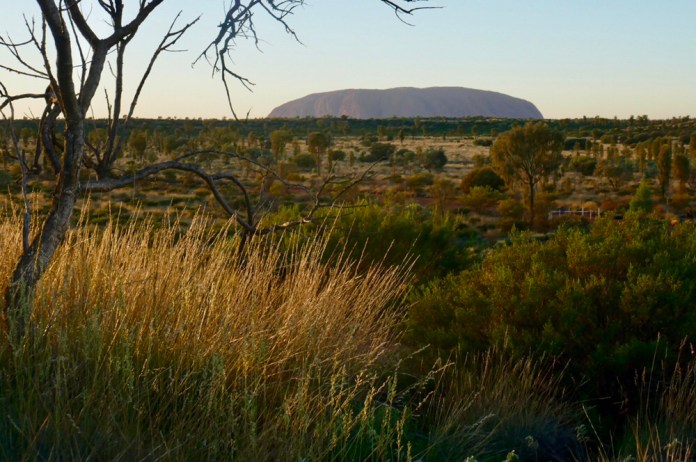
Last Monday morning, I was driving to Yuelamu. The drive is substantially a single lane bitumen road. Long sweeping curves, the opposing cars or trucks or more often than I would like, road trains ( especially those big four tanker green ones that contain enough petrol to make a crater the size of wolf creek), are hidden by scrub. It’s not too busy this time of the year, too hot for any sensible tourist.

I had slowed down to cross a grate and to my left, on the rocky verge, were a trio of camels. There was Dad, Mum and Junior. Earlier in our stay, I had a driver, Steve, who told me that there had been a lot more rain than usual. This explained the vast green beyond the verges, the plump cattle dotted under the ghost gums, and the healthy looking camels I was seeing. I stuck my head out of the car window ( having opened it first) and used my fool of an iPhone to take a few photos. The three camels ambled along, studied me, and then with the assumed superiority of anything on four legs as opposed to a mere two, put their heads in the air, and shuffled into the scrub.

This morning, I was driving my Prado back to Alice. The first 80 km of the trip from Yuelamu is on sand track. There was a soaring brown bird above me. Then an immense shadow covered the bonnet. Reminiscent of being buzzed by a dragon in Game of Thrones. Earlier on, I had seen two mighty wedge tail eagles, sitting side by side on a tree branch, not far from King Canyon. The wind rustling their feathers on their necks. Their savage looking beaks, curled at the tips. They did not look at me but seemed fascinated by something on the horizon, far beyond what I could see.

LANDSCAPES

In my third week, I did a two-part job. Three days at Imanpa and two at Kings Canyon. Imanpa is a sorry town right now, full of regret. There had been a terrible row between two branches of the one family. Row is a euphemism. About six people wound up in hospital, carried by the Flying Doctors for skull fractures, arm fractures, and other serious injuries. As a result, half the town is in Alice Springs awaiting court appearances either as defendants or witnesses or both. It’s complicated. The court will be like a revolving door. There will be so many defendants, if everyone was found guilty, the prisons would burst.

Many other people who have lived in Imanpa for many years, were truly terrified by the savagery of the violence and have left. It’s doubtful services should continue in the long term given the low population. The remaining elders are reaching out to the many who voluntarily left, to heal some wounds. But the animosities run deep and I’m not sure they will ever come back if they are safely settled elsewhere. Anyway, the point of this story is this. I was driven back from Kings Canyon on a short cut called the Ernest Giles Track. Ernest Giles is famous as the first explorer to climb Uluru and the also first one to be carried down it by locals. The Ernest Giles track is in pretty good condition and offers some fabulous views as well as another detour to Henbury Meteorite crater. We drove along happily, frequently airborne on the humps. And some sliding now and again. But my driver, Steve, was unflappable. He is a real local. He’s built roads, driven trucks. Done seismic work for uranium mines. He never minded a brief stop, so he could have a smoke.

Kings Canyon and Uluru. These are wonderful places. I spent a week at Uluru, never seeing the rock up close but had some great views. I went for runs in the morning. It was still hot for a morning jog, dark but for a headlight, and the tracks were sandy. Anyhow, I trotted along, made my way up to the lookouts dotted around and enjoyed the views. Uluru to the left and Kata Juta on the right. All around them is a dead flat, sandy plain. These monoliths are the tips of the iceberg, well they would be if wasn’t so hot. The peaks of mountains and ranges which at one time, tens of millions of years ago, had an ocean lapping their rocky shores. The Amadeus ocean was the place where fish first evolved. Aborigines talk about Australia as the place where the Dreamtime gods, first kindled life in the world. Perhaps they knew this all along.

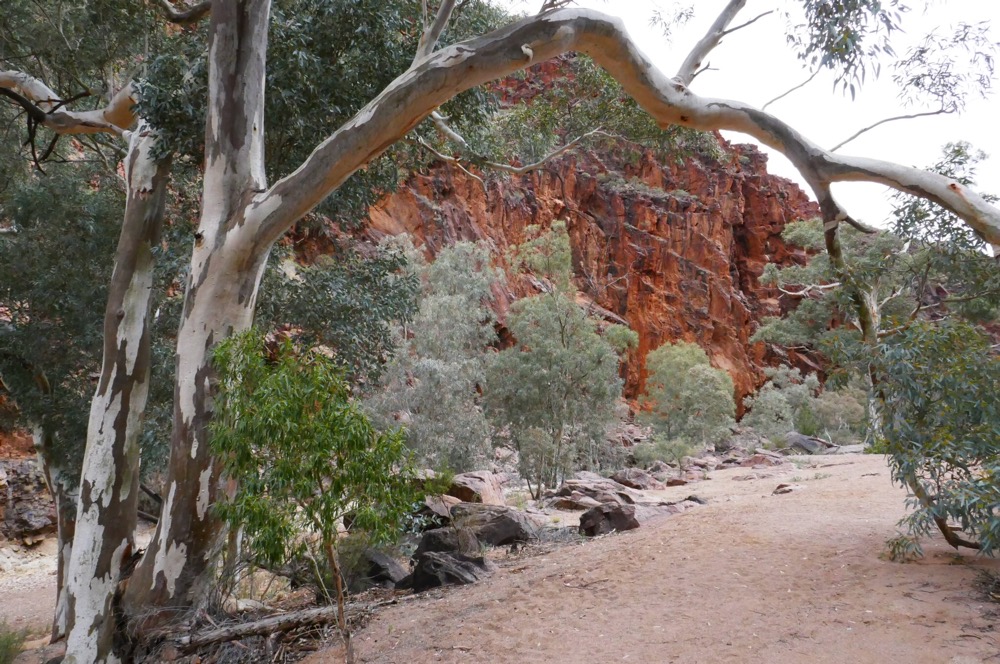
Kings Canyon is a part of the Giles Ranges, that extends fifty kilometres or more in a east west direction. At sunset, I could see the cliffs lit up, glowing orange cliffs with dark brown mesas above. Chris and Chrissy who are long term Nursing personnel at Kings Canyon Clinic, told me that one particular day it had been raining. Raining so hard, so long that a waterfall was now tumbling down the range. Wow! The clinic was closed, and all the staff drove to take photos of this temporary phenomenon. Chris also uses a drone to take pictures. He has made some stunning shots of the ranges, especially at sunset. They look even better at fifty meters altitude with the fading sunset light coming from behind the drone. Chris is a keen photographer, and I was very impressed with his portfolio of photographs. He prefers the natural world, in particular a dead tree behind the clinic, where birds come to roost and relax. Galahs, Corellas, Rainbow Bee Eaters, falcons, Zebra finches all come to enjoy this perch. In his front garden is a pond, filled with flowing water. The smaller birds like the zebra finches splash around, throw water into the air and are oblivious of any dangers such is their enjoyment.

PEOPLE

When I went from Imanpa to Kings Canyon, a half way meet is arranged. Some one from Imanpa, drives to a meeting point on the highway where Chris

from Kings Canyon can collect me.

My driver, for this trip was Ricky Orr. Ricky is an Arrente Aboriginal man who hails from Horse shoe bend station. His family includes some white but mostly black fellas. He told me stories on the trip. For once I had the good sense to listen and not talk.

Punburu is the spirit dog of this area near Imanpa, and runs as far as the now Stuart Hwy to the east and Uluru to the west. Ricky’s grandfather worked on a station, and one day, he was sitting out side a remote outstation after a long, hot day mustering cattle. He have heard something, something big and fast moving in the scrub not far from him. His hairs on his neck went up as it does for anybody when supernatural things are happening. He had a rifle, he grabbed it from the cupboard, but was too frightened to load it, as cartridges fell on the timber floor of the verandah. The creatures, because there were two, burst out of the scrub, just as he closed, and latched the door. The door shook violently, as it struck repeatedly. The animal, pushed its paws, covered in a yellow, orange fur, under the sill. It scratched at the floor and door. Another dog, threw itself against the walls. They stayed only a few minutes but it was many hours before Ricky’s grandfather dared open the door.

His Uncle was walking along a dry river bed. These rivers fill up in the wet season and can span fifty meters or more. They fill with churning water at first, but as it slows down, it’s a great place for the Aboriginal kids to swim, swing out on an old rope and then drop into the cool water. Aboriginal women fish, using their long skirts, to scoop fish out of the streams. Anyway, today it was dry. He could see brumbies crossing the dry river, but amongst them one creature was loping not running. It was as big as a horse, but hunched over, then leaping along not trotting. Though it was travelling with the herd, it was no horse. It was Punburu.

Ricky nearly met this giant dog once. He was in the following vehicle for a seismic team. Over the years, big mining companies from Australia and overseas, have wanted to do scientific seismic studies to determine the presence and quantities of gas, coal and uranium. The front vehicle suddenly stopped on this sandy road. Ricky pulled up behind them. The driver, and the scientists in that car, were pointing right . “ Did you see it? Did you see it?” “See what” said Ricky as he looked in the direction they indicated. Whatever it had been, it was too late, the creature, had smashed its way through scrub and vanished. And that’s the closest my interlocutor had ever come to seeing Punburu, at least so far.
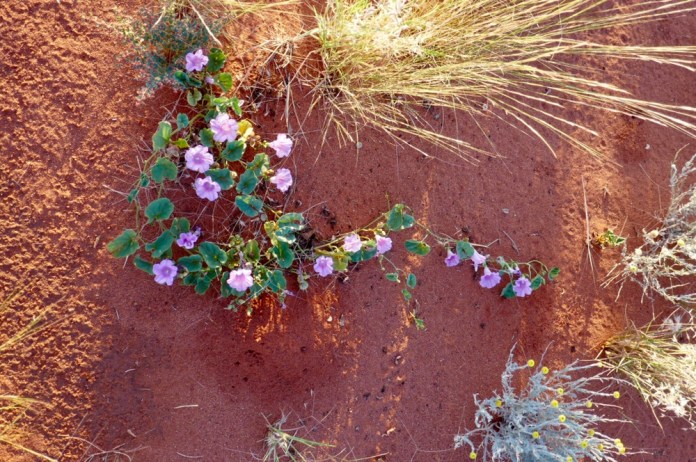
Ricky told me about the Kurijah. Nowadays, Aboriginal people break aboriginal law all the time. Why is this? Once it was Elders who decided if someone should be punished, now the government says, we the government will decide who does wrong and who doesn’t and we the government will mete out punishment. The Elders don’t have a say. But the government is not there all the time to enforce their law, the governments laws are not Aboriginal laws and this causes ill will. Now even Elders are abused and threatened by some young people who are angry because these Elders tell them not to drink alcohol, or get drunk, and not to beat their families and neglect them. There are Elders who do drink, sell beer or turn a blind eye to drugs. They are tolerated. The other Elders, are so upset by the violence and chaos in their communities, they leave, living isolated lives in outstations. They are almost outsiders because they are decent men, who have been beaten and threatened by young, violent drunks. Before this all got out of hand, before white man’s law was the only law, there were travelling lawmen called Kurijah. Kurijah were judge, jury, and executioner if need be. They had more authority than even Elders and their decisions could not be questioned. They would spear, kill or punish an offender. Aboriginal laws always go two ways. For example. A person can expect another family member, however distant, to give them money or food if they ask. This law has degenerated into “ humbug” where it is more or less begging off anybody. But what’s worse than this. There was an obligation to respect Elders and obey them and care for them as they grew older. This has stopped in too many communities. The old ones are prey not people. Their money, food and medicines are fair game. Thankfully, this is not true for everybody but it’s frequent enough to cause a lot of misery. Some communities are worse, and you guessed it, money, alcohol and drugs are central.

ALCOHOL

WOW! A number of so called Dry Communities have been turned to chaos by alcohol. Victoria Bitter, Jack Daniels and Chardonnay are the most popular. They are purchased in large quantities usually in WA or SA and ferried on back roads. The alcohol is consumed or sold. One evening at midnight, a drunk women, knocked on the door of my flat, sporting a bruised eye from a fight she’d been enthusiastically participating in. Where does the money come from? Mining companies pay huge money in rights and the money is too often squandered on alcohol. What’s really sad is that there are some great people who have put up with this alcohol fuelled chaos.

Most Children in communities are all smiles; clean, well dressed, with a mother who loves them. These kids have all the wonderful potential of any new child. Other children, hair filled with nits, hair knotted by neglect and bodies rarely washed, with truly dirty clothes, are far from rare. Some of these children have FASD from considerable alcohol exposure in the womb. I spoke to a young teacher, who says of course education is the future for children, but children with FASD (foetal alcohol syndrome disorder) gain less from education due to the intellectual impairment and impulse control problems alcohol damage has created.
ART

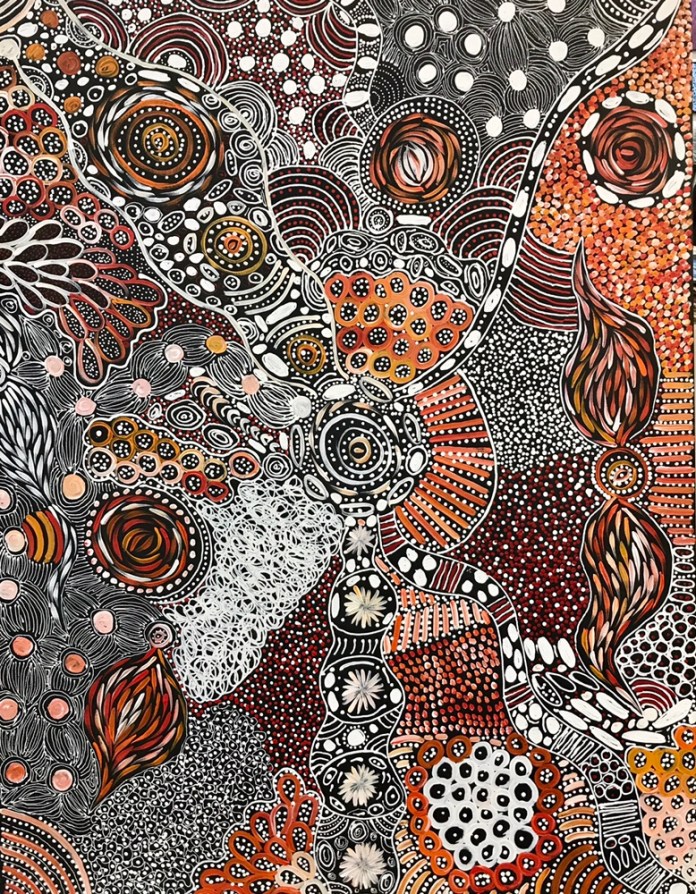
Jennifer and I have a great admiration for Central Australian art. Much of what you will see dotted around markets or shops is very generic. The bush tucker paintings and bush medicine paintings are widely available for purchase. These are still sincere expressions of culture and should be treated with respect for the artist as well as the work. They are more traditional. However there are many painters with a newer, less traditional vision who are experimenting, combining their totems, stories, attachment to country with new ideas about colour, composition and the use of medium. Such a painting is one we bought. We purchased a Utopia painting by Jane Golder. It was on an early morning run/ bike ride when we went past the painting hanging on a wall at Jila Gallery. We were both knocked out by it, its hues, it’s content. Well, we decided to buy it immediately. It features below.

Chris Hakanson showed me some of his photographs during a lull in seeing patients at Kings Canyon. This clinic sees predominately the white people who live and work at the Resort and at a nearby station called Kings Creek. However, there are three active communities that use the medical services as well. One of these communities has a remarkably competent and enthusiastic Elder who has, through sheer drive, made his community safer and more secure, with above average school attendance and better health profiles generally. Unlike many communities where money is “ sit down money” from Centrelink or local mining royalties, this community has embraced cultural education for other Australians and does terrific, well organised tours. They were so cashed up they actually bought a brand new bus for another community to do similar ventures. Sadly, the bus was trashed and abandoned barely a month later.

Chris showed me his photos of Rainbow Bee eaters. These beautiful birds are members of the kingfisher family and are commonly seen wherever there is reliable water in the centre. All his photos, both of birds and landscapes, are of a very high standard and, unlike many photographers, he shows animals or birds actually doing something. Life leaps from the image. When I went to Yuelamu, I met Karolien and her husband Jason. They are kiwis. Karolien is the very competent nurse manager and Jason is studying as well as painting. He is an excellent animal and bird artist. Kindly he has agreed to do a painting for me from one of Chris’ Photos. Funny how things work out!

Every year there are cultural festivals at Kings Canyon. Chris showed me photos of an artist who works with sand. The sand on the ground, the sand that’s everywhere. I’ve seen a renowned Utopia artist, sitting casually on the ground, creating wonderful art with her hands, pressing a scalloped pattern with the heel of her right hand. Chris’ friend creates emu tracks, goanna and perentie tracks, foot tracks, stories, maps only using his hands. Made with breath-taking precision. As well as local Aboriginal children, many young people from interstate schools attend these festivals and are all very impressed.

WATER

I was standing in the shower at Yuelamu when I thought about water. Yuelamu is 280 km from Alice Springs. 200 km on bitumen, mostly via the single lane Tanami Road. It’s being widened to cope with the increasing, especially tourist, traffic. Then a drive along 80 km of sand.

It took some time for the shower to stop spluttering and actually flow. The water is filtered at least twice but still has a salty, metallic taste. Streamlets bathed me rather than the decent warm gush of water I prefer. It left me feeling indifferently clean due not only to the poor flow but particularly from the lack of water quality. Every house in the community has a special tap to use for cooking and drinking, this water is filtered several times to try and improve its flavour by removing the heavy mineral load. Once Yuelamu had two huge dams, these are now shadows of what they were, and unusable due to infestation with algae. You cannot swim in them, much less drink from them. The water we use in Yuelamu is from the great artesian basin, but unfortunately, the water 💦 is heavily filled with minerals. This was not always the case. When the basin hereabouts was freshly tapped, the water was much better but as the table dropped , the pumps begin to bring up the brackish water from deeper, more turgid layers. Water security is the sword hanging over the head of every community and town in central Australia. It’s measured in years, not decades.

Fracking means money. It can mean mining using high pressured, solvent-laden water pumped into strata deep below the surface and extracting the shale gas for export, but this would not mean anything, if it did not mean money first. My second day at one clinic, all the men wanted to be seen in the morning, as there was a lands council meeting at Laramba to see how much money they would get from the pipes that would be built across Aboriginal land to carry the gas south to South Australia, probably Port Augusta. The communities where the mining will take place will also get a great deal of money. A friend of mine, Richard, was at a meeting held at Elliott, north of Tennant Creek, where the Royal Commission into future fracking was hearing delegations from the locals. Richard told me not many locals were there but the few who were, asked very thoughtful questions. Where do the solvents go when they are pumped in? Could they contaminate our water or even everybody’s water? Where will the water come from to be used to flush the strata beds? What will happen to the bores once the gas is used up? I don’t know the answers to these questions but I think, that the next big environmental battle is going to be here in NT over fracking. On one side will be the mining companies, and locals who will benefit, and on the other side it will be locals who are concerned about the possible desecration of country as well as potential threats to water security. It has the potential to divide Aboriginal communities. Given the level of violence in many communities, disagreements about fracking and money could get ugly.

THE GREAT BARRIER REEF

WELL! I bet you didn’t see that coming. One Friday evening we went to a talk about the Great Barrier Reef at the Alice Springs library given by Anna Kriedt. Anna is a long form journalist. She has had a long essay about the reef and it’s challenges published in the prestigious Quarterly Essay. It’s a thoughtful, essay which took her many months to complete. Overall the news isn’t good with the inevitable sediment from dredging bays for ships and mining run off, going to choke the corals which rely on truly clean water to thrive. The most damaged parts of the reef up to now have been the areas affected by agricultural effluent. Over the last ten years universities and farmers have worked together to modify these issues. And it’s been a success. The reef was about to reap the benefits of a decade of hard work and investment by farmers and academics. Not government! The sediment loads from mining dwarf that of a hundred years of farming practice. The only good thing about all this, is that ordinary people working together can achieve incredible things. Anyway, if you want to get informed read Anna’s article.
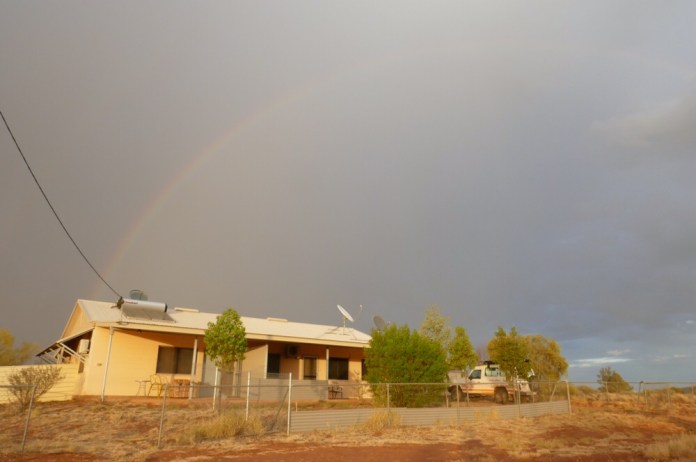
CANTEEN CREEK

My second week began with a charter flight to Canteen Creek. I had a super week with Cassie and Susan. Cassie is the manager. She does not get strung out about cultural sensitivity where health is concerned. She has had a policy that if a child is going to be seen at the clinic, they must have a clean face. Snot smeared faces are the norm in some communities. This spreads influenza, trachoma, viral and bacterial illnesses. In Canteen Creek I saw some kids with grubby clothes but not one with a snotty face. There is a basin and soap at the clinic to wash up. What’s wonderful is that the kids love Cassie, and therefore, now demand to be clean. I did not see one skin infection or scabies when I was at Canteen Creek.

Canteen Creek is famous for being the setting and inspiration for the ‘ Cheeky Animal’ books. A local Aboriginal artist and writer have created these wonderful children’s books. Isla, our two year old granddaughter, when she sees an animal or pet being naughty, calls out ‘ GO AWAY, CHEEKY ANIMALS’.

THE ARGUMENT

I was sitting in the tea room at Imanpa and a discussion arose about the evils of the old cattle stations when Aboriginals both men and women worked for chits in the station stores and worked long hours in trying conditions. Interestingly, Ricky disagreed. It was not all bad. His father, grandfather had worked on the stations and they loved it. They were proud of the work they had done and were not ashamed. Ricky said that they had a purpose in life, enjoyed being together and with the white station owners. It wasn’t really about money. They had enough to live on and anyway, the station owners were not rich men in most cases. There was no ‘ sit down ‘ money, if you wanted to eat, you had to work. And you know, Ricky’s forbears had no problem with that.

Ricky does cultural tours too, as well as his regular job in health. When he was a young man, his father and especially his grandfather would sing the Dreamtime stories. Some he sang so often, that Ricky remembers them very well. But young people in those days were more interested in listening to pop 🎵 on the radio than hearing old stories. It was only long after his grandfather died that he realised the riches he’d missed. He reckons that Arrente people have about a third of their total stories. The stories of Aboriginal culture cannot be told to just anybody. There must be ceremonies before a story can be told. Some stories are for children, some only for men or women, once fully initiated. Both levels of initiation. So not all Arrente people knew all the stories even before white men came, some could only be received late in life. However, there is a unique opportunity. Strehlow is a famous name in Alice Springs. The first Strehlow was a minister at Hermannsburg,

He learned the local language and wrote the first bible in Arrente. His children and grandchildren, grew up more like Aboriginal children. One became an anthropologist and with his language skills and rapport, recorded on tapes, many of the stories of this vast region. Ricky plans to visit the Strehlow museum in Alice Springs, and hear and transcribe those stories to tell a new generation. What a fabulous project!

EPILOGUE

I apologise for this disjointed unnarrative narrative. If there is a point to take home, it’s that there are many bad people and silly people of any colour, but there are many, many more good, kind people who deserve support, praise and encouragement. Sometimes, the wrong people have control but nothing lasts forever, and younger wiser people in a community could take leadership in their turn, and change things for the better.

Jen asked me to mention that at Epenarra clinic there is music playing all day in the waiting room and the locals love 💕 it. Jen also told me about an incident on the Stuart Hwy coming back from Willowra via Ti Tree. She was about 90 km from Alice Springs when she was passed by not one, but two, pilot vehicles travelling north towards Darwin. After quite a gap, it was clear why two vehicles were needed. Realising that there was a large vehicle coming, Jen had to get right off the Stuart Hwy and park on the verge. Even road trains would have to do the same, and they usually have total rights to the road! Actually, there were two trucks each carrying the biggest buckets for diggers that she’d ever seen. No doubt heading for a mine somewhere. They took up the entire width of the road. Impressive! Nothing’s bigger or better than anything in NT.

Standard
Central australia, Central Australia Work

Central Australia October 2017

Conclusion to four weeks of Central Australia
I have not been writing weekly for the last three weeks of my stay here in Central Australia. After the excitement of battling storms and flying through thunder clouds, the rest of the stay seemed a little hum drum. None the less every day here in the Centre is a learning experience. So I will write about some of the people and events I have been able to witness.


I met some medical students at Yuendemu. The three girls have spent three weeks here. Yuendemu is 293 kilometres from Alice Springs. There are some hills nearby which offer a challenging steep walk as well as scenic drives and any exploration of Red Rocks about five kilometres away. It’s a rough, overgrown track along a sandy surface which crosses some steeply banked, now dry stream beds. They have spent their time seeing patients, travelling out into community with the child health nurse, getting involved in the immunisation program for meningococcal W. And learning a lot about indigenous health and life.  
During these three weeks, they were still able to participate in lectures and tutorials via Telehealth from ANU in Canberra. It’s delightful to see such enthusiasm in my future, fresh medical colleagues. I had the opportunity to speak with two of them as I was the chauffeur on the drive back to Alice Springs. The challenges of study and work for our younger doctors are just the beginning, setting up life long relationships, making a family, staying in touch with parents and siblings, deciding on a career path, are all substantial decisions. Delaying a family, sacrificing a career, being separated from personal support, are all issues for any young professional, whether or not they are medical. For the previous generations of graduates, many females decided to do General practice because of its greater flexibility compared to many of the specialities. Its certainly possible to be a mother and be a specialist, but it’s not easy, and a lot of thought needs to go into how her family is going to be raised. The father may be the main contact parent. I don’t have any problem with that. I have met many people who were raised more by Dad than Mum, and they turned out fine. I’m glad thats all behind me now and I can just enjoy being a grandparent and a doctor too. Best of both worlds!

During our time in Yuendemu, the female Staff and students were confined to the clinic or their flats because of men’s business. This is the time each year, sometime between October and early December when boys are circumcised after an initiation into manhood. This is a very, very special time. However, it’s not conducted the same way each year. In particular, the prohibitions for women blundering into a ceremony were pretty serious this year. If any local Aboriginal women got a clue “travelling men” were nearby and coming along the road, they would rush into the house dragging in the female student and child health nurse. They would huddle away from any windows, fearful of an inadvertent peep of the men. “Travelling men” is the term for the boys and men who travel through the community between sacred, ceremonial areas often with ochre painted on their torsos and bodies. The clinic was very quiet, as women were too frightened to come in. Even the clinic reception staff, dropped down under their desks when any men went past the clinic windows.

Does this sort of thing happen during Women’s Business ceremonies, well, no, it doesn’t? Aboriginal society is still overwhelming patriarchal, and women don’t have the power men do. We have met young , especially more educated, women who avoid marriage and long term relationships because of the realistic belief they will be victims of domestic violence from their partners or their family. 

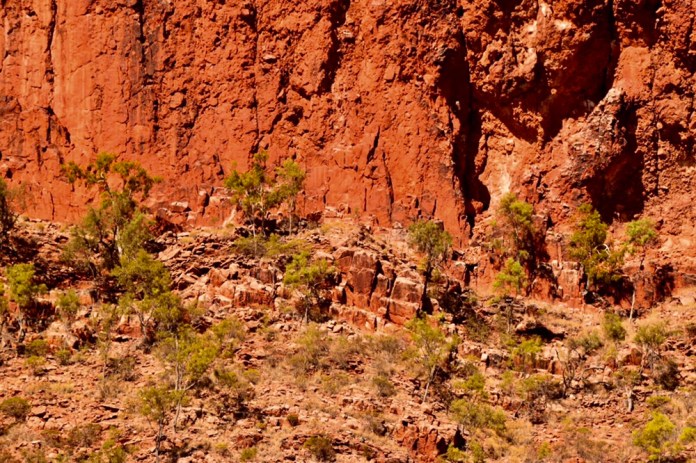
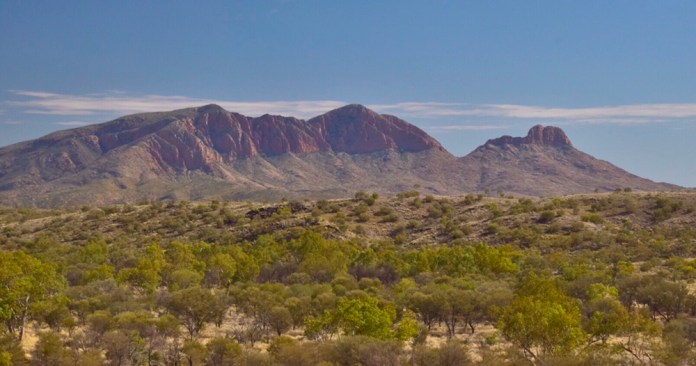
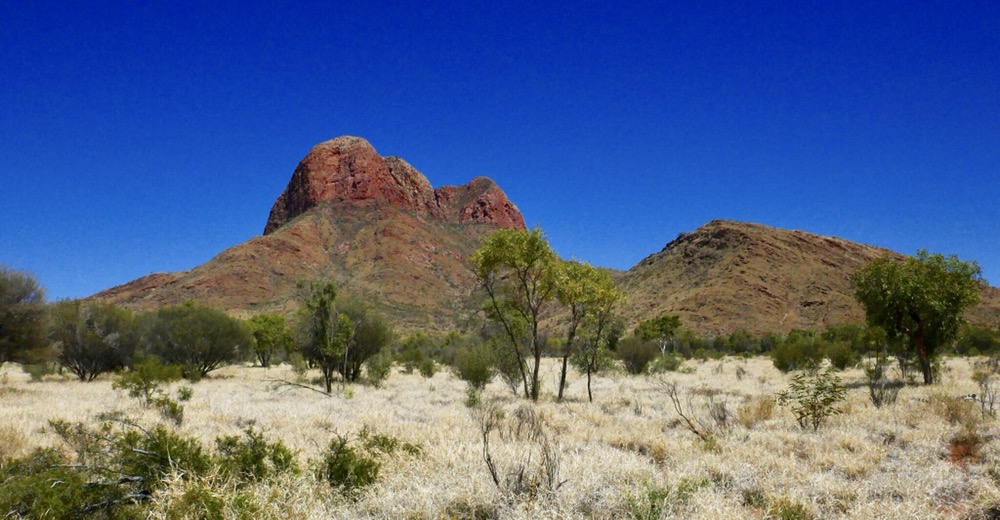
Jennifer and I did spend one week together, at Papunya. This is a magical place, with splendid mountains and ranges around and approaching it. The lightly forested arid country gives way to abruptly rising hills and mountains, many with vertical cliff faces of a striking red orange. The drive to Papunya is unquestionably, the prettiest in central Australia. On a Wednesday, we both finished at five o’clock, and took a chance the gallery there would still be open. Fortunately! It was! We entered through the wire fence. Under the trees and to the right, four Aboriginal ladies were chatting and painting, sitting on their large, rectangular green mats, hovering over their canvases, carefully dabbing dots of acrylic or performing assured, straight or curved lines, following their chalk markings on their material. They called out greetings to us, and waved us to the door. Joan, the Manager and her little son, were still there and let Jennifer and I have a look around. The main area was now clear, all of the painters who had been working inside that day had already packed up and walked along the dusty roads, to their homes in Papunya. Their unfinished paintings, were stacked up leaning on the walls. Other completed canvases, had been detached from their wooden frames, and rolled up and stored, in the recesses of a large table. The visitors gallery was small, but abundantly furnished with fine paintings. Some were on the wall, while many more were in piles we could sort through. Nothing caught our eye. However, as we wandered out, we saw a gorgeous work, red and gold, reminiscent of Chinese storms and dragons. It was actually a Water Dreaming. The theme of the terrible storm, with the land and rivers inundated, the sky erupting with thunder and lightning the colour of white gold with piles of hail covering the mountains and trees, is a powerful theme and a common one in Papunya art. We spoke to Joan, the manager, and as we walked and chatted, we saw another painting, it was red and grey and black and where the first painting we admired was swirling colours, this was almost severe in its internal architecture, repeated lines, rectangles, and bold, uncompromising colours. It was a statement of a very confident artist. The painting was unfinished but still visually arresting. The next day, we decided to buy at least these two. The finished painting and the unfinished one, which could be sent later when finally completed. The following lunchtime, we spoke briefly to Jacky the painter, and we agreed to come back later and collect the works we could and settle the accounts. Over the next five hours, Jacky worked non stop to compete the work. It was everything we hoped it would be. Her theme was the same event, the same water Dreaming, but she tackled the event in a completely different way. We bought a third unfinished painting as a gift. We were lucky to have an opportunity to buy it, as it was destined to be part of a gallery commission in Sydney. This gallery regularly has major gallery sales, in London, and Berlin. This gallery in Papunya is a powerhouse of what is arguably the finest Aboriginal Art in Central Australia. 

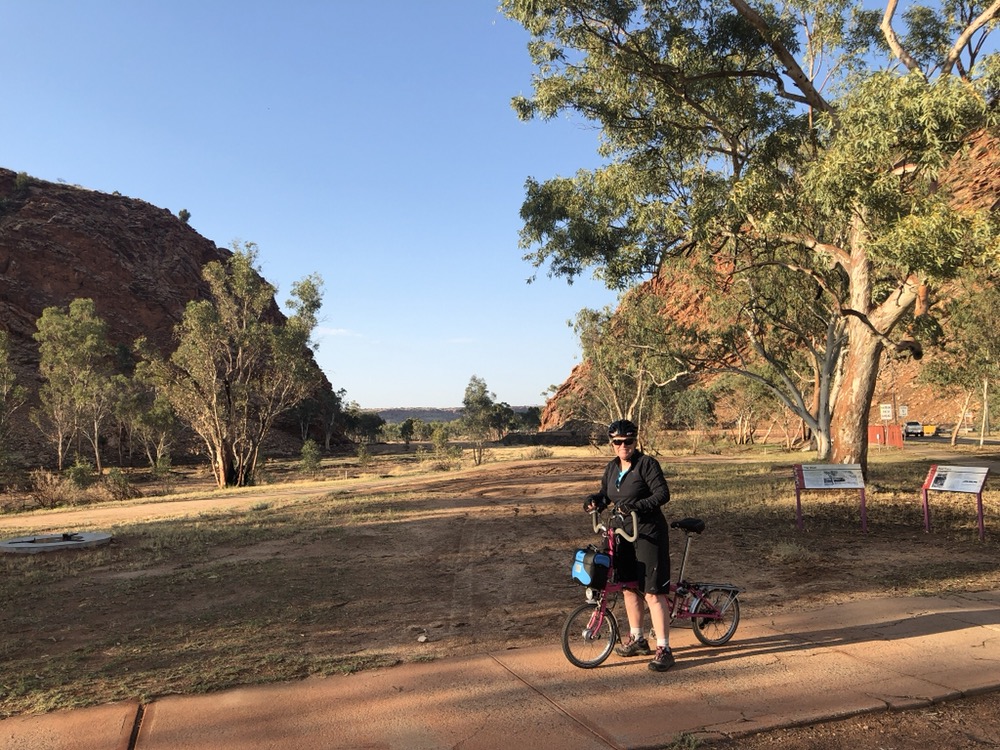
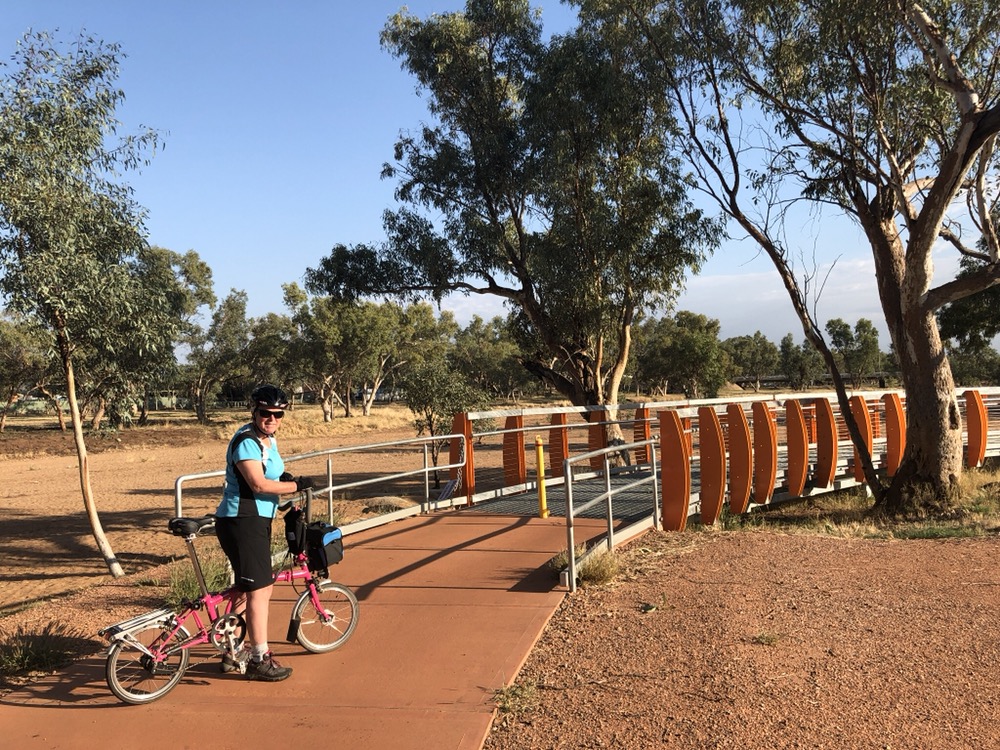
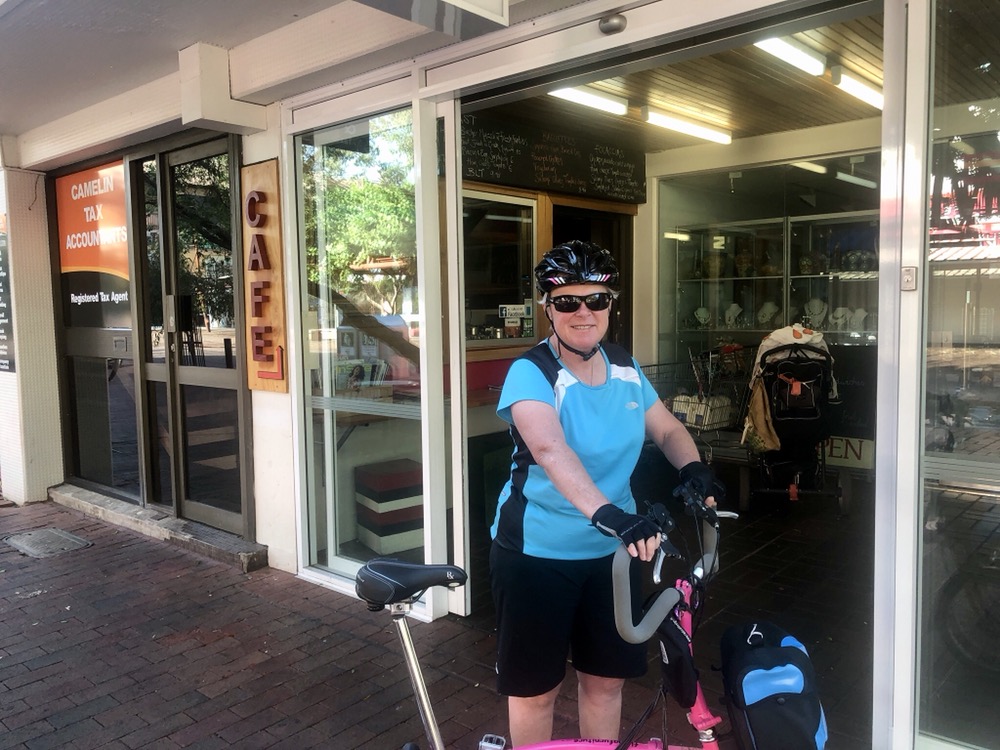
Jennifer and I had weekends together as well we our week in Papunya. It’s getting hot in Alice Springs, high thirties. Even walking around is pretty exhausting. The local Aboriginal kids are still running around playing, and standing on the hot concrete and bitumin of the roads. We would get up at 5:30 am and go for a cycle ( Jen) and run (Bruce) around the Todd River. It was about 18 degrees early in the mornings and very pleasant, moving slowly under the River gums, or admiring the Gillen range. We would stop for Coffee at Red Sands, and have a macchiato each at Robs wonderful cafe. Then a short 10 minutes jog back to the apartment. On Friday nights, we would walk or drive to Montes. Now, not all their cooking is worth bothering with but there’s a few stunners, we would recommend any of the chicken parmiganas, the barramundi, any of the wines, and the Nutella brûlée for desert. Their pizzas are good too. What we really enjoy about the venue, is it’s relaxed, slightly hippy atmosphere, where anybody in Alice can chill out for an evening. Most of the seating and tables are exposed to the elements with only that gorgeous Central Australian sky above you. We usually sit under cover, with the circus and rodeo posters and banners on the opposite wall. Interesting place, and not to be missed on any trip to Alice. 

After our run, there is the obligatory shopping for weekend and next weeks supplies, and then, we would spend the rest of the day takin* it easy. Jennifer reading a mystery and me with enjoying a science fiction on Netflix or playing guitar with my music stand on the lounges dining table. Ooch, that first six weeks of a new piece, it it’s unavoidable if you want to progress in musical competence. 
As always, the high point of the four weeks has been the wonderful Aboriginal patients I have had the privilege of helping care for and the association with the incredibly competent and hard working Aboriginal health workers and White nursing staff. It inspires me to read and think about how we as a white population , who aggressively occupied this land, foster so many of the health and social problems we are so concerned about now. To give an example, it’s a general observation that most indigenous children are pretty wild, and undisciplined. It’s easy to ascribe this to a careless attitude about the kids however, one factor in the genesis of this issue is concern about children being taken from parents. If a child is punished or disciplined, particularly physically, the fear of a parent is that Child Protection will take the child away from them. Aboriginal mothers really fear the prospect of losing their kids to welfare if they actually discipline their children. This is one reason why families are so mobile, trying to escape any radars in a clinic about their care. 
STIs and especially Syphilis, were brought into the Aboriginal community by white men. Again, these are our diseases inflicted on a society without the means to cope with or understand them. The attitude to marital and extra marital sex is often pretty casual, and it’s only compounded by heavy alcohol use by some ( a minority) Aboriginals of both genders. Early adult pregnancy is very common. The current Syphilis outbreak is not yet under control, due to difficulties in detecting, treating and following up cases and their contacts. In a clinic, we will be notified that a certain patient is coming to the community and has tested positive for Syphilis. But locating them is very difficult. In fact more often than not, they changed their travel plans and have gone somewhere else or they are still in Alice. There is a lack of complete and easily accessible information between all relevant health providers. There is an attempt to connect us more electronically but a patient can opt not to participate in permitting universal access to their records. The system is also clunky and slow and it takes time and effort to find significant information even when you do have access even to this limited information base. Bottom line, It’s difficult and I think some hard decisions need to be made about the use and abuse of medical information if we are going to tackle these health problems. 
What we have done and what we do, still has an enormous and seriously underestimated impact on the health and social problems in Aboriginal Society,

Standard
Central australia, Central Australia Work

Barkly Run the girls plus one trip.

Barkly Run

Hi Everyone, we re back in the NT again. This time an effortless flight from Melbourne to Alice Springs arriving in the late morning of 15/10/17. We left Melbourne at 9:30 am but thanks to time zone and other aberrations in the passage of time, we landed at soon after 11 am. The weather here is warm and very pleasant, the skies are actually visibly blue.

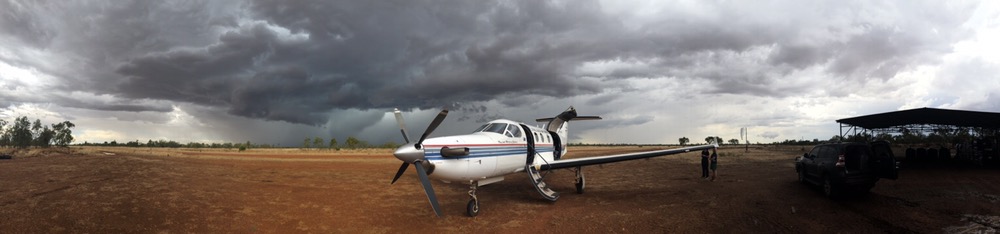
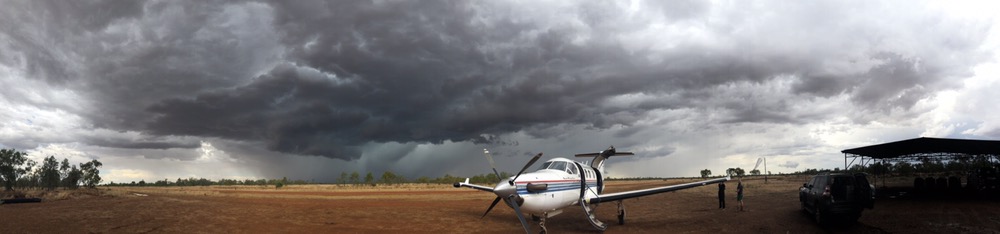
It is  always a whirlwind tour to some of the grand old stations and out stations when doing the Barkly. However, this trip was unusual for a few reasons. Firstly, it was my first visit to Mittebah. We entered airspace over the station through some impressive looking clouds. I felt like I was in a toy plane within these massive dark clouds all around us and as the plane weaved and spiralled between these dark, brooding immensities suddenly lightning struck earthwards. 
When we landed, I visited two boys on the station with some mild problems. As with any station, the hospitality and friendliness is unparalleled. We then drove back the short distance to the strip. It’s a well compressed, gravel, strip but tends to be a bit short for a larger plane. The sky looked ominous, dark, thunder clap clouds, occasional twists of lightning striking down. Lightning had caused some fires still burning on the station. The pilot was unimpressed with the weather, and we all happily agreed to stay till things sorted themselves out. Then the rain struck. An inch of rain ( 25mm) fell in two hours rapidly converting their older airstrip to a narrow lake, the roads became slippery and muddy. It was a deluge. We sat in the kitchen. The owner lent me a dry shirt to wear while mine dried off on the covered verandah. She had the girls busy peeling extra vegetables for our anticipated impromptu overnighter. 


However, the sky cleared enough and the airstrip was good enough to take our 4 and 1/2 tonne plane up and away. We arrived at Antony Lagoon only four hours late. Luckily, for once, it was not too busy and were able to finish at seven. We tramped over to the kitchen, kicking over the cane toads, to enjoy Cook Maze’s lamb shanks and bread and butter pudding. There had been no rain here, and the staff were agog to hear about the dump of rain we’d experienced. 

Next morning, we visited Brunette Downs, and then Alexandria station that were both busy clinics, not finishing till late. 

Secondly the trip was a girls club plus one (me). The pilot, whose name is Heather and Charlotte, the nurse we picked up at Elliott on the way from Tennant creek. Heather has only just started with the RFDS owing to some vacancies from staff movement interstate. Heather is an extremely competent pilot, she explained that the qualifications and experience required for RFDS Pilots is way more than that required by airline pilots. Her path was work and study over nine years to achieve selection for this job, where only four years is enough for international pilots. The RFDS job is way more interesting, having to do actual flying as opposed to reading comics while the autopilot flies you to within 20 meters of a touchdown with a 747. Unfortunately Heather took a tumble down one of the clinics steps and badly bruised her shins. I tried to reassure her by telling her I’ve an iPad app which I could use for the plane. Fortunately, her condition was less severe than first feared and so our remaining flying was much less eventful than if I’d been anywhere near a control. Was it something I said?

Charlotte, is new to the territory, having been an ICU nurse for several years at St Vincent’s in Melbourne. Her boyfriend is a doctor now working at Tennant Creek. She was totally fed up with the aggression, spitting, rudeness, and bad language of way too many patients she would have look after at work. Over a 12 hour shift! They were too many drug addicts, abusers of ice, heroin, cannabis, who had wound up in Intensive care and felt a pressing need to hassle all the staff as they woke up from their misadventures. People here in the centre whether of any colour, and no where more than the stations, are polite, considerate and thoughtful – well mostly. 

Charlotte and Heather were repeatedly invited to a function to be held at the Barkly Roadhouse, situated on the Barkly Highway. This is the The Barkly Women’s Meeting. As many women that can, fly, drive or even ride, will attend. About fifty usually can make it. It’s a weekend event usually run two or three times a year, where the women can network ( gossip), and hear presentations from speakers of the caliber of Jean Kitson, and other impressive women. There is a market where ladies who have special skills in crafts can sell their works; hats, ear rings, jewellery, make up, you name it. Yours truly was not invited, but that’s a relief because only a male would be asked to cook at the Barkly women’s meeting. 


After leaving Soudan Station, we flew to Elliott to drop off Charlotte and all the boxes of gear. There is a lot of plastic boxes filled with medications, emergency gear, computers ( however, lacking a power cable ) and printer with bonding issues to the computer. 
Then to Tennant creek, to refuel and collect some staff from the hospital. The pilot and I were marooned there, the hospital was meant to collect us both so we could get some lunch. No such luck, so we survived by each eating a butterscotch bun we’d secreted from Soudan Camp kitchen. Breakfast was at 5:30 am. I don’t mind missing a meal, but I was not happy my pilot was. Anyway, the incident is going upcountry. 

Arrived back at Alice at 6pm. I was too hot and bothered to cook so went out on a solo date to Montes for Clare reisling x 1 and Mexican chicken parmi, which is a chicken breast with abundant avocado and cottage cheese. Such a terrific chill out place.

The rest of the week is sorting out stuff from the Barkly Run and inscribing these words of wit and wisdom. 

Next week, Elliot.

Standard
Central australia, Travel

Central Australia Road trip 18 Epilogue

We have arrived safely at the kids place in Melbourne. We spent last night at Dimboola. What A terrific choice it was! We decided to stay in a unit rather than camp out as a wet camper canvas would never dry out in Tasmania. The unit was small but more than adequate. As Dimboola is two kilometres off the highway, its quiet with only the croaking of amorous bullfrogs echoing over the camp ground. The Wimmera River is beside the park, and so it’s only a short walk to enjoy some attractive scenery.
In the evening we went to the Victoria Hotel for dinner. It was built in 1924 by the Ballarat Brewing Company. It’s step back in time with ageing, cracked but still very comfortable chesterfields in the lounge and reading room. The shelves are stocked with the classics such as books by Conrad and Maupassant, as well as whole sets of encyclopaedias. The chicken parmis were great, especially with the Cape Jaffa Sauvignin Blanc to help wash it down. 

On the drive back to Melbourne, our only major stop was to have lunch and a wine tasting at Seppelts at Great Western. A very nice spot to enjoy food and wine.

Well, that’s that for the trip. It has been a terrific chance to see and experience so much of Australia, including; meeting the many people of the outback, the relics and stories of the Ghan, the natural history of central Australia and the Flinders, and eat at some wonderful venues. As well as getting robbed in Adelaide, losing stuff, and breaking bits off the camper-trailer. A very great adventure. Will have to do some other spots next year if we can drive up in 2018!

Standard
Central australia, Travel

Central Australia Road Trip number 17 Martindale Hall, Clare, SA

 We are seriously on our way home. We left Arkaroola on Sunday morning and drove to Hawker. On the way we drove through the Flinders Ranges and Wilpena. The road is bitumen through the southern Flinders so travel is a lot faster and a lot less dusty. At the end of the dirt roads is the small town of Blinman. Blinman was the site of a major copper mine and even today there are mine tours available. We did not have the time for a tour but did have time to enjoy a famous Blinman meat pie. They are just huge and taste great. I followed it up with a quandong tart – takes like a rhubarb and pear mixed together. Now quandongs are not only very tasty and very interesting. The quandong tree is a root parasite. It uses the nutrients directly from the roots of another tree to grow. Once the quandong is big enough it can go out on its own. We saw plenty of quandongs at Arkaroola. 

The southern Flinders ranges is very beautiful. The roads bend and twist, cross creeks, and provide spectacular views of this magical country. 

After arriving at Hawker, we looked at our watches, mmmm, only two o’clock so why not get to Clare. So we did, taking the R.M. Williams Way there. We arrived at Clare caravan park at just after five. It closes at 5:30. Set up camp then went to Sevenhills Hotel for a meal. A very good choice. This morning we visited Crabtree Winery, Annies Lane winery and had lunch at Paulets. The Bush Devine cafe at Paulets has wonderful views of the Clare. Gum trees dotted around rolling green hills, with the bright yellow of canola dominating some pasture. 

However the high point of the day was our early morning visit to Martindale Hall. This has to be the best Victorian era Georgian Italianate mansion / great house we have ever visited either here in Australia but even in the U.K. The house, the grounds, the halls interior, the furnishings, the paintings, the clothes hung in wardrobes and on dressers are all original. You are asked not to touch anything but there are hardly any of those dreadful roles and barriers, and glass screens people like to put inside stately homes.
The hall was built in the mid nineteenth century by a very wealthy family. They had made their money in sheep grazing and were originally from the Lake District. It was this money, 30,000 pounds of it that paid for the building in 1858. By the twentieth century, the house had to be sold, and eventually was bequeathed by a subsequent owner to the University of Adelaide As a venue for agricultural studies. In 1986 it was passed to the National Trust. It’s a building that had has always been loved by whoever owned it. 

Its interiors and exteriors were used in the film “ Picnic at Hanging Rock” to show the school in the movie. While we were there, the sound system played Handel not Beethoven as in the film.

We have had a quiet afternoon after returning from lunch and will be continuing our journey to Station Pier tomorrow morning. We have met some delightful fellow travellers including some other Tasmanian refugees. All of them thoroughly enjoying retirement and their lives on the road.

Standard
Central australia, Travel

Bararranna track, Arkaroola

Emu bush

Tellite Gorge

Stubbs Waterhole


Here we are in Arkaroola. Arkaroola is private wilderness sanctuary to the north and immediately abutting the Gammon ranges national park. It’s dry and hot in Summer but this time of the year, well, it’s still dry but it’s not hot. Overnight, it’s cold and over the day it gets to the high twenties. It’s perfect walking weather. Sunny, warm enough and usually a breeze to keep the flies from finding us.

Arkaroola was a pastoral lease for many years until it was bought by Reg Sprigg, a geologist and academic, in the 1960s as a sanctuary for rocks, plants and animals. It’s the northern extreme of the Flinders Ranges. From any high point, there are Ranges of abrupt hills as far as the the eyes can see to both the north and south. 

We are camped in a powered site, not far from the shower and amenities block. Around us are tall hills, bright orange in dawn or afternoon light, acacias snarled up the steep slopes. On this our first night, a full moon came up between two hills making an arresting sight.
We are staying here five days. On our first day, after breakfast, we got a lift from the sanctuary owners to the start of the Acacia Ridge walk. It begins about five kilometres along the road. We were joined by an older couple, Michael and Rosemary on the walk. As we took loads of photographs, they left us for dead, but waited for us every five hundred of so meters along the track. The track goes steadily upwards and provides some terrific views of Old Arkaroola station and it’s surrounding hills. At the top there is a branch to the summit, wow, there are some great views north. It is some very impressive scenery. On the way, we saw different types of flowers and shrubs including fox tails, red hops, dead finish, bush tomatoes and Sturt’s nightshade, a tall plant with blue flowers rather than the purple bush tomato flowers. We saw bush pears, big and green but not for eating yet. 

From the summit, the track winds past a huge steep rock face and then drops quickly on a slippery surface. We grappled our way down till we reached the road, then only a short distance from the village. By now it was getting warm, so we relaxed over the afternoon beginning with lunch of ham-cheese toasties at the cafe. We later returned in the evening for dinner. It’s a very good restaurant. Afterwards we walked along the gravel, stony road up to the campsite.

The next morning, we decided to walk the Mawson Spriggina walk. Spriggina is a 15cm flatworm that was one of the denizens of the pre Cambrian seas and oceans. It’s named after Reg Sprigg, it’s discoverer. The walk commences near reception, and heads past the motel style units, then onto the rough Arkaroola countryside. It undulates around hills, and dry creek beds with some wonderful views. We saw some interesting plants including the beautiful Curly Mallee, as well as hakeas and coolabahs. We reached some fascinating volcanic intrusions. These were ancient upwelling of lava that never reached the then surface, but were trapped into the tough sedimentary rock. There is Sitting bull, as well as the Pinnacles. Their orange colouring contrasting with the blue grey of the sedimentary rock remaining. The walk continued back. We met a mum and baby red kangaroo. They were a bit nervous about us but we still took some great photos as they watched us. In the afternoon, Jennifer drove to Bolla Bollana Rockpool. This very pretty Rockpool, is reached by quite a rough Track. The next Waterhole was an even more difficult road trip. After seeing the 4WD AHEAD OF US rocking and dropping, we piked, and turned around only to meet another car on this really narrow bit of road. We nestled the car as far off the road as we could, giving the car a massage with dead finish. Much of the scratching merely removed the caked-on bulldust, but there has been some slight damage. The result is called bush pinstripes.This acacia is tough and spiky. We got back about 4:30 and chilled out over the evening. 

Today has been a quieter but still very interesting day. We visited the mining museum with loads of interesting stuff about geology and many examples of rocks and fossils found here in Arkaroola. This was timely to do as Jen and I did a geology field trip over the afternoon. Mark Sprigg drove us out to see several interesting geology features of this area. Arkaroola, like the rest of the flinders ranges is part of an uplift that was created by the ramming of what would come to be the eastern states of Australia with the much more ancient original australian continent. In Arkaroola there are some important faults, we saw one today. It’s movement is frequent but tiny with about 300 microtremors per year. At faults there is weakening of the barrier rock layers usually provide and minerals can come up and penetrate the sedimentary rock. We visited disused copper, and manganese mines. There was also a reasonably successful gold mine. The gold was all near the surface and not in a vein. No one could figure out why until only very recently. The reason is quite amazing. Apparently a particular type of Cyanobacteria eats gold. Then water bubbling up the fault, carries the bacteria including its contained gold up into the upper levels of sediment. This makes Cleopatras talent for drinking pearls look stingy. We visited the ochre wall. Ochre from here would go all over Australia. An endemic mica containing iron was considered very valuable for its glistening red colour as a paint. As Mark drove across a creek, he told us over the car engine noise that two years ago, scientists had been studying the rock formations and fossils here. It’s ancient, about 700 million years which is long before plants and animals but in the Proterozoic. This was the site of an immense coral reef, made up by bacteria and primitive life forms and was larger than our current barrier reef. The atmosphere was much lower in oxygen than today and so these bacteria survived on carbon dioxide and sulphide gases. Impressive stuff. However, the highlight of the day was our visit to Tillite Gorge. It’s a steep, rough road but Mark handled it expertly. Tillite Gorge is named so because the sedimentary rock contains huge rocks. They were dumped from a glacier into a shallow estuary or sea a very long time ago. The larger rock floor of the gorge is scratched by the ice grabbing stones and ripping them along. It must have sounded like four fingernails on a blackboard. Apparently, this actual site was instrumental in discovering Snowball earth. This was 800 million years ago, and describes our whole planet covered in a giant glacier: A giant snowball.

It has been a very interesting afternoon. Jennifer got more tips about 4WDing.

This evening, we had dinner at the restaurant, before walking back here and snuggling up in the camper trailer.
One thing I have learned on the walks here is that in dry, relatively cool weather conditions, thirst is NOT a reliable guide to hydration requirements. When I walked with Di and Dave I had a lot more fluid and electrolytes and felt fine during and well after the walk. Here I drank only to quench thirst and felt fine during the walk but completely awful that evening and the next day. So the point is, keep those fluids up!

It’s Saturday and it’s our last day before departing in earnest to catch the boat. It is still overcast which might put a mozzie on tonight’s astronomy experience. Mm. Any way we gave had a terrific day, doing the final short walk in Arkaroola. It’s called the Bararranna Walk and it’s Highlights are the tellurite lined creek from Tellurite Gorge, and the Bararranna Gorge and Stubbs Waterhole. The track is a circuit beginning from Welcome mine trail head. This was the site of a copper mine so there is lots of malachite and ansurite fragments on the ground. The mines are vertical drops mostly with just a few bits of timber marking them. However unless you were silly enough to go near them, they don’t pose a risk to adults. The track winds westward, its narrow and rocky and eventually comes to a slate and shale field. There are Emu bushes here, it’s a pretty red fuschia flower. It’s on the blog prior to this one.

 We dropped down into a creek bed, and went downstream, climbing down the dry waterfalls. Everywhere tellurite rock. This forms beneath melting glaciers as stones and small boulders drop into the sea bed. When this sea bed sand becomes rock, the erratics are still imbedded. We enjoyed our cups of tea nestle don the rocky outcrops. We were on the lookout for rock wallabies but no luck, though we did see some wallaroos. 

The track follows the creek to its junction with Arkaroola creek. Here we found Stubbs Waterhole, and it’s very still, very beautiful. Sheer quartzite walls with a green Rockpool. The rivergums all standing mute as sentinels near the banks. There was a small yellow bird drinking water and then flew up to sit in a tree near the Waterhole. Arkaroola creek is also fine walking. The track now requires small and large boulder hopping rather than scrambling. The stones are of so many colours reflecting their many origins. We diverted to visit Bararranna Gorge. There’s a massive ripple rock platform tipped into the vertical. There are masses of blue flowers. There is some water in the rock pool. It is a very peaceful sight. We carried on along the creek and ultimately back to the car. We passed some interesting geology. There was a huge rock that had been scratched by stones moved by a glacier. There was the formation called Humanity seat which is vertical sedimentary rock consisting of quartzite and shale. There is a spot early on in the walk where you see two small hills, these contain evidence of early bacteria that once created the huge coral reef I mentioned earlier. 

The walk has been terrific. Though only seven kilometres, we were tired out by the end. We drove back to the restaurant at Arkaroola. The kitchen was closed by now so we had chocolate cake instead. 

Right now I’m sitting beside the camper, I’ve had a shower so smell a bit better, and Jennifer has put on the clothes to wash. Arkaroola has been a great place to visit. I can really recommend it for the adventures and beauty it offers to the traveller.

Ripple rock – ancient sea floor

Bararranna Gorge

Scratching indicates glaciation – stones imbedded in moving ice scratch the rocks

Standard