

Author Archives: brucebarker2016

Hermannsburg, NT
About 125 kilometres west from Alice Springs, a drive will take you to Hermannsburg Historic precinct. It’s a beautiful trip with the magnificent red sandstone cliffs and hills of the West McDonnell’s to the south and to the north, the rolling hills of the Arrente. The trip only take 90 minutes along a sealed road. There are signs warning of horses and kangaroos but these are much more of a danger at night than in the daytime. For some lengths of Larapinta Drive, stock can wander over the road as well, so it best to be alert day or night!
Hermannsburg is a living community with about 700 people of which over 600 are Aboriginal. We drove past the roads that lead to the houses and the few shops, instead following the signs to the historic precinct. After being there for two hours, enjoying it enormously, we would both strongly recommend a visit if you ever have the opportunity.
Hermannsburg, the name, comes from the city in Germany where the first Lutheran missionaries to this region were trained. The first two arrived in 1877 only a few years after the explorers and the even more recent pastoralists. The Aborigines who lived in this area, now called the Finke by thewhite people, faced an uncertain future. Their land was taken from them because the pastoralists needed it for their stock. Police were pretty hostile too, with many local people shot and killed. Charges never lead to a conviction for a white policeman for doing this sort of thing.
They were lost, starving and extinction was a real possibility.
Many missions in Australia, and in colonies all over the world have been rightly criticised for being the soft side of colonialism and as important in destroying local culture as guns and soldiers were. Here I think it was different. The Finke River Mission provided a refuge, food, accommodation, and what medical help they could offer. The difficulties in getting supplies to the mission in its early days were horrendous and expensive. None the less, tradespeople who came as well as the pastors, built the church and out buildings, some of which are still standing.
Notably, Carl Strehlow, the pastor from 1894 to 1922 at the mission, was fluent in Arrente and produced the New Testament in that language. This had never been done before, anywhere in Australia. During his time there, he and his wife survived droughts, financial difficulties and the hostility of many people including government during world war 1.
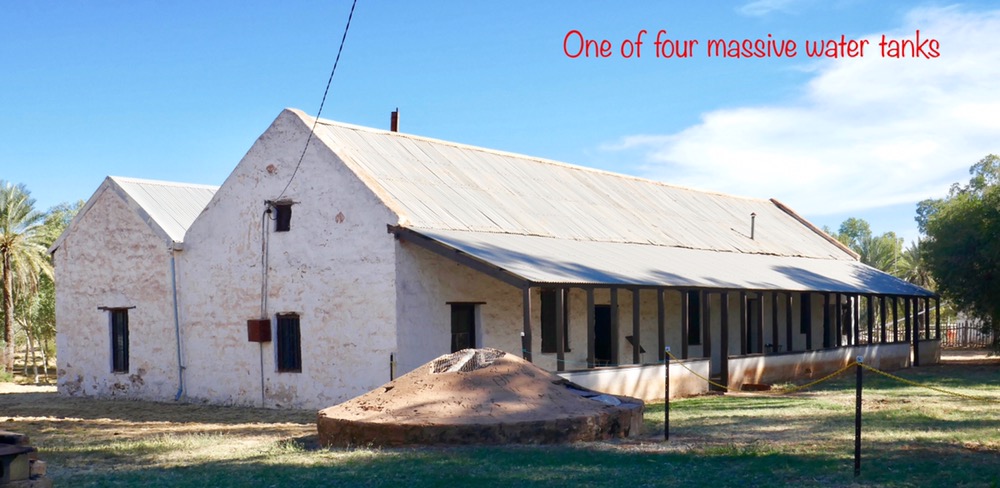
Up until the 1920s, the children suffered terribly in droughts. No food could be grown, particularly vegetables and in one particularly terrible drought, 85% of the children died from scurvy. In those days there was no rail link from the south and no way of getting food to this remote area. Soon after, the mission built what was regarded as impossible, a pipe to a reliable spring that could fill their massive water storage tanks and finally grow vegetables and food all year round.
Trade schools were set up, especially a tannery and leather processing business. The Aboriginals made leather from cattle and kangaroos. They made shoes. The women processed salt to help safely store meat for many months in the dry, hot conditions. It was a viable community until the attitudes to missions changed, and many Aboriginals drifted away to outstations now funded by government and nearer their own lands. The modern pastors and families of the seventies would no longer put up with the deprivations of the early years. The Lutheran church pulled the pin, moving its administration, efforts and funds to Alice Springs.
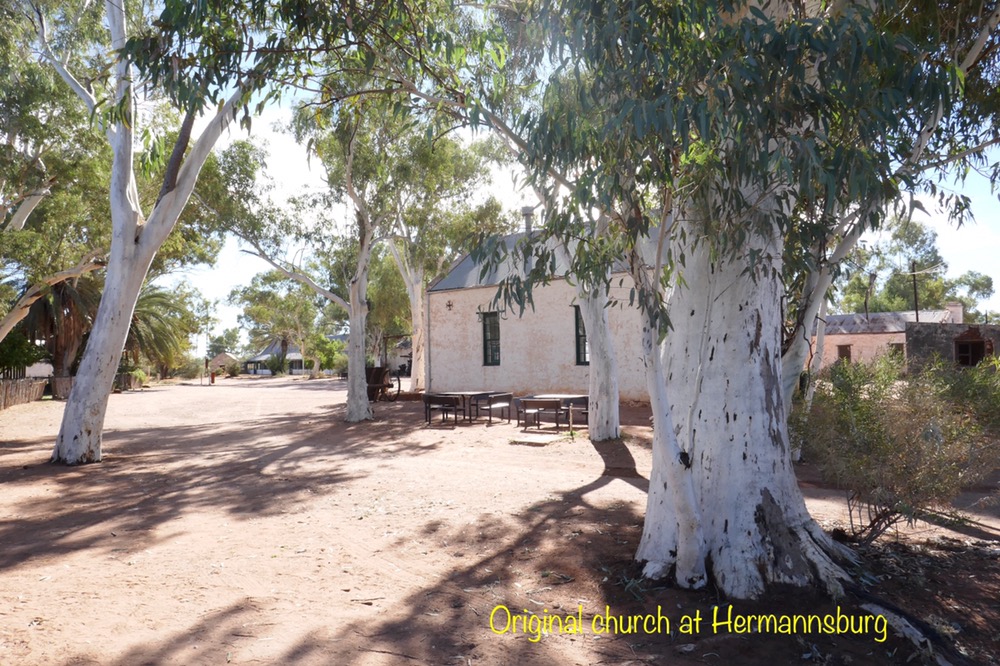
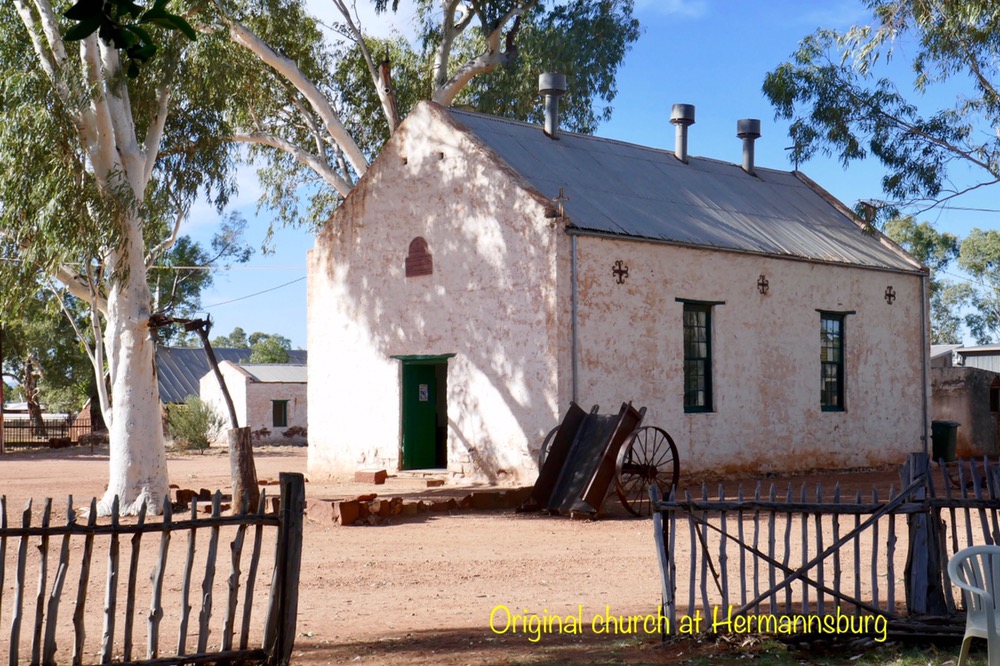
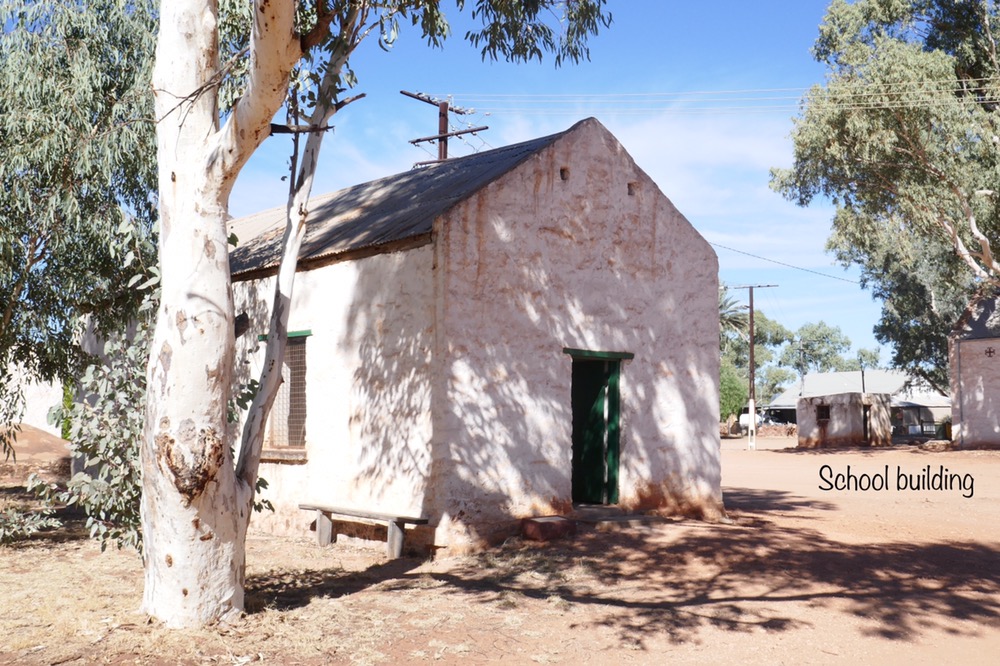
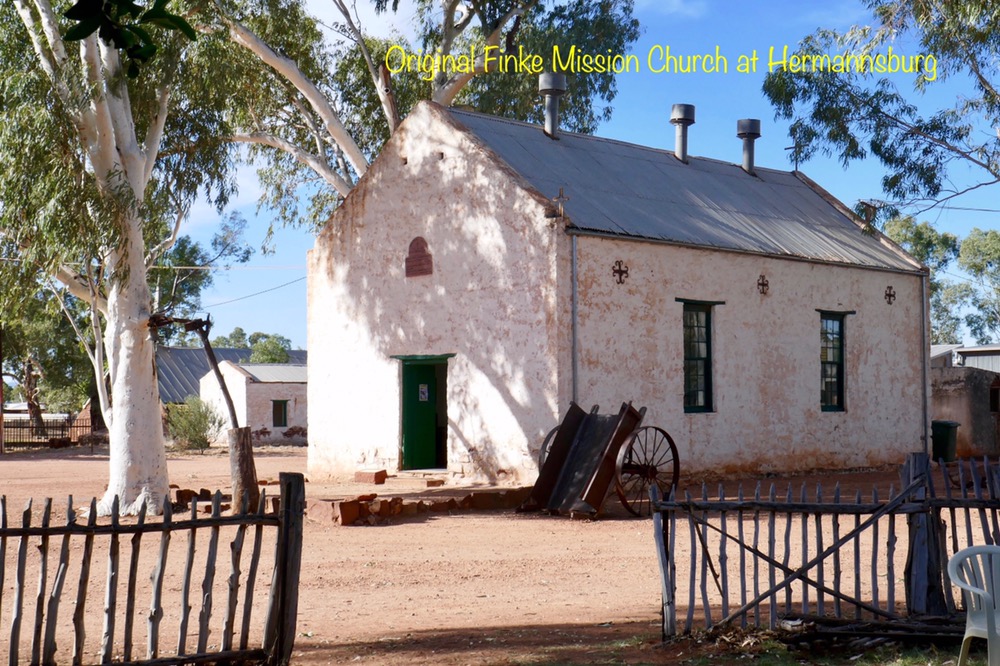
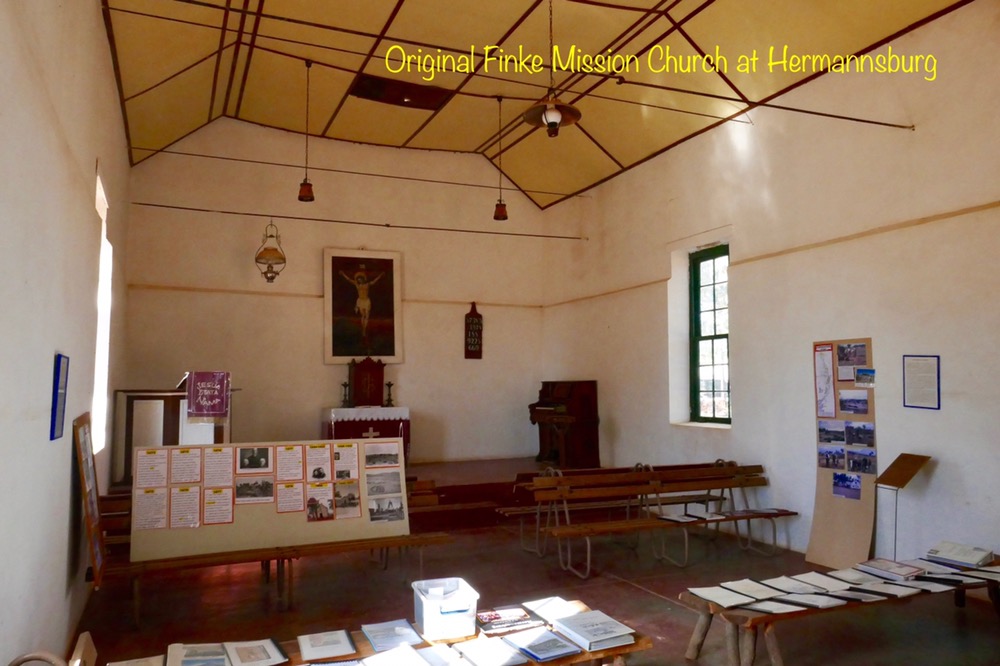
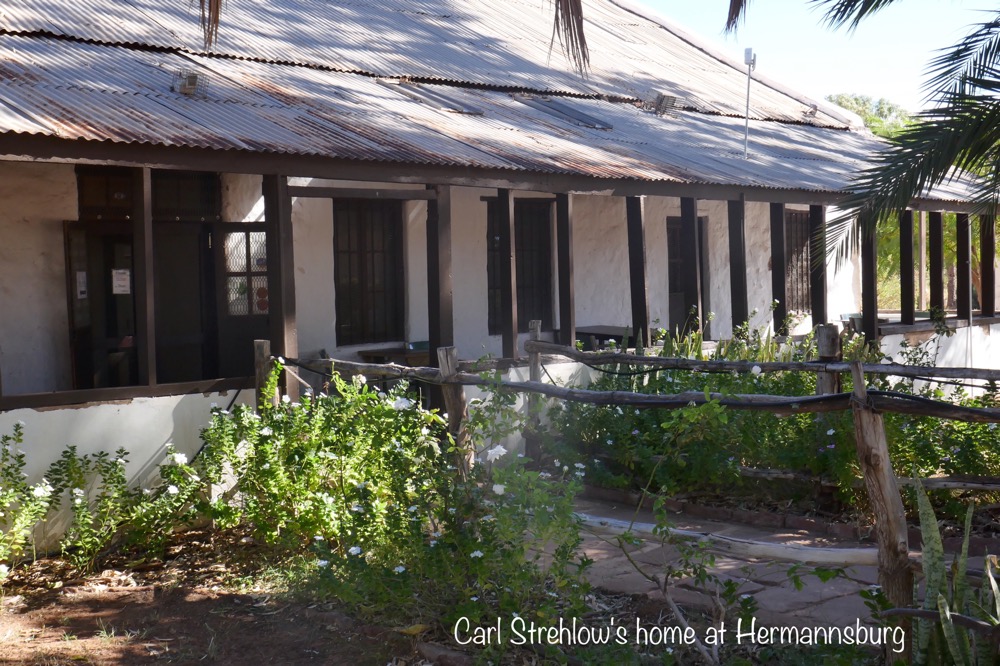
The old buildings still exist. In the middle is the tall white church. Out the front are two river red gums. A steel beam balances between them, and from that beam hangs the church bell. The early pastors had serious doubts about the safety of building a steeple. The walls are thick, cool, and limed white inside and out. The walls are made of limestone blocks that were dug and prepared nearby and moved by cart. Around the church are the Tannery, the manse, the bakery, five massive buried water tanks, accomodation, infirmary and dental office. Behind the buildings are a grove of date palms, a useful food supply in this hot climate. In the buildings are artefacts left over from the working years of the mission. Restoration projects on cars and equipment is slowly happening, including a mechanical, motorised borer.
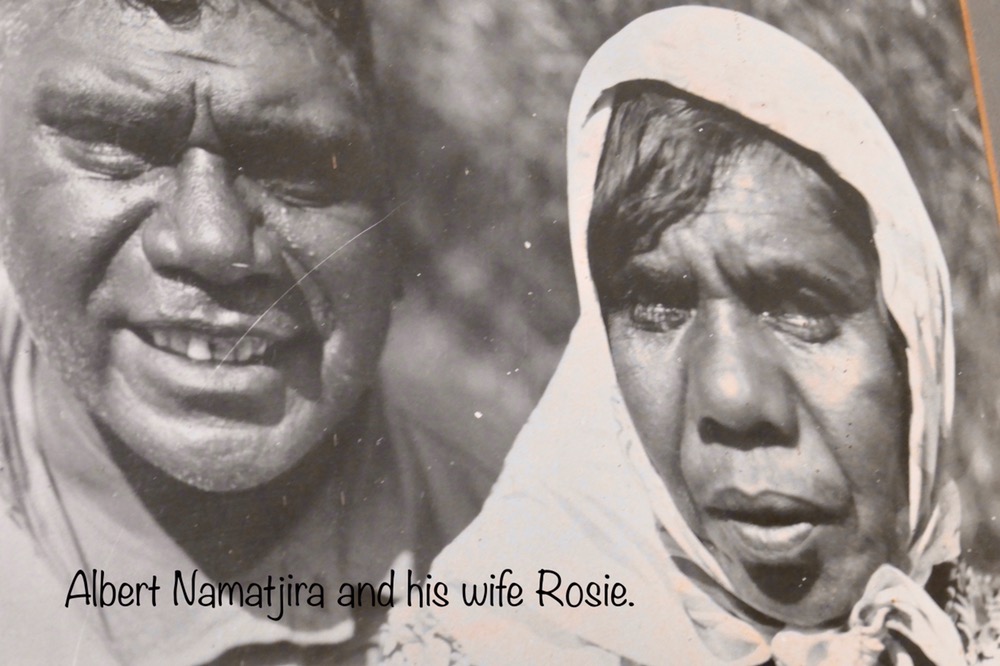
A highlight for our visit, is all the information as well some paintings by Albert Namatjira. He was born near Hermannsburg and spent most of his life nearby. As a young man he had the great good fortune to meet Rex Batterbee. Rex was a water colourist, and a very good one, who had travelled northwards from Melbourne to explore and paint views of the country around Alice Springs. He quickly realised what a great painter Albert could be, and taught him the artistic skills he needed. The student soon overtook the master. In 1936, he had a solo exhibition of his work in Melbourne. He soon became very famous. He produced a tremendous body of outstanding work. However, this fame backfired, as he was given the unique right amongst Aboriginals, to buy alcohol. Under the humbug rule, where you have to supply friends or family with whatever they want if you possibly can, he supplied lots of grog to these people at Alice Springs. Outside town, there was notorious drunkenness and violence due to this preventable situation. When a girl was murdered in the camp, enough was enough, and he was jailed. It truly broke him, and he died a month after his release.
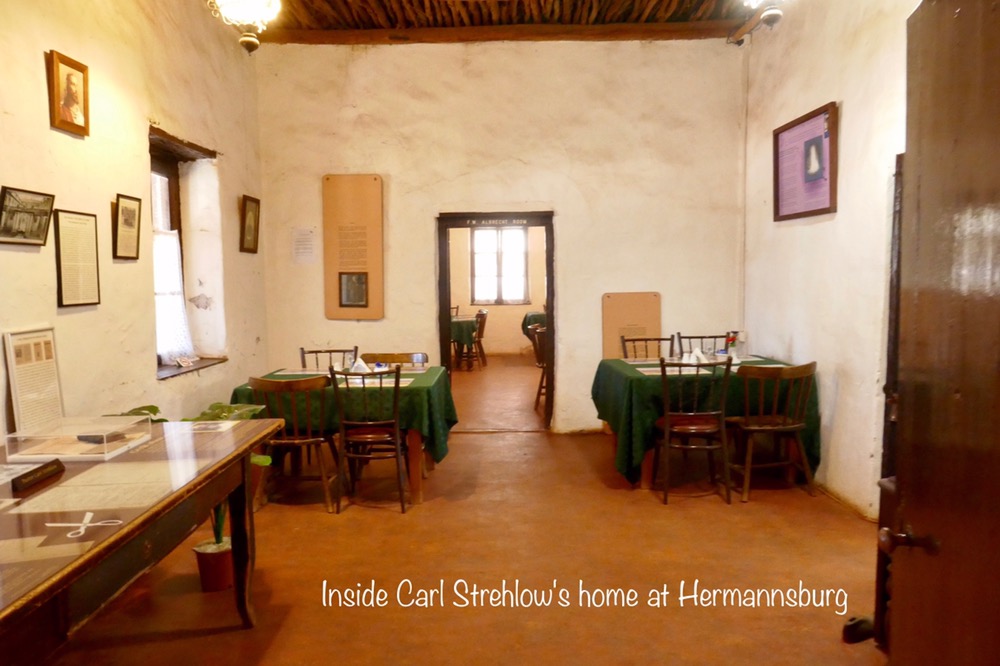
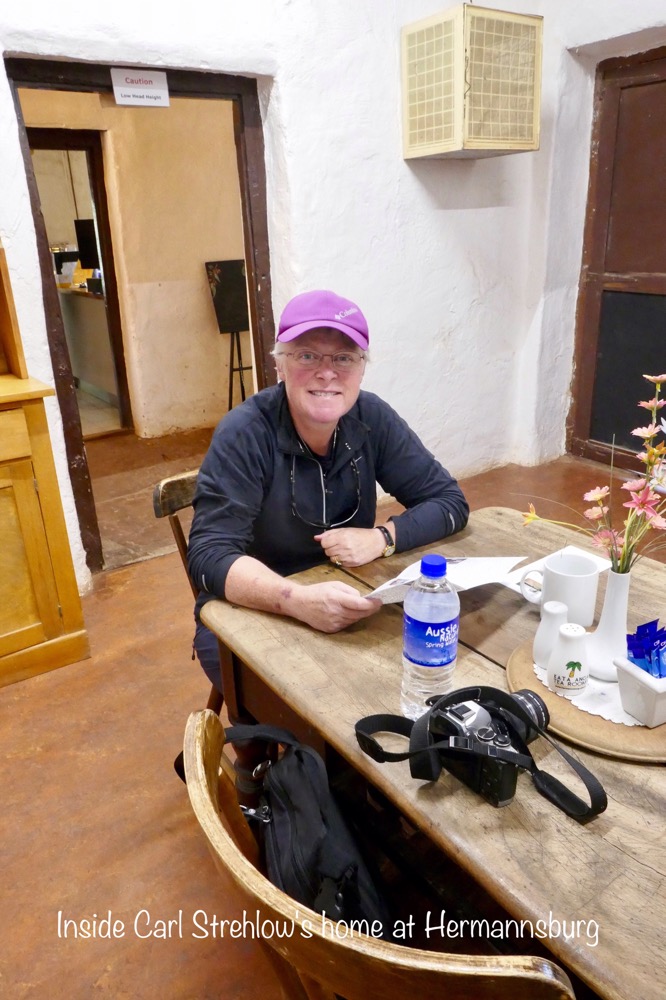
We had some of the local fare at the tea rooms, formerly Carl Strehlow’s home. Strudel of Course! If you look up from the desser, you can see the mulga tree branches still forming the roof supports. We walked through the dining rooms, reading the displays, enjoying Albert Namatjira ‘s paintings, and enjoying the peace and quiet. However, as we stood near the church, we could hear local Aborigines singing enthusiastically as part of a a Saturday church service. There are CDs in the gift shop of their concerts performed both here and overseas. The modern church is much more comfortable, it is also built from local stone but it’s not limestone but sandstone that forms the walls. It’s only just big enough for its congregation.
This mission is a reminder of the courage and resourcefulness of the early pioneers of central Australia, and the religious zeal that inspired the early Lutheran pastors to protect and foster the Aboriginal people. Today, there is a strong Lutheran presence in many communities, but they are mostly Aboriginal pastors. There is no problem at all blending the Christian message with the dreamtime stories. And there never has been. When a pastor became very sick, one of the mission Aboriginals said he would get help from Alice Springs. He left the mission, picked up a handful of grass and laid it in a fork of a tree, and sang a song to the sun, for it not to set until he had completed his trip. He travelled far and fast covering the distance from Hermannsburg to Alice Springs and back in three days. He then removed the grass, placed it back on the earth and thanked the sun. He was a well known Lutheran pastor in his own right.





Central Australia Road trip 2 lake Nash
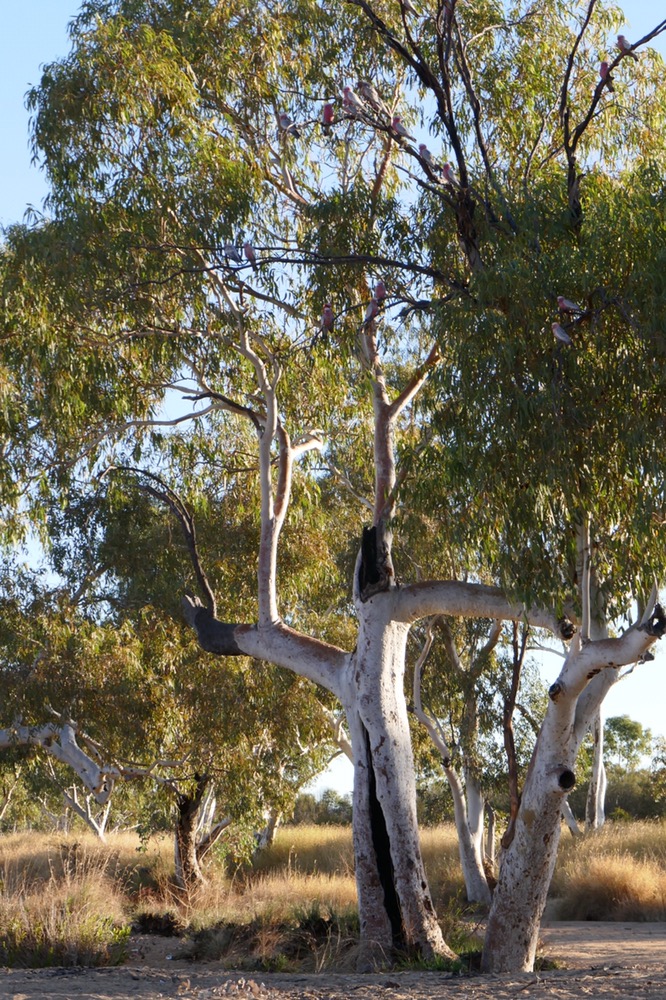
It is Thursday evening and the working week is drawing to close. I’m lying in bed in the donga. It’s been very cold at night so I’m wearing my thermal top and my black beanie. The wind is howling outside. There are some street lights on the road beside the donga, just beyond the wire mesh fence. It is very quiet for a change, the cold and wind keeping the dogs huddled together on verandahs rather than barking at the moon and stars. In the morning we will go for a walk. We walk along the Sandover Highway, all of four meters wide and made of hard red clay starting to crack and tessellate as the summer wet finally dries out. The plains of spinifex and grass are dead yellow, faded from their rich summer green. Cockatoos and corellas group in masses in the few trees, looking like pallid tropical flowers amongst the leaves and branches till they erupt together into the air, keening and calling.

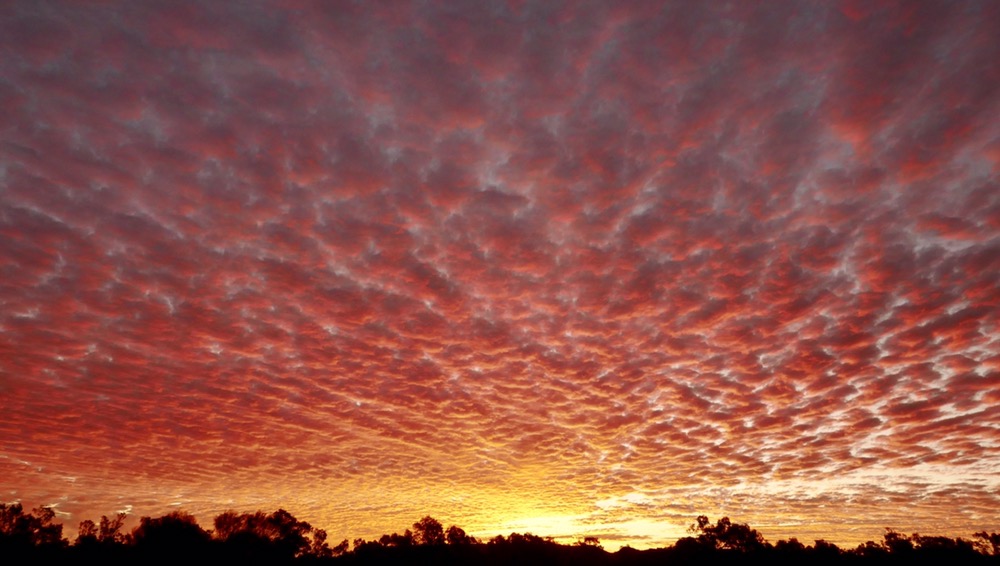
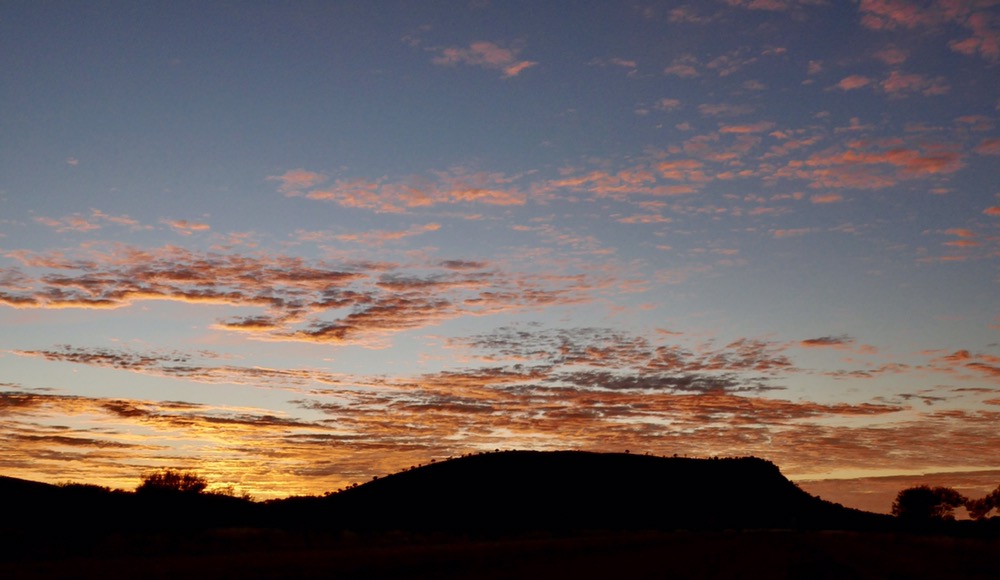
 We walk over the plain, diverting onto dusty, nearly overgrown side roads , it would be too easy to get lost in the maze of intersecting tracks. We carry sticks to threaten the dogs nearer town if they get too cheeky. There is always a beautiful sunrise to the east, it can be vivid pink and red, or a burnt dry orange, lighting up along ripples of clouds. The sky is clear and deep blue, and fades only minimally as the day truly begins and the sun climbs above the horizon.
After breakfast we head over to the clinic. It’s only a short walk. As Jennifer or I make up our coffees, we settle in for the morning meeting with the other staff. The clinic is badly understaffed and there is a too real possibility the nurse manager will have to forgo her leave. The logistics of providing staff to clinics such as Lake Nash are complicated and difficult. The nurses here have enormous responsibility, severe isolation, and really no hobbies they can pursue. Even walking safely can be difficult with the heat and the dog packs. It takes a tough, resourceful woman to do this job. I say woman because I have met only one of two male nurses in my time. One of the staff left to work elsewhere while we were here. Their level of competence and savvy clinical judgement is incredible. These remote nurses are the best.
It’s been a quiet week for us. At least so far because as you all know, things can get pretty dramatic, pretty quickly even on a half morning’s work tomorrow.
While we have been here in Lake Nash, the news on TV has been about a treaty between whites and blacks. No one has mentioned it here. The people here just get on with life. Politics seems a very long way away. The big players who are passionate about these sorts of things don’t come here. People still buy their coke, forget their tablets and miss important appointments. While other people care for their sisters, listen with intelligence and interest as we explain about their health, and proudly drink water rather than sugar riddled beverages. As a doctor, I see and hear the stories of their lives. Of being a stockman. Of riding hell for leather across this arid country till his horse is tripped by a deep crevice and he is tumbled off and the horse rolling over him. Of being a small boy and walking beside his father as he cares for a vast desert market garden used to provide food for personnel in WW2. Just one of many unwritten stories of the indigenous people’s contribution to this country’s war effort. Of the woman who accompanies her sister three days a week to the local dialysis centre, and does all the work setting up and running the hemodialysis. She will do this forever never complaining, never forgetting. This buddy scheme is the norm in remote communities and again it is an unwritten story of self sacrifice and commitment.
My tapestry grows greater and richer with each person I meet and each story I hear.
All of these stories and people, their voices and faces, are painting in my minds eye a vast canvas coloured by their resilience, warmth and vitality, but tinted with some sadness by the seemingly insoluble and ongoing problems these wonderful people face. I don’t think they care much about a treaty. I think they want to survive and enjoy life as much as they can from one day to the next. Unlike white people who struggle to exist in the present, many Aboriginal people, live far more in the now than we do. This is both good and bad. Living in the moment gives a warmth and spontaneity to life and reduces needless worrying but on the downside, it’s hard to take actions which have a pay off in months or years from now such as taking medication daily. The financial insecurity of Centrelink, the costs of food and services, the social commitments of communal life, sorry business, gambling, alcohol, isolation, the lack of much employment and issues around health, all produce a sometimes chaotic situation in many remote indigenous families. So is it really so very surprising that they want to live in the present moment and avoid focusing on a future which is hard to understand, just plain frightening or of pasts overburdened with loss and grief?
There are not the social and support services here in the bush that we all expect in the major towns and cities. So why do they stay here? Simply because they love this land and are a part of it. For all the difficulties of living remotely, this land is as much a part of them as they are of it. The men talk about the heat of summer, the cold winds of winter, and the satisfaction of having worked on the land. So maybe that is what a treaty needs to be about, their authority over this land. There is a medieval story you may know. A knight has offended a mighty witch and she will stay his punishment only if in one year, he can correctly answer her question. The question being ” Above all else what does a woman want?”. He eventually learned there is a simple answer to the question but it was confronting all the same; the right to choose for herself. I believe that the Aboriginal people in these remote communities should be permitted to choose for themselves too, to run their townships their way and to educate their way. I think we do live in interesting times. Could they do a worse job than white government? Now that’s hard to imagine.
///////////////////////////////////////////////////////////////////////
I have written before about the health impact of water in Central Australia but I learned something new. While we have been at Lake Nash, we met the dentist who comes out to this region. He has done this for thirty years. He told us about a problem at Ali Curung. Dental problems are severe with brown discolouration and loss of enamel, but no decay, due to excessive amounts of fluoride in the water they drink. It’s twenty times the amount added to drinking water in the cities. In addition, tea contains fluoride. And the longer it is brewed the more fluoride is leached into the brew. Here the Aboriginal ladies, brew pots of tea all day or have multiple tea bags in one cup. Unfortunately boiling water for drinking deals with bacteria and viruses but concentrates heavy metals and chemicals. No one has measured the intake for the average person in Ali Curung but it would be three or more times the maximal recommended intake at least. Now fluoride in normal amounts strengthens bone and protects teeth but in large amounts both of these beneficial effects are reversed as bones and teeth cannot form properly. Bones in the arms and legs become brittle and break too easily. Teeth never form proper enamel and pit and break even in adolescence. Normal dental repair and fillings won’t work as the scaffold of healthy enamel is not there. And yet barely forty kilometres away, at Murray Downs, their teeth are perfect aside from soft drink induced caries. Their bore pumps water from a different aquifer. This problem with fluoride has been known for decades but it is considered by government to be too expensive to fix. Water would have to be processed by a costly industrial process to remove the industrial quantities of fluoride.
All the water used in Central Australia is from the great artesian basin, the freshwater it contains comes from as far north as New Guinea and eastwards as far distant as the Great Dividing range. It travels over hundreds of years and thousands of kilometres through horizontal cracks in the sedimentary rock of our ancient seabeds into the rocks beneath central Australia. This vast underwater lake is the Artesian Basin. However it’s quality and safety vary enormously. It can be contaminated by pondages of effluent, or by agricultural chemical run off, seeping down from the surface. It will also be contaminated by the minerals in the earth at their location such as fluoride in Ali Curung, or Uranium salts at Laramba. Water quality is assessed by tallying up to forty different biological agents and mineral toxins, and I recall that very few community bores fulfil all the listed criteria for desirable water in remote Australia. The situation will only get worse as all water reserves are diminishing rapidly due to population pressures. Yuendumu is one example of a town with very limited water security, with a rapidly diminishing supply to its bore. The central desert is littered with communities abandoned due to the local bore dying. When communities run out of water, they have to move elsewhere with a duplication required of all their facilities, few as they are.
The assumption of clean, safe, reliable drinking water is currently not the case in many remote communities. Yet the costs and effort needed to address this issue and provide universal ” town quality water” would be enormous, and clearly quite beyond the capacity of the territory government. Yet would it not be possible to provide even one safe supply of drinking water, one tap adjacent to the shop so at least the locals can fill up water for drinking? Use the bore water for washing and cleaning but have a seperate source of imported or processed water for drinking. Solutions don’t always have to be big and industrial and mind-blowingly expensive.
Reprieve
I had been awake for what seemed hours, the darkness of my hotel room purged by tiny flashing LEDs and the shaft of light from the streetlights outside. It was three am. The illuminated dial of my watch visible on the side table, nestled in the folds of my jacket. I turned over, closing my eyes, willing silence on a slowly dripping shower. I gave up, sleeping seems so futile, I rubbed my eyes to full waking, and sat up in bed, rearranging the pillows for my back. I turned on the bedside light by reaching down and fumbling for the switch on its power cable. I was now lost in a tunnel of yellow light and did not know what to do next.
I had flown to this city on the other side of the world earlier today, it took funds I could not really afford to waste but I had to leave. The trip was sudden, maybe ill judged, but to stay meant losing everything. There are some things even I cannot brazen out of. At least I had my freedom, if only for now. I’m no policeman with a knowledge of what country extradites and which does not. This current hotel is on the back roads, the edge of the city, and I have never been here before. The concierge does not ask many questions. And my name? My name is not important, it’s not what it was only a few days ago, so there is really no point you knowing.
You will be wondering why I left, why am I hiding and why am I running as hard and as fast as I possibly can. I cannot give the details, too much information in too many places is what gave the game away. The money has been slowly accruing, a trickle of cash into my hidden account until I got unlucky. It’s been a solid five years of success until I got stupid and altered the program to nudge up the haemorrhage from my clients accounts. Stupid, so stupid, not rounded off balances tipping tiny amounts of money but a full handed leap into the till. The first nobody noticed, the second might as well have flashing lights and ” go directly to jail ” cards.
The appalling taste of opportunity wasted. Yet it was my own uncontrolled avarice compounded by my computing naivety that made this situation come about, and made it necessary to run.
It’s four am, my phone must have found a local carrier as it is whining in my trouser pocket. I stand up, reach over, twist away the fabric and yank out the thing. In the tiny black text there is a message. It is an automated message from the hardware back in Sydney. ” Unable to complete program changes requested, incorrect passwords, please enter correct authorisation codes. ”
And so it never happened, and a few days later, I was back. A brief sudden holiday, a dead distant relative, I cannot remember what excuses I gave for my precipitate disappearance but I never tried to alter that program again. It is such a sweet little earner, and I have no right to expect another reprieve.
A hint of evil
I met him socially, at concerts as a fellow concert goer and at school functions as his children went to the same school as my two children. His were in higher grades but many school activities where parents were expected to be present were for several years of students. I later met him professionally and he was always friendly, courteous and did his best to be helpful. In short he was agreeable. I had no suspicions of any particular flaw in his character.
The news was a shock. I was working remotely, and rarely got news of home. Home and my friends and acquaintances seemed immeasurably far away. So I received the news in snippets. A comment, an aside about local affairs in the letters that infrequently arrived. The rare meeting with a traveller from my old home. I dismissed it as lawyer talk, the cutting of a tall poppy, a local boy made good is as much a source of envy as admiration. I thought, at least at first, this could not be true. The man I had known for so many years, not withstanding the casualness of any relationship we had, seemed in complete contrast to the horrible stories of his cruelty to his own children that were being reported.
By the time, I learnt of his imprisonment and conviction, it had all taken place months before. The evidence even at my distance seemed convincing. The conviction was a fair thing if it was true. Certain acts in our society are crimes but their commission is not a sign of irrefutable evil. The textbook villain with every aspect of his relationship with his fellow man distinguished by uniform avarice and evil, is a caricature. Many people, maybe most people who do evil things, may not be evil to their innermost natures. Like my old friend, much of their life is good, the outward signs of compassion and courtesy clearly evident in their dealings with most people but then there is their commission of evil and not once but many times. The evil act which shows part of their nature is clearly, badly fallen. Is their exemplary behaviour a sham, a put up job or is it just as sincere and true a part of their personality as the tendency to evil in a different setting?
To have good and evil exist in the same person should not be the revelation it is for most of us. No one is completely good and no one completely evil. All of us are mixtures of these polar natures. It is only a constant moral will that stops the criminality, the cruelty of which any of our species is capable of from manifesting itself. That moral will can sicken, can die or may never be born but without it, we are at the beckoning of our emotions and appetites. There must be that loud inner voice who whispers and then shouts, this must not be. Perhaps he did not listen to that inner pealing of morality, and eventually learned to ignore it, hiding the guilt from himself. He never seemed troubled to me but was always confident and relaxed. I believe, it is the great paradox of our times that is the guiltless who feel guilty, and those who should be truly ashamed are not, and walk head up, back straight with any lingering doubts smothered into silence by their internal webs of dishonesty.
Central Australia Road trip part 1
Jennifer and I have been on the road since the 16th of May, arriving on the north island on a cool, dark Melbourne morning as we drove along the ramp out of the Spirit and into its early traffic. Against a dark and dusky sky, we drove along the city streets towards Geelong Road, then diverted to the Western Ring Road on the way to Hilary’s place in Roxburgh Park. After breakfast, all four of us not counting the dog, did a walk at Woodlands. Isla fell asleep in her backpack, Gertie padded along and around, as Hilary and us walked along the bush tracks. Afterwards, we enjoyed immense fresh scones with dizzily piles of cream and jam at the Woodland homestead. While we were enjoying ourselves, the trailer was getting some minor repairs for a leak around a power outlet at Cub Camper in Campbellfield.
That evening we arrived at Horsham, raining, dark and so putting up the camper for the first time seemed a little too daunting. We stayed overnight at the International which was surprisingly quiet despite being right beside the Western Highway. In the morning we got off to an early start, arriving in Adelaide after dropping through the very scenic tree filled Belair Park, to stay at the Big 4 Marion Holiday Park. It had excellent facilities. I was a bit too tired and I think I may have left the car door ajar. We discovered later we had got off lightly with only my ancient iPod stolen. Our cameras were found by someone staying at the park, so we got those back so thank goodness.
We spent Saturday at the Convention centre at a conference / GP Update on women’s and children’s health. It was busy, packed with useful presentations and so well worth attending.
On Sunday we took it easy with a slow start. We had had dinner on Friday night on the sea front so we thought it was worth having lunch at Glenelg. When we arrived street side, the air was punctuated by the ear splitting sounds of pile drivers and earth moving equipment. We had a light lunch then scuttled back to the quiet of the camping ground.
On Monday we started the next leg of our journey back to Alice, arriving at Port Augusta mid afternoon with plenty of time to set up the trailer. We are both finding the trailer very comfortable, it’s cooking platform excellent and bedding lovely, cosy at night. It takes about ten to fifteen minutes to set it all up unless you need to add the awning which is zipped to the main tent.
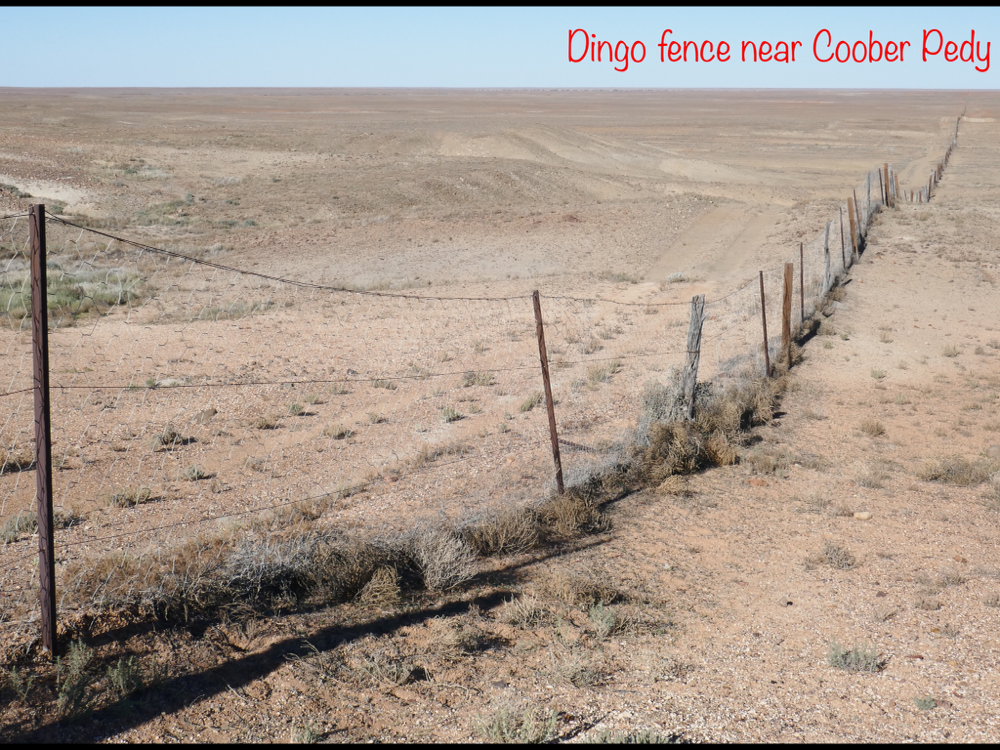
From Port Augusta we drove to Coober Pedy. I felt myself quite tense in Adelaide, a mixture of big city noise and bustle plus having had such a close shave with a robbery. I felt myself relaxing as we headed north, the wonderful music of Bach and Handel in the car, the featureless plains and hills and above the beautiful, blue, crystalline skies of the outback.
Coober Pedy is fascinating and should be on anybody’s ” to go ” list. The caravan park is called the Stuart Range Resort. It’s major problem for us was the thought disordered layout of the camper and caravan parking. Eventually we located a spot and set up. We clicked open our chairs, tossed on the blankets for later and had showers. We spent two nights at Coober Pedy and here is what we did. The next morning we spent an hour setting up the tyre dog sensors on the tyre valves. This remote sensing gives the pressure and temperature of both trailer and Car tyres. It’s fascinating to watch the pressures over the drive. Changes in pressure can indicate leaks, the lower pressure means more tyre road contact and the friction sends up the temperature which causes blow outs.
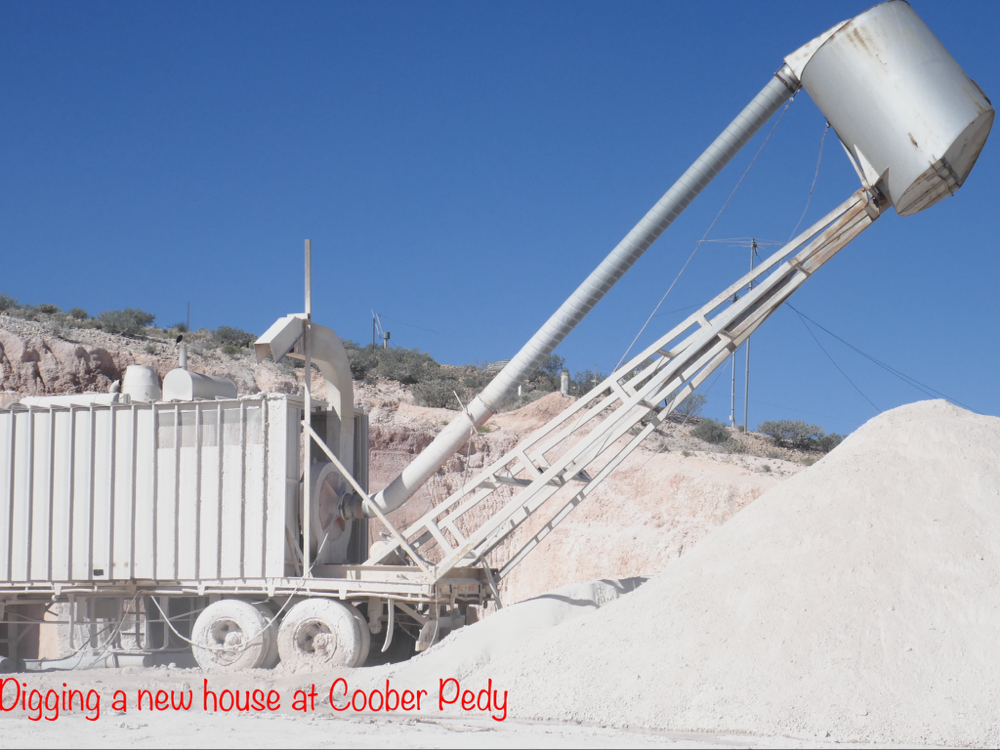
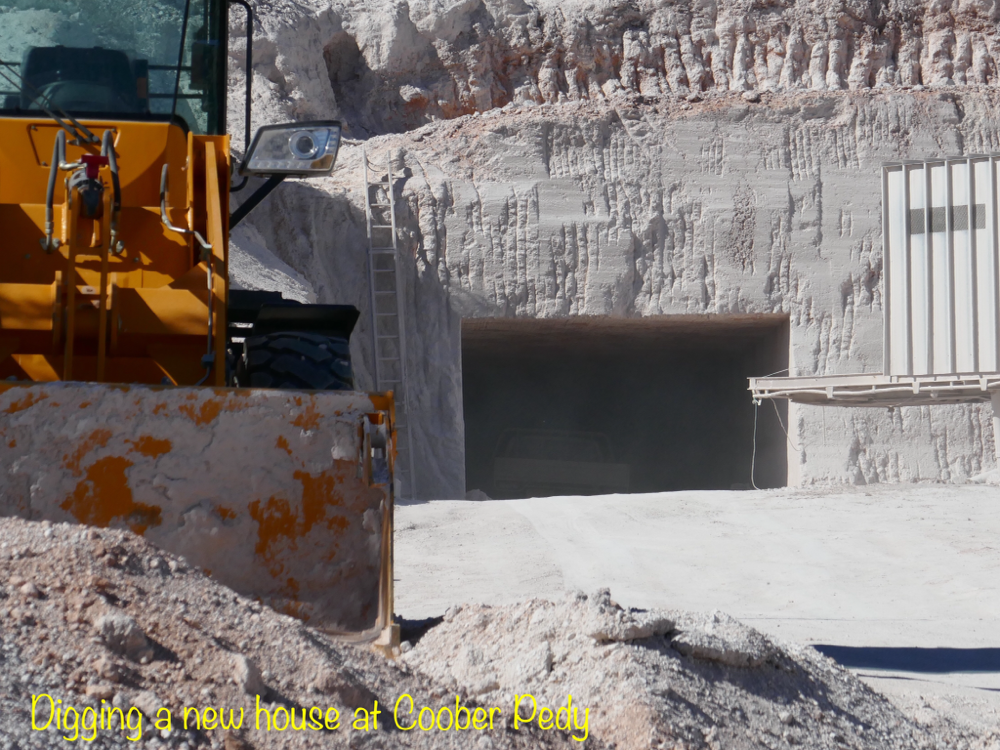
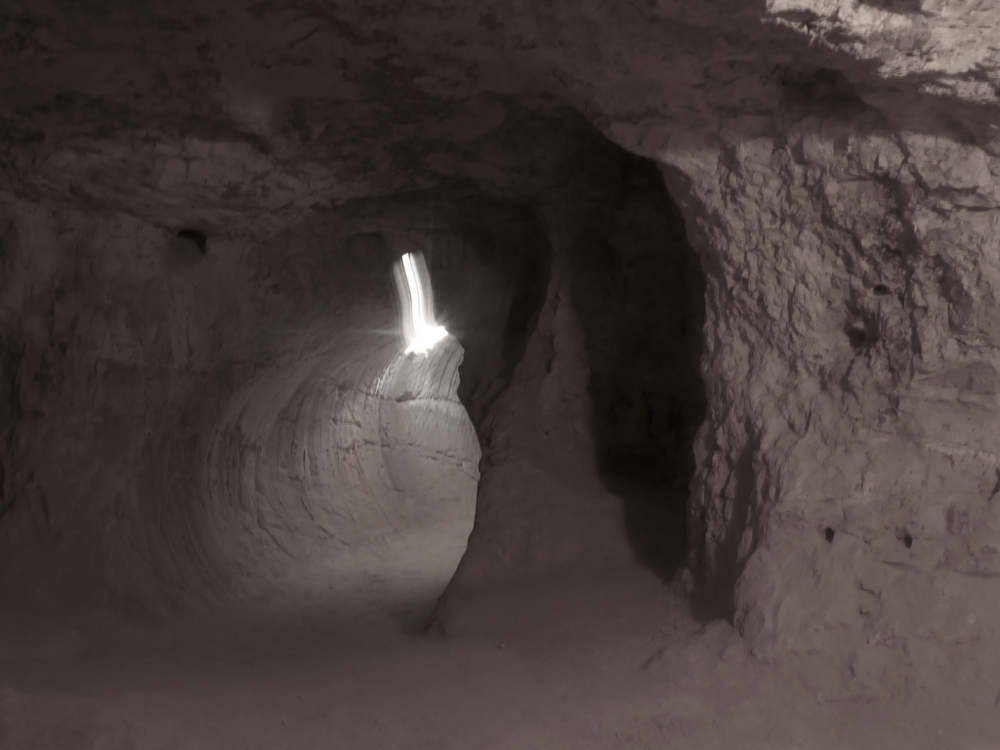
In the afternoon, we joined other travellers on a bus trip around Coober Pedy. Now Coober Pedy is an Aboriginal phrase that means ” white fellas living in holes” which is what the miners and locals do to escape the heat of Summer ( 50plus degrees) and the cold ( minus five) of Winter. The underground houses are called Dugouts and have a uniform temperature of 23degrees all year round. Ventilation is provided by a narrow pipe that sits a few meters above the ground directly above the dugout. Two of these ventilation shafts are perfect. If you have too many the warm air can heat the dugout too much.
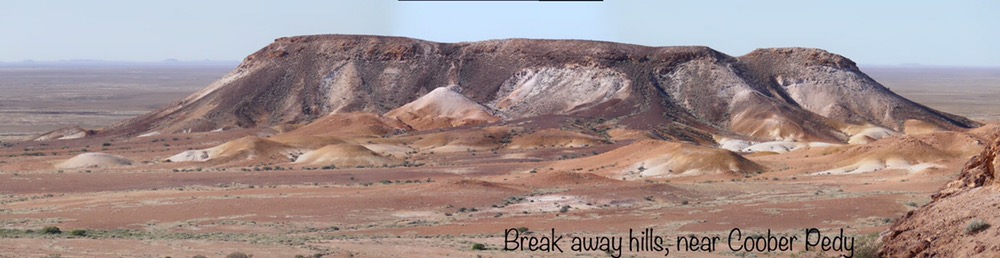
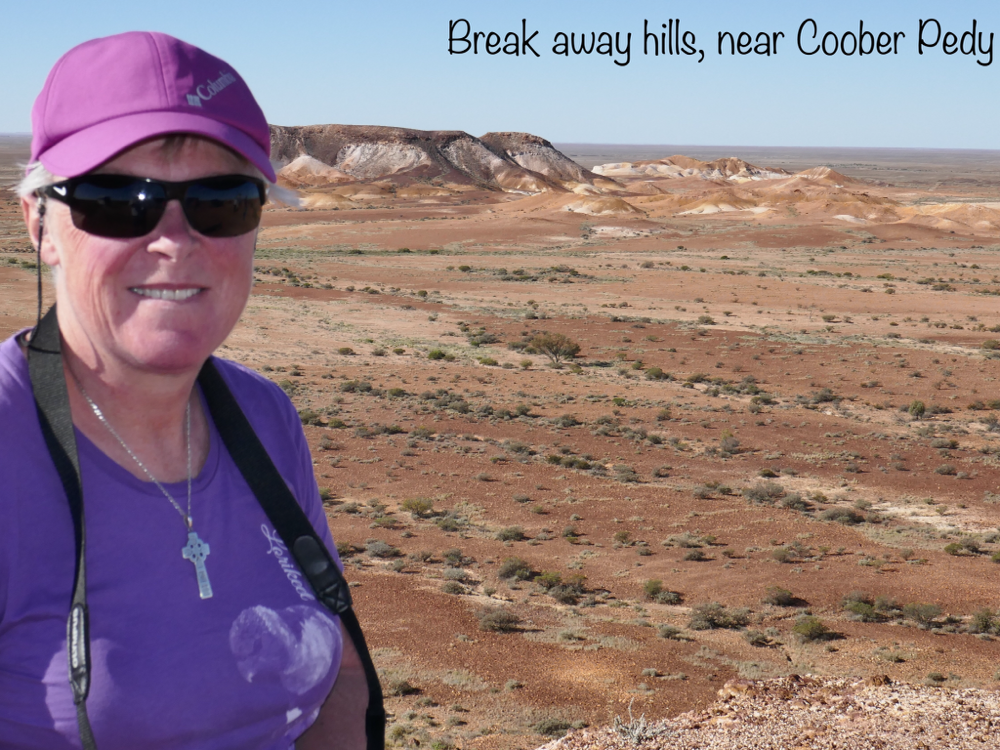
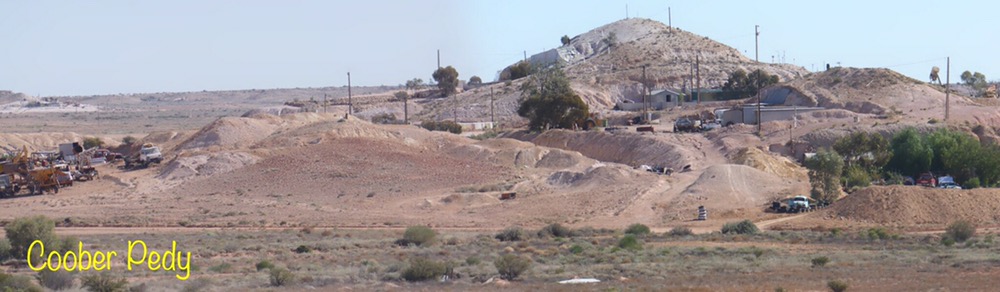
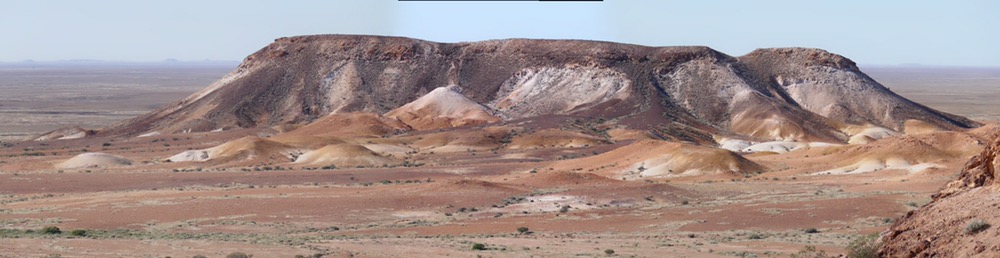
We learned about the rise of Opal mining in Australia, beginning in remote Queensland and ending In Coober Pedy, the richest opal site in the world. Our guide had been a miner for many years and knew many interesting stories about the history and characters that make up a frontier town like this. We visited the Breakaway Hills. This area has been used for films such as Mad Max Thunderdome and Pitch Black. It is now a reserve. The scenery is stunning, the ironstone caps if the hills staining the shale with red and gold down their flanks. There is no mining allowed here, its all natural. For most of Coober Pedy, conical piles of diggings fill the horizon. They are dangerous to walk around as no shafts are refilled. A 70 meter drop has killed or injured tourists and locals alike.
We visited the museum. Here was saw a movie on Opal. It described its ancient origins in human affairs, beginning in Roman times. Then opals were dug out of secret spits in the carpathians. These opals are muted compared to the vivacity and colours of Australian opals. The sheer brilliance and quality of our opals made European buyers hesitant to purchase them. The Australian Opal market really took off in the USA, and to his day, many fine opals find their eventual owners in America. I bought Jennifer some Opal ear rings and matching pendant, milky white with fiery reds and greens. The colours come from diffraction of light by minute amounts of water trapped in the hardened silica. Opal is ancient sand, descended from the ancient seas of Australia, 120 million years ago.
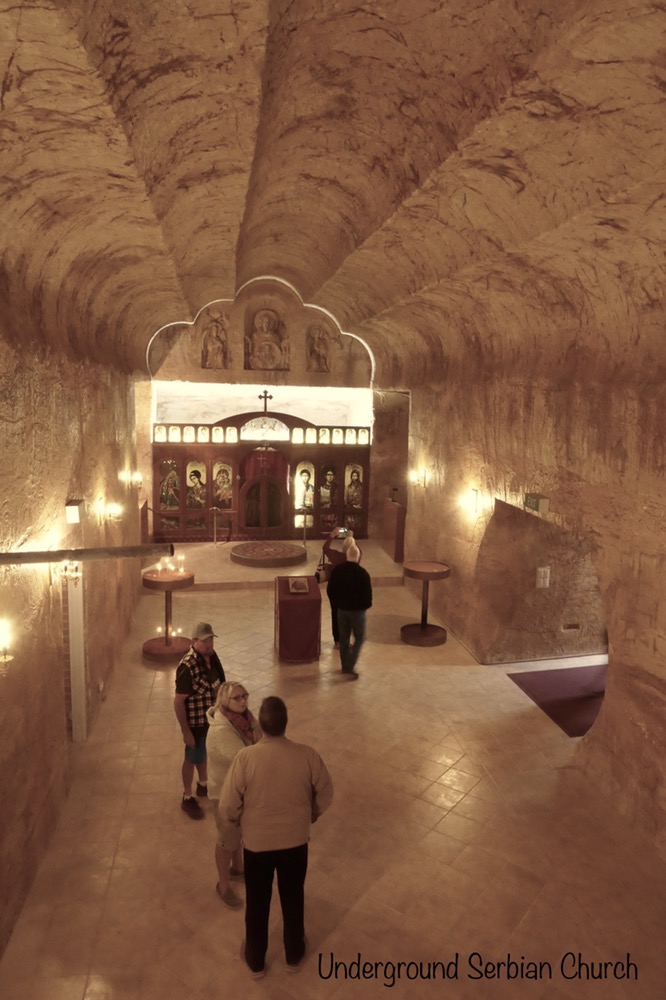
Our penultimate visit was to the Serbian Church. This is also a dugout as are most of the many churches here in Coober Pedy. It is a serene home of prayer and community, the parishioners are now to old to stand for the two hours of an orthodox service. On the walls are five sculptures by an early member of the church. They are religious. They are are of Christ, Saints and the man in saint of the Serbian church. He died soon after he completed them, still a young man and clearly a gifted sculptor.
In the evening, we had pizzas at the resort. These were the yummiest pizzas I have ever had. John who owns the resort, jokes that it took a Greek like him, to make Italian Pizzas. He would be in his mid seventies, and is still vibrant and hard at work, taking tour groups in the daytime and cooking pizzas in the evenings.
The next day we drove to Erldunda. This is only 200km from Alice but it would have made a 700km drive for the day which is just to far to be safe. It’s a very good park but suffers from the noise of the generator even though it’s 200meters from where all the trailers and caravans are parked. But the wonderful sunrise made up for that. A few people were disturbed but I slept well, with my silicon earplugs soothing my sleep.
We met Con and Sue Polizos from Phillip Island, they had a terrific rig with all amenities, microwave, oven, you name it. They are a lot of fun and joined us for a chat while I played my guitar, and we sat outside in the sunshine. At Adelaide we met Ted and Joe, who are travelling as well. They helped using with the cub as they have a very similar model to us.
Well right now, I’m writing this as we head to Alice Springs, north on the Stuart Highway. We are seeing our old landmarks like the Finke and turn-offs to places we have heard about or have visited before.


Flying
Outside the window, tiny irregular puff balls of cloud hover in the sky, their height above the ground is uniform, at least as uniform as anything in nature is going to be. The green and brown patterns on the ground below are muted by the haze of heated air and dust. The man beside us, is paying attention to the screen on his overlarge mobile phone, typing in text or queries or what ever people do with these adult toys. At one time adult toys meant something risqué to the middle aged but unnecessary for the young. He soon ceased his typing and laid his head back, gazing languidly out of the window. He watched the wing for a few minutes which I imagine would be a great deal more interesting if he could actually see the movement of air over and the lift sustaining flow coursing beneath the wing, he just might have stayed awake longer.
His snoring though midway between a rumbling and wet, sloppy purr is barely audible above the engine noise, those abrasive sounding motors are grabbing in innocent bystander atmosphere into its turbines then hurling it out compressed, singed and very, very quickly. Propulsion, not just a good idea but fundamental to staying ten kilometres above the ground, and therefore making it possible to sip this fairly average Chardonnay and simultaneously feel like a sardine oriented in the vertical opposed to more typical horizontal a la John West – the absence of oil is appreciated.
Flying is the miraculous, the utterly incredible converted to the hum drum, the banal. It is a totally awesome achievement. Something weighing as much as a suburban house not only stays aloft but gets from here to London chewing up the remains of Jurassic ferns. Doing it once is incredible, doing it twice is amazing but unfortunately doing it, a million times is plain boring. It is too easy to forget, if we ever actually knew in the first place, that crossing vast swags of real estate, like thousands of kilometres in a few hours, and a) not dying b) doing it while sitting down and c) doing it in comfort, was completely impossible for nearly all of human history and unless there is evidence to the contrary, earth’s history. Early Australian explorers took three years to go from the bottom to the top of Australia and back again, ruining health, suffering serious sunburn and all of the benefits accrued to their wealthy backers, poor recompense indeed for their trouble.
All this stuff, the stuff that flies, the rockets that enter space, motor cars traveling along, all them come from what is inside of the heads of scientists and engineers and businessmen and businesswomen. Now if is too often said that technologists and any monied class lack soul, lack any romantic imagination, that mystical poetic dreaming apparently exists only in music, art, and even cooking if TV cooks are any guide. These activities are creative whereas applying logic and science to a problem is dehumanising and the opposite of creative. Is it cheating to get the answers by using logic? However Imagination uses logic, as it uses memory, perception, education, and so on. Imagination is the overarching goal which all these attributes of human thinking ultimately serve. Imagination is paramount in any and all human endeavours that really change how we live and what we know. This applies as much to developing, applying and distributing revolutionary new technology as it does to artistic endeavour. Flight is technology, is business, is hyper organisation – at least not for booking agents who keep mucking up my baggage bookings – but it’s more than all that, if you close your eyes and breath in deeply, it is completely magical. It is romance. It is poetry.
Step back from our world weary 21st century and imagine the wonder and awe our grandparents had when mechanised flight went from the impossible to visible reality.
The laws of gases, of force and mass and acceleration, of gas and fluid motion in the Bernoulli theorem. These are all dry stuff and they aren’t magical, there just laws, their tools created by or discovered by humans. What’s magical is that the human mind discovered ( invented?) them, and they are right. They’re right because using these laws works, over and over again. They are the Swiss army knives that do a million things. But get this, a two kilogram blob of fats and carbohydrates stuffed in a calcium based skull, cobbled together over two billion years of trial and error can just click into what’s true about the world and in fact the whole universe, now that’s mind blowing. Then those same human brains have the determination and discipline to create sophisticated technologies based on that derived understanding of natural forces and processes, and then to use them ( mostly) safely, is doubly incredible.
Come on get excited about our modern conveniences , our phones with their own inner lives, steam engines thundering through forests and over deserts, our jets which carry us all over our world, and most of all give a toast to the people who made them all.
The plane is going to land soon, and a final miracle I hope will occur, which is getting off in one piece.
India : precautions and warnings
While everything is still very fresh I want to write down some of the scams you will meet in India, some annoying, some amusing and some downright troublesome. I will list them in no particular order than what occurs to me. Also I have included some precautions and take home messages about safety and security.
A Taxi driver or tuk tuk driver picks you up from the airport, you are tired, this transport was pre-booked so you assume it will be plain sailing into a comfortable bed in your booked hotel. The driver tells you the hotel is closed/burnt down/terrible/surrounded by a demonstration or whatever. He rings ” the Hotel” to confirm this and then takes you to a hotel where he gets a commission. These hotels are uniformly rubbish, they won’t let you contact your booked hotel and it can get very heated trying to extract yourself from this scam. Taxis booked by Intrepid were fine.
2. You leave your hotel in the morning ready for adventure. An overanxious to please man approaches you about a tuk tuk. You say where you want to go. Your query price as there are no working meters, ever. He says, whatever you want. You have got to insist on a definite price and get it down, as foreigners pay vastly more than do locals. Your own hotel can give you an idea of what is reasonable. You are on your way, and the driver stops his vehicle outside an emporium. Only five minutes he says. More like an hour. You are shown expensive goods in one section, then another and another if you don’t just walk out. We bought a beautiful carpet and organised for it to be shipped back. But when we were hand passed to the jewellery section, we baulked. Got up and left. Unfortunately, you have to be rude to these people as they will waste your time extravagantly hoping to wear you down into purchasing something. And whatever you do look reluctant to purchase, and the price comes down, big time. If you driver pulls up, and pressures you to go in, just say I want to go to my hotel now. I am not getting out till I am at my hotel. Or whatever your destination is. Indians abhors people who waste their time, if you are not going to play ball, they cut their losses and drive you away from the emporium.
3. Temples. Holy men are called fakirs, giving us the term fake. There are some sincere ones but they are not in tourist traps botting off tourists. A holy men in a temple asks for a donation. There is a tray with a 100 rupee note and incense burning. Every tray in that temple has a 100 rupee note, to allay your suspicions. Most temples that would like donations have a clearly marked donation box and warnings about giving money to ” holy” men.
4. Varanasi. This place needs a section to itself. Holy men grab your hands or thrust flowers into your hands then demand money for the blessing they have given. Children too thrust flowers into your hands and then ask you to pay.
5 . Beggars. Beggars will grab your arms, push their babies in your face, and just obstruct you. Beggars are uniformly rural villagers who were convinced by a city businessman to come into a city promising them well paid jobs. In fact they are marooned, they have to beg and a percentage of the take goes to the businessman who seduced them here. The children and babies may not actually be theirs, there is a huge problem of abduction of young children at railway stations, these children are abused, often mutilated to make them more effective beggars. This actually does happen.
6. Monuments and forts. The big expense in an India trip is paying entrance fees 50 times greater than locals. Adding to this cost, some enterprising ticket sellers, offical ones in the booth, will shortchange you. Always count your change, and if it’s not right, confront them. If you block up the works, and get confrontational, they will cough up the money. Don’t leave the counter till you have checked your change.
7. Indians expect a tip, but if service is really shoddy they can do without it. 10 rupees for carrying a bag in a hotel, a porter at a railway station, about 5% is a good tip at a restaurant but check the bill if there is a service charge, this means a tip is already included – no need to tip twice.
8. Photography. Don’t pay for photos, ask politely for permission but your are an amateur who will never make money from your photos. Another common scam at monuments like the Taj Mahal, is a scammer will say here is a good place for a photo, and here, and here and then they demand a tip. I have had security guards do this scam.
9. Don’t forget personal security. Keep your passport in a RFID WALLET / SLEEVE. Keep one debit or travel card with the passport. This is back up cash if you lose your other cards. Your wallet should be secure, preferably a zip up wallet and a chain to attach it to your belt. Your camera strap should be sturdy. I was told that motor bike riders can use a sharp knife to cut off your camera strap, but as most motorbikes travelled at little more than walking pace and a fast getaway is impossible due to the traffic.
Have a debit card as well as a traveller cashcard, it’s worth having a variety as ATMs may not take all cards and having no local currency is not an option.
A small LED TORCH attached to a chain with your keys to your luggage or pack can prove very handy in temples, crypts, power failure or poorly lit streets.
Keep bag numbers low, you will often be tired, distracted, and it’s just too easy to forget that fourth bag on a seat or taxi. Do a bag count often and especially when alighting from trains or taxis or tuk tuks.
10, Hawkers. These are rarely a big nuisance, if you say no politely and move on, they won’t hang around. Occasionally, a hawker can be really persistent, repeatedly say no. But if it’s getting a problem, say no like you really mean it. Sometimes some judicious aggression is needed. Also Indian sellers, snake charmers, hawkers, believe that touching and looking are the same thing. Don’t look at their products.
11. Guides. Every time you walk around, people will ask where do you come from? Where are you going? About two thirds of the time, it’s part of a scam. Touting for a business. Expecting a tip for pointing out that a shop you want is two doors away. The trouble is you start to view most possible interactions as opportunities for trying to rip you off. Now they are all small amounts, but let’s face it, white tourists and even more so Japanese tourists, are viewed as walking cash machines. These local people earn just about nothing, they don’t get any social security if old, sick or unemployed, they just starve. If I have sounded critical of Indians in the above text, I must temper that now by saying, their daily struggles to get enough to eat are not those even the poorest person has to face in Australia. They need to make money any way they can and they cannot afford to be squeamish about how they do it. There is a true desperation to many of them in their lives which we cannot understand. That fifty rupees can be a meal for a family. So don’t get too upset, don’t be too defensive, sometimes it works out for the best.
12 Trains. It’s well worth having a chain and reliable lock to secure your bags ( also locked) to the attachment points beneath the seats. Also pack your bags to make them flat not fat – this enables the bags to fit easily under the benches. Always have your own role of toilet paper in a snap lock bag as train loos don’t have paper. A good time for a bag snatch is just when your train has arrived. Your carry pack is resting on a bunk, you are tired and inattentive.
13. Toilets and hygiene. It’s impossible to avoid exposure to E. coli. You can minimise it, and it’s worth doing as the lower the exposure then the milder the upset will be. Use anti bacterial gel often and always before meals and after the bathroom. Wash your teeth and rinse toothbrush in bottled water. Bottled water should have a definite click when you open it otherwise suspect it’s been refilled. Any cold foods such as sliced pineapple, apple and so on may have been washed in contaminated water.
If you do get diarrhoea promptly take 800mg statim ( that means take it straight away ) norfloxacin and two loperamide. This is very effective. Icthammol and zinc cream in a tube protects sore skin. Extra fluids especially with hydralyte for electrolytes. And if no vomiting then eat, even if you don’t feel like it.
14. Basic medical kit. Saline for SMOKE and insect debris in eyes. Bactrim DS for skin, chest and urine infections. Panadol for headache. Sunblock applied each morning before walking out. A 12 cm wide heavy minimal stretch bandage for sprains. Some betadine liquid/ wash for any animal bites.
15. Buses. If you cannot get your bags on a rack or under the bus, then quickly buy a seat for it. It’s a long long trip with luggage on your knees.
16. Offical guides at heritage areas. More often than not they cannot be understood. They will rush you through and out the exit before you realise you are back at the parking area. They want to push you through quickly to get another job. Avoid them. If you can get an audio guide they are usually quite good. If you cannot, many travel books like Lonely Planet have adequate descriptions of the site.
17. Air travel. The main problem is the often small amounts of foreign currency which require a time wasting declaration at the exit. Check before you leave home. India has major limits on American dollars for example.
E visas do not save time. You will wait two hours in a queue of less than a dozen people. Indian bureaucracy is hamstrung by antiquated technology and a lackadaisical attitude to customer service. In short, never have a short connection time , less than three hours, between an international arrival and a domestic departure.
18. Alcohol. Never, never, never get drunk. Never take a drink from a stranger. Always see your drink mixed. It’s too common to have drinks spiked and lose PIN numbers, credit cards or worse. This does happen, in fact to one of our group when in Bali. Have fun but be wary and careful.
 brucebarker2016