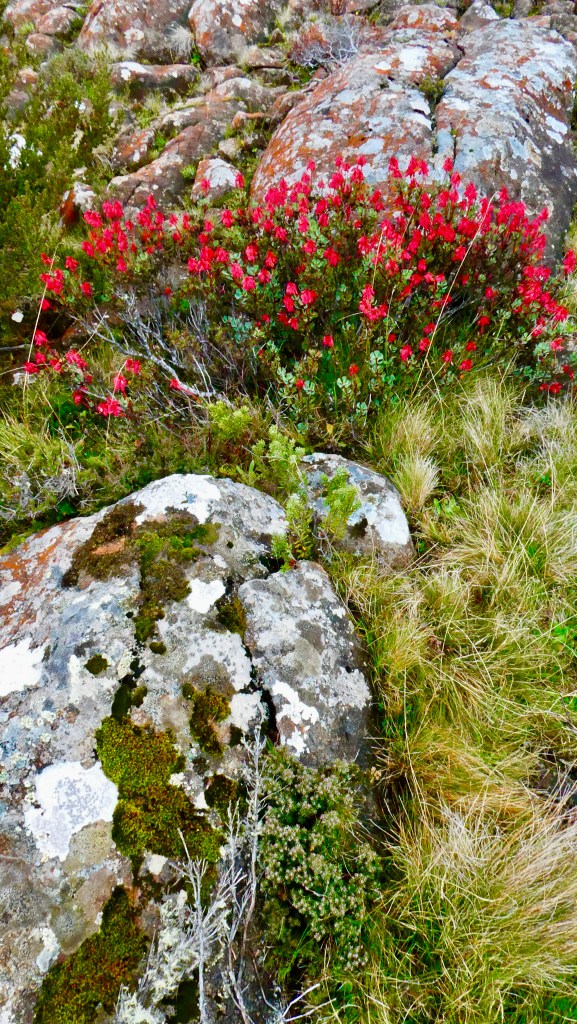
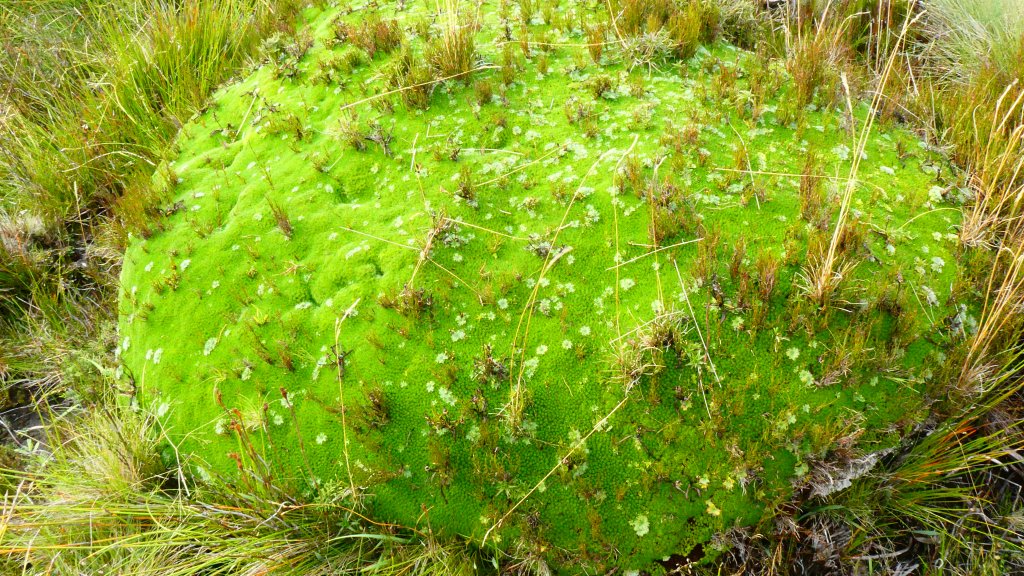
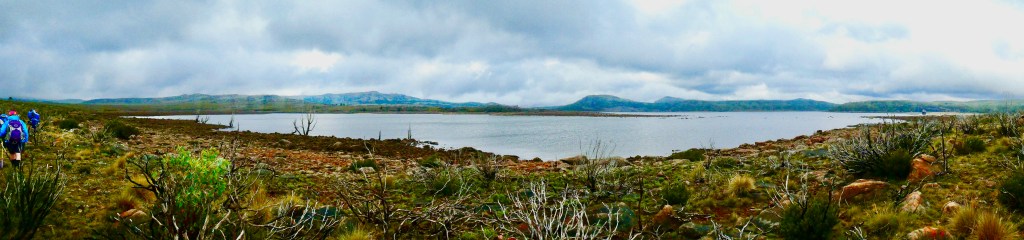
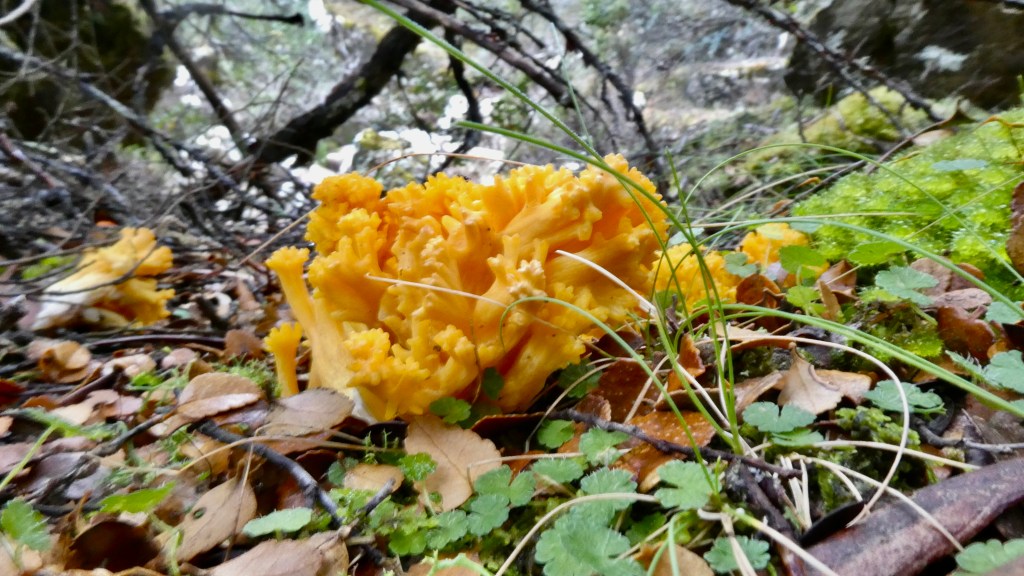
Last Sunday, ten Ramblers drove out past Mole Creek all the way to the dam at Lake Mackenzie. The skies and clouds threatened rain. When we exited our vehicles warm clothes were essential. The surface of the land gently undulates, most trees are dead, burnt offerings, leaving only cushion plants and native grasses. The bright native called Mountain Rocket is splashed haphazardly, nestled on the ground beside dolerite boulders. Brightly coloured fungi sit beneath grasses and twigs or emerge en masse from dead blackened branches. There are massive, splendid green cushion plants which evaded the fires. At my feet are miniature havens brimming with tiny plants, masses of white flowers in some, red berries in another and all are awash with water.
We walked along a minimal track, skirting the lake. We entered a boulder field. We carried on to Lake Mackenzie hut. This small cabin was built to replace the original hut swamped by the rising water when the dam was built. There many artefacts including canals and pipes to manage the water now stored in the lake.
The hut is well built. It has a wall dedicated to information about the hut, lake and the high country of the central plateau. There are sturdy timber bunks. There is a loo a short walk away with fabulous views; views of the person using the throne.
There are some trees that survived the fires, a patch of snow gums and pencil pine within fingertips of another pencil pine burnt down to a skeleton. There are fine views the old shore line, previously sandy lake was one of three adjacent lakes, now combined into one, a crescent of water that arches around the elevation adjacent to the hut.
After lunch we took a shorter route back but this was harder than the tramp in. Thickly congested boulders provided ample opportunity to balance, jump, pivot and so on.
After we reached the cars, it was only a short drive to the other end of the dam wall. Estelle saw two wedge tails circling high above the dam wall.
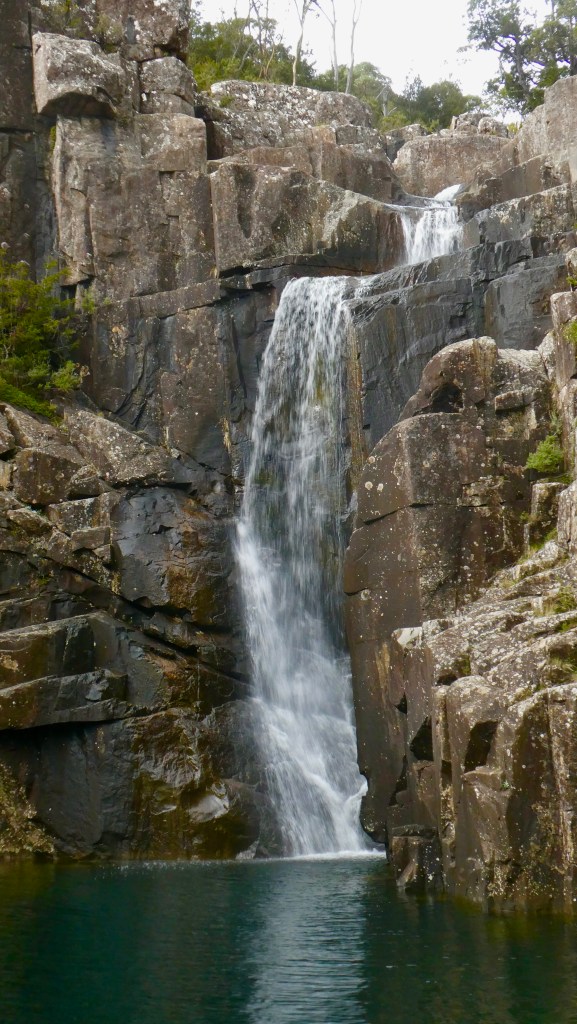
We walked beside a canal then descended steeply beside a huge water pipe to Parsons creek. For much of the descent there were concrete steps. Parsons creek was challenging because of fresh boulders. Jen and Elaine decided they had ample time on boulders and went back to the cars. The rest of us persisted on, the track entered the forest, it took us in just a few minutes to a lookout over parsons falls and the pool beneath. Then a forest scramble until we reached the viewpoint at the bottom of the falls which we could see across the water of the pool.
On our way back, it began to rain. I found my umbrella to be adequate as there was little wind. We decided that visiting Devils Gullet in the rain was not worth the effort so we drove to Earthwater cafe for coffee, tea and cakes.
Parsons fallsmountain rocketCushion plantsTiny refugesLake Mackenzie hutLake MackenzieA tarn near the hutA magnificent Pencil pine that defied the fireCoral fungus
At the end of March, 2022, Jennifer and I drove to Bruny Island to spend time at Inala as well as with Max and Lyndel. We drove straight to our accommodation which is off the lighthouse road and about twenty minutes drive to Inala. Inala is a property dedicated to conservation. The owner, Tonia has owned this area of 1500 hectares since the 1990s. Previous owners had logged some sections and Tonia has allowed that section to recover. It’s not as pristine or as rich in birds, plants and other animal life as the recovery is slow.
The house we stayed at for three days is leased by Inala. From its back verandah, It’s only a short walk, a descent to a beautiful beach. There is a small island immediately beyond the mouth of the bay. The house is large with comfortable furniture. Around the house is forest, tall eucalypts spiral and twist above a low bush crowded with ferns and bracken. At night, as darkness comes, Quolls frequent many of the houses on Bruny Island in their search for food.
That evening Max and Lyndel arrived to share this house for one night. I went for a walk with Max to see the beach at sunset. Very quiet, water lapped the beach, narrowed as it was near high tide mark. The following morning, there was a large tidal flat with wet rippled sand and small pools left by the retreating water.
On Tuesday morning, we woke up early to the sound of our alarms. We needed to be at Inala by 7:30 am. It pays not to drive too quickly. Even so, the next day, a pademelon launched itself from a culvert, breaking its leg as it hit the rear tyre of our car. It was very annoyed. We tried to get help as we were near Inala but the little creature climbed into a blackberry patch. By the time help arrived, he was hiding in the prickly, dark blackberry bush.
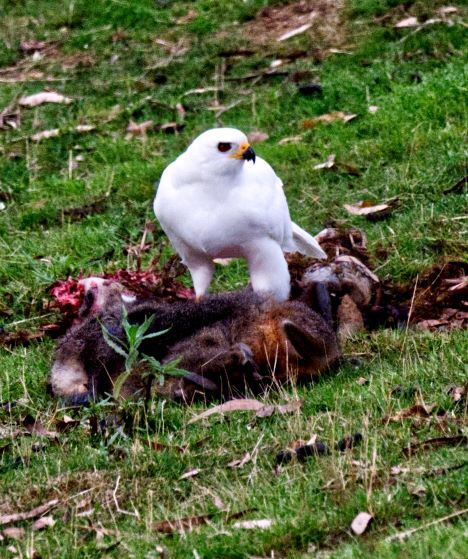
After we arrived at Inala, our guide conducted us to the bird hide. We had exclusive use for two hours. This hide is for taking photographs and observing raptors. Road kill, mostly pademelons, are laid out near the hide. There is a large glass window of photographic quality. The first bird to visit was a Grey Goshawk. The example we saw and watched for some time, had glossy, white plumage. At first it perched on an old tree branch, seeming to gain in confidence, then it dropped down to the carcass. The local birds know about this regular food and will come here for a meal rather than take their chances with cars when eating on the road. It is really a magnificent bird. Bright intelligent, yellow eyes sit behind a sharp, curved beak. It’s legs are muscular, and end it strong, sharp, orange claws.
Max, Felix ( a young friend Max is teaching photography) and Jennifer had exactly the right lenses while I had a great camera but too underpowered a lens. Their photos were really outstanding. Max used a gimbal that allowed him to pivot easily and precisely on his tripod.
We all took so many photographs. Jennifer took 700!
Then, after the Grey Goshawk was sated and flew away, a brown goshawk arrived. He was even more skittish. He perched on the tree branch, flew away, then soon returned, then at last he flew the short distance to his waiting breakfast. This is a very beautiful bird, a brown and white stripped chest, soft brown plumage down his back and had the same piercing, yellow eyes. He had to contend with ravens who were interested in the carcass as well. They would flap around, dancing to and fro, gauging the annoyance and irritation of the Goshawk, before pecking away as it’s back was turned.
The time went quickly, at at 9:30 we packed up our cameras, lenses and tripods. We went back to our car, and drove back to the house. Max and Lyndel, left later in the morning. We returned to Inala to explore the unique gardens located there. Gondwanen species are well represented, so we can see trees and plants , mostly native to South America and the Pacific, including Australia.
There are concrete paths but it’s easy to cross the lawns as well. There is an electrified fence to keep cats out. Native animals such as antechinus and swamp rats now make this area their home. There are so many of them, and so busy commuting between trees with their yummy seeds and nuts, that their trackways can be seen in the grass. There are several Wollemi pines. Often pot bound when they arrive, they all flourish when properly planted here in Southern Tasmania.
We had a relaxing afternoon. The next day we packed up the car with our belongings, grabbed cameras, and went back to Inala. We were to meet Tonia, and spend three hours walking with her, exploring the property. By now it was overcast. In short, a dismal sort of day, that later turned to rain. We did not see as many birds as we hoped but we we still had a great time. Tonia explained many interesting aspects of the life here. We spent some time at the pardolote hide which is nestled amongst manna gums. The forty spotted pardolote is an exclusive feeder, eating the sap of manna gums by piercing leaf veins with its specially evolved beak. It also eats lerp, the leftovers of insects which live beneath the bark of manna gums. The striped pardolote is much less fastidious in its diet. We did catch a glimpse of one later, it was amongst a nothofagus in the garden but here in the hide in what can be considered prime real estate for these elusive birds, they were scarce. Now in fairness, this may be due to a Collared Sparrow hawk that was flying from tree to tree, hassling a pair of green rosellas. A pardolote would be an easy meal for a sparrow hawk.
We walked along bush lanes which Tonia had built to wind within the forest. We could hear many birds but is hard to see them. I had a wonderful glimpse of a pink robin behind some bracken. I was amazed how quickly and accurate Tonia was in identifying birds from their calls.
By the time we finished, we were all cold and wet as the rain had settled in. We had a lovely day but more importantly I began to learn some of the skills a bird watcher would need. These would include ; patience, listening, good binoculars and knowledge of the birds habits. Tonia has Swarovski binoculars which are very expensive and very good, providing a wide, crystal clear view. At home in Launceston, Jennifer bought a pair of Nikon 8 x42 binoculars which are light and much less costly.
We had lunch at the Bruny Island Winery. We both enjoyed Pork Rillete which is sort of a pate. It was served with bread and crushed nuts. It was a very good meal.
We carried onto Max and Lyndel’s place. We let ourselves in and had showers before Lyndel arrived back. She had spent much of the day, driving on Bruny Island to show another guest some of the highlights.
We had a relaxing afternoon. I played some guitar. In the evening, we watched one of our favourite movies; Dean Spanley. The next morning, we continued our journey. We drove to Hobart to stay at Hadleys Hotel. That evening we had dinner at Rockwall, Friday night at Maldini and Saturday lunch at the Greek restaurant in Salamanca place.
Hadleys is very quiet despite being in the centre of Hobart. The rooms are old school, very comfortable and quite charming. Our room faced the roof which covers the dining atrium on the ground floor. We did some shopping for some hiking and camera gear. We thoroughly enjoyed our visit to the State Cinema where we saw the documentary called River. The seating was comfortable and the film was excellent. We visited the adjoining bookshop.
On Saturday morning we walked to Salamanca for the market.we hoped to get dresses for both our grand daughters. We succeeded in getting two lovely dresses for Lauren but not for Isla. It seems to be a problem buying nice clothes for her size and age. Luckily we did purchase two tea shirts to add to the books we already have for her imminent birthday.
Each morning I went for a run along the old railway track. Jennifer on her Brompton bike was close behind. The first time she became very cold and so the next time, she wore some purchased thermal tops and fresh gloves and was much more comfortable.
Saturday night was concert night. Beethovens ninth symphony as performed by the TSO in the concert hall. It was a wonderful performance which was only marred by two mobile phones going off, the latter in one of the few quiet passages in the symphony.






 brucebarker2016