
14.2.2022
We decided to do the walk from the lower car park at Liffey to the top car park and return.
Its about a 9 km hike. The track begins at the campground located downstream on the beautiful Liffey River. The track is very clear as it begins its way north through dry sclerophyll forest with abundant tall, straight trunked gum trees and bracken ferns. A sawmill was located here in bygone times and the timber was all extracted from this valley. There is now little other evidence of forestry activities except for the track itself where felled trees were brought down on a simple log railway. In convict times heavy transport was done by groups of men who were chained together but in the more enlightened times when Liffey was exploited, I suspect horses were used. Animals have been badly treated in the most part. I think back to my own Welsh heritage when my grandfather worked as a boy in the coal mines, sweating beside pit ponies who were born, lived, worked and died without ever seeing the sun.
Thankfully in this part of Tasmania, the forest has been permitted to recover. It lacks the giants of the rainforests seen further south, especially in the magnificent Florentine Valley but there is still plenty of variety to enjoy on this walk.
The sky is hazy from forest fires burning northeast of Launceston. The bluffs above the river are finely obscured by smoke. They are sandstone. It was lifted here by dolerite, which is still deep in the earth, far below our boots. The genesis of the Western Tiers is one of the geological consequences of Antarctica tearing itself from Australia. Antarctica left behind the island of Tasmania with which it has always previously travelled.
The rain and snow spilled onto the high country to the west (well at least West now) and melt water formed torrents, the landform changed, creating the ancestral Liffey River. It flowed with vigour, powered by altitude and abundant water, etching its way through the sandstone. This sandstone forms the river floor and the steep valley sides, littered with caves.
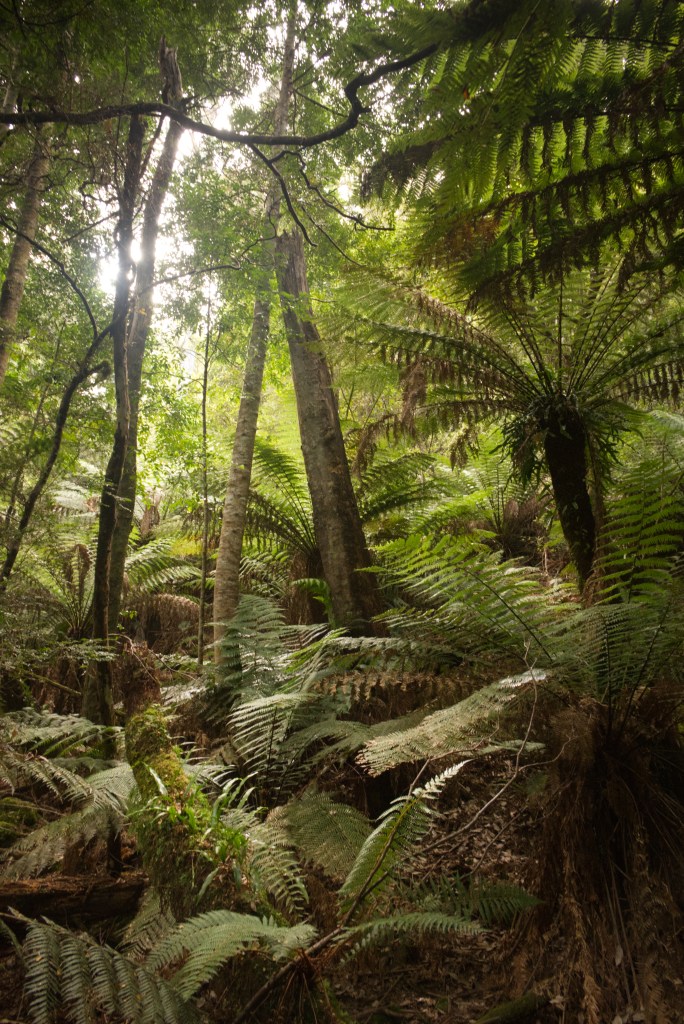
Man ferns, also called Tree ferns, and even more correctly, Dicksonia Antarctica. Again, this link with Antarctica. The track winds gently, swaying and undulating between these tall ferns. They are abundant, especially in dense groves nestled between the larger eucalypts located on the shallower slopes. Their fern branches arch over the track shading walkers like us. The brown fibrous surface of the ferns is inviting to touch, its pleasant to run my fingers over it. The light is even; a sunlight dimmed by morning, smoke, and the many sheltering trees and ferns. It scatters softly over the plants and down along the river; much of the bank is dark, forested, obscured but there are some renegade splashes of light which graze the water or a fortunate fern; aglow before the rest.
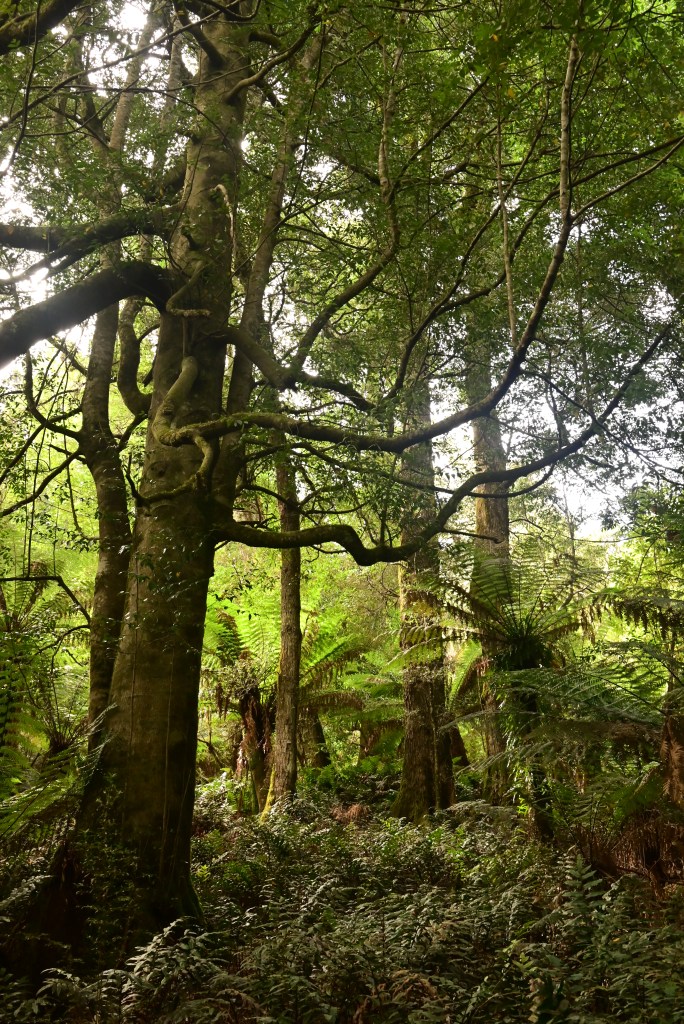
Soon we ascend, into a mixed forest with Myrtle Beech, Dogwood, Native Olives, Leatherwood, Sassafras, Celery top pines and tall eucalypts; the latter stand high, confidently astride the others except for the occasional large Myrtle Beech. The Myrtle Beech is an evergreen with small delicate leaves. Their dropped, brown, dry leaves are scattered over track and forest floor alike.
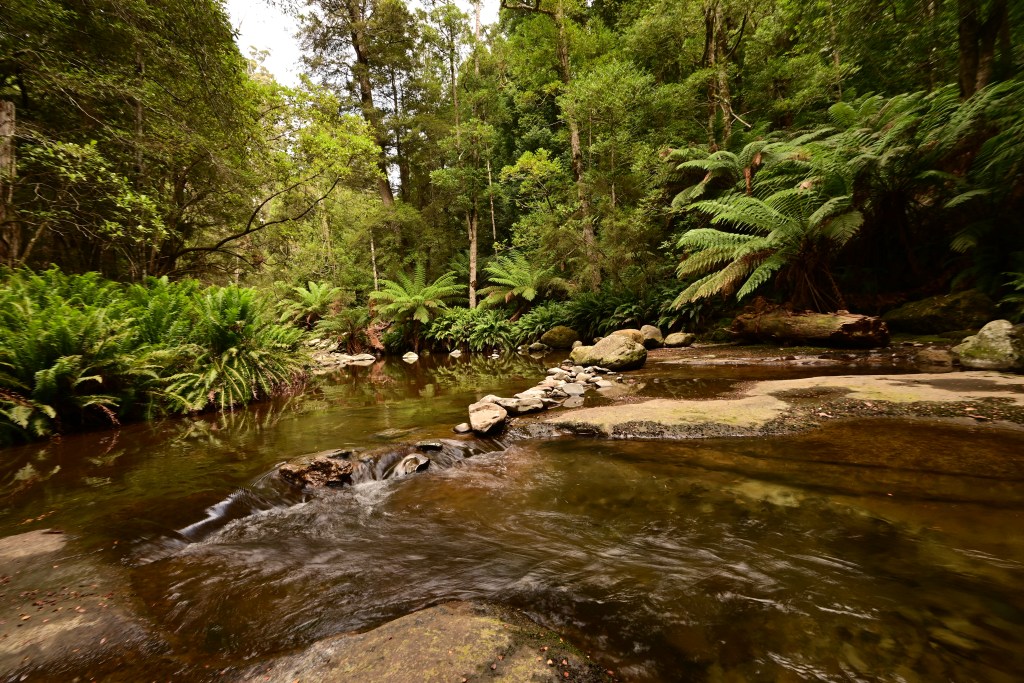
There is always the sound of water flowing, tumbling in the river. At some locations its possible to drop down the bank and look along the stream. It has been unusually dry in Tasmania the last 3 months, and the general water level is low. Fish can be easily seen as they dart to and fro in the transparent water. The ofttimes single river running from bank to bank is now braided into separate, shallow streams; these splash between rocks; at times congregating in deep pools then they continue, their paths re-joining again and again.
We crossed the well fashioned bridge over Quinn’s Creek, a tributary of the Liffey.
A family of Superb Blue Wrens flitted together out of the forest to alight en masse on the branches of tree ferns. They rapidly darted off again and through the twisted branches of Myrtle Beech and as suddenly disappeared as they had arrived.
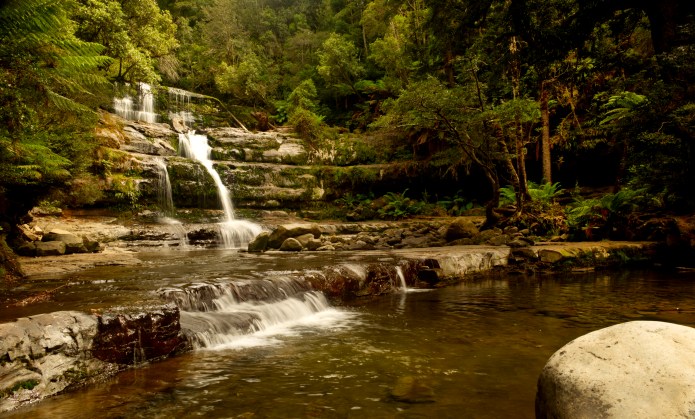
The first waterfall is 4 km from the beginning of the walk. It has been the subject of many calendars including one of mine. There are many round or oval stones that are not sandstone. The question arises about how they got here. They are called drop stones. At one time, probably the last great Ice Age from 2,000, 000 to 10,000 years ago, there were glaciers and ice bergs calved by them. Glaciers collect stones and rocks, then as the Ice bergs begin to melt, these stones are lost and fall to the bottom of the river or lake. The waterfall is series of horizontal sandstone shelves which sweep across the rivers course. It is a delightful waterfall even with the minimal flow we were seeing today.
Jennifer and I set up cameras, attached lenses, played with filters, and took lots of photos. Later we saw a family group with some 2 year and 3-year-olds straddling and climbing the steps to enjoy the views. We carried on the track to the cascades. We sat on a dry rocky platform beside the stream to relax. Afterwards we took more photos of the river, its pools, and cascades as they swirled around us.
We walked up the steps to the car park for a light lunch while sitting at one of the wooden picnic tables. On our return, we stopped off at a look out, then, when I returned to the track, I met a Tiger snake. It was in loose coils sunning on the dusty path. Suddenly unravelled and tried to enter the cover of foliage beside the track. I stepped backwards quickly and inadvertently collided with Jennifer and sent her flying backwards. Jennifer was sore from her heavy landing. Thankfully no permanent damage. The snake was gone by now. Tiger snakes are very venomous. This one was an adolescent as it was not big or long. These are even more risky as they cannot do dry bites very easily or limit the amount of venom they instil into a bite. Tiger snakes can be black (like this one), stripped, or even yellow and have a large head unlike the more delicate tapered head of a Copperhead snake.
It as getting warmer as the morning turned to afternoon. The air was dry and becoming dusty from distant smoke, but the forest was just as beautiful. The harsher light discouraged photography. At the conclusion of the walk, we both felt tired and a little irritable. We had not drunk enough. We knew this as we studied our water bags when we pulled them out of our packs.


 brucebarker2016
Thanks Bruce, nice story telling again about a lovely walk, The Ramblers are doing this walk again, I think on July 3rd as it was the first walk done by the Ramblers 50 years ago.
Regards,Trevor ________________________________
LikeLike