
I am lying down in our cabin on the “Spirit of Tasmania”. It is just past 8pm and a nearly full moon is sitting amongst clouds in the sky. The engine is throbbing the superstructure. The ship horn sounds from high above me. To the south I can see land, green, flat and dark inching out of the water.
I have not written much about my work in the last few months and feel that omission is overdue for correction. My previous blog described my walk in the South West. This narrative will leap frog that with stories, impressions and photos spanning the last few months.
Flying
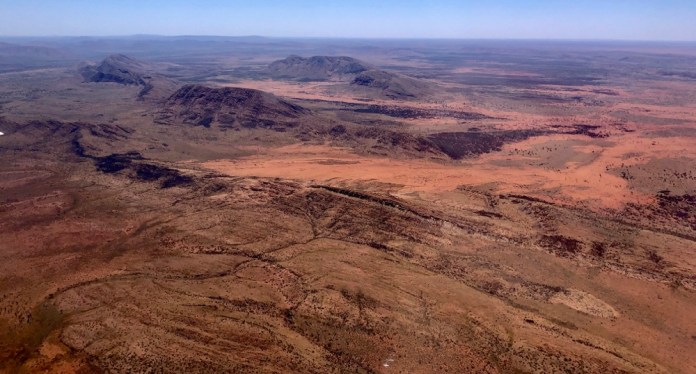
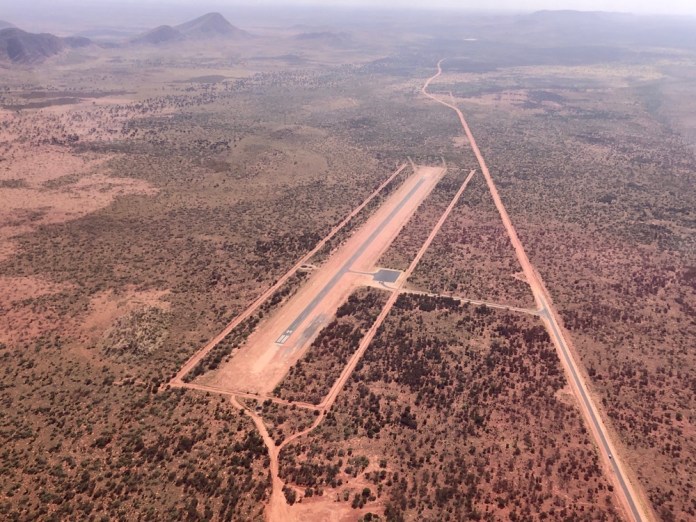
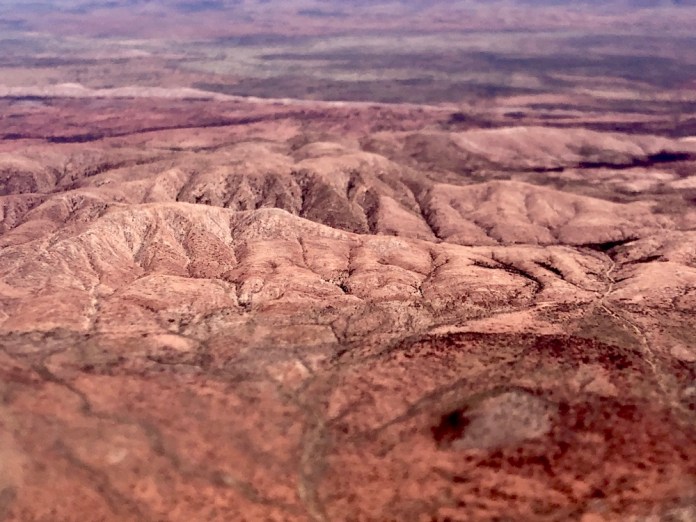
I am minutes from landing at the airstrip at Docker River. I am in a Cessna. I cannot recall the actual designation but it has six seats and two engines. The land beneath us is hot and has been hot for the last three months. For December and January the temperature has been regularly over forty Celsius. The air above the red sand of the arid zone swirls upwards in invisible thermals. These small planes pivot and twist in the cavorting air giving their pilots plenty of work. The plane bucks like an angry brumby as we encircle the strip far below. We almost hover over the several curving ranges which surround Docker River. As the plane drops, the hills, steep and worn, rich browns and reds, rise up to span the vista around me.
Then, one wheel touches the tarmac; the velocity of the plane had seemed slow relative to the landscape but with landing the true speed became fully apparent. The slowness of flight moments before was an illusion that collapsed on reaching the ground. Now trees rushed past, fence poles blurred where they had been so distinct and studying them down below me through the planes window had been a leisurely process.


Walking
I like walking, walking without people swerving in front and behind me. I walk early in the morning to complete several kilometres before I need to get ready for work which starts at eight o’clock. It’s dark, most dark when clouds blot out the stars and the moon has set. I wear a small rechargeable headlight which illuminates the ground I front of me. At Docker my small flat is on the outskirts of the community so walking does not rise much interest in the local dogs. There are only a few scattered barks from a fenced but open gated property fifty meters down the road and opposite me. I make sure my light is turned hard down and walk quietly and quickly in the other direction. This road is made of bitumen not dust, and therefore provides a smooth surface. It’s also very new and therefore lacks the potholes and cracks as the road is flexed by the repeated heats of summers.
It’s still hot, about 25 degrees and will climb to 45 degrees by lunchtime. This is the other reason for walking before sunrise. Even a short walk to and from the clinic back to my flat at lunchtime is exhausting, the power of the sunlight assaults my bare arms and it’s heat is felt through my shirt. Noon and afternoon do not make for pleasant walking.
The air is still which is unusual as cyclones far away in Queensland have created a torrent of wind that has buffeted the community for several days. It is pleasant walking into a cool breeze but not when the wind hurls the western dust against my skin and eyes. Motionless dead air is acceptable at least until the temperature begins its ascent with sunrise.
I walk carefully. If I am going to meet a snake it will be now. The high temperatures of desert daylight are as uncomfortable for the snakes, lizards and native animals so they do their hunting and scavenging in the dark. My narrow beam of light guides me along the road. It’s illumination keeps me on the road and avoid the sharp edge to red dust. It’s not the dust I fear, it’s ubiquitous, it’s the edge itself. A serious fall has consequences that don’t exist in the city or town. It can be hours before some vehicle travels nearby and mobile phones usually do not work so even calling for help can be impossible.
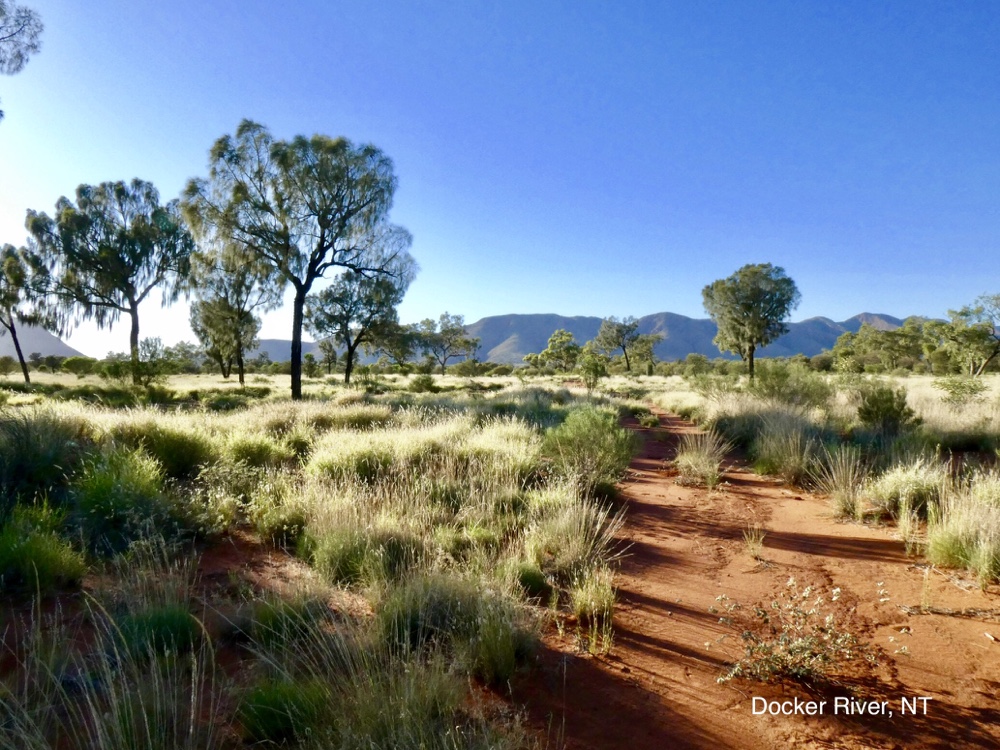
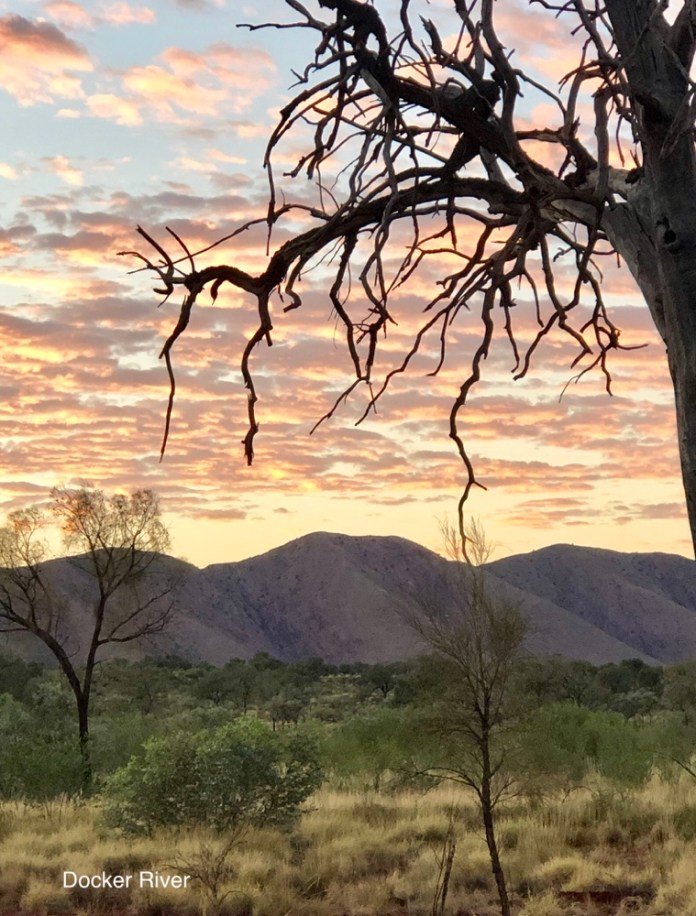
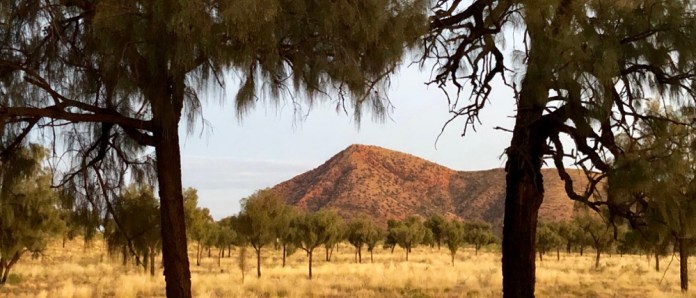
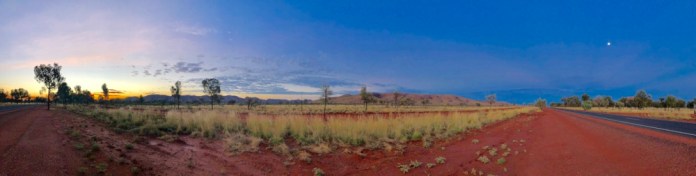
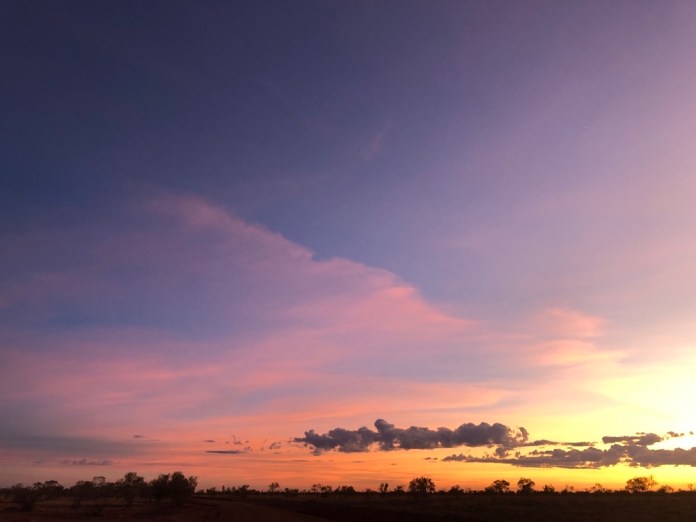
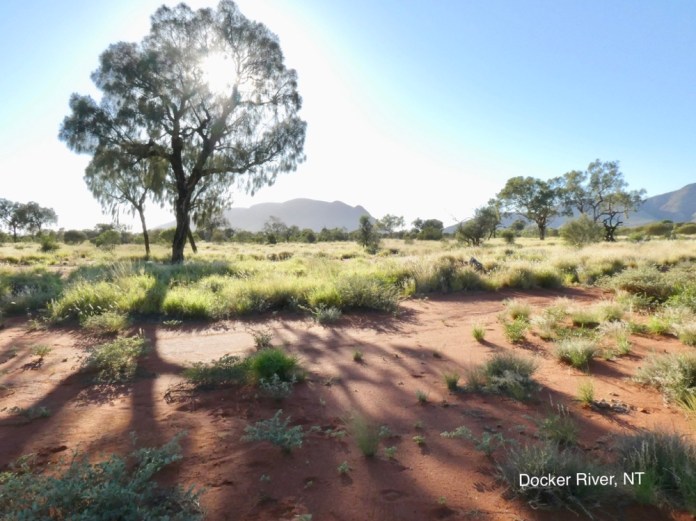
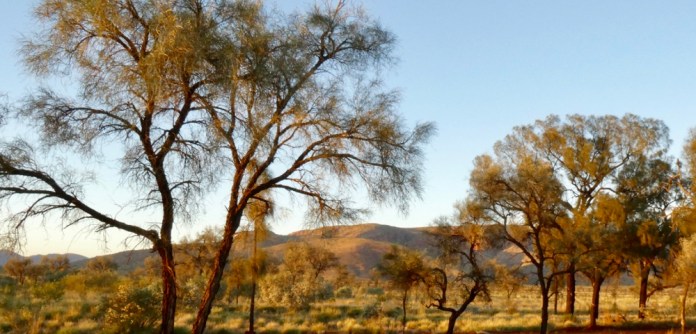
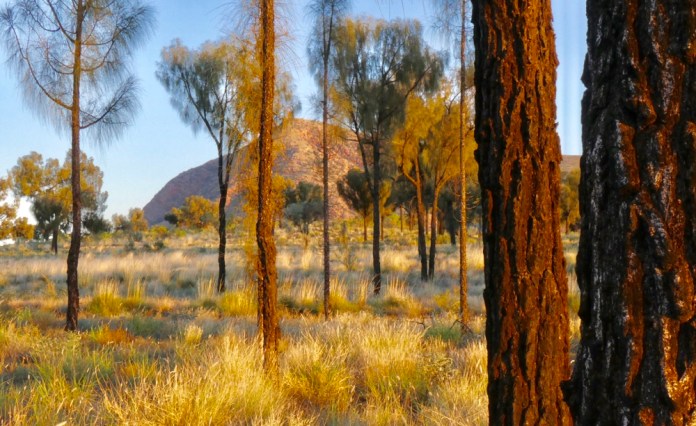
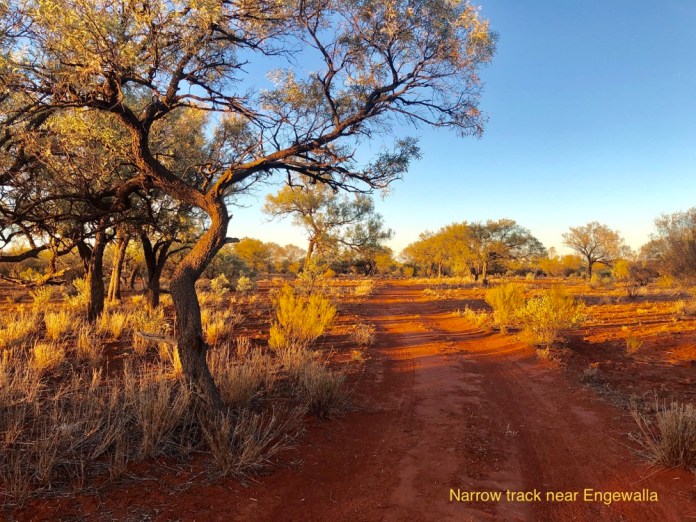
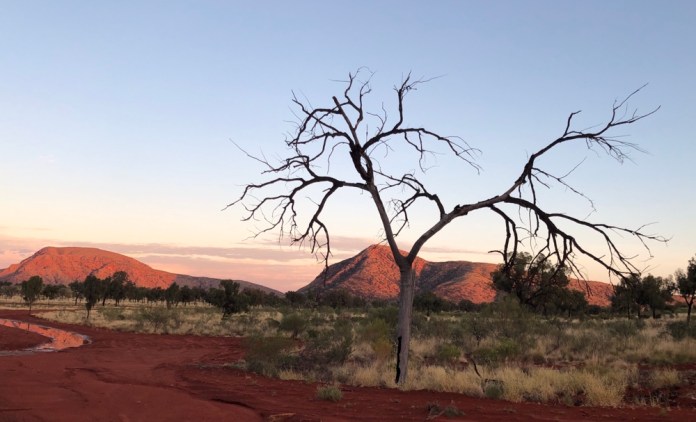
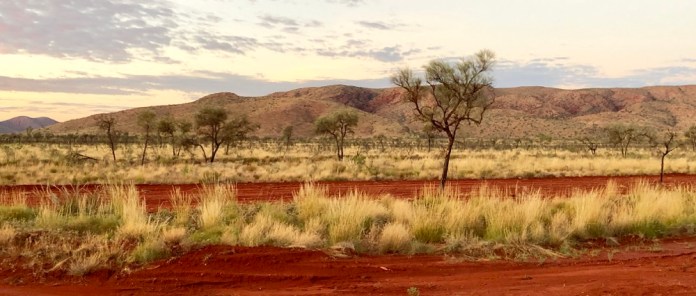
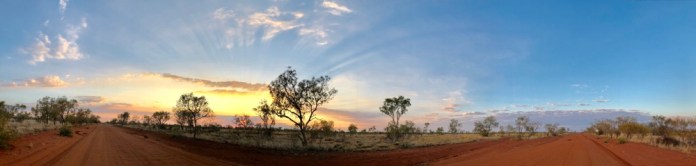
The tall grasses are dry and fill this narrow plain from the community to the highway and beyond that to the ranges. There are old desert oaks aligning the high way. On this walk, there is a kilometre Walk north then I turn west on the highway. This highway is bitumen from just before Docker and much of the distance to the West Australian border, near a town called Giles. When the sun rises and I walk along the highway I can look to every cardinal and see pink stained hills rising out of red dust plains, spotted by groves of desert oaks. These trees are impressively vertical with none of the twisting boughs typical of gum trees. They are dark grey green with a rough, deeply corrugated and ridged bark on their trunks. On the ground are dark brown discarded seed pots, split along their flanks to all the fine seeds to disperse in the summer wind.
It’s still to dark to see this as I walk along. I hear a low throbbing sound and to the right of the road I can see something moving vertically. My appreciation of colour is still poor in this light but it seems to be washed out yellow, a bump of matter lifting from the ground to the air. To my left I see a large male camel bare its teeth at me from twenty metres away. There are trees behind me I get get to if I moved quickly but I do t move fast, I move deliberately avoiding sudden movements, avoiding any motion that would signal me a predator or prey for that matter. I cannot outrun a camel but I was far enough away to get to shelter amongst the trees. It turned its head away and wanders away from me but still paralleling the road. It’s lost interest but I abandon that route for this morning. One of the great dangers of outback driving in the Western Desert occur at night; a dip in the road, a dip sheltered by desert oaks is a favourite place for camels to sleep overnight.
Brumbies, especially the stallions, can be very threatening. I cannot deny how beautiful they look, the lean, well flanked mares, shiny new colts beside them and the tall, powerful stallions standing guard over them. Both camels and brumbies are more common than is usual near this community owing to the lack of water. I saw two donkeys trapped in the local teachers yard, this vertical huge ears studying me above their black eyes.
I walked back braving the brumbies that had walked into grazing near the highway. I got as far off the road as I could as a white stallion watched me out from the red dust; it flicked its head and mane as it snorted before losing interest and cantered back to it small herd.

 People
I like meeting people and I want to connect with them. It’s not enough to provide the consultation. I want to try and make a positive change for them possible by talking and relating to them in some way. This positive action can be a judicious medical decision about treatment or a test. That’s perfectly valid and in fact why I am paid to do this job. However, I want to make the encounter positive in a more fundamental, human sense. I want to show I believe they are important, that this doctor believes their human experience is valuable and that their efforts to survive in these isolated places is appreciated.
I don’t think I can truly understand their experience, I have had not my culture besieged by another one; all its values and structure undermined or just plain torn apart as theirs has over the last century. Young people are so different from the Elders. They have grown up with easily available alcohol even in dry communities, they have money to gamble with, DVDs to watch at all hours and have too abundant time on their hands. Elders can survive in the country in which they live but most of the younger ones here in the Centre would struggle to do so. All that knowledge, all that culture, all those stories are under threat. Some of it is spread at cultural gatherings such as Men’s Business but the attitude to the old ways is often pretty lackadaisical. I asked one young man what he did to pass the time, thinking it would be doing cultural stuff, making spears or boomerangs, preserving the bush skills that connect him and enable him to survive in his country, but no it was watching DVDs.
I can understand that many of the skills and knowledge and stories may seem irrelevant if you have a modern car, can just buy food in a store, or watch TV for entertainment. I talked with a 40 year old Indigenous professional man who admits he ignored the old songs and stories his parents wanted to teach, preferring to listen to Pop music on the transistors popular when he was growing up. Now he is very interested in obtaining many of the stories and traditions but it is a race to do so before the old ones pass on. What makes his connection to his country strong is knowing its stories, knowing where the soakages are, knowing which foods are available, where and when and just being here. As a white person much of the world has become homogenised by our culture of industrial capitalism, exploitation of poorer peoples over the entire world and the adulation of celebrities, and I don’t want that to happen to my Aboriginal patients and friends. It’s not my decision what a people do but I want to make clear in my encounters that I admire their achievements as a people and as individuals. I believe this is the most important thing I do here.
Thunderstorms
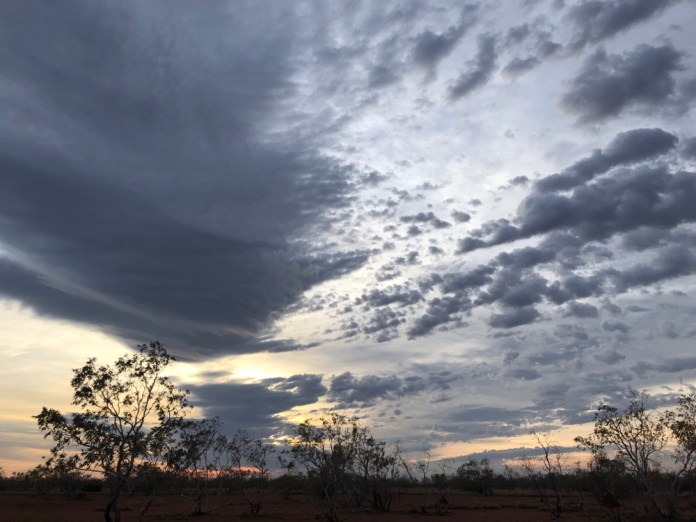
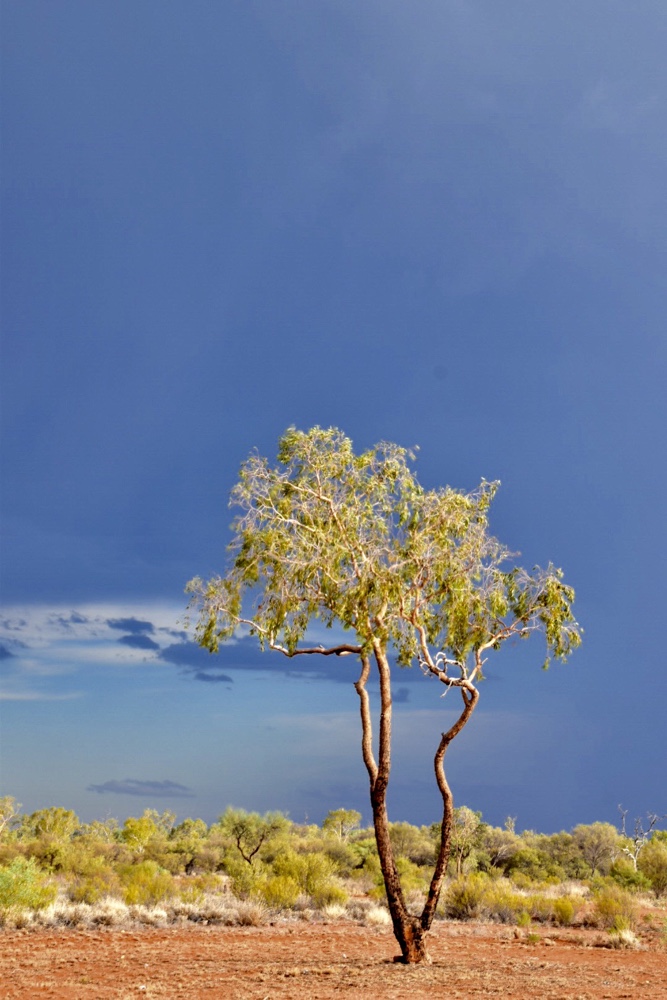
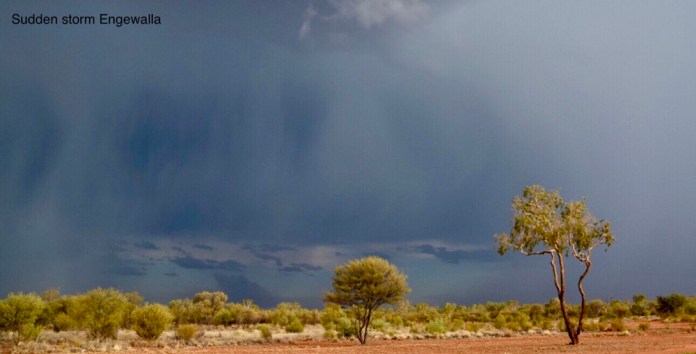
We were at Lake Nash and it had been hot, that dry, furnace like heat which assaults you as you leave the air conditioning in the clinics or houses. To the north east, great bundles of grey clouds were lifting off the horizon. We had been watching the news reports of a cyclone over North Queensland including the flooding of Townsville. We are about 10 kilometres from the Queensland border with the Northern Territory so its not a surprise to get some spill over here. The clouds had that grey sheen beneath them descending to earth; a tell tale sigh of rain. Then multiple streams of lightning formed a wall to the east, at least four almost simultaneous strikes. It was at least a minute before the thunder reached us.
By now we were sheltering under the carport attached to our donga, not that that would be any protection. The wind rose up, wafting clouds of red dust off the roads and desert, sending it into our eyes and faces. Now at last there would be rain. The need for rain is an almost visceral physical sensation; at last something to end the heat if only for a while, the heart of the land and the people beats differently, faster and lighter.
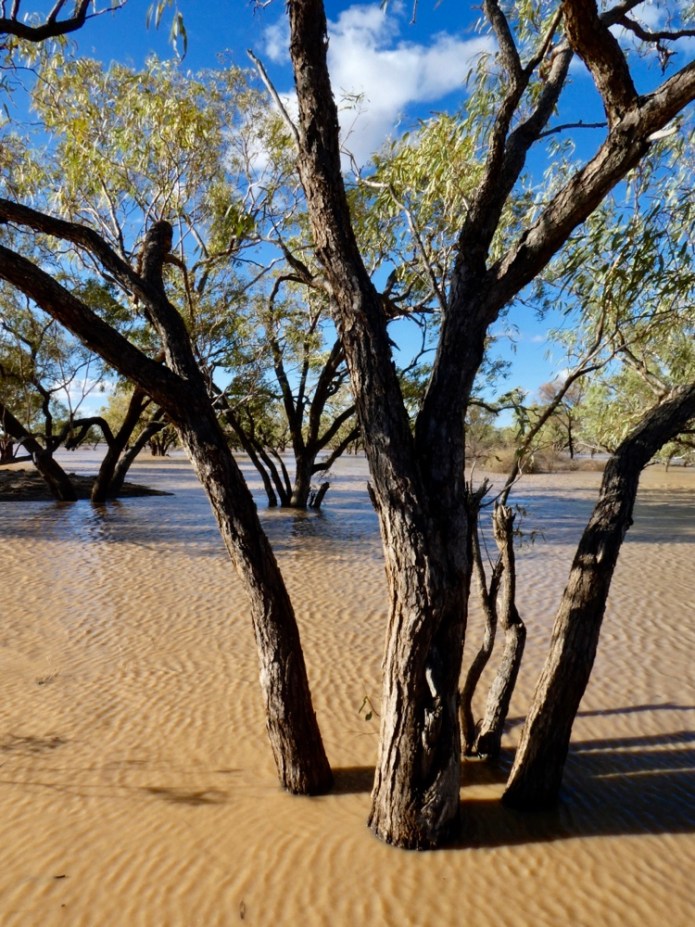
But it never came, well not from the sky but from the north. The rain fell abundantly in the catchment of the Georgina River. Two days later, we drove with Adele to the river where the Mt Isa Road crosses it. The river was flowing with water not sand. The local children were playing in the river-water covering the road. Infants with paper nappies were splashing in the brown liquid. Other children bent down to pick up stones and toss them into the water. Adults stood around talking, an older lady sat on the new bank and her grand children dug channels in the mud making new routes for the rising water.
The water swirled around the tree trunks as three young Aboriginal teenage boys jogged into the water, then swam the deeper midstream until they could reach the bottom again with their feet. A group of three sat on the opposite bank, some 100 metres away from us on our bank. They were sitting patiently in the sunshine. They had crossed earlier today and were marooned as the water level quickly rose. The local station owner was going to bring a motor boat down from his property to ferry them Homeside.
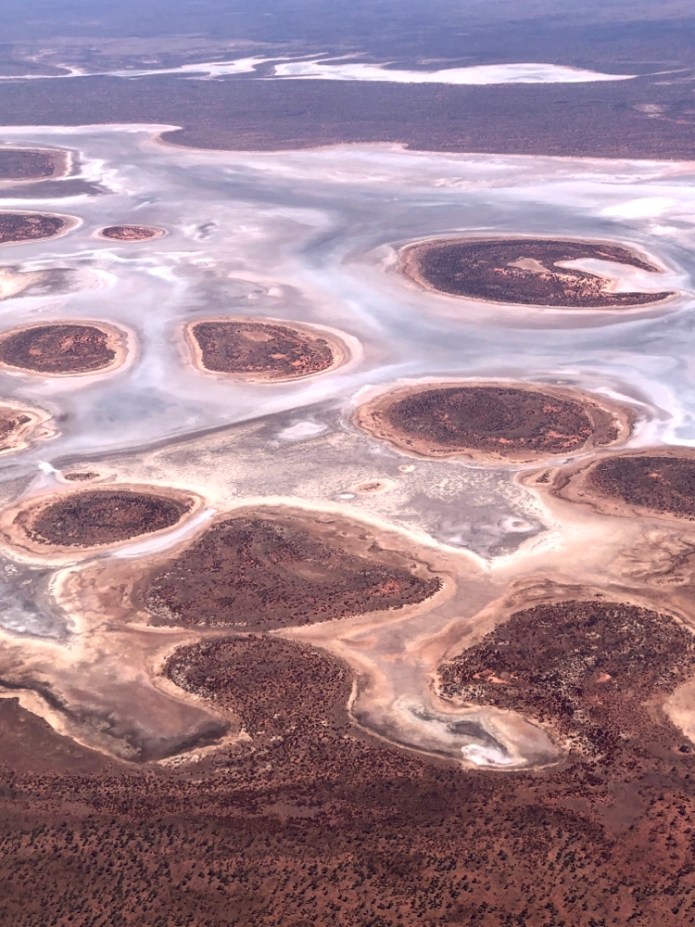
This water is destined for Lake Eyre where it will glisten over the salt until it fills the Great Basin and then pelicans and other sea birds will come to breed and nest in their hundreds and then thousands until the central desert sun dries the lake and recreates it’s salt plain, with a residue of sludgy, salty mud beneath the surface.



 brucebarker2016