

It’s Thursday, it’s the the last day of our four week locum in Alice Springs.
Jennifer is still driving back from Willowra while I’m sitting in the doctors meeting room in Alice. I had a shorter drive this morning from Yuelamu.
Every trip here is interesting and always generates a variety of feelings and thoughts based on the experiences we have here. I would prefer any narrative of mine to be coherent, have a flow, have a clear start and ending but real life is never like that. Every true story blends the past, future, impressions, misconceptions and is therefore anything but coherent or logical.
ANIMALS
it was a warm day. No not warm, it was body sapping hot when any action or thought takes ten times more effort than it should. An ambient temperature of 42 degrees at five o’clock. I had finished work at Yulara clinic, ( Ayers Rock Resort) and I was walking the short distance to my room at Desert Sands. I had just begun climbing the steps when I met a small reptile. The thorny devil, moves in a jerky, mechanical way. It’s body put together with a higgledy piggledy splatter of yellow, triangular scales, all pointing in different directions. Ecologists say that the arrangement channels water from the body to the mouth. To me such a radical body plan would only make sense if it actually rained. There is no denying, it’s cute in a hopeless, ‘ why did I evolve in the first place?’ Sort of Way. Two tourists were flopped on the concrete steps, their faces and cameras were I thought alarmingly close for the little creature. But it seemed very relaxed, and was content to pass the time however second rate the company.

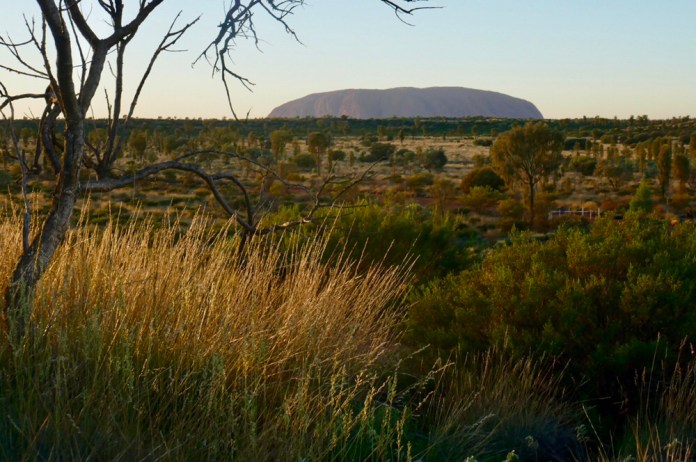
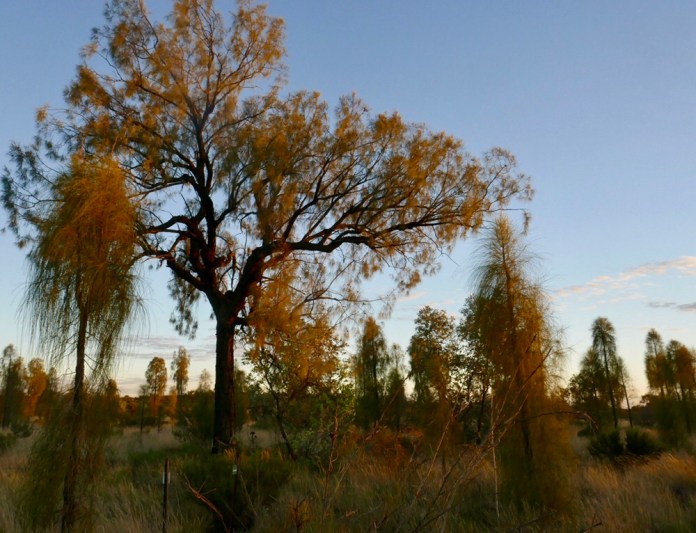
Last Monday morning, I was driving to Yuelamu. The drive is substantially a single lane bitumen road. Long sweeping curves, the opposing cars or trucks or more often than I would like, road trains ( especially those big four tanker green ones that contain enough petrol to make a crater the size of wolf creek), are hidden by scrub. It’s not too busy this time of the year, too hot for any sensible tourist.
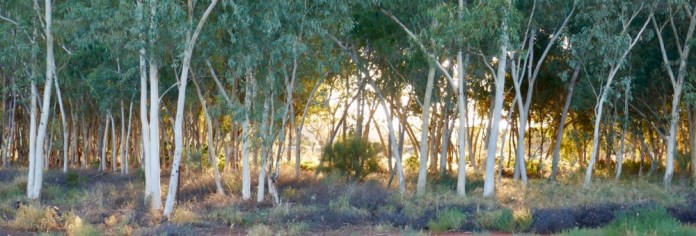
I had slowed down to cross a grate and to my left, on the rocky verge, were a trio of camels. There was Dad, Mum and Junior. Earlier in our stay, I had a driver, Steve, who told me that there had been a lot more rain than usual. This explained the vast green beyond the verges, the plump cattle dotted under the ghost gums, and the healthy looking camels I was seeing. I stuck my head out of the car window ( having opened it first) and used my fool of an iPhone to take a few photos. The three camels ambled along, studied me, and then with the assumed superiority of anything on four legs as opposed to a mere two, put their heads in the air, and shuffled into the scrub.
This morning, I was driving my Prado back to Alice. The first 80 km of the trip from Yuelamu is on sand track. There was a soaring brown bird above me. Then an immense shadow covered the bonnet. Reminiscent of being buzzed by a dragon in Game of Thrones. Earlier on, I had seen two mighty wedge tail eagles, sitting side by side on a tree branch, not far from King Canyon. The wind rustling their feathers on their necks. Their savage looking beaks, curled at the tips. They did not look at me but seemed fascinated by something on the horizon, far beyond what I could see.
LANDSCAPES
In my third week, I did a two-part job. Three days at Imanpa and two at Kings Canyon. Imanpa is a sorry town right now, full of regret. There had been a terrible row between two branches of the one family. Row is a euphemism. About six people wound up in hospital, carried by the Flying Doctors for skull fractures, arm fractures, and other serious injuries. As a result, half the town is in Alice Springs awaiting court appearances either as defendants or witnesses or both. It’s complicated. The court will be like a revolving door. There will be so many defendants, if everyone was found guilty, the prisons would burst.
Many other people who have lived in Imanpa for many years, were truly terrified by the savagery of the violence and have left. It’s doubtful services should continue in the long term given the low population. The remaining elders are reaching out to the many who voluntarily left, to heal some wounds. But the animosities run deep and I’m not sure they will ever come back if they are safely settled elsewhere. Anyway, the point of this story is this. I was driven back from Kings Canyon on a short cut called the Ernest Giles Track. Ernest Giles is famous as the first explorer to climb Uluru and the also first one to be carried down it by locals. The Ernest Giles track is in pretty good condition and offers some fabulous views as well as another detour to Henbury Meteorite crater. We drove along happily, frequently airborne on the humps. And some sliding now and again. But my driver, Steve, was unflappable. He is a real local. He’s built roads, driven trucks. Done seismic work for uranium mines. He never minded a brief stop, so he could have a smoke.
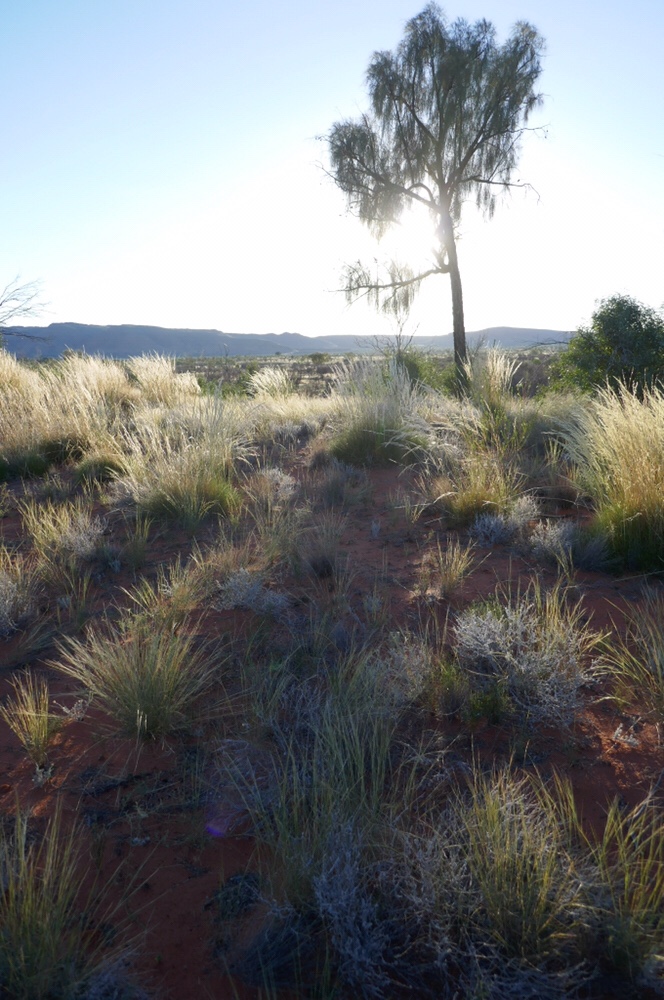
Kings Canyon and Uluru. These are wonderful places. I spent a week at Uluru, never seeing the rock up close but had some great views. I went for runs in the morning. It was still hot for a morning jog, dark but for a headlight, and the tracks were sandy. Anyhow, I trotted along, made my way up to the lookouts dotted around and enjoyed the views. Uluru to the left and Kata Juta on the right. All around them is a dead flat, sandy plain. These monoliths are the tips of the iceberg, well they would be if wasn’t so hot. The peaks of mountains and ranges which at one time, tens of millions of years ago, had an ocean lapping their rocky shores. The Amadeus ocean was the place where fish first evolved. Aborigines talk about Australia as the place where the Dreamtime gods, first kindled life in the world. Perhaps they knew this all along.
Kings Canyon is a part of the Giles Ranges, that extends fifty kilometres or more in a east west direction. At sunset, I could see the cliffs lit up, glowing orange cliffs with dark brown mesas above. Chris and Chrissy who are long term Nursing personnel at Kings Canyon Clinic, told me that one particular day it had been raining. Raining so hard, so long that a waterfall was now tumbling down the range. Wow! The clinic was closed, and all the staff drove to take photos of this temporary phenomenon. Chris also uses a drone to take pictures. He has made some stunning shots of the ranges, especially at sunset. They look even better at fifty meters altitude with the fading sunset light coming from behind the drone. Chris is a keen photographer, and I was very impressed with his portfolio of photographs. He prefers the natural world, in particular a dead tree behind the clinic, where birds come to roost and relax. Galahs, Corellas, Rainbow Bee Eaters, falcons, Zebra finches all come to enjoy this perch. In his front garden is a pond, filled with flowing water. The smaller birds like the zebra finches splash around, throw water into the air and are oblivious of any dangers such is their enjoyment.
PEOPLE
When I went from Imanpa to Kings Canyon, a half way meet is arranged. Some one from Imanpa, drives to a meeting point on the highway where Chris
from Kings Canyon can collect me.
My driver, for this trip was Ricky Orr. Ricky is an Arrente Aboriginal man who hails from Horse shoe bend station. His family includes some white but mostly black fellas. He told me stories on the trip. For once I had the good sense to listen and not talk.
Punburu is the spirit dog of this area near Imanpa, and runs as far as the now Stuart Hwy to the east and Uluru to the west. Ricky’s grandfather worked on a station, and one day, he was sitting out side a remote outstation after a long, hot day mustering cattle. He have heard something, something big and fast moving in the scrub not far from him. His hairs on his neck went up as it does for anybody when supernatural things are happening. He had a rifle, he grabbed it from the cupboard, but was too frightened to load it, as cartridges fell on the timber floor of the verandah. The creatures, because there were two, burst out of the scrub, just as he closed, and latched the door. The door shook violently, as it struck repeatedly. The animal, pushed its paws, covered in a yellow, orange fur, under the sill. It scratched at the floor and door. Another dog, threw itself against the walls. They stayed only a few minutes but it was many hours before Ricky’s grandfather dared open the door.
His Uncle was walking along a dry river bed. These rivers fill up in the wet season and can span fifty meters or more. They fill with churning water at first, but as it slows down, it’s a great place for the Aboriginal kids to swim, swing out on an old rope and then drop into the cool water. Aboriginal women fish, using their long skirts, to scoop fish out of the streams. Anyway, today it was dry. He could see brumbies crossing the dry river, but amongst them one creature was loping not running. It was as big as a horse, but hunched over, then leaping along not trotting. Though it was travelling with the herd, it was no horse. It was Punburu.
Ricky nearly met this giant dog once. He was in the following vehicle for a seismic team. Over the years, big mining companies from Australia and overseas, have wanted to do scientific seismic studies to determine the presence and quantities of gas, coal and uranium. The front vehicle suddenly stopped on this sandy road. Ricky pulled up behind them. The driver, and the scientists in that car, were pointing right . “ Did you see it? Did you see it?” “See what” said Ricky as he looked in the direction they indicated. Whatever it had been, it was too late, the creature, had smashed its way through scrub and vanished. And that’s the closest my interlocutor had ever come to seeing Punburu, at least so far.
Ricky told me about the Kurijah. Nowadays, Aboriginal people break aboriginal law all the time. Why is this? Once it was Elders who decided if someone should be punished, now the government says, we the government will decide who does wrong and who doesn’t and we the government will mete out punishment. The Elders don’t have a say. But the government is not there all the time to enforce their law, the governments laws are not Aboriginal laws and this causes ill will. Now even Elders are abused and threatened by some young people who are angry because these Elders tell them not to drink alcohol, or get drunk, and not to beat their families and neglect them. There are Elders who do drink, sell beer or turn a blind eye to drugs. They are tolerated. The other Elders, are so upset by the violence and chaos in their communities, they leave, living isolated lives in outstations. They are almost outsiders because they are decent men, who have been beaten and threatened by young, violent drunks. Before this all got out of hand, before white man’s law was the only law, there were travelling lawmen called Kurijah. Kurijah were judge, jury, and executioner if need be. They had more authority than even Elders and their decisions could not be questioned. They would spear, kill or punish an offender. Aboriginal laws always go two ways. For example. A person can expect another family member, however distant, to give them money or food if they ask. This law has degenerated into “ humbug” where it is more or less begging off anybody. But what’s worse than this. There was an obligation to respect Elders and obey them and care for them as they grew older. This has stopped in too many communities. The old ones are prey not people. Their money, food and medicines are fair game. Thankfully, this is not true for everybody but it’s frequent enough to cause a lot of misery. Some communities are worse, and you guessed it, money, alcohol and drugs are central.
ALCOHOL
WOW! A number of so called Dry Communities have been turned to chaos by alcohol. Victoria Bitter, Jack Daniels and Chardonnay are the most popular. They are purchased in large quantities usually in WA or SA and ferried on back roads. The alcohol is consumed or sold. One evening at midnight, a drunk women, knocked on the door of my flat, sporting a bruised eye from a fight she’d been enthusiastically participating in. Where does the money come from? Mining companies pay huge money in rights and the money is too often squandered on alcohol. What’s really sad is that there are some great people who have put up with this alcohol fuelled chaos.
Most Children in communities are all smiles; clean, well dressed, with a mother who loves them. These kids have all the wonderful potential of any new child. Other children, hair filled with nits, hair knotted by neglect and bodies rarely washed, with truly dirty clothes, are far from rare. Some of these children have FASD from considerable alcohol exposure in the womb. I spoke to a young teacher, who says of course education is the future for children, but children with FASD (foetal alcohol syndrome disorder) gain less from education due to the intellectual impairment and impulse control problems alcohol damage has created.
ART
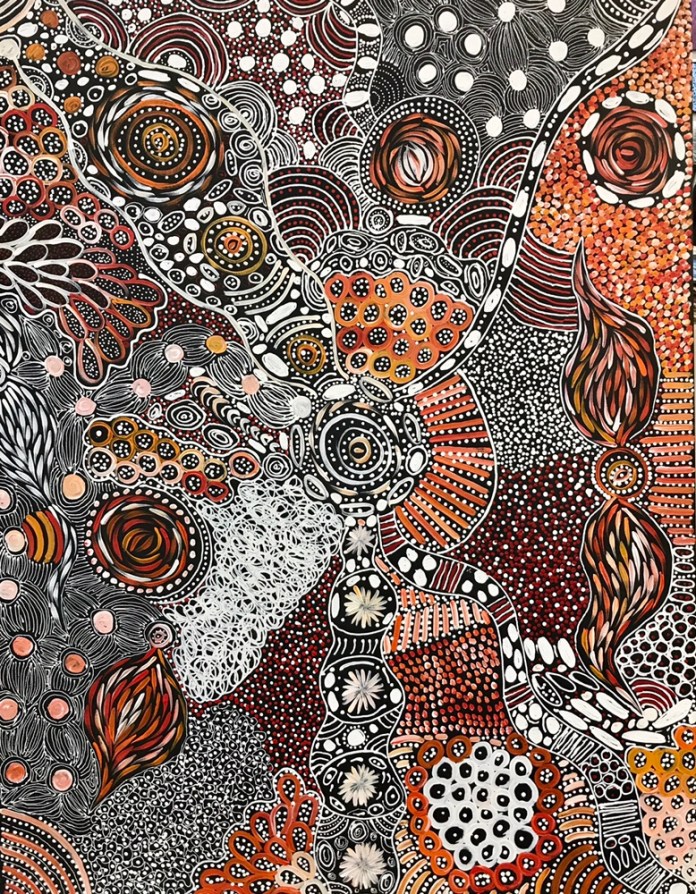
Jennifer and I have a great admiration for Central Australian art. Much of what you will see dotted around markets or shops is very generic. The bush tucker paintings and bush medicine paintings are widely available for purchase. These are still sincere expressions of culture and should be treated with respect for the artist as well as the work. They are more traditional. However there are many painters with a newer, less traditional vision who are experimenting, combining their totems, stories, attachment to country with new ideas about colour, composition and the use of medium. Such a painting is one we bought. We purchased a Utopia painting by Jane Golder. It was on an early morning run/ bike ride when we went past the painting hanging on a wall at Jila Gallery. We were both knocked out by it, its hues, it’s content. Well, we decided to buy it immediately. It features below.
Chris Hakanson showed me some of his photographs during a lull in seeing patients at Kings Canyon. This clinic sees predominately the white people who live and work at the Resort and at a nearby station called Kings Creek. However, there are three active communities that use the medical services as well. One of these communities has a remarkably competent and enthusiastic Elder who has, through sheer drive, made his community safer and more secure, with above average school attendance and better health profiles generally. Unlike many communities where money is “ sit down money” from Centrelink or local mining royalties, this community has embraced cultural education for other Australians and does terrific, well organised tours. They were so cashed up they actually bought a brand new bus for another community to do similar ventures. Sadly, the bus was trashed and abandoned barely a month later.
Chris showed me his photos of Rainbow Bee eaters. These beautiful birds are members of the kingfisher family and are commonly seen wherever there is reliable water in the centre. All his photos, both of birds and landscapes, are of a very high standard and, unlike many photographers, he shows animals or birds actually doing something. Life leaps from the image. When I went to Yuelamu, I met Karolien and her husband Jason. They are kiwis. Karolien is the very competent nurse manager and Jason is studying as well as painting. He is an excellent animal and bird artist. Kindly he has agreed to do a painting for me from one of Chris’ Photos. Funny how things work out!
Every year there are cultural festivals at Kings Canyon. Chris showed me photos of an artist who works with sand. The sand on the ground, the sand that’s everywhere. I’ve seen a renowned Utopia artist, sitting casually on the ground, creating wonderful art with her hands, pressing a scalloped pattern with the heel of her right hand. Chris’ friend creates emu tracks, goanna and perentie tracks, foot tracks, stories, maps only using his hands. Made with breath-taking precision. As well as local Aboriginal children, many young people from interstate schools attend these festivals and are all very impressed.
WATER
I was standing in the shower at Yuelamu when I thought about water. Yuelamu is 280 km from Alice Springs. 200 km on bitumen, mostly via the single lane Tanami Road. It’s being widened to cope with the increasing, especially tourist, traffic. Then a drive along 80 km of sand.
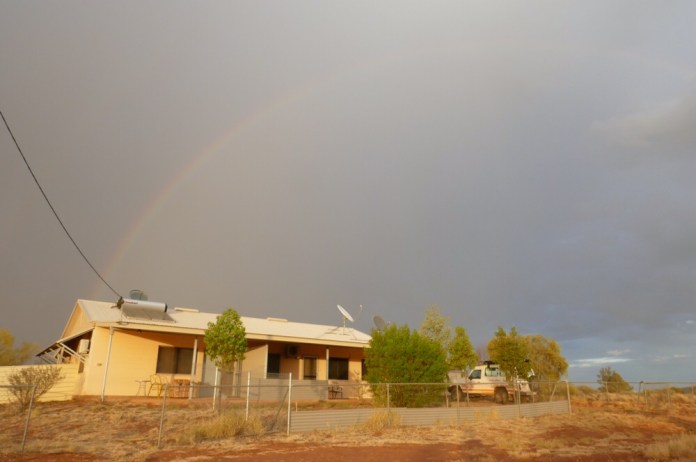
It took some time for the shower to stop spluttering and actually flow. The water is filtered at least twice but still has a salty, metallic taste. Streamlets bathed me rather than the decent warm gush of water I prefer. It left me feeling indifferently clean due not only to the poor flow but particularly from the lack of water quality. Every house in the community has a special tap to use for cooking and drinking, this water is filtered several times to try and improve its flavour by removing the heavy mineral load. Once Yuelamu had two huge dams, these are now shadows of what they were, and unusable due to infestation with algae. You cannot swim in them, much less drink from them. The water we use in Yuelamu is from the great artesian basin, but unfortunately, the water 💦 is heavily filled with minerals. This was not always the case. When the basin hereabouts was freshly tapped, the water was much better but as the table dropped , the pumps begin to bring up the brackish water from deeper, more turgid layers. Water security is the sword hanging over the head of every community and town in central Australia. It’s measured in years, not decades.
Fracking means money. It can mean mining using high pressured, solvent-laden water pumped into strata deep below the surface and extracting the shale gas for export, but this would not mean anything, if it did not mean money first. My second day at one clinic, all the men wanted to be seen in the morning, as there was a lands council meeting at Laramba to see how much money they would get from the pipes that would be built across Aboriginal land to carry the gas south to South Australia, probably Port Augusta. The communities where the mining will take place will also get a great deal of money. A friend of mine, Richard, was at a meeting held at Elliott, north of Tennant Creek, where the Royal Commission into future fracking was hearing delegations from the locals. Richard told me not many locals were there but the few who were, asked very thoughtful questions. Where do the solvents go when they are pumped in? Could they contaminate our water or even everybody’s water? Where will the water come from to be used to flush the strata beds? What will happen to the bores once the gas is used up? I don’t know the answers to these questions but I think, that the next big environmental battle is going to be here in NT over fracking. On one side will be the mining companies, and locals who will benefit, and on the other side it will be locals who are concerned about the possible desecration of country as well as potential threats to water security. It has the potential to divide Aboriginal communities. Given the level of violence in many communities, disagreements about fracking and money could get ugly.
THE GREAT BARRIER REEF
WELL! I bet you didn’t see that coming. One Friday evening we went to a talk about the Great Barrier Reef at the Alice Springs library given by Anna Kriedt. Anna is a long form journalist. She has had a long essay about the reef and it’s challenges published in the prestigious Quarterly Essay. It’s a thoughtful, essay which took her many months to complete. Overall the news isn’t good with the inevitable sediment from dredging bays for ships and mining run off, going to choke the corals which rely on truly clean water to thrive. The most damaged parts of the reef up to now have been the areas affected by agricultural effluent. Over the last ten years universities and farmers have worked together to modify these issues. And it’s been a success. The reef was about to reap the benefits of a decade of hard work and investment by farmers and academics. Not government! The sediment loads from mining dwarf that of a hundred years of farming practice. The only good thing about all this, is that ordinary people working together can achieve incredible things. Anyway, if you want to get informed read Anna’s article.
CANTEEN CREEK
My second week began with a charter flight to Canteen Creek. I had a super week with Cassie and Susan. Cassie is the manager. She does not get strung out about cultural sensitivity where health is concerned. She has had a policy that if a child is going to be seen at the clinic, they must have a clean face. Snot smeared faces are the norm in some communities. This spreads influenza, trachoma, viral and bacterial illnesses. In Canteen Creek I saw some kids with grubby clothes but not one with a snotty face. There is a basin and soap at the clinic to wash up. What’s wonderful is that the kids love Cassie, and therefore, now demand to be clean. I did not see one skin infection or scabies when I was at Canteen Creek.
Canteen Creek is famous for being the setting and inspiration for the ‘ Cheeky Animal’ books. A local Aboriginal artist and writer have created these wonderful children’s books. Isla, our two year old granddaughter, when she sees an animal or pet being naughty, calls out ‘ GO AWAY, CHEEKY ANIMALS’.
THE ARGUMENT
I was sitting in the tea room at Imanpa and a discussion arose about the evils of the old cattle stations when Aboriginals both men and women worked for chits in the station stores and worked long hours in trying conditions. Interestingly, Ricky disagreed. It was not all bad. His father, grandfather had worked on the stations and they loved it. They were proud of the work they had done and were not ashamed. Ricky said that they had a purpose in life, enjoyed being together and with the white station owners. It wasn’t really about money. They had enough to live on and anyway, the station owners were not rich men in most cases. There was no ‘ sit down ‘ money, if you wanted to eat, you had to work. And you know, Ricky’s forbears had no problem with that.
Ricky does cultural tours too, as well as his regular job in health. When he was a young man, his father and especially his grandfather would sing the Dreamtime stories. Some he sang so often, that Ricky remembers them very well. But young people in those days were more interested in listening to pop 🎵 on the radio than hearing old stories. It was only long after his grandfather died that he realised the riches he’d missed. He reckons that Arrente people have about a third of their total stories. The stories of Aboriginal culture cannot be told to just anybody. There must be ceremonies before a story can be told. Some stories are for children, some only for men or women, once fully initiated. Both levels of initiation. So not all Arrente people knew all the stories even before white men came, some could only be received late in life. However, there is a unique opportunity. Strehlow is a famous name in Alice Springs. The first Strehlow was a minister at Hermannsburg,
He learned the local language and wrote the first bible in Arrente. His children and grandchildren, grew up more like Aboriginal children. One became an anthropologist and with his language skills and rapport, recorded on tapes, many of the stories of this vast region. Ricky plans to visit the Strehlow museum in Alice Springs, and hear and transcribe those stories to tell a new generation. What a fabulous project!
EPILOGUE
I apologise for this disjointed unnarrative narrative. If there is a point to take home, it’s that there are many bad people and silly people of any colour, but there are many, many more good, kind people who deserve support, praise and encouragement. Sometimes, the wrong people have control but nothing lasts forever, and younger wiser people in a community could take leadership in their turn, and change things for the better.
Jen asked me to mention that at Epenarra clinic there is music playing all day in the waiting room and the locals love 💕 it. Jen also told me about an incident on the Stuart Hwy coming back from Willowra via Ti Tree. She was about 90 km from Alice Springs when she was passed by not one, but two, pilot vehicles travelling north towards Darwin. After quite a gap, it was clear why two vehicles were needed. Realising that there was a large vehicle coming, Jen had to get right off the Stuart Hwy and park on the verge. Even road trains would have to do the same, and they usually have total rights to the road! Actually, there were two trucks each carrying the biggest buckets for diggers that she’d ever seen. No doubt heading for a mine somewhere. They took up the entire width of the road. Impressive! Nothing’s bigger or better than anything in NT.
 brucebarker2016