
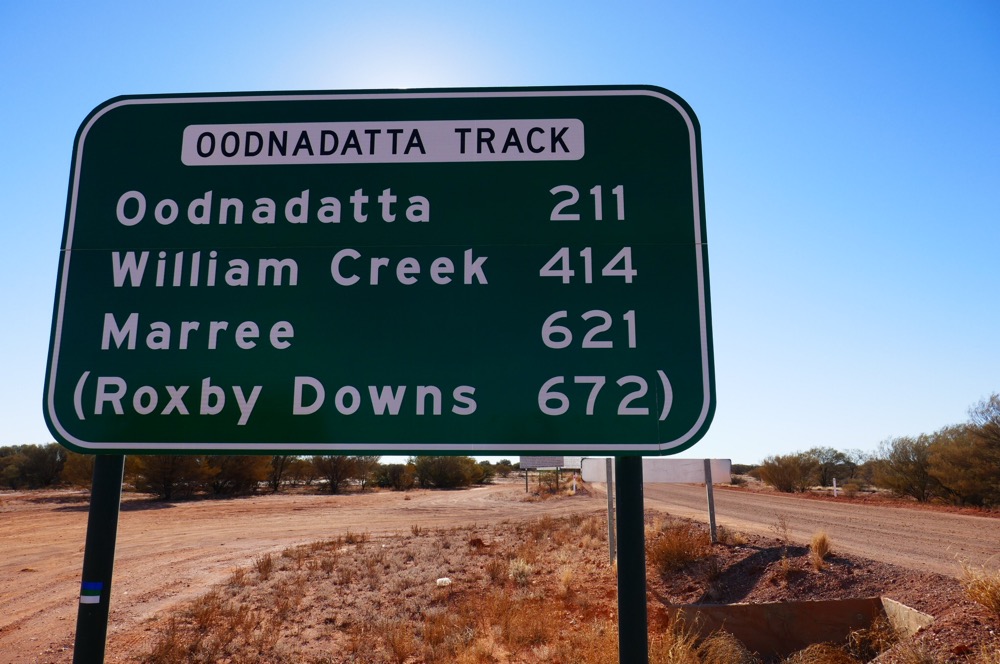
Well we have done it. Jennifer drove the Oodnadatta track over three days beginning on Saturday morning and finishing today here at Marree. We began the trip from Marla which is on the Stuart Highway after driving south from Alice Springs on Friday. We have done quite a bit of preparation for this trip, it’s nothing hard, well nothing compared to the ultimate one which is the Canning Stock route but it was the first remote drive we have ever done.
Marla is pretty basic. A fuel station to fill up. A minimart. And a Caravan park where we stayed overnight. We set off the next morning. We lowered the pressures in both car and trailer and we noticed immediately how much smoother the car was on corrugations. But the corrugations at Marla are nothing compared to the bone jarring at the south east end of the track.
Our target destination for day one was Oodnadatta. The track is pretty good with dips and corrugations aplenty but not much sand to speak of. The scenery is not overwhelmingly beautiful but it’s tough, dry and plants and animals here have to struggle. The Sandhills are impressive , long lines of sand lying kilometre after kilometre in length, and generally lie east west due to prevailing winds. There are pale yellow ones just south of Oodnadatta, and then big red ones near William creek which to be honest, does not have a lot else going for it.
Oodnadatta means myrtle flower. I don’t know if it’s a blossom pink but it should be, as Oodnadatta boasts the quirky Pink Roadhouse. This is a great place, the staff are terrific but the decor is Pink upon pink. They do meals, mostly burgers! The kitchen closes for meals at six so we visited the Transcontinental Hotel to see about dinner later in the evening. No luck there, as they are closed for renovations. So Jennifer cooked a meal for us. The caravan park is a bit sad, three trees, and yet the amenities were very clean, water was hot and there was a shelter to escape the wind. It’s been really windy all three days of our trip. Jennifer is feeling a bit troppo with it. Oodnadatta is well worth exploring. The terminus of the Old Ghan ended at Oodnadatta for fifty years before the extension was built to Alice Springs in 1929. That was a sad day for the town as up until then it had been a very busy place. There was lots of work for the cameleers, the shopkeepers and publicans. But somehow it carried on and how it did is documented in the museum ( previously the railway station) in the middle of town. The building is in excellent condition and each room has displays about different aspects of life here. There are photos and displays about the Aborigines, the Chinese, the Afghans, the farmers, the railway men and their wives and their families. There are other presentations on the Old Ghan, the natural history of the area and the present efforts of the local people to make a living in Oodnadatta. We spent an hour there looking at all these interesting photos and documents.
After leaving Oodnadatta, we planned on stopping at Algebuckina Bridge. However we arrived there so early we were just too tempted not to carry on further. We visited many of the old Sidings and stations that used to provide the services and stopping points for the train. Some of them are piles of stone and rubble while others are substantial buildings and facilities. They are are all made of local stone, mortared in place, with timber lintels. Galvanised steel roofs are now often replaced by fresh air. The stone walls are in two layers. In the railway buildings which are intact , the temperature is a pleasant twenty degrees despite much warmer outside temperatures. The lintels are timber for the windows and doorways. Near the railway tracks are the bore, a tall steel chamber and pump that taps up water for the train, and the water storage tower, a huge rectangular steel box an outlet to go to the steam locomotive. There are three or more steel rails at right angles to the tracks which are the remnants of the coal loaders. There is often a lot of coal fragments on the ground. There are often overland telegraph poles, with their ceramic cream insulators standing askew nearby. The only glass is not in the windows but in the piles of broken bottles that litter the surrounds ( railway men were solid drinkers). One station has been well restored, its nearer Marree and it’s called Curdimurka Siding. Every two years there is a hugely attended outback ball at this station. Most of the left over sidings and stations are pretty sad spots, the sole grave was a suicide at the first one we visited. Hmmmm. They are incredibly isolated in many instances with little opportunity for the fetlers ( track maintenance) to see other people or even escape their hot dry dusty work.
After Oodnadatta we stopped at Algebuckina Bridge. There are many bridges on the Old Ghan and many are still there. The longest on the railway and it’s still the longest bridge in South Australia. It’s way off the ground, about thirty meters and it’s long, at least five hundred meters. You can walk a short distance on the bridge today. The engineering is in the finest nineteenth century traditions of solidity, strength and a hint of real daring. The solid steel spans are supported by a crisscrossing of steel girders, with huge rivets. The forest below growing up in the creek sits well below this fine span. We carried on through to William Creek. We did stop briefly at the hotel there. There is really not much there. Downed a can of xxxx each then drove. We decided to camp at Coward Springs. And we are so glad we made the effort!
Coward Springs still has a lot going for it. When the Old Ghan was operating, it was a destination in its own right. There was a hotel, which only closed in 1962 and there were hot springs. Coward Springs resulted from a mound spring, that when it punctured the artesian basin in 1879 made a huge outflow creating an instant oasis for birds and people. Now there was not only water enough for the thirsty steam engines but more than enough for dusty hot railway men, and holidaymakers from Port Augusta, to bathe in the hot (29 degree c) springs. The camping area / springs are nestled adjacent to the conservation park, and its on private land. The new owners have done a fabulous job, of getting the bore working again, reestablishing the wetlands, replanting the trees, bringing back the birds and creating a soaking pool for us ageing boomers to relax in. They have also restored the engine drivers cottage, which is now used as an excellent museum that tells the story of Coward Springs. They have restored the station masters cottage into their own home. And except for the bristling satellite dishes, it looks brand new and totally like it would have appeared in the springs heyday.
We went for a warm swim this morning, and a kite flew just above us, hovering as we floated in the water.
We left Coward Springs and visited some other springs nearby. These are Mound Springs and the build up takes place over hundreds of years, forming a small hill, with a bubbling lake on the top. The water spills over, and as it is loaded in minerals, it coats and colours the mound. We saw Blanche Cap and the Bubbler. These springs are quite natural, and are simply areas where water under the heat and pressure of the artesian basin, bubbles to the surface. What I found truly amazing is that this water is millions of years old, it has percolated through rock for all of this time, before finally emerging in a rock fault to return to the surface but not as rain but as aquifer water. A notice board near Lake Eyre said there are 130,000 Sydney Harbours of water, in the Great Artesian Basin. How on earth can they know that?
Any way, I’m sure it’s a lot because all of central Australia is utterly dependent on this water. The route of the original Ghan was chosen because of the presence of reliable bores. Steam engines are very, very thirsty. All of the appalling problems in building and then maintaining the railway, were necessary because this is where the water was. Once diesel replaced steam, the game was over, and in only a few years, the Ghan was rerouted from Tarcoola well away from the difficulties of the old route. But for all that it was an incredible railway, full of stories, full of adventures and had far more charm than the smelly modern diesels that replaced these plucky narrow gauge steam engines.
We visited Lake Eyre today. We walked down from the lookout, to Lake Eyre South. The water is gone, at least for now. The soil was crusty and orange. The pure white salt filled the horizon. There is a blue mirage, a horizontal band that looks just like a vast lake but in truth, it’s not there, not today. In many spots along the Oodnadatta track we saw vast salt lakes, dried and flat with sand dunes abutting them. They are startlingly white, and not much will grow. Salt bush is the nearest inhabitant to a salt lake. Lake Eyre has a magical, perfect beauty, it tricks the eyes, and seems to abolish distance as you gaze over it.
We arrived at Marree, at 2:45 today and enjoyed some sparkling wine at the local Marree hotel. We drove around to the caravan park up the road and have settled in nicely. The owner, also called Jen, does dinner as well. So tonight, after sitting around the fire in a cradle, we had dinner of beef curry and then yummy trifle. Jen ( not JB) sang some songs and we all had a super evening. Tomorrow we are off to Arkaroola.
This morning we spent some time exploring Marree. The wide railway station platform has broad/ standard gauge on the right and narrow gauge on the left. Marree was the spot where goods, people and well just about everything, had to swap from the standard gauge train from Port Augusta to the narrow gauge train which took you to Oodnadatta till 1929’ then after this time, all the way to Alice Springs. There is a small museum in the old station office. A lovely Aboriginal lady showed us around. There are old posters for the Central Australia Railway, announcing holiday options. There are many old photographs showing the pitfalls of the Old Ghan. It was truly a modern adventure.
The timetable was the roughest of estimates and could be weeks or as much as three months late getting to Alice. Trains were derailed. Sand hills covered the tracks. Trains crashed into each other. Rivers washed away the bridges. It was quite amazing it ran at all. The local Aboriginal people worked not only building the old Ghan but also worked as fetlers. It was an extraordinary time in Australia’s history with some rough customers working with no questions asked on the remote sidings isolated from their sometimes murky pasts. Afghan cameleers running hundreds of camels out of the main stations to supply pastoralists, but later the miners in the Kimberly Gold rush, and the scientists like Madigan who took off from Marree to cross and explore the Simpson desert. Wow! On the top it off we saw an actual emu chick wandering with his Mum in the streets at Marree.
Next stop is Arkaroola, the private sanctuary in the northern flinders region.
 brucebarker2016