Short fiction, Short stories and poetry

Beauty

Willy split apart pea pods with his Mum. His bare elbows resting on the cracking white laminex of the kitchen table, and his fingers diving into the central pile of peas. He loved her very much and these few hours between arriving home from school and Dad coming home from work were their special times together. He asked her for a glass of milk and he drank it greedily smearing a moustache of white with the back of his hand. The afternoons sunlight formed rectangular pools of light on the kitchen floor and the table through the windows. It was a warm day but Willy felt abundantly well and happy that afternoon. 

At six o’clock, promptly, he heard Dad kicking off his boots at the laundry door. As usual he had come round to the back of the house to enter. The click of the door and a loud ” Hello Darling, hi Willy ” filled the kitchen. Willy felt that his father filled a room in a way his mother did not. When his father left a room it felt emptied while when his mother did so, it felt as if she had not really gone. Mum suffused the home while Dad filled it physically. Willy was an only child but that did not worry him as some of his friends seemed to think it should. They tumbled out of station wagons like beetles out of an upturned plastic bucket, all squealing and fighting. Willy spent some holidays with the cousins and for a few weeks, he did the same things as his noisy friends did year round. It was a treat but he did not miss it when he was home again.

Willy thrived on routines and closeness, even doing something different to one or other of his parents or close school friends was okay if they were close. Going to school with Mum in the car, walked into the class, meeting his teacher and the school work. It was a busy day, every day, but Willy loved it. However, he did not enjoy going to see doctors. They were okay but afterwards there were often blood tests and he did not like these. He learned to be suspicious about anybody in a nice blue uniform saying, ” this won’t hurt”. 

Sometimes his Mum looked worried, it could not be about him because he loved her perhaps even more than Dad, which was a lot. She would sit at the kitchen table, resting her chin in her hand and gaze blankly, not seeing him until he touched her on the arm. She looked at him with sadness, it was so quick that Willy was sure nobody else would have seen it. It was a mystery to him because life was so perfect. Dad played tumble with him, and chased him over the furniture. Mum told us off because we would break a chair or the sofa and we could not afford to replace them. Willy never saw things were never new in his home. But he did not see or even realise it could be a problem. It was a problem for his Mum. Sometimes in the evening after Willy had gone to bed, tucked up under blue blankets and his stuffed kanga somewhere under the sheets lurking about, his parents sat and talked about many things that Willy would never understand. About money, about the future, about Dad’s job, all of them them things Willy would never be able to worry about. They loved him with all their hearts as much as Willy loved them, but there was always an annoying spectre, of loss, of missing out on the future for Willy deserved. 

The next day was like all the others for Willy. He hardly cried. He ate, He played and he loved deeply and unashamedly. His is a peaceful beautiful soul which lies complete unto itself if not the world’s.

Standard
Central australia, Central Australia Work, Uncategorized

Alice Springs March 2017 part 3 Laramba

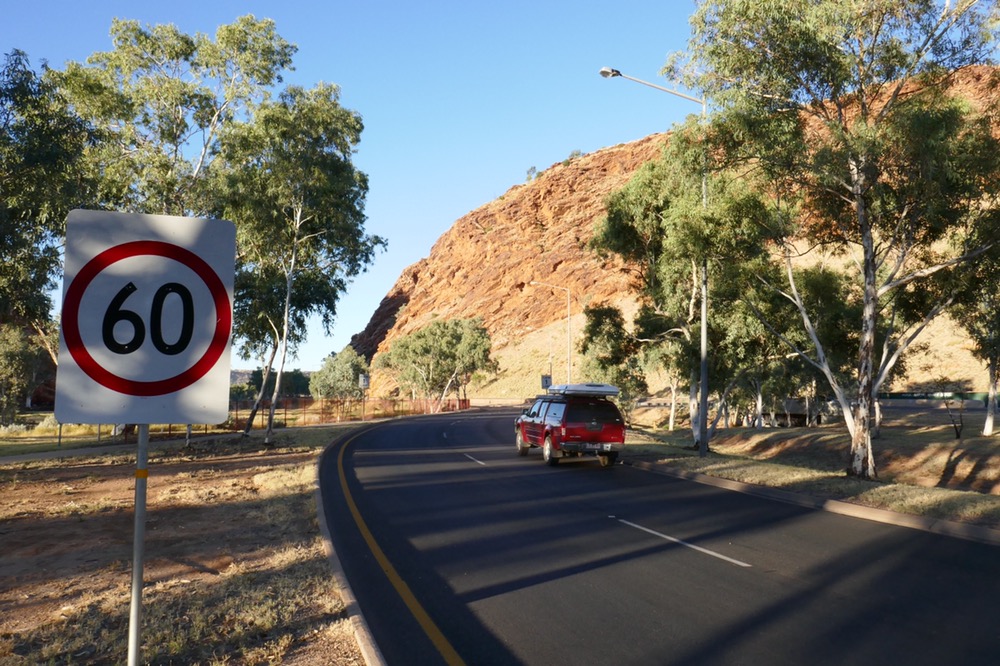
IMG_3187IMG_3184IMG_3222IMG_3217IMG_3216IMG_3213IMG_3206This week we have travelled to different communities. Jennifer has driven up with a medical registrar, Sally to work the week based at Ali Curung. I have returned to one of my favourite haunts of 2016′, the little community of Laramba. I brought a student nurse with me who will be staying 2 weeks to my 5 days.

Today is Tuesday, and beside the young student Loren, there is Helen who I met last year and Natalie who is working a few months before taking up another nursing position at Gove. They are a terrific bunch to work with, more chaotic than some, but are willing to do the work and round up the patients I need to review. Natalie and L drive round the dusty and bitumen streets in the troopie, getting out of the car/truck to wake up people sleeping in the afternoon and most interesting for them, a card game of the ladies where many crisp fifty dollar notes were piled on the red ground between them all. Yes, it’s not just the men who gamble, the ladies do too.
The weather has been truly magnificent, about 30 degrees in the daytime, beautiful sunshine, a gentle breeze and a pleasant 10 degrees overnight. I walk to work, it’s not far but I’m thought of as a bit of an oddity trudging along the sandy road from my accomodation on the edge of town to the clinic nestled between the local primary school and the work for the dole centre. The children are wonderful. As I walk past, they call out Hi, Hi. They all wear a blue collared shirt, and blue shorts and run and tumble in the playground every chance they get. The best lawn in town is at the school and it’s protected from the sunlight by a large steel gazebo. It’s lovely hearing laughter from the school wafting around the clinic, best sound ever.
I have seen some interesting medicine, met interesting people, talked to some inspiring people, sparked a few ideas in my colleagues about how to look at problems and tore strips of a mother who did not have the brains god gave a badger by allowing her child to throw away a plaster put on for a serious fracture. I said to her that obviously your five your old daughter is in charge at home – why else would you not keep specialist appointments or do the right thing by her. If I put a plaster on now, would you let her take it off again. Of course your answer is yes. Parents abnegating their responsibility as adults is feeble laziness and a moral failure in their duty of care for their child. However most Aboriginal parents, especially the mothers, can deliver a tongue lashing if the kids step out of line. Overall kids do have a lot more autonomy, if they don’t want to eat or wash, that’s okay, until they get to school and meet Lucy. Lucy is the no nonsense head teacher and she has definite rules about hygiene and self care which she demands from the children – as a result the kids are happy with such a firm consistent hand, and all the little ones love school. One eight year old, a slim young lad said the thing he enjoyed most at school was spelling, closely followed by reading and writing. His mum was sitting in the chair beside me and volunteered that he already can speak three languages, Matabari, Walpiri and English. He is planning with his Mums support and encouragement, to go to high school in Broome to really study English, and he has his eye on another Aboriginal language too. It is tremendously encouraging to see a child and parent with the talent and wit to work hard at something the child loves doing. I talked about how it’s important to study white man stuff but also study Aboriginal stuff too. It’s not easy, it’s learning two cultures, two ways of thinking but the great advantage is that such a person straddling two worlds will have a huge knowledge and spiritual base to understand their experiences. White people tend to be spiritually and community impoverished, living lonely materialistic lives while Aborigines can live in each other’s pockets and inhabit a rich and real spiritual and magical universe. On the other hand, Aborigines struggle to cope with concepts of disease and the part they can play as individuals to ease the burden upon themselves. The welfare state of the 30s to 70s created expectations that white people will bale them out but I think they are rapidly learning they must be self reliant and stand up for themselves. Recently one community was basically diddled out of government housing money, where tens of millions went to bureaucrats in the NT government and was not used in producing actual buildings. They complained loud and long, good on them.
Most Aborigines are poor, they are cut out of the money making pie by location ( remoteness), education ( minimal general and vocational training opportunities) and for many, a lack of aspiration and for all of them a lack of opportunities. You cannot just fall into a career here like you can do in a major regional centre or big city. However, I am very optimistic about the future because of the children I talk too and hearing what they have to say. Education is definitely improving, the standard of reading and writing and numeracy is vastly better than it was a generation ago and improving yearly. I have spoken to many teachers that assure me this is the case, and all the many enthusiastic young students who tell me they love to learn certainly backs this up. Remoteness will get less with satellite based internet and communications, improved roads and better resources in regional centres – Alice Springs has a university and vocational colleges geared up for serving students from remote communities. How functional they may be open to discussion. There are at least five proper high schools in the central desert. The days where substandard education for Aborigines was assumed is rapidly going with more and more dedicated teachers. The biggest problem us truancy often abetted by the parents, but local engagement and encouragement is helping. Now in Laramba most truancy is connected to family dysfunction, reflecting potentially serious problems in those families.

Aspirations improve with exposure to realistic ideals of success and the ever increasing momentum from many inspirational indigenous role models, then through effort and opportunity, they will become people useful to their communities whether as Aboriginal health professionals, nurses, doctors, dieticians and all the other trades and professions. I had the pleasure of meeting Alice who is newly in charge of the work centre. She agreed that there is not much work offering but if you create it, there are lots of useful things that need doing in the Laramba community. Roads, recreation areas, public facilities can be improved or introduced. She has the wherewithal and connections to get resources from government, a process which is always a morass for the inexperienced. People like her can make an enormous difference to any remote community.
However, whatever the chosen career they should not abandon the magic, love and community of aboriginal culture, they will need that to cope with the modern world and stay Aboriginal in their hearts; indeed, I hope that with time they can share these skills with us all. We city people say community, family, love and faith are important but we don’t walk that way, instead embracing isolation, materialism, selfishness, and a vacancy in place of spiritual yearning. Aboriginal culture can teach us a lot about how to live life better as well as what not to do too. It’s all rather fascinating. The spiritual and magical aspects of all of our lives have been neglected for too long.
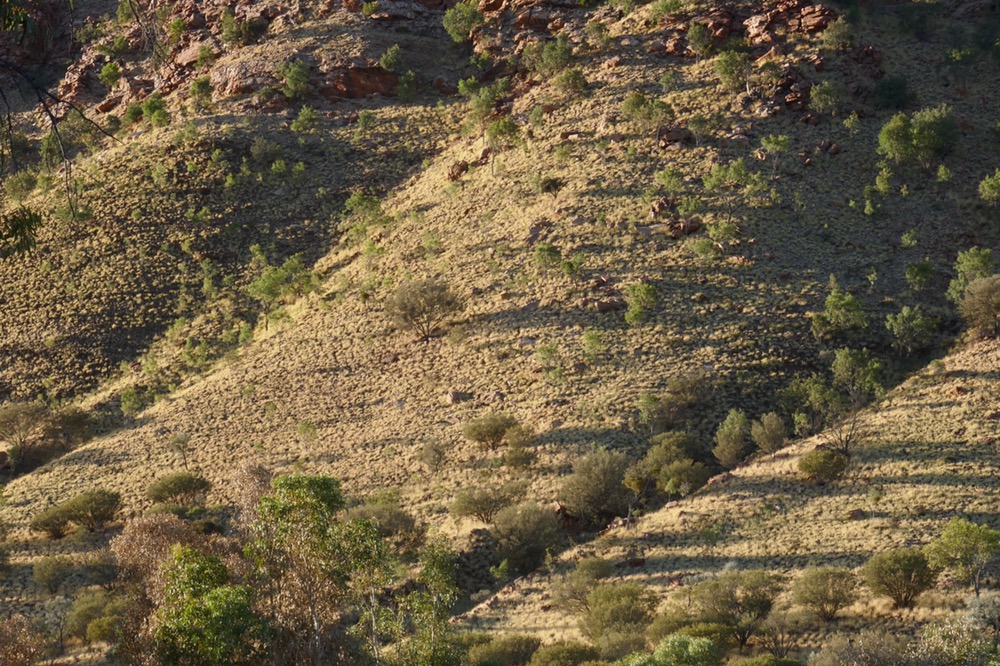
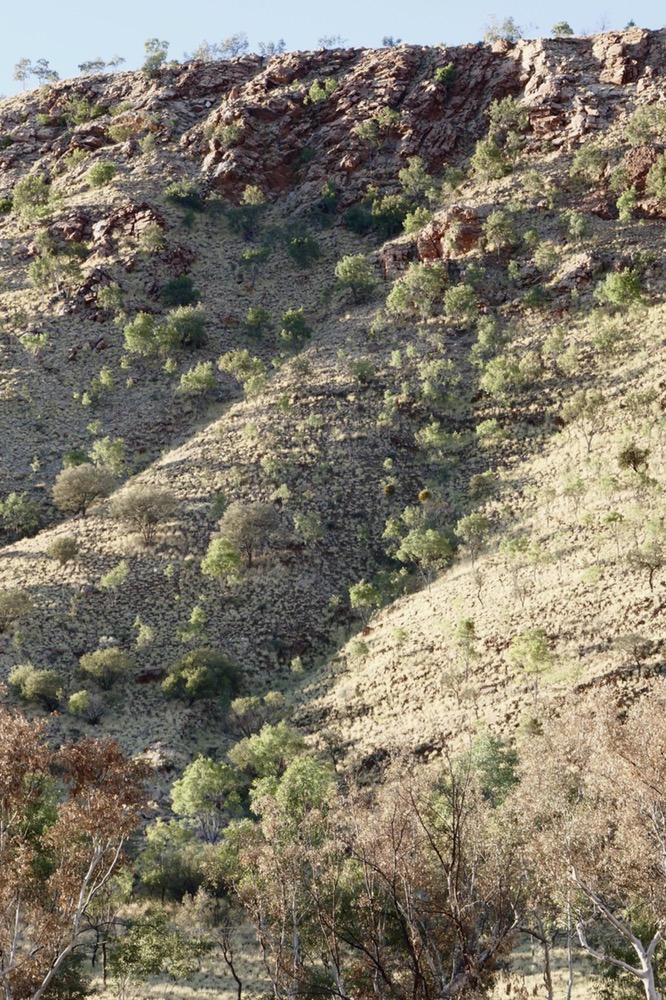
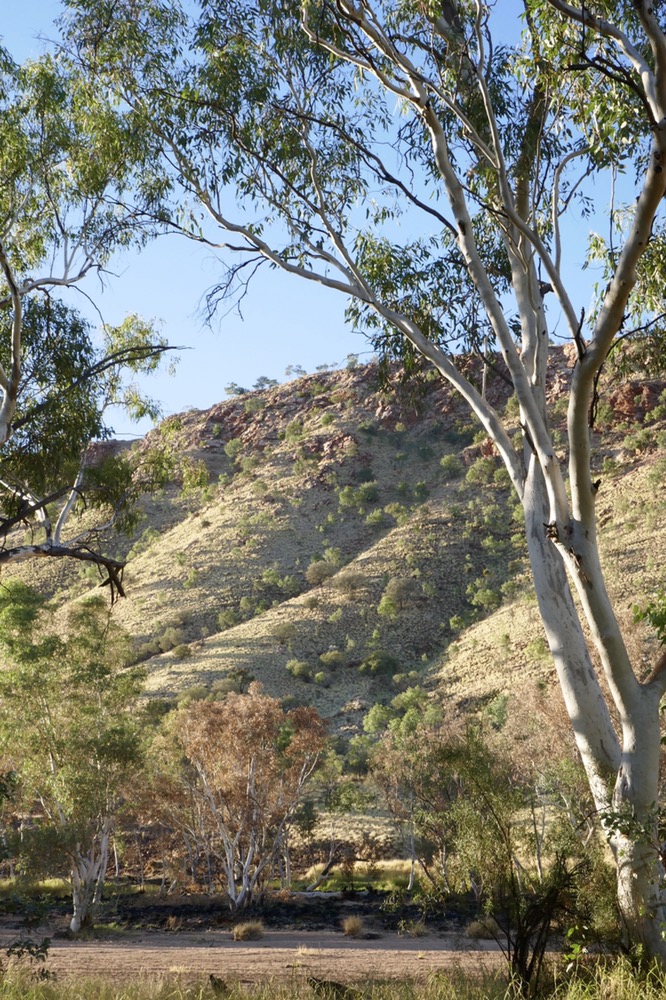
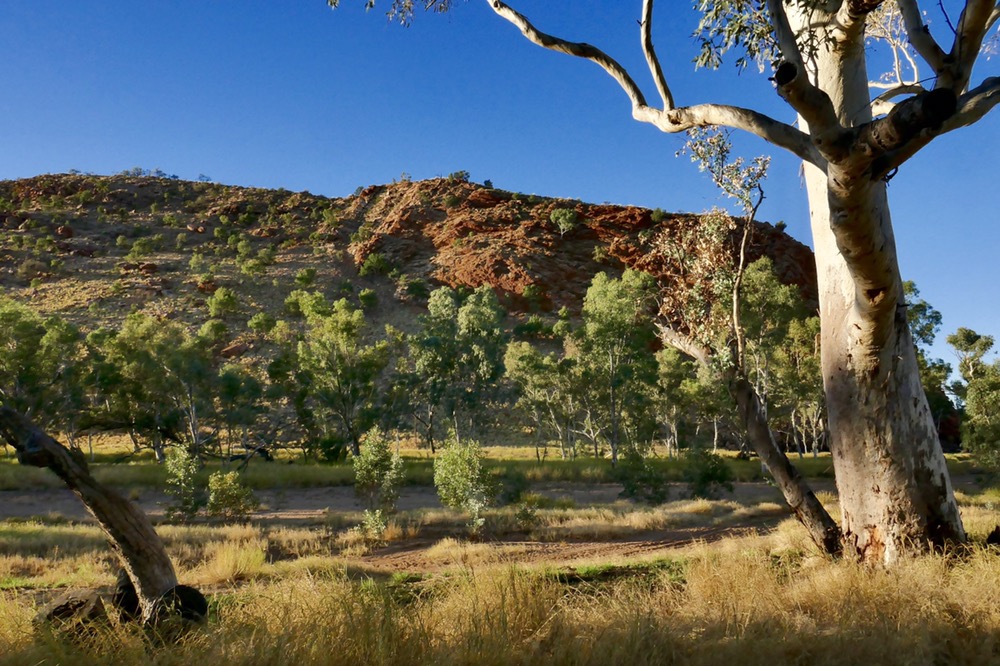
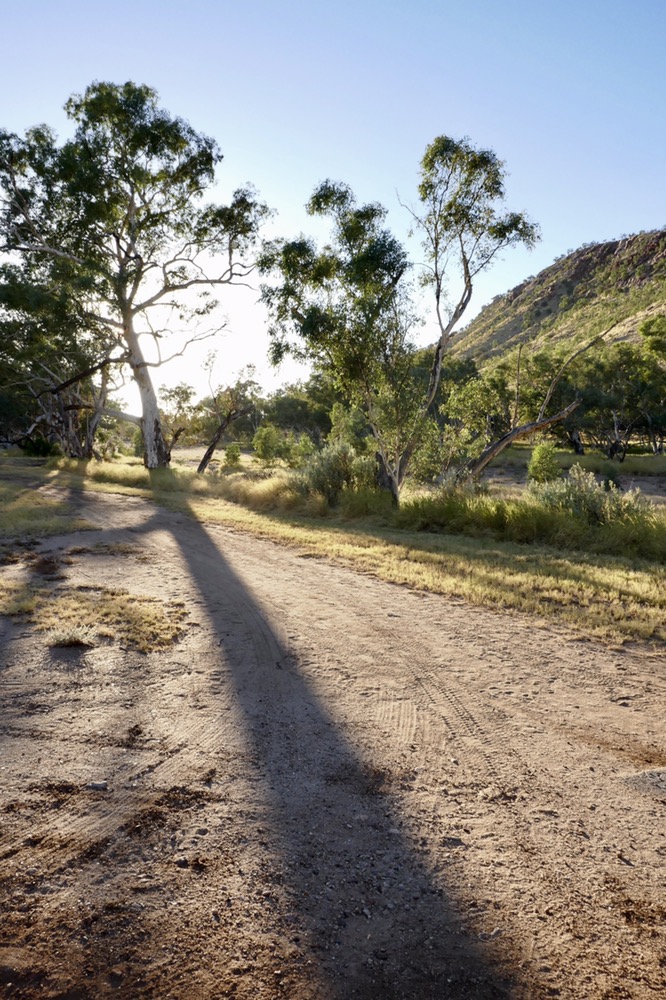
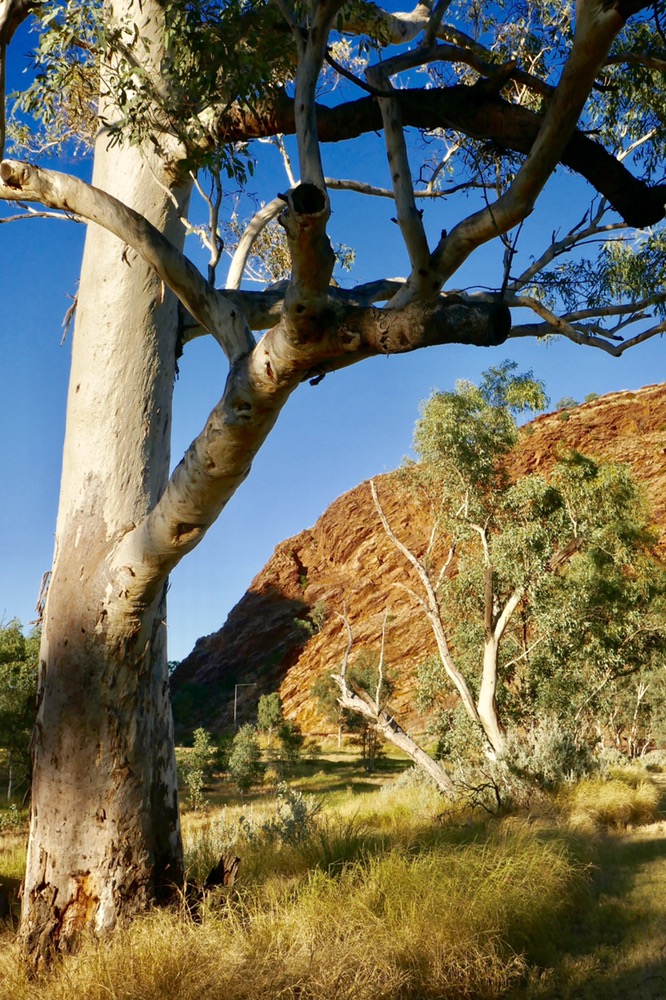
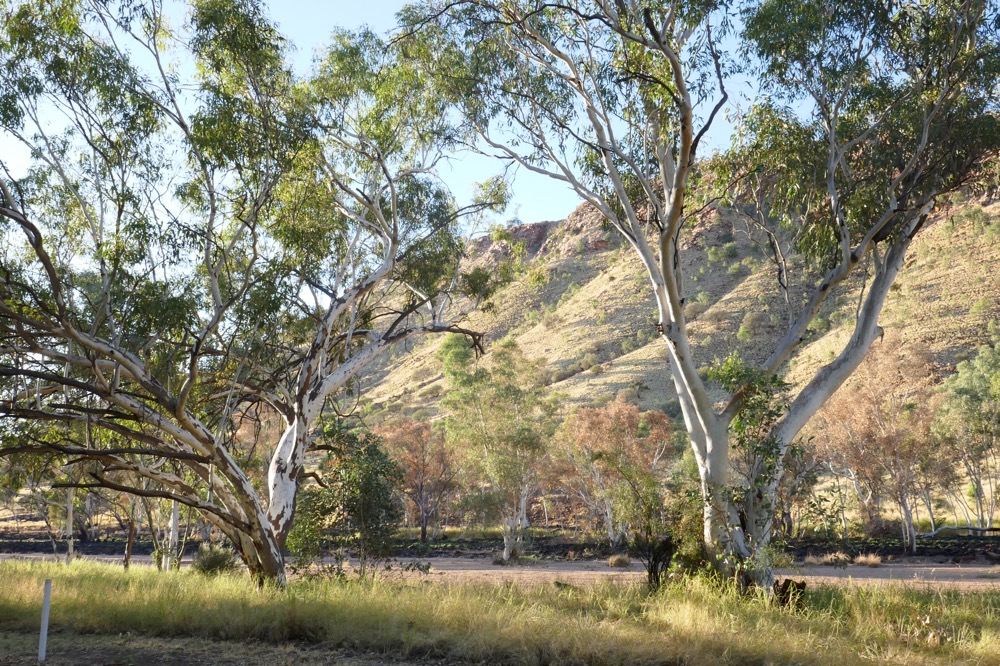
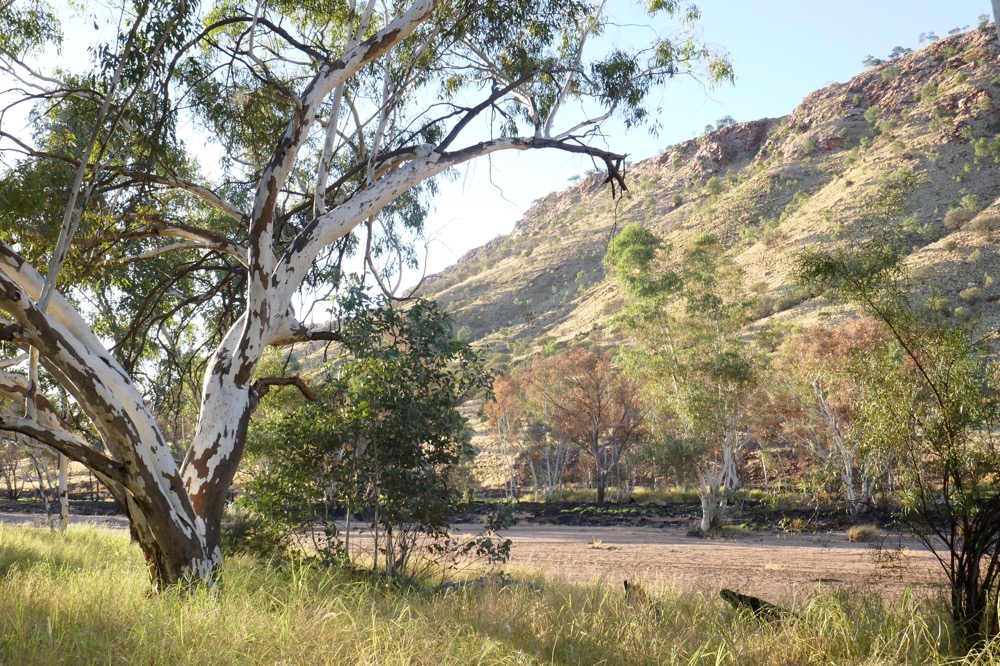
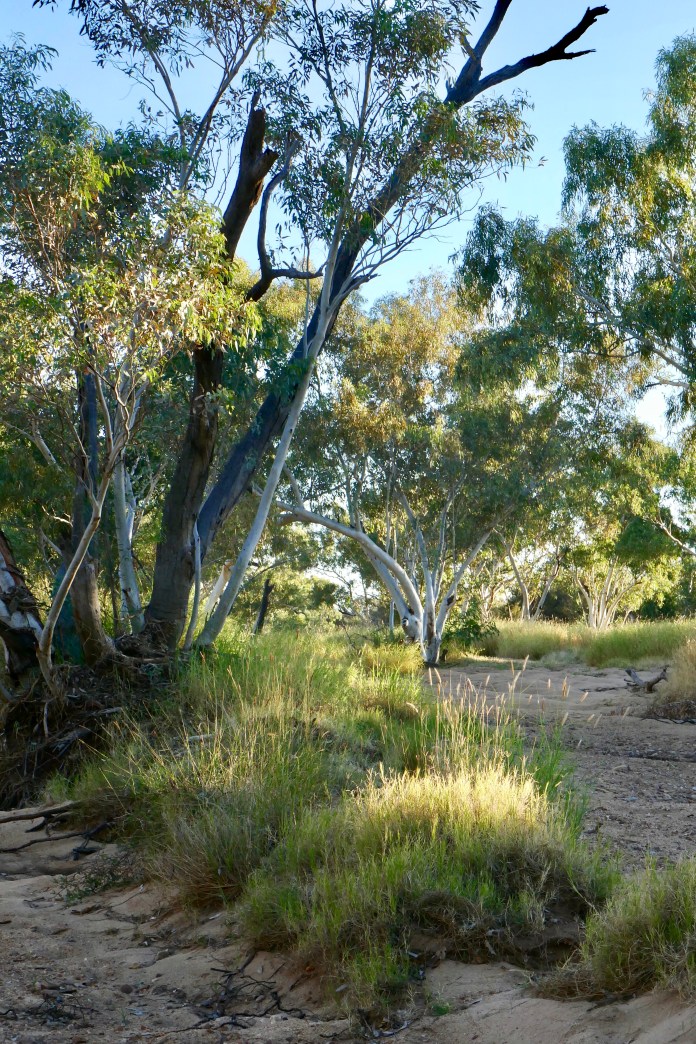
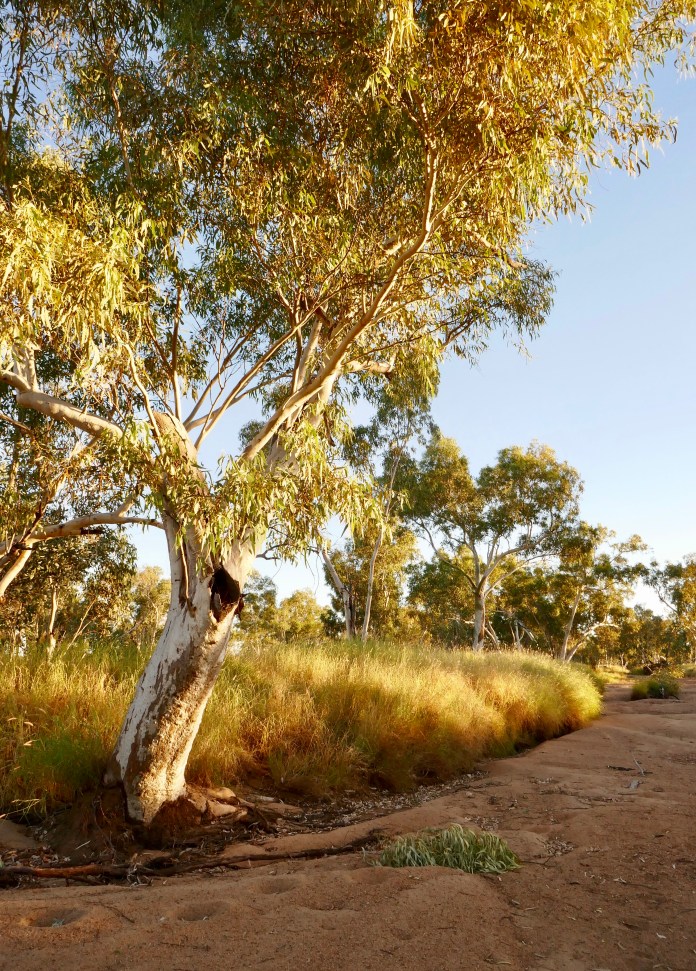
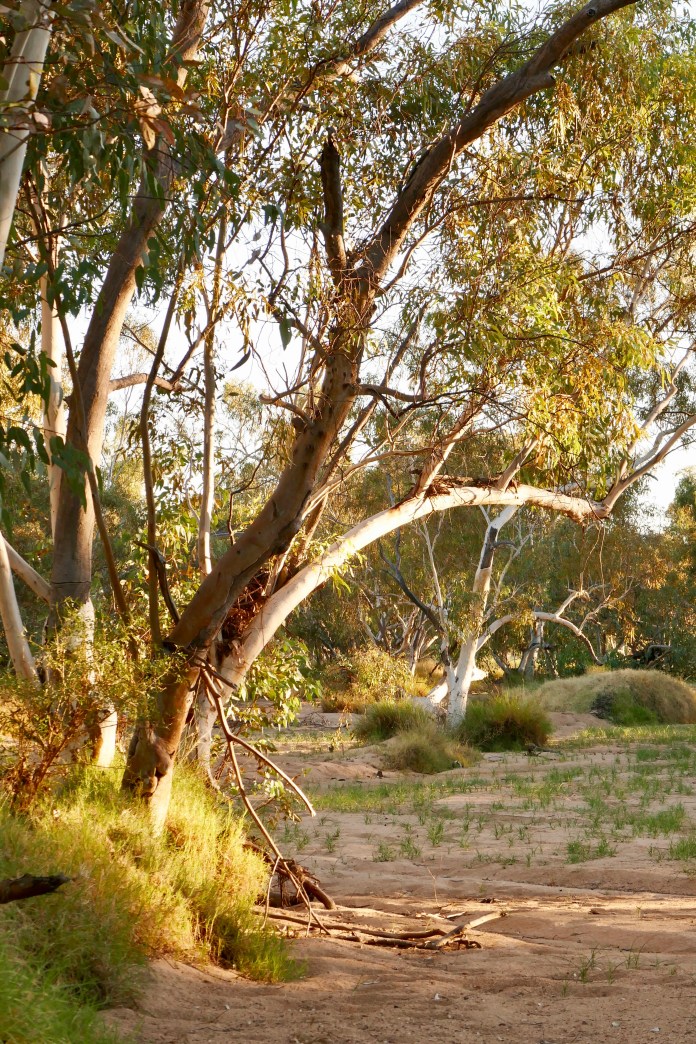
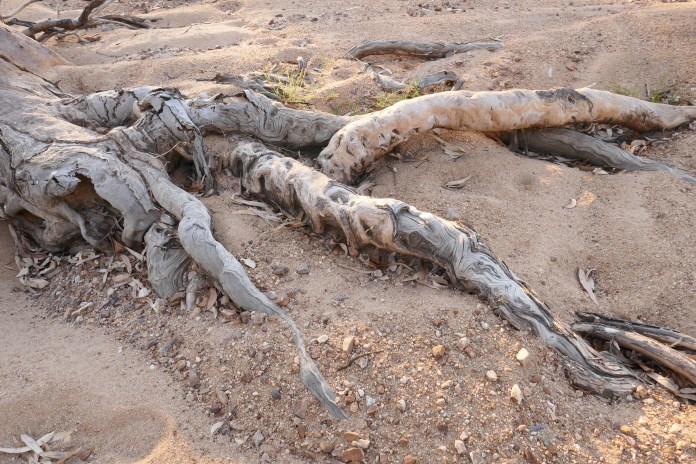
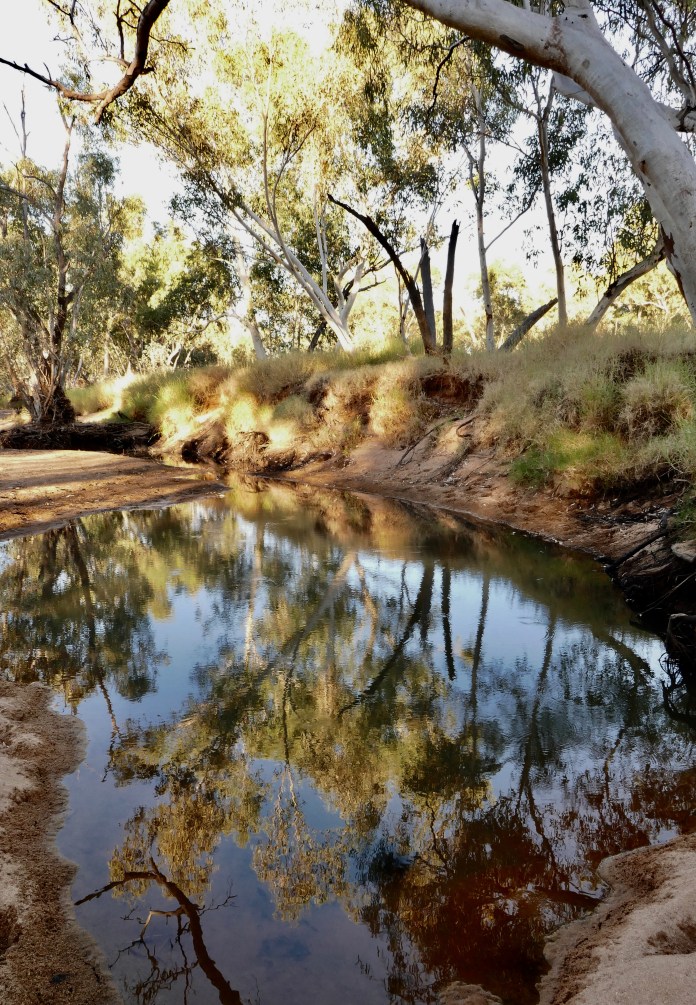
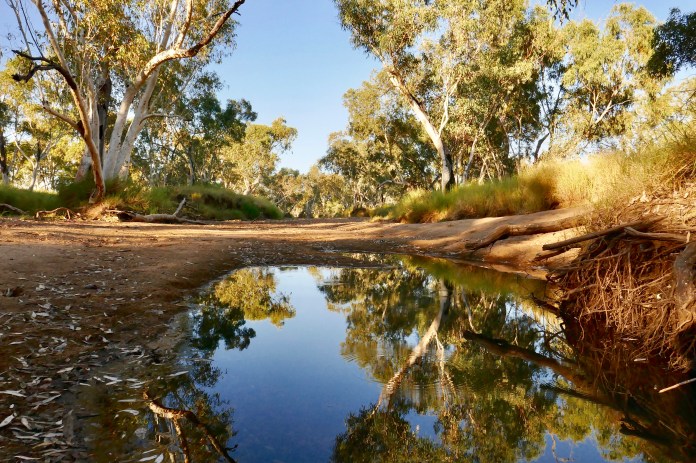
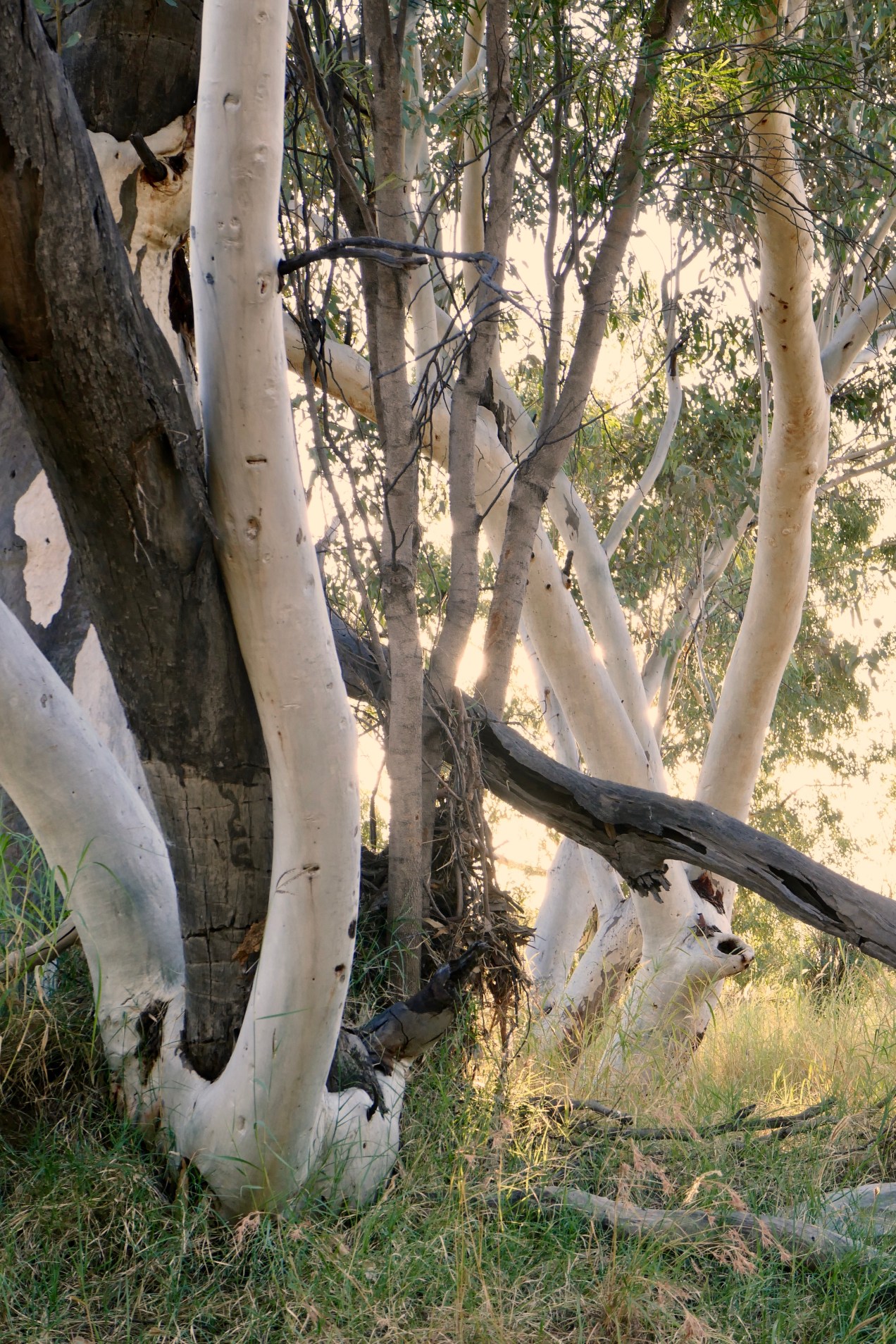
I went walking Tuesday night and then this morning, for the hour of sunset and sunrise, along the nearly dry Napperby Creek. It was about 30 meters wide when it was in flood earlier this year following the unusually high rainfall in January and February. It’s now mostly dry, sandy walking. There are a few lingering dark pools, mostly full of madly breeding mosquitos and insects. Yet sometimes they give wonderful reflections of the trees and grasses of the creek bed. The sandy floor of the creek has many undulations formed by the flow of water and eddies produced around islands, trees and shrubs. The ghost gums and river gums look especially beautiful at the extremes of the day, their multicoloured bark highlighted in patches by the oblique golden rays of the setting or rising sun. There are many birds enjoying the shade and water; zebra finches, ring necked parrots, galahs, cockatoos, budgerigars, crested pigeons, and even a wedge tail eagle was perched in a tree above me. It flew off, lumbering into the air with big lazy flaps of its immense wings; it must have been spooked by the sound of me trudging through the sand.
Laramba is a very beautiful place.

Standard
Short stories and poetry

Science fiction story: destroyer of worlds?

Shiva braced himself against the blister, his tentacled three eyes studying the devastation. His own vessel orbited in a darkness uncorrupted by life. He and his three companions, were very likely the only living things left in this region of space. His left eye swivelled on the cold glass, its iris constricting to focus on the charred planet about which he slowly circled. It felt unfair that gravity was unchanged by the holocaust afflicting that once orange and blue world, mass was mass after all.
Shiva remembered very clearly, and even if he could not, if somehow he needed reminding, his computers were brim full of detailed images, not only from space but from the planets surface, the result of his surveillance electronics and video from his swarm of microscopic drones that teased out facts and numbers from the entire planet. The gathered information included the daily lives of typical inhabitants, the contents of computers, the mountains, the deserts, the animals and insects, the plant life and even the majestic views of the night sky from the local perspective. While Shiva could not, others of his kind could assemble all this mass of information into a self consistent virtual world which could play on and on while the real one smouldered for aeons far beneath him. Yet, he could not reconcile himself that somehow something created from his voluminous data bank constituted anything which would ever approximate real life or be worth a fraction of what was nor irretrievably lost.
Ganesh growled angrily beside his left shoulder, the navigator of their ship, spitting and snarling. He could not yet speak as he trawled through his atavistic emotions, using his sub verbal responses to replace his usual language, it could not begin to express his feelings and thoughts. His is a language of technology, mathematics and physics but sadly lacking in the vocabulary of loss. Shiva studied him too, he was responsible for making a faithful a record as possible of not only this planets end but of their own responses. As if their loss was any more than a diminutive counterpoint, an aside.
The planet beneath them was once whole, a living if limping world, an ecosystem presumed upon by its inhabitants which Shiva recalled was a common enough attitude in the wilder Universe. It’s deserts were a mixture of ages, some were ancient dried up oceans rippled with sand and tundra but too many were barely a century of the planet’s years. They flanked the great cities wallowing in their own pollution. This was a world facing inevitable collapse but other worlds had faced the same situation and dealt with the poisons and waste well enough to thrive, and join the assembly of planets and systems. The only qualification for membership was evidence of good stewardship of at least their own world. This is still considered the basic duty of being in possession of an ecosystem. Ignoring the needs of your own home world clearly implied an incapacity to care for the wider universe. Until that attitude changed, no one was going anywhere from this planet.
Shiva was the galactic appointed adjudicator for this planet. He did not give him any satisfaction to witness such a cataclysmic failure of the assessment process. Never before in the history of this galaxy, had a world been on such a knife edge of self destruction that his appearance would trigger utter, total immolation in a few hours. He had carefully staffed his drones with minor consciousness, giving them a dull capacity to choose where and who they would seek out and record. Drones had followed the few leviathans in the air and oceans, mystified that such violent passages though the atmosphere were permitted. Children in schools , their shadows now smudged on any remaining walls, had been studied for weeks playing, talking, laughing and like most children in the galaxy, studying as little as possible. It seemed so normal.
Shiva had watched all this, and though he could not feel the poisoned air in his lung or taste the caustics in their drinking water, he could imagine it. The numbers from the drone sensors were telling, the problems widespread and largely ignored from its tiny watery pole in the north to the great mountain continent in the south. 
Of course his assessment about membership was not irreversible, many worlds had improved their stewardship enough to have decisions about quarantine from the larger universe reversed, but it was final enough for now. Shiva had followed the set reporting protocol, the planets media agencies subverted for only a few minutes. Shiva’s physiognomy was a galactic standard, his feathered wings demurely folded, his muzzle laced with fine razor sharp teeth, and his afore mentioned three eyes retracted back into his face and forehead. His appearance differs from a typical insect inhabitant of this world, and even from the bipedal creature which appeared to be in charge, but Shiva had seen the media files often enough to see creatures sharing his appearance were often portrayed in what the locals called ” movies” and would not cause any alarm. 
Even before he had finished his short explanation of his task, in the most ancient and early language he could find, there was chaos. The choice of Sanskrit was one for which he would be criticised on his return home but it was the oldest and richest language he was able to find. It just seemed to suit him. Yet it was even before any attempt of discourse or of negotiation, that he could see the trails of missiles littering the skies beneath him. And then the massive fires spanning continents and the multiple golden clouds erupting out of the lower atmosphere. Shiva watched with emotions of amazement, regret, sadness, and anger. He folded his wings back, nestled them into the hollows in his spine, sealed the skin with its muscular pleats and then feeling empty and lost, he hovered inside his ship. He floated there for many hours. It felt smaller than it ever had before, and eventually its blisters became opaque, the third consciousness inside the ship began its sleep, readying itself and the two corporeals for the trip back to their own home world. His last thoughts were muddied by those deep hypnotic drugs, but they were real nonetheless, was it his name or was it his appearance or was it something of which he had now no idea at all. But why he thought, would the name of Shiva trigger the end of the world?

Standard
Short stories and poetry

Science fiction story: the flytrap

Dust and smoke and steam swirled around and out of the braking vents as the spacecraft landed. It’s silvery silhouette still glowing from atmospheric entry. The tapering ship sunk into the ground until its huge diagonal fins gripped and held its bulk firmly. Woodland covered much of this continent but here at least it gave way to a grassy plain, an irresistible landing area for space faring visitors.
There was a male and female aboard, one roused from hibernation only hours before arrival and another who had converted their ship from a galactic inhabitant to an atmospheric craft as well as make the logistic decisions as they entered this solar system about where and when to land. They were both tense; excited and enthused by the prospect of exploring a new world. 
Meanwhile, the planets own inhabitants sat on tree branches, about which their tails were firmly coiled, the leaves shielding their eyes from the sunlight while they waited for movements from the ship. This was nothing new for many of them. The younger ones clicked in excitement but the older wiser ones patiently waited for developments. The lower door pivoted out and down, creating a steep gangway. The first of the ships occupants walked down to the ground. He or she looked around, twisting in a silvery carapace to the left then the right. Another followed the first, and likewise studied the surrounds completely unaware of the many primate eyes watching them.
Machines pistons began repeatedly driving the lower limbs of the carapaces, the two spacers headed deliberately away from the ship, cracking the branches as they moved through the forest. They had a definite direction in mind, they always did. The indigenous followed along, skittering along the trees and abundant branches, they moved without any fear of falling, confidently and always out of sensor range of their quarry. 

The spacers entered the clearing, and there two hundred meters away, was the edge of the great dish, it has survived, cared for by the local inhabitants for hundreds of years. They saw them kneel by it, and then carefully tread around its perimeter, after a kilometre they found the narrow access tunnel and tore off the metal grate with a gust of steam from the arm vents. The carapaces were too large to negotiate the tunnel, there was a hiss of escaping vapour, and two humanoids dropped to the surface. They entered the tunnel, almost inpatient in haste.

The primates waited, the rains which had been threatening from far off finally loosened and water bucketed out of the sky. Their fur soaked, the young ones had built up courage enough to touch the abandoned metal bodies. In time they lost interest and rejoined their elders on the edge of the clearing. 

//////

They revisited the ship that had landed so dramatically a few weeks before. Already the vegetation was moving toward the silvery ship, in a few months it would be invisible like all the others, toppled then smothered in the trees and foliage. All the previous visitors who had voyaged countless miles and for hundreds if not thousands of years still lay beneath the dish, a maelstrom of lost souls, all who had pursued the television signal from the dish which began transmission two thousand years before, and was the bait, the fly trap that protected the inner, greater and hidden worlds a parsec away. The engineered primates sat eating leaves and fruit, and watched their planet remove one more invader. Their job done.

Standard