India, Travel

Day 6 India trip from Thar to fort

What a wonderful night. I lay on my camp bed, warm under the violet, Rajasthan quilt, looking directly up into the night sky. Peter had pointed out many of the northern constellations to Jennifer and I before preparing for bed. Cassiopeia, Polaris, are some of magical words and places we discussed as he pointed them out to us. Though I have spent time in the northern hemisphere before this, this was the first time light pollution, atmospheric pollution, or prolonged daylight did not conspire to prevent this experience.

Every time I woke up overnight, I looked up, a cavalcade of constellations followed one after the other. In particular, I saw the Big Dipper at about 1 am. Each time, I drifted off to sleep easily enough , and finally woke refreshed. Toilet facilities are a tree and sand. After a simple breakfast, I asked Api how to say thank you. I tried it out on one the camel handlers. Api was appalled when I said he was Taliban. The other guides went quiet. Thank you is not pronounced Taly ban but doe no Vaad. I tried this out a few times without any further potential international incidents.

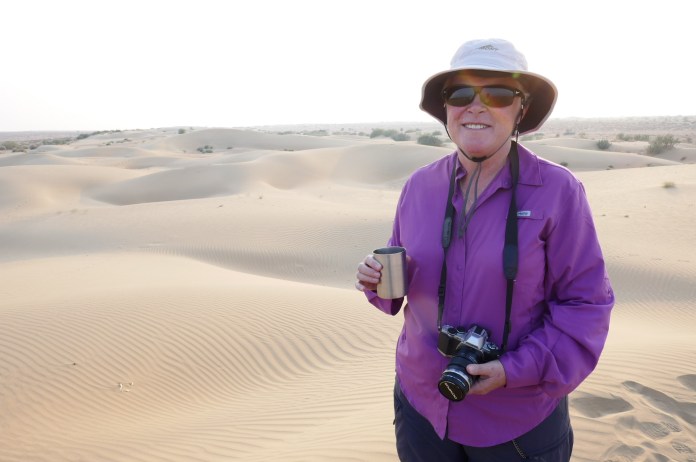
We climbed onto the dunes for a final lingering look across them, and there behind us one of the guides was walking in the sand, carrying a round steel tray with two hot chais for us. Very thoughtful!

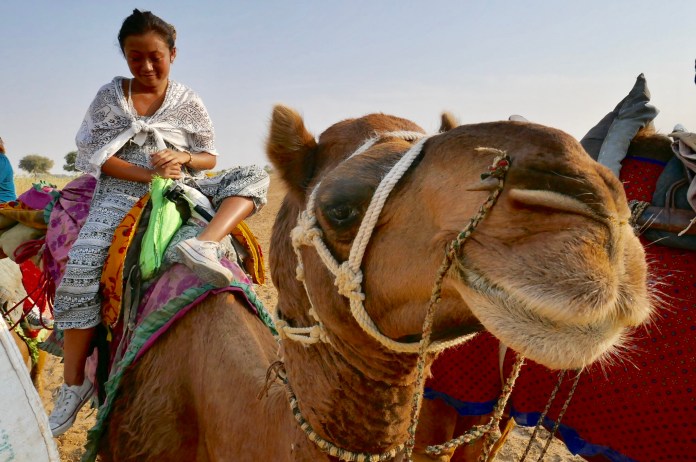
Jennifer was bruised on the camel trek, by the steel pommel which is the hand hold on the saddle so she elected to return by jeep and not have another camel ride. So as the others headed off into the sunrise, with Bubbles, King Kong, Barbie, and the other camels carrying them over the sand, we trotted along behind. Their speed looks slow, and even on the camel you feel as if you are getting nowhere fast but nothing can be further from the truth. We walked behind them, and the camels quickly outpaced us with their enormous stride, and dead sure footing.

We climbed into the sturdy little Mahindra jeep.. The doorways are plastic and curl up and forwards to attach by Velcro straps behind the front pillar. The young driver, did a quick namaste and prayer, then off we went. We travelled through a village, we saw a bus with 12 students on top. Even though it is Saturday, the kids are at school. The village houses all looked solidly built, with bricks made locally. Stones were jammed into some windows to keep the houses warm at night over winter. It can get as low minus three overnight in winter. Cows wandered on the roads, camels grazed beside it munching acacias as we drove along the dusty road, me clutching the steel hand rail in front of me.

Soon we will be having ing lunch, and doing a walking guided tour of Jaisalmer.
//////////

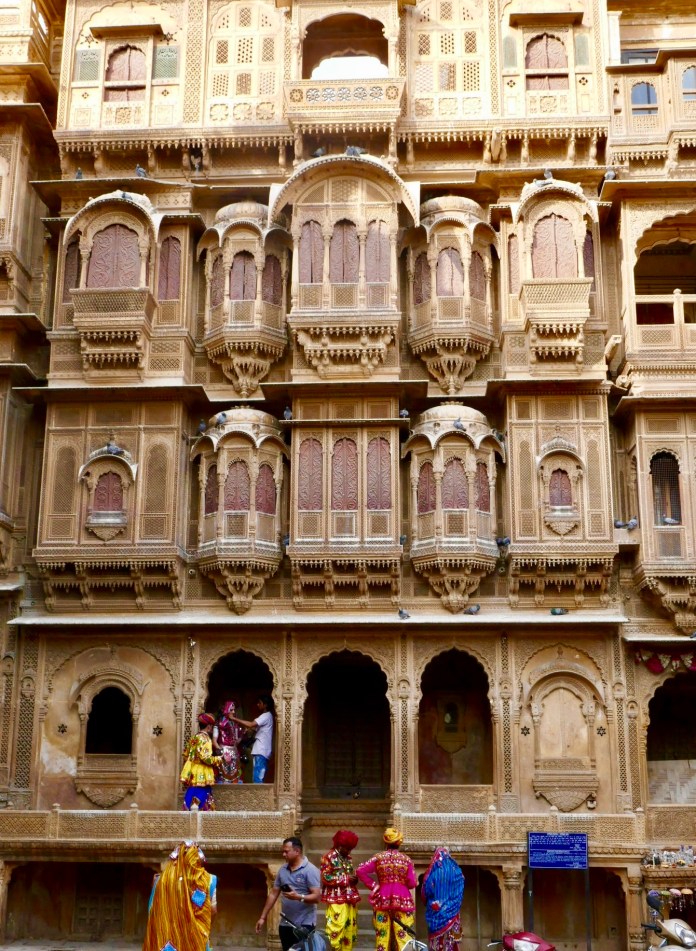
We all enjoyed a beautiful lunch at an upstairs restaurant called Killa Corner. Jennifer and I sharing a kofta vegetable dish. Then it was quickly back to the hotel to meet our guide for the afternoon. A local of many generations who had many interesting stories and facts about Jaisalmer. Fort Jaisalmer is best known as the Golden fort due to the beautiful yellow sandstone exclusively used here and in the surrounding township. Jaisalmer is 75 kilometres from Pakistan, and there is minimal cross border trade. Until the formation of Pakistan and the division of India, Jaisalmer had been a prosperous city based on one of the trunk lines from the Silk Road from China to Europe. There were Muslim, Hindu and Jain traders, Buddhist monks, mercenaries and adventurers of all sorts who frequented Jaisalmer. It was really wealthy before the sea routes opened up to Europe, seriously affecting the amount of trade going by land. There are five Jain temples built solely for the visiting Jain traders. There are no Jains living in Jaisalmer but every year there is a festival and Jains come to celebrate in the temples. There are very few Jains in India today. Jains like Buddhists are an off shoot of Hinduism, and they are very strict about their vegetarian diet ( no root vegetables though), avoiding any animal products such as leather and if very strict, never shave or even wear any clothes.
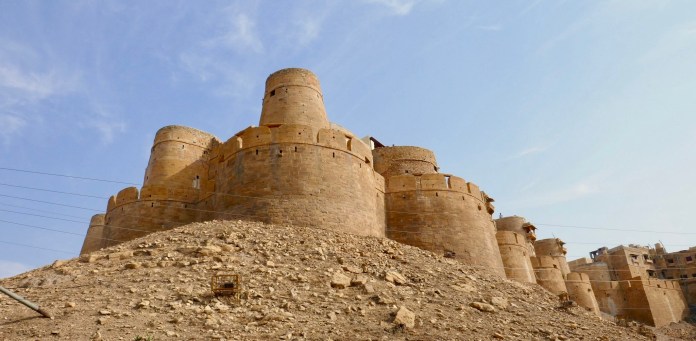
The Golden Fort has been attacked three time in all the years since it was first built. The fort has some advantages both natural and man made, that would have always made it a challenging military target. There are over 90 bastions, armed with cannon on the perimeter, at the base of the wall are loose stone and gravel making it difficult to use seige engines and the four gates of the fort are all approached along winding routes which made it impossible to use elephants to ram the great doors. The intense heat of summer, up and over 50degrees centigrade made it physically exhausting to even wait out the city. There is little water outside the fort itself which has reliable if not generous wells inside it.
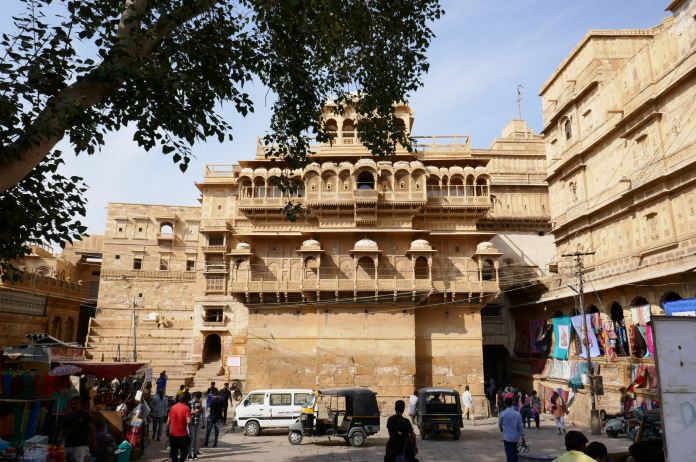
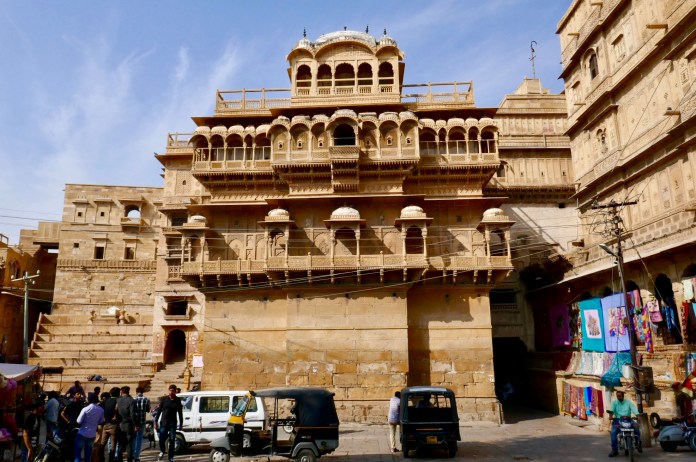
On the tour we visited one of the bastions and learned about its defences. Then visited the Twin palaces of the Maharajah and Maharrana, now no longer used by the former royal family, its seven storeys now badly corroded by damp and termites. Beside the entrance to the palace are a series of stone tiers with a white throne atop. This is where the Maharajh and the local Brahmans, perform a yearly festival. We visited the Prime Ministers house which was built by the then first minister in the 1880s by two brothers. The house has quirky features that were the result of a teasing rivalry between the two men. In one corner of a balcony there are apsaras ( dancing girls) and in the other, some carved musicians. The patterns on or above a window are different on the right compared to left side of the house. By the way, these especially ornate houses, are called Hevelli. The sandstone is intricately carved at the stone masons, then brought to the house site and assembled and then mortared in place. It remains a demanding skill but we saw two houses being built using the same techniques as hundreds of years ago. All houses must be built with the yellow sandstone available locally. There is no red sandstone here and you are not allowed to build with it in any case.The Prime Ministers house is still owned by the same family who are now trying to restore it. They finance this by selling camel bone products, we bought a Namaste: a namaste is a carved hand in two parts with Ganesh, god of good fortune in one half and Lakshmi, goddess of wealth and spouse of Vishnu in the other half.

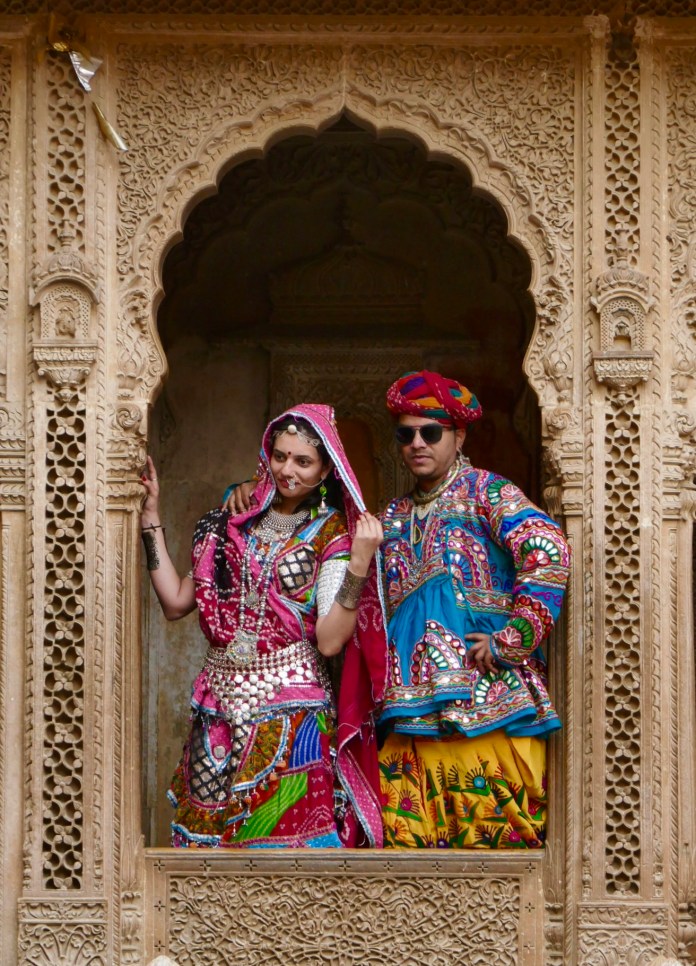
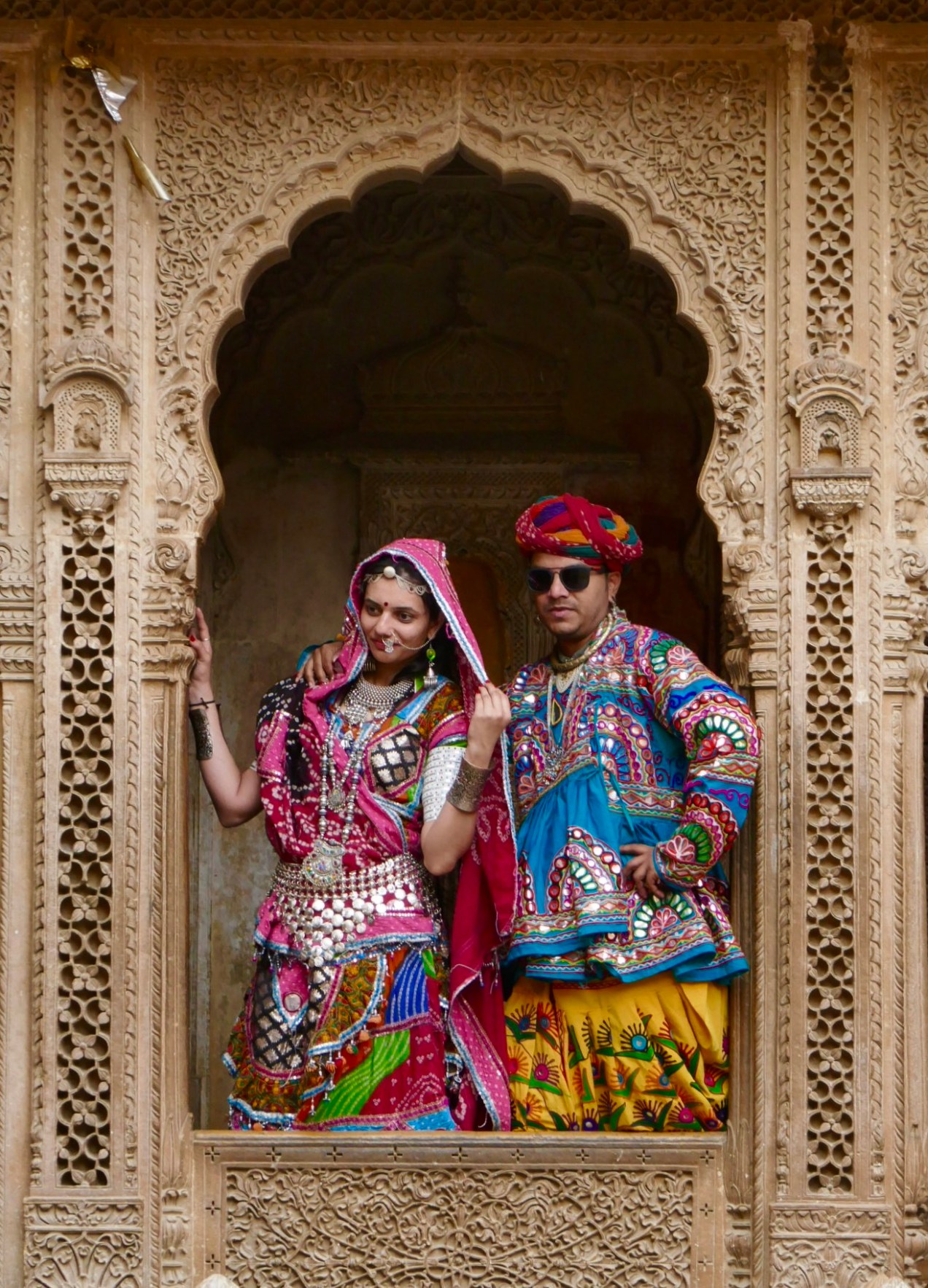
We visited a hevelli buIlt by a once prosperous Jain trading family, who abandoned it many years ago. Nowadays it is owned by the government, and Indian tourists dress up in garish Bollywood clothes available to hire in a courtyard opposite the house, and take photos of themselves. Seriously weird stuff!
We visited a rural cooperative, set up by the government of India, to enable local people to compete with the businesses that have moved into Jaisalmer in recent years for the tourist trade but sell goods made anywhere but locally. We had a long but interesting presentation on fabrics, including cashmere versus pashmina. We bought two scarves, a men’s one made of pashmina and a scarf of ibex wool for Jennifer in a dazzling turquoise.

We had a marvellous Indian meal at a rooftop hotel in Jaisalmer, and enjoyed a surprisingly good Indian white wine. On the way back to the hotel, we passed three weddings. Noisy, fun affairs with the bridegroom resplendent in purple and silvery brocade and a brightly coloured turban, he atop a festooned white horse. All around him danced his mother and sisters, in dazzling rich red saris with gold trim. Lots of hand waving and all in time with the drummers, pounding loudly on their instruments. The other guests milled around or sat, the men with orange scarves over western business suits and wearing red turbans, before they all headed off along the street to continue the wedding.IMG_2080IMG_2087IMG_2095IMG_2096IMG_2098IMG_2100IMG_2101IMG_2102
Standard
India, Travel

Day 5 India trip the Thar desert and Jaisalmer

IMG_2032IMG_2037IMG_2040IMG_2039We are sitting on our camp beds, the sky our roof, and a campfire has been successfully lit. Venus sits high in the western sky. The dunes are no longer visible, the dunes of the great Thar desert. But I will start at the beginning.
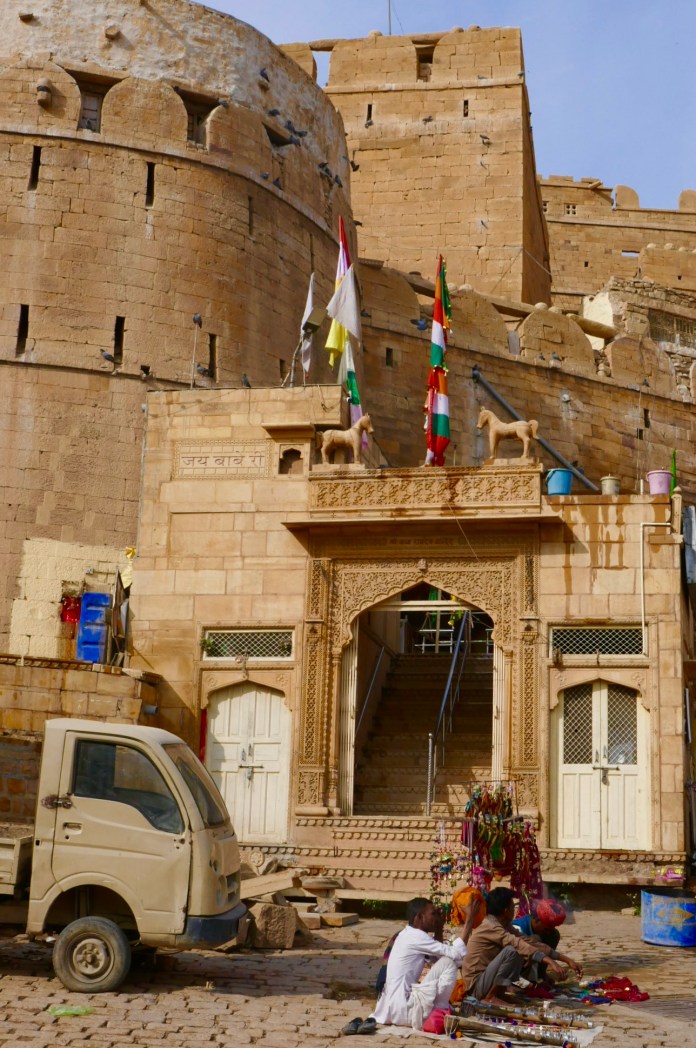
We woke up at 7am. The train gently bumping along. Our bunks were comfortable and the fan adequate to keep the carriage cool. Outside a vendor, walked along the narrow corridors, calling out Chai, Chai. It was 10 rupees a cup for delicious Chai. Jennifer and I bought some meals for the train trip in Delhi, and this morning we had the leftover dosa, and some semolina cakes. We arrived at Jaslaimer railway station at 11:30, right on time. We pulled and carried our bags behind our guide, onto taxis, then we travelled to our accommodation. I had my first sight of the fort. It is a vast complex, thick walls which slope to battlements: its rich colours are all from the yellow sandstone blocks and mortar originally mined from the Thar desert. First built in the 12th century by a raja, a local king. This same family stayed in charge of this part of Rajasthan, fighting off, or negotiating its survival until 1947 when the establishment of India’s independence included the end of all the princely small states. They survived the Mughals and even the English ambitions for India.
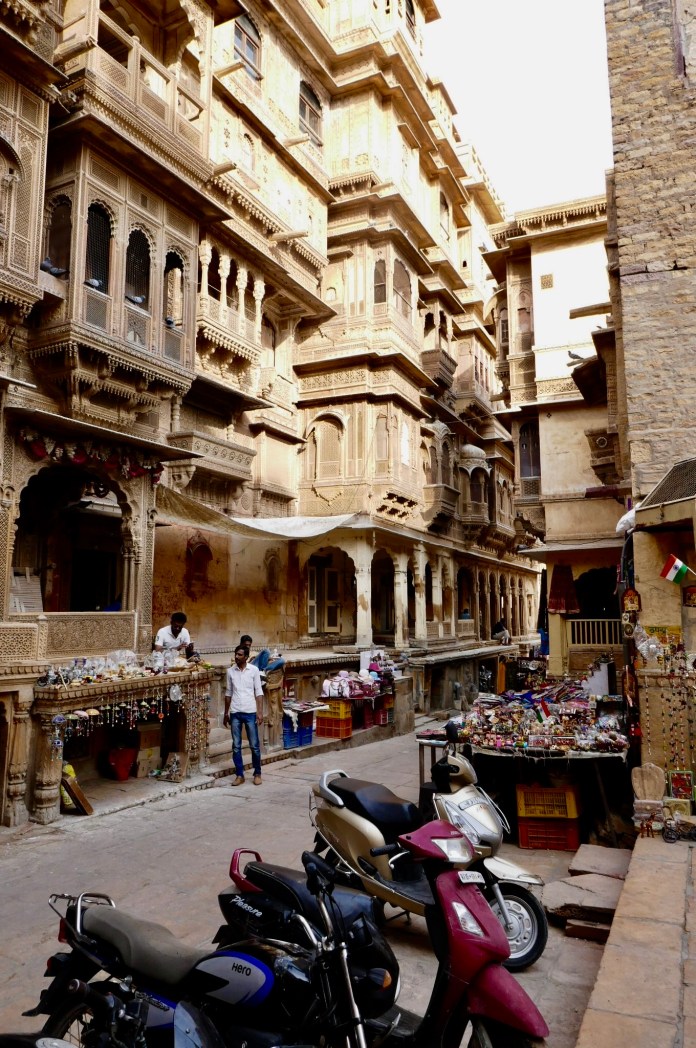
The fort is a beautiful construction of itself, but also includes many other later and notable buildings including three famous Jain temples. We hope to explore them when we return from our Thar adventure. The narrow, paved streets, the three storey buildings with doors on the streets. Shopfronts selling books, Hindu texts, novels and light reading, as well as books about Indias history in all types of languages. Leather goods, fine shawls, carpets, cascade out of windows, and cover the street walls of the shops. Motor bikes and small cars negotiate the twisting alleys, honking and accelerating, on the steep ascents and descents.

We will spend the next few days exploring these marvellous streets and shops.

After we arrived at Deepak Hotel, we climbed the steep steps up to the lobby, then to our rooms. It is an incredible room, paintings of hunting rajas, lacework designs in mortar on two walls, red translucent curtains and a low table and wooden chairs. It is a very comfortable room indeed, and I would not be surprised to see Aladdin pop in through a window.

The fort is largely the responsibility of the government, as the building is collapsing in some areas which is due to changes in water use following massive increases in tourism. The fort is built on sand, and the changes in water level, have triggered subsidence. The government of india is doing its best to approach this problem, financing repairs. Our hotel is part of the wall itself, I suspect it would have been soldiers and officers quarters at one time.
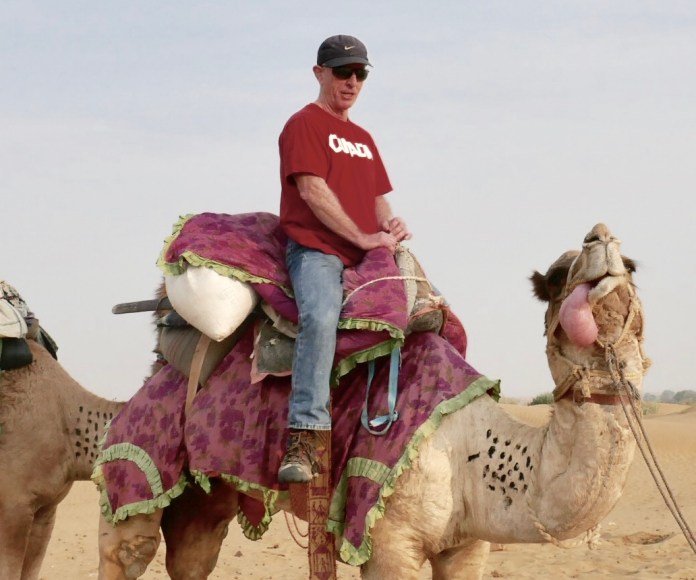
After lunch, we all took light bags for our camel trek. Bundled into three 4WDs, we travelled about an hour to the outskirts of the Thar desert. Waiting for us were some camels and their handlers which are already kitted up for our trek. Getting on and getting up, is a bit harrowing. It’s essential to lean back to stop falling off the front of the camel. Once up in the air on the saddle, it’s not too bad, the rocking takes some getting used to and negotiating dips and rises requires some attention by the rider ie me.

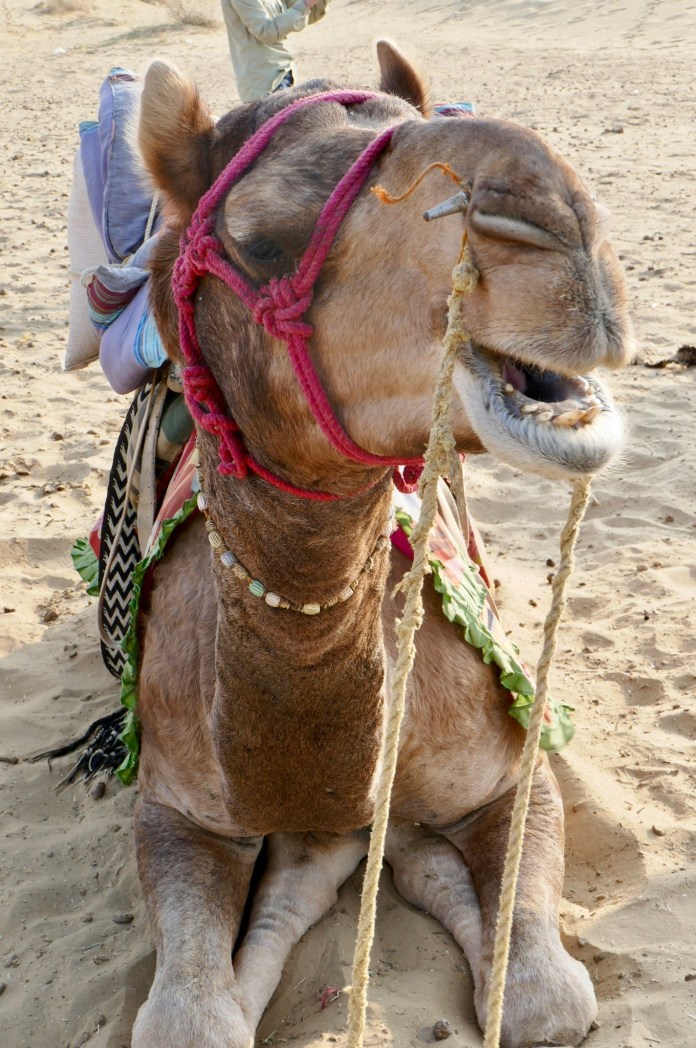
The ride went for 90 minutes . The highlight was Jennifer’s saddle slipping down the camels neck, a situation not compatible with safe camel travel. Poor Jennifer slid off elegantly and was caught by some of the attentive camel handlers. After that, Jennifer preferred to ride in the camel cart. The camel is known as the Ship if the desert, and now I know why, you rock up and down just like a bout, the snorting and grunting resembles a diesel onboard marine engine, and the clincher us when they sneeze or snort, I get a cooling spray of camel drool. As I said just like a ship!
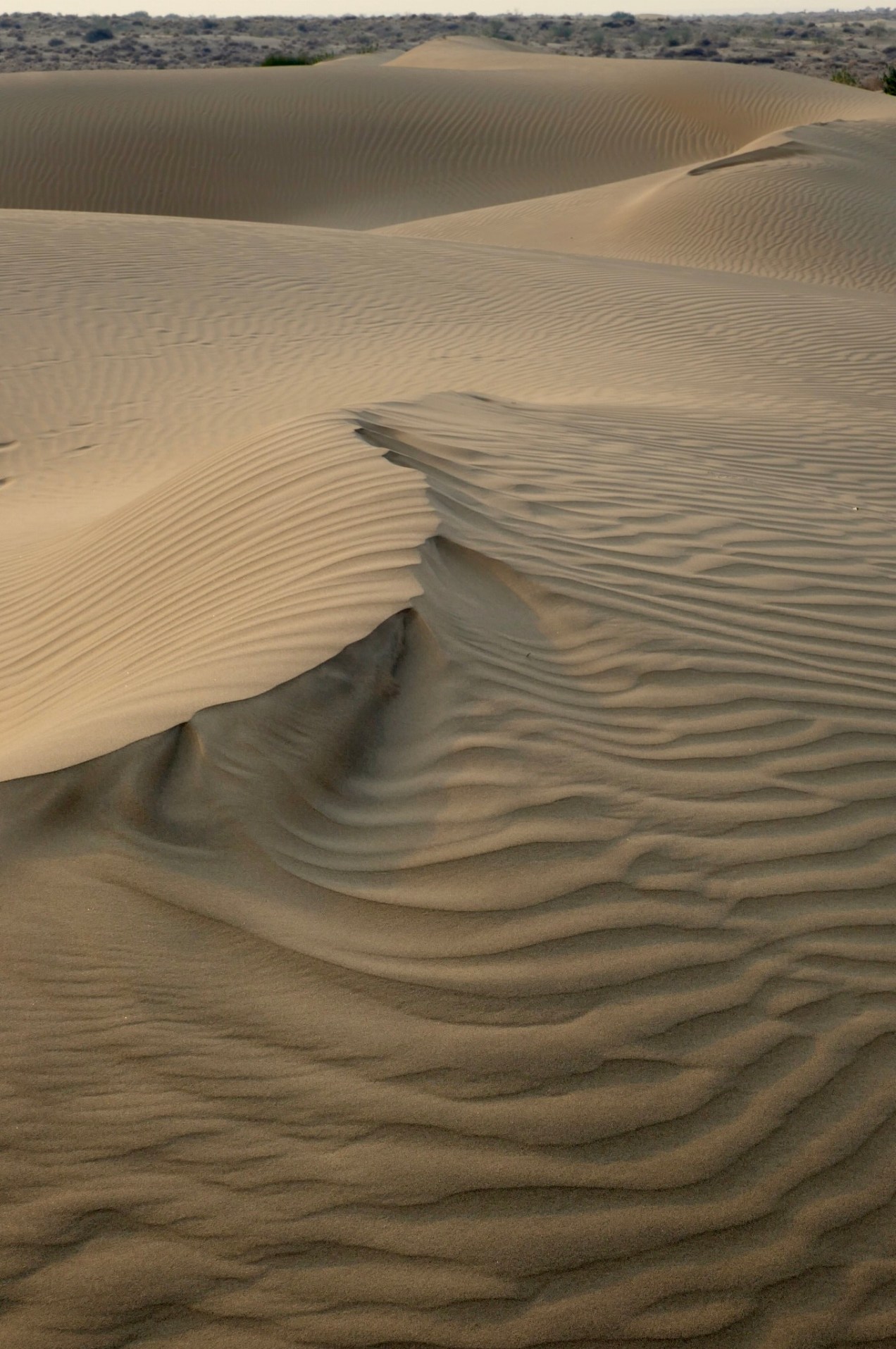
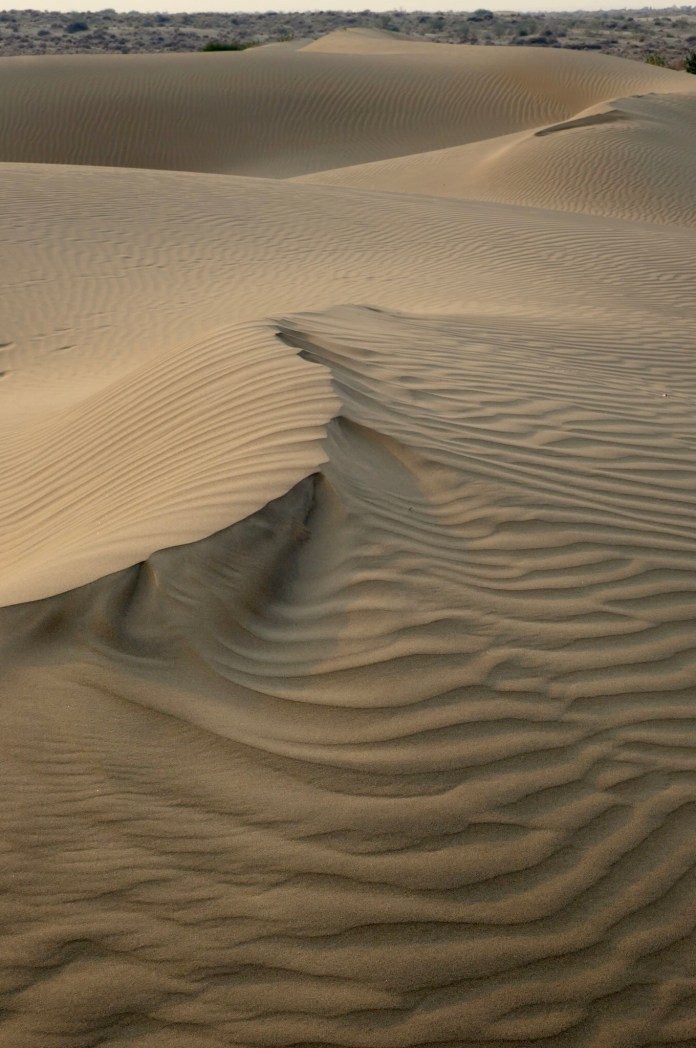
After settling in at the campsite, we all have comfortable camp beds and plenty of warm blankets. We walked onto the dunes which are famous in the Thar. This is an immense desert but only small portions are sand dunes, rolled into heaps, crests and hollows by the desert wind. The sculpting is beautiful and ever changing. However, the Thar has been a barrier for invaders to India for Millenia, fatally testing the mettle and resolve of many armies.

The evening has closed under the sky, the northern constellations clearly visible. What a wonderful day it has been.

Standard
India, Travel

Day 4 India Trip Old Delhi revisited

The trip has commenced. Last night we met Api who will be our team leader on the tour. We sat around tables at the hotels conference centre to get the low down on the tour, dos and don’ts of India and a definite no no which is riding elephants. Riding camels is okay as they have always been ships of the desert and they will never ever do what they don’t want to. Elephants try to oblige, the typical circus climb on and up the elephants trunk actually injures the animal. This is why Intrepid has taken such a strong stand as a tour organisation.
After the meeting, we ( hence forward the group) walked to a fine restaurant and Jennifer and I opted for the package meal of three chicken dishes and lamb rogan josh. All beautifully cooked, and a vastly more flavoursome meal than the previous night at the hotel. There the chicken kormas lack of flavour was only exceeded by the gluey texture in which the chicken was criminally entombed by the chef. It was a fun evening with the group made up of two anglicised Chinese, Mum and daughter, us, one young new nurse from the Netherlands and the rest are Canadians. The next morning the final member of the group arrived at breakfast, a young Colombian who has been working in Germany,
Overnight, the dog chorus started up at 2 am. It lasted till 4 am. Even ear plugs jammed into the inner ear, could not obscure this annoying cacophony.

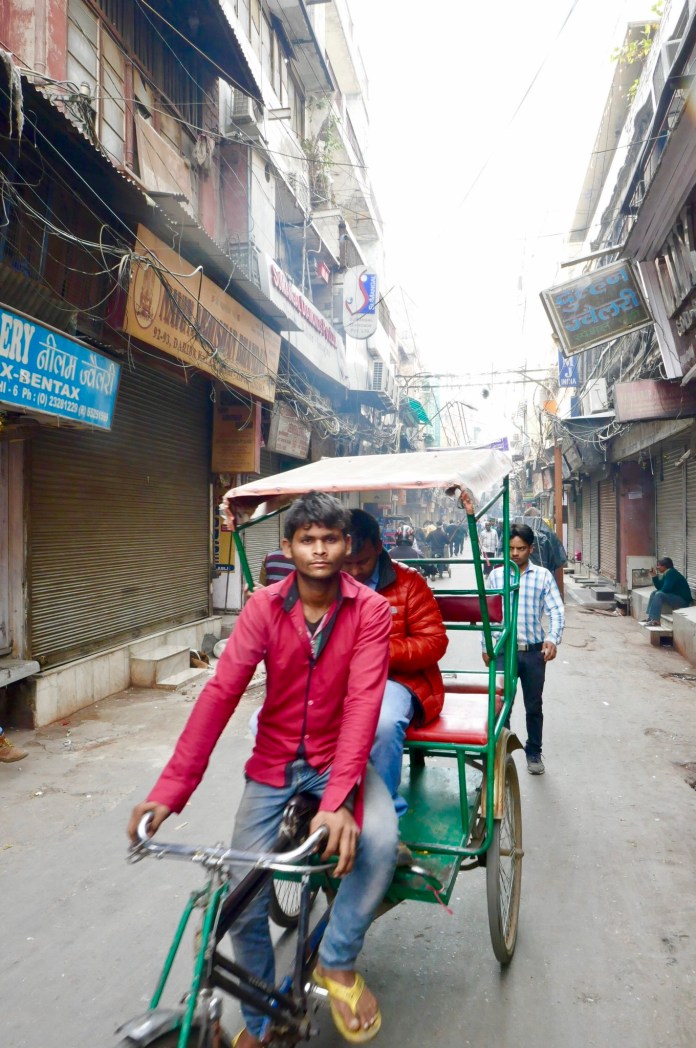
In the morning, we had a bright early start, we all walked to Karol Barg station, then took the metro to Chawri Bazar on the yellow line. It was crowded but not bone crushingly so, which was pleasant. We took bike rickshaws to Jamah Masjid. Our driver looked pre cardiac trying to pull us along on a rickshaw with shredded tyres and about five gears. The driver pulling the two Chinese ladies in his rickshaw, who weigh about 45 kg each, looked blithesome as he zoomed past us.

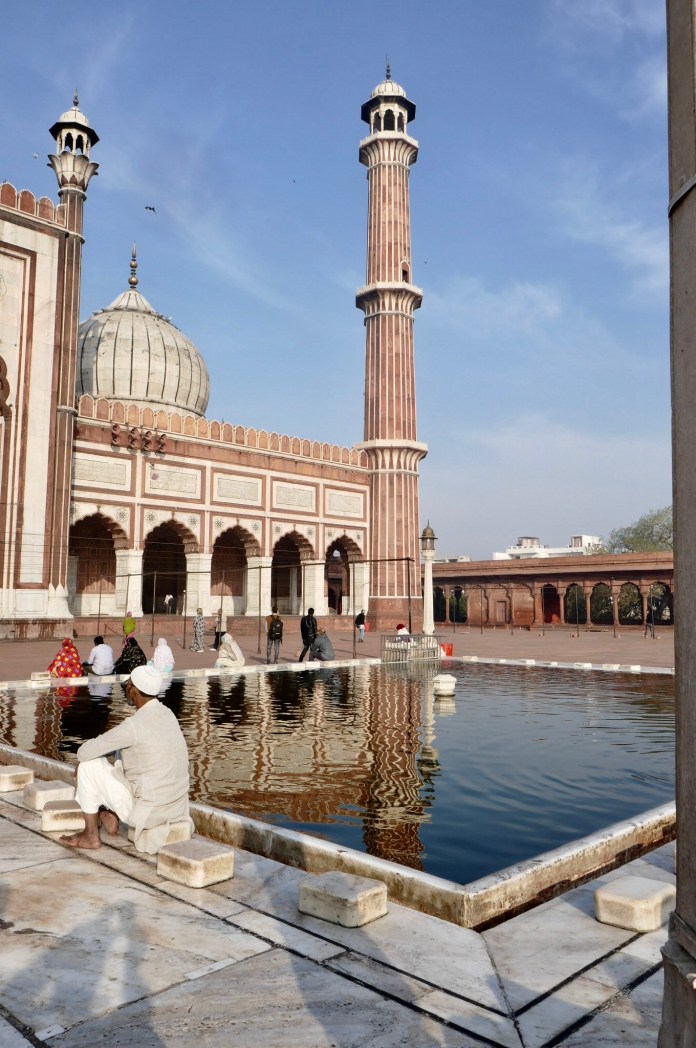
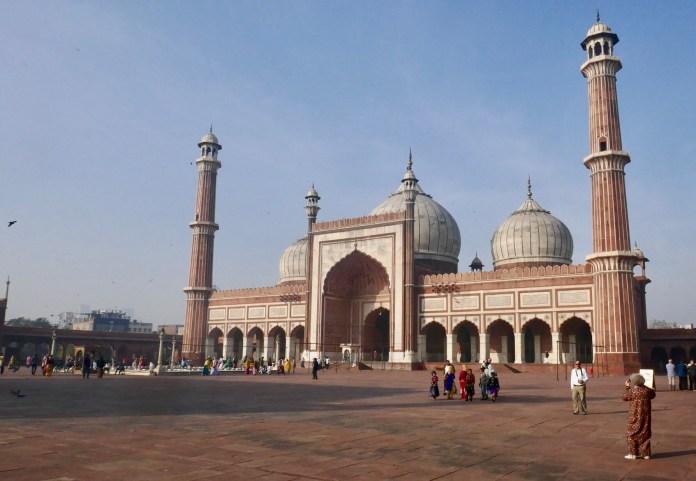
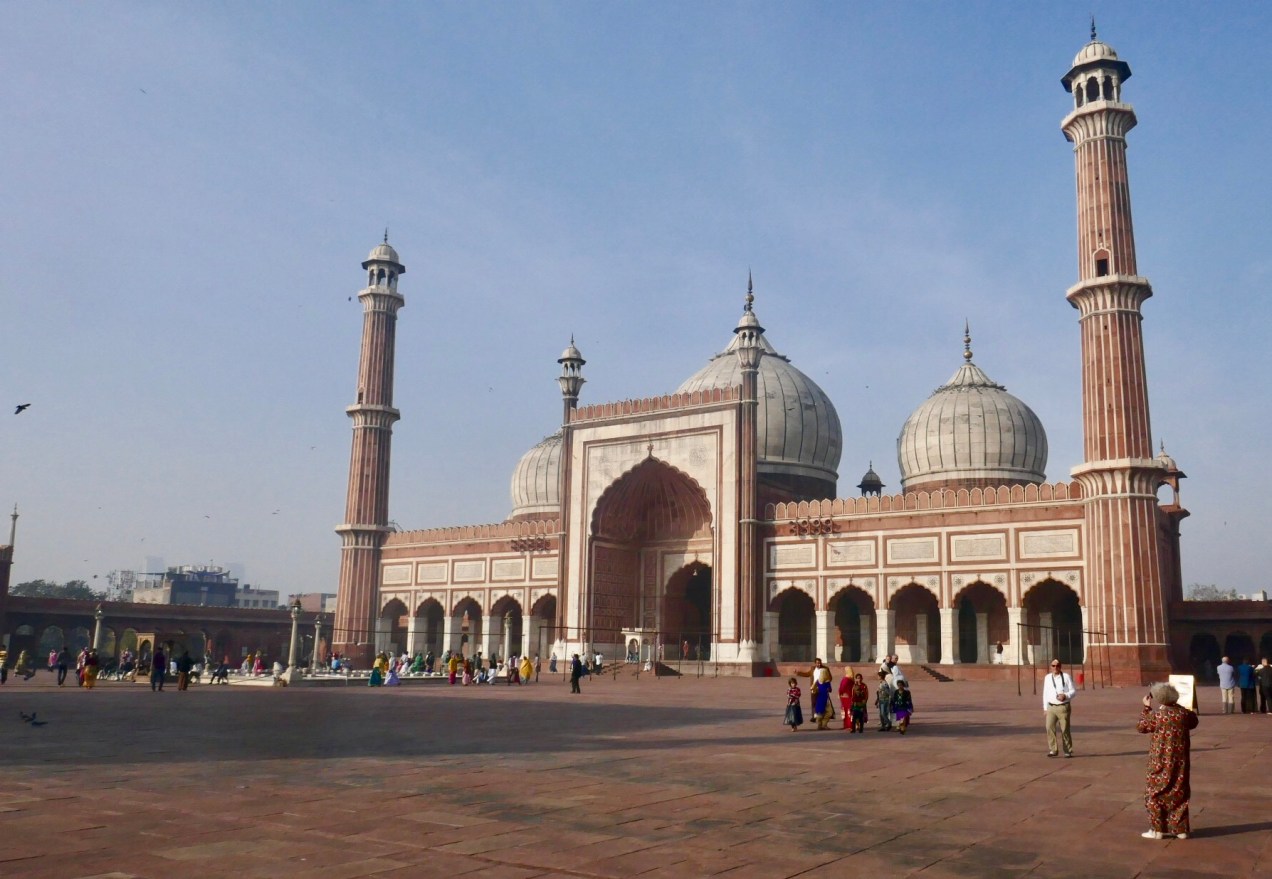
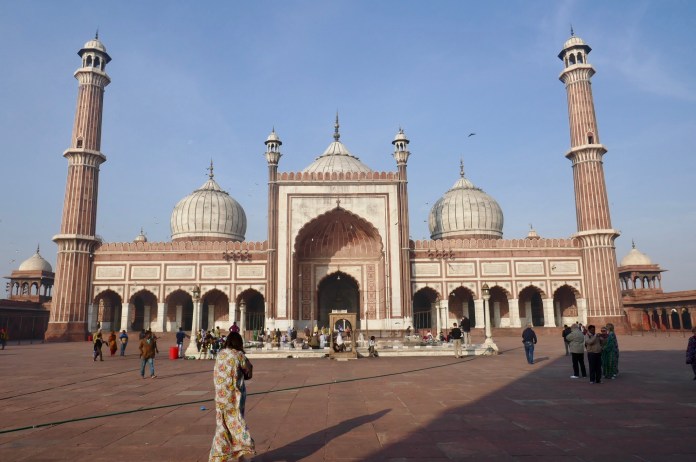
Jamah Masjid is an immense yet still beautiful mosque, and in fact, was the last building constructed under the auspices of Shah Jahan. Aurungzeb his son, imprisoned him soon after, and he spent his final years, in a cell with a poignant view of the Taj Mahal. The mosque has a vast paved area, a large rectangular pool, the paved area regularly accommodates up to 25,000 worshippers. The sandstone coloured mosque itself has splendid minarets at its apices. Inside the building, vast pillars support a roof with a series of magnificent Mughal arches. Light dances into the building, shining on and through the red sandstone, a material rightfully beloved by Mughal architects.
Entry is free, but it’s 300 rupees to use a camera. The gate officer tried to diddle me of 200 rupees, that’s four dollars. When I write that down, I sort of wonder why I got so testy with him. When he said it was alright, and I answered, not it’s not alright, a long bloody way from alright. Any biggish white guy is an unknown entity re aggression, and he is not to know, I have the martial prowess of a potato.
None the less, I am really glad that I used my camera, as it is a very, very beautiful and interesting place.

We then rejoined the rickshaws, for another trip to the Sikh Temple we visited yesterday. We were able to take photos this time, as well as visit the brobdingnian kitchens of the Sikhs. Massive woks, the size of small boats, pans over a meter in width and height. All of them bubbling over immense hot jets and some being stirred by turbaned Sikhs with huge ladles. It reminded me of Lemuel Gulliver who visited the land of the giants, Brobdingnag. Sikhs at their temples, provide free food to any visitor at no cost.

The temple area, was just as moving spiritually as on our first visit. There is a spirit of tolerance of Sikhs for other religions and in fact this temple is one of the few places where all members of all faiths can enter together and talk together. Also there is tolerance of Sikhs for the varieties of religious faith within their own sect, there is no ill will between the most traditional of Sikhs and those who wear only the turban and do not adopt all the attributes such as never shaving or cutting hair of the most devout followers. There is a religious side to Sikhism, the clothes, the rituals and there is a spiritual side, where prayer and faith are emphasised.

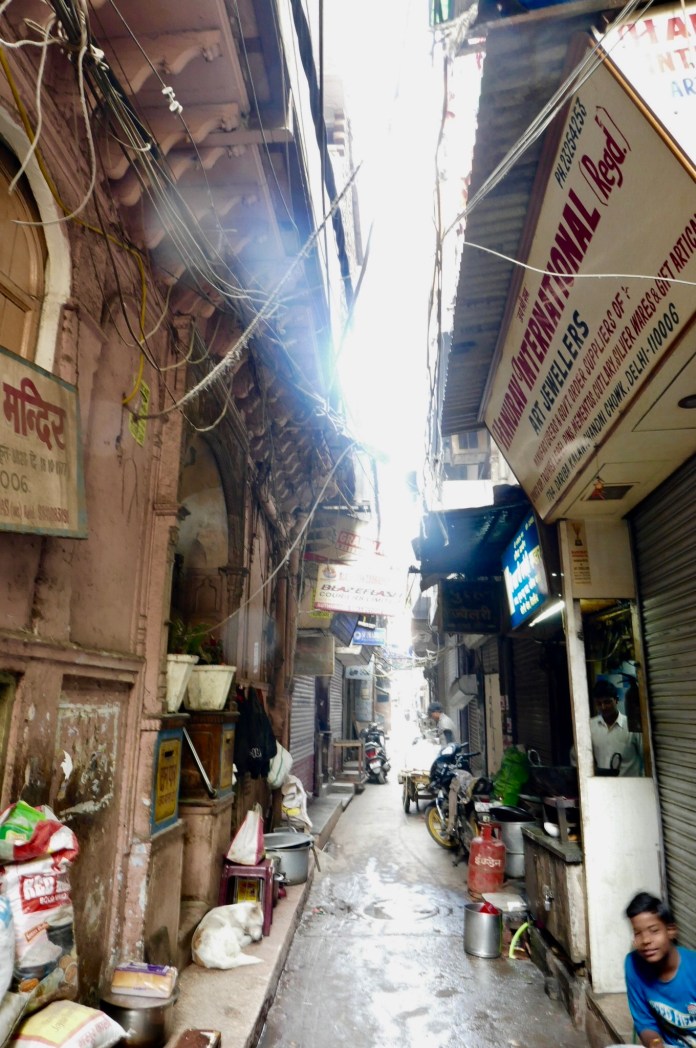
We had Chai, and samosas at a nearby outdoor cafe, all absolutely delicious, then headed back to Karol Barg, and the hotel. On the walk back, I studied the ancient buildings. They were built in the 16th century and are barely altered even today. Outside the gutters and corners of the buildings, are confused spider webs of electrical and phone cables. I suspect every power point has its own direct cable to the generating power station.
We did some shopping on our return, bought some food for our overnight train trip to Jaislamer. We head off in a few minutes, so I will conclude.

//////////////

It is now 6pm and Jennifer and I are sitting, well to be honest I’m lounging, in seat/sleepers 19 and 22 of carriage A1. We left the hotel amongst a fleet of cabs, bravely dodged the limitless number of other vehicles which decorate New Delhi’s roads to transport all of the team to Old Delhi Railway station. The route skirts the wall of the Red Fort, giving a foretaste of the many forts and Palaces we will experience in Rajasthan. The railway station, is large, with two vertically striped pink and white towers that vaguely resemble minarets. We put our luggage through the scanners, which is required at all stations including all those of the metro. In addition, everyone is scanned and patted down for weapons. Men going through a scanner on the left and women on the right, the only other difference is the ladies area is screened.

We went to platform 9 to wait for the train. A long, some what beaten up two tone blue train, with NR on the sides, pulled in. We are all allotted particular seats in the carriages. The sleepers are more comfortable and much less jerky than sleeper trains coming out of Hanoi. I suspect the tracks are better laid but perhaps I am being premature, as we have 19 hours to go. The train is no Grande Vitesse, pausing at stations (40 actual stops) and sometimes in the middle of nowhere in particular, as if to savour the darkening Indian countryside. It’s dark now, but in the daylight we would have seen farms and trees, growing mustard trees, sugar cane, coconuts and of course rice.

We will while away the hours eating our pre cooked Indian meal of dosas, then chill out with a book or iPads.

PS the dosas were yummy!!IMG_2017IMG_2015IMG_2012IMG_2011IMG_2006IMG_2002IMG_2001

Standard
India, Travel

Day 3 India Trip Humayan’s tomb

Today there is no organised guide or tour but thankfully we have our own a short list of sights in our Delhi bucket list. Jennifer and I spent yesterday at the Red Fort, so we decided to visit the major outstanding relic of Shah Jahan’s grandfather the hopelessly bumbling , Humayun, who stumbled through the early to mid sixteenth centuries, losing a kingdom then winning it back by virtue of last man standing, and his spectacular final demise that was so appropriate.
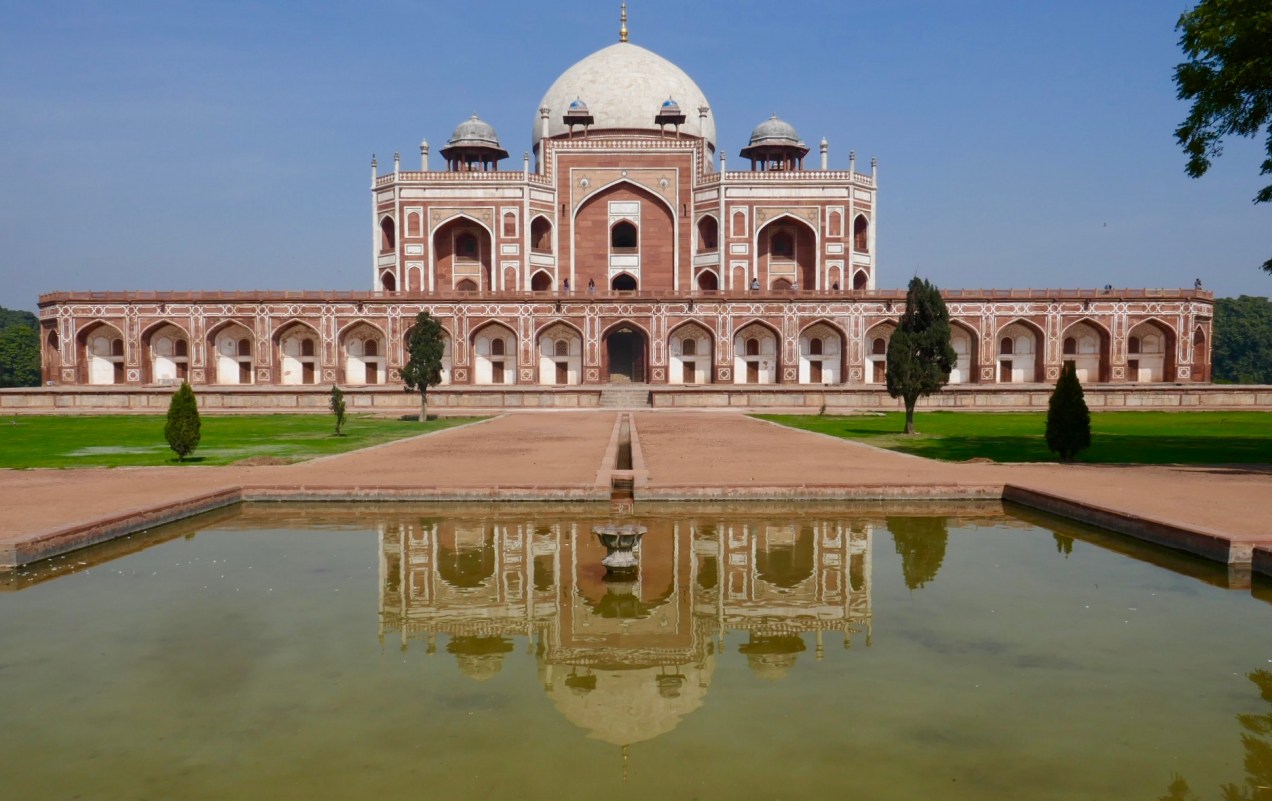
His wife was a totally different cut from him, the power behind, in front of and both sides, of the throne. Yet at his death it was she who commissioned a tomb, that combines most of the Mughal ideas about what constitutes paradise in this life and the next. The Mughals loved water features, and there are four kilometres of water paths and features in the tomb grounds: they loved symmetry in the natural world especially in their gardens, and so there are acres of cultivated gardens with magnificent trees and arbours all around the tomb: and they loved proportion and magnificence in their monumental and military architecture, and the tomb of Humayun exhibits these features at a level of taste and sophistication that is only exceeded by the Taj Mahal, the love, memorial offering of Shah Jahan to his adored wife, Mumtaz.
Built in the mid sixteenth century, the tomb and its grounds were neglected over the following centuries and it fell into a very sorry state. In the last few years, there has been a resurgence of interest in the historicity of India, and in Delhi, this inspired a massive investment in reconditioning monuments. The chief beneficiary has been Humayun’s tomb. The restoration work still continues in many areas, on many of the other tombs, walls and gate buildings that share the grounds of the tomb. However, the crown jewel of this area, the main tomb itself has been superbly and lovingly restored to its former glory. Cheap restorations that used modern materials like steel and concrete have been removed and replaced with the material and techniques which the original builders using lime cement and stone.

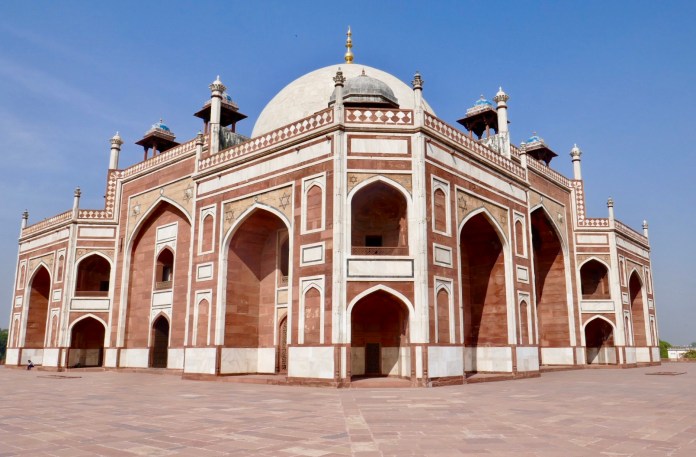
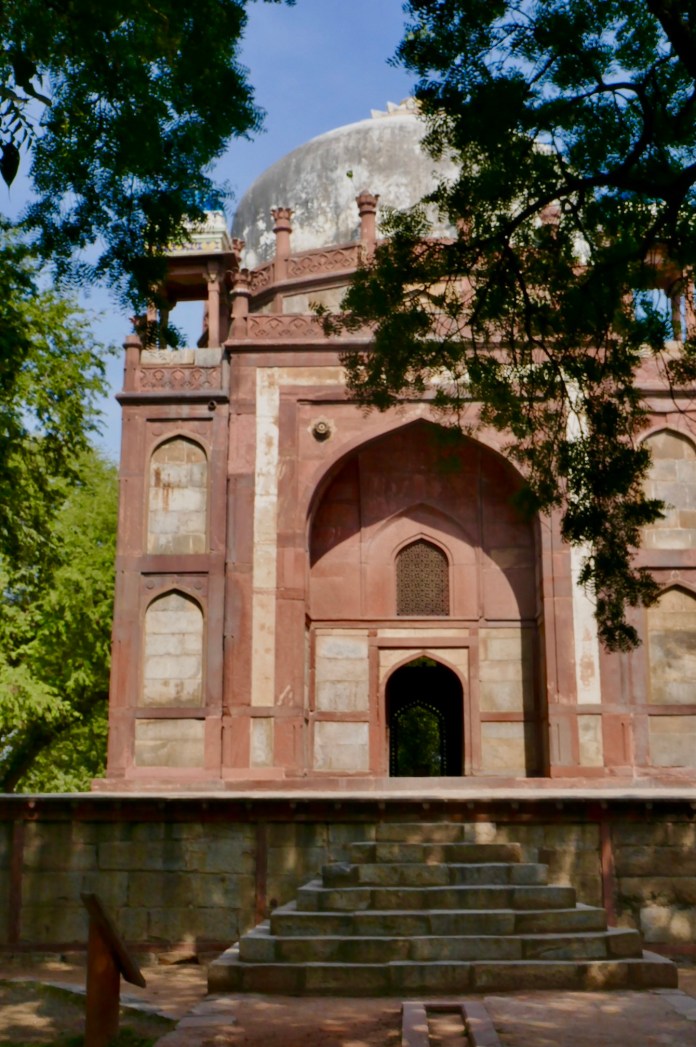
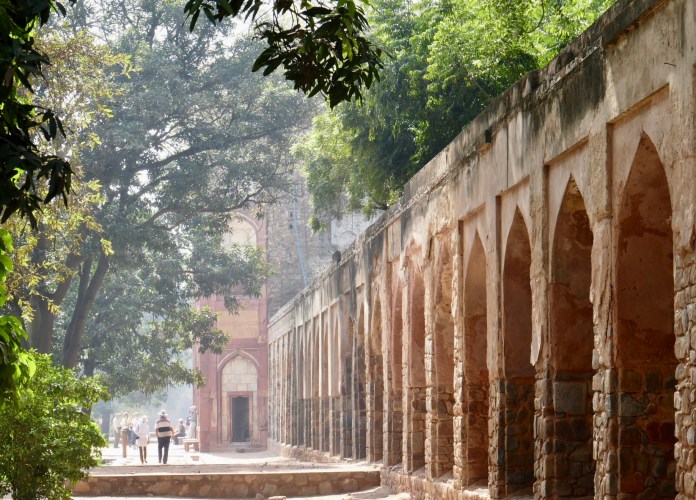
You enter through two successive gates, these are three storey buildings that provide access through the walls. The walls are tall, strongly made, and would be as suitable in a fort as in protecting a mausoleum. The walls featured repeating Mughal arches, and are very attractive in their own right. After descending the steps of the second gate, you first see the tomb complex. The light from this direction was not flattering, the glare washing away the rich reds, oranges. On the roof is a vast cupola, and at its apex, a spire of pure gold. Minarets crowd the corners. The entire building is raised up, as an enormous plinth, so you have to ascend a steep staircase, then in front of you is the monument itself.
There is only one entry to the main rooms, so we walked around the building enjoying the fine views of the gardens and the four gates, named according to the cardinal directions. Long narrow pools, mostly filled with water, softly cascade into larger rectangular pools with a single fountain in each. Walking beside these pools feels cool and refreshing, just like those TV Adds for almost anything. However in this case, it’s true, the air seems cooler, the heart less troubled.
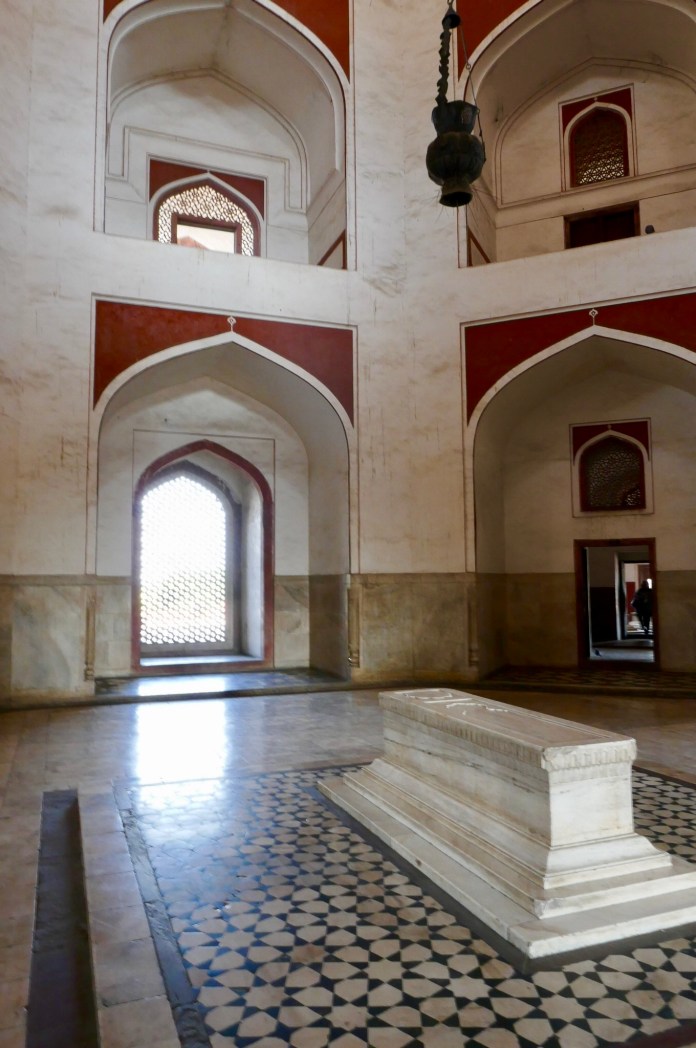
Inside the building are several rooms, tall interiors, with patterned metal grates for windows, one above the other, diffusing gentle light onto the coffins, for not only Humayun is buried here but many other Mughals rest here as well. Humayun has pride of place, but the peripheral rooms are all occupied.

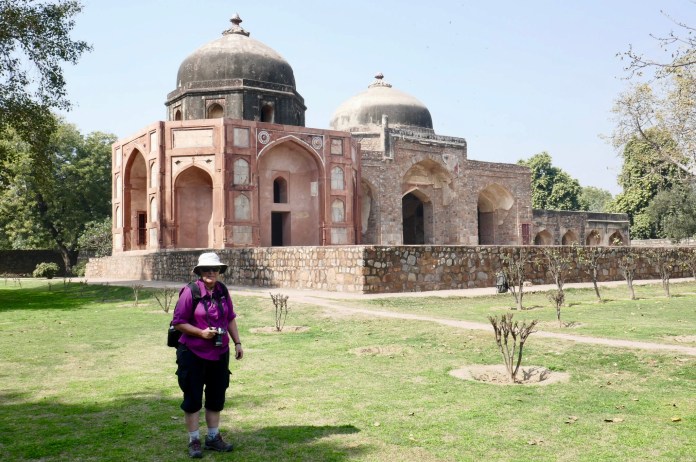
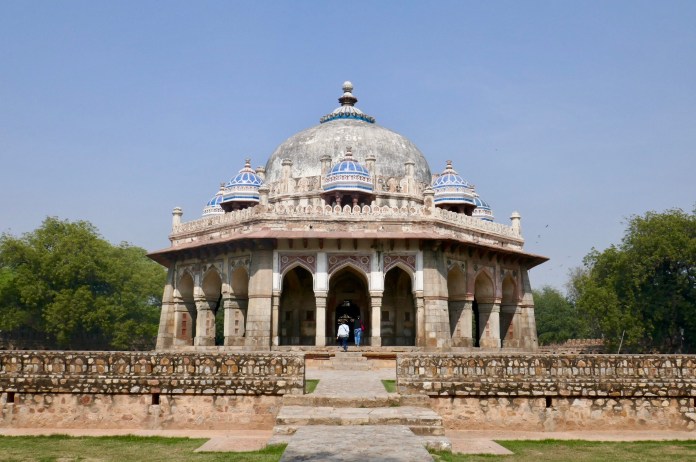
Outside the main building are other mausoleums, including the “Berber”, a tomb for an officer of Sher Sur , as well as many other simpler affairs with tombs even resting beneath trees. There is an ancient mosque still awaiting restoration, and some true ruins, their original function and inspirations long faded away.

Sher Sur was an Afghan adventurer who toppled Humayun from his kingship, and was the first of five of his family who ruled the extents of the Mughal empire for about thirty years, until as happens in every royal family, the brains and drive just dribbled away. Humayun was given back the throne, after perching in Persia for most of that time. He rather enjoyed his time away developing a love of astronomy, in which discipline he was considered more than competent. He died only a few years after returning to rule the empire, stumbling down a flight stairs at his library. It was said he stumbled out of life as he had stumbled his way through it.

On the way to the Monument, Jennifer and I hired an overcycle ( motorised ) rickshaw. The driver gave us a bullshit story about the grounds to the tomb opening at 11 am, we knew they opened at dawn but we were both fascinated about where this was going to go. He suggested going to a bazaar. Actually it was an emporium, a very slick affair it was too. However, they had some genuinely beautiful rugs, so we bought on for 35,000 rupees which is about $680 A. It will ( we hope) be sent as agreed to our home in West Launceston.
After this we were driven to the carpark at the tomb complex. We had already agreed on the price but there is always some argy bargy, so he got a little more! Smiles all round!
After our walk around the tomb complex, we hired another rickshaw driver, and again agreed on the price, but he took us to yet another emporium, ” on the way”. Funny, but our bums were just glued to our seats, and we chanted ” we want to go our hotel, we want to go to our hotel”. Hare Krishnas would have been impressed. Anyway he relented and off we went, only a short hop as per distance but with much car tooting, ambulance sirens whaling while utterly immobile, and brakes screeching, as cars and other vehicles tumbled around the roads. We reached our hotel and as we paid him, I complimented his singing voice as despite all the rigours of the drive he had been happily singing away with not a care in the world.IMG_1989IMG_1988IMG_1983IMG_1997IMG_1976IMG_1998IMG_1999

Standard
India, Travel

Day 2 India trip Red Fort

It is now just after five o’clock and we are taking the weight off our feet, after spending all day walking. We met Adi, pronounced as in Adidas, outside a hotel only a short walk from Hotel Perfect. While we were waiting a host of rickshaw entrepreneurs came over to talk. One especially innovative and imaginative example, said he was from Tasmania. What part we asked, and he confidently said Brisbane. We became suspicious, but he did know Tasmania was cold so that allayed those suspicions somewhat.

Adi is a tall Muslim man from central India who is as fit as he is enthusiastic. We walked to the station and travelled as two legged sardines, to Chandni Chowk where we walked through narrow alleys to emerge in Old Delhi. Bustling with people, cars, motorbikes, bullocks pulling carts, men on bicycles piled up with goods including one with five huge gas containers balanced around his bike like mines. A collision with him, would demolish two city blocks. We visited a special, very holy Sikh temple, where one of the last gurus was assassinated by one of Aurungzebs minions. Aurangzeb was the last of the truly great Mughal emperors, a list which includes his father Shah Johan, as well as Akbar, Babur and Humayan. Unlike most of them, he was a devout Muslim, who was very strict and intolerant of Hinduism much less Sikhism, and did his best to wipe it out. All he succeeded in doing was converting a peaceful dogma of tolerance and compassion, into a militarised religion, that gave all the later Mughals and the English considerable headaches.

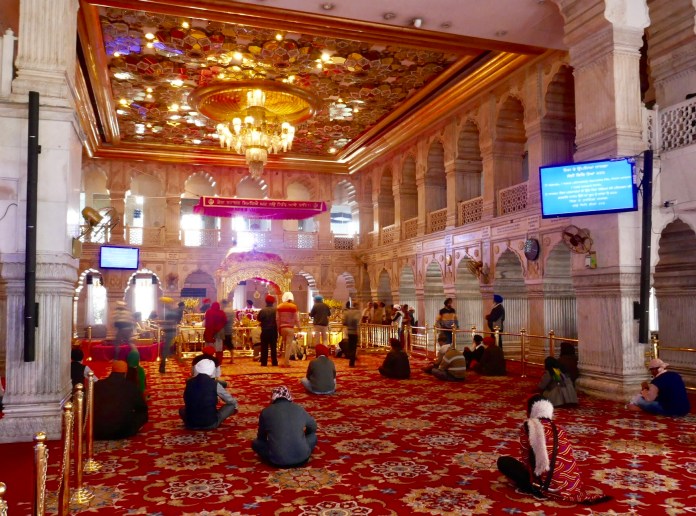
This Sikh temple had many visitors. We sat down inside the street entrance, removed our shoes and socks which were kept in a storage room to collect later. Adi put some scarves on our heads, not just Jennifer, but me too. I had a very appealing pink scarf. We waded through water at the base of a flight of steps then entered the true holy temple area. Some appellants at our sides, dropped to their knees at the door, touching their foreheads to the carpet, then entered, repeatedly bowing their heads and hands. Others who were already there sat on the carpet inside, they were talking and listening to the music played and sung by three Holy men. Their voices were pleasant, the song rhythmical. Gold symbols of Sikhism stood before the alter. The alter consisted of a holy relic, the arm of the guru murdered there all those years ago, thankfully now inside a box that was covered in flowers and orange and yellow garlands. Above it was a golden canopy, then a rich red curtain draped above that. It is serene and resplendent.
After exiting, we visited three cafes, the first is in a very narrow dingy lane, that goes back to the time of Shah Jahan who ordered the building of Old Delhi, he called it Shahjahanabad. He went on to build the Taj Mahal for his wife Mumtaz. Well this lane, with its poor light, and shallow drains is not the Taj Mahal but it is the best place for Chai. Tea powder, water, sugar are boiled up briskly and repeatedly in a pan over a violent burning gas jet, then cinnamon and more sugar, and milk are added, then a few more boils up over the flame, then it’s poured through a strainer into paper cups. Some semolina biscuits were available to soak up the rich flavours. The chai was delicious and hot. The maestro, is a small, elderly man but he has one of those faces where it’s hard to judge Age. In his grey jumper, with a grey cap on his head, he will spend all day making Chai.
We visited Padarthe Wala. Now this place has been operating since 1875, and changes slowly, the laminex tables from twenty years ago, still service the current diners. Some of these diners have included the big names of Bollywood, and photos of them tucking into Keemas, cover one corner of the walls. Keemas of all types, we has one with potato, one with mixed vegetables, one with paneer. The contents inside fried Indian bread, a keema. They provide a tray of curries which you can dip the keema into. The banana curry was especially yummy.
We had a samosa at another cafe and Jebi. The samosa was mostly peas, not potato, and I freely admit I prefer it to the standard one. The Jebi is shredded semolina coated, dripping with sugar: yummy but evil.

We visited the spice market in Old Delhi. Shop after shop, had banks of trays and bowls with brightly coloured and pungent spices. The men sat or stood beside balance scales, a design as ancient as all Asian trade. Everywhere the susurration of voices were engaged in languages of trade, of buying and selling. We walked behind and above the market, up three flights of narrow stairs, to the roof, to look down not only on the market but the magnificent mosque adjacent to it. As I descended the steep steps, I was frequently pressed to the right as men came quickly up them carrying on their heads and shoulders 30 to 40kilogram bags of rice, never pausing for breath.
After a wonderful two hours Adi left us to our own devices. We could see the Red fort from where we had walked. So off we trotted, but the major hurdle was at the end, where streams of traffic, paid zero notice to pedestrian crossings, or any form of traffic direction that might pause their headlong rushes along Delhi’s streets. Eventually we were across, and wondered if we get back over it again, as it was not even peak hour!

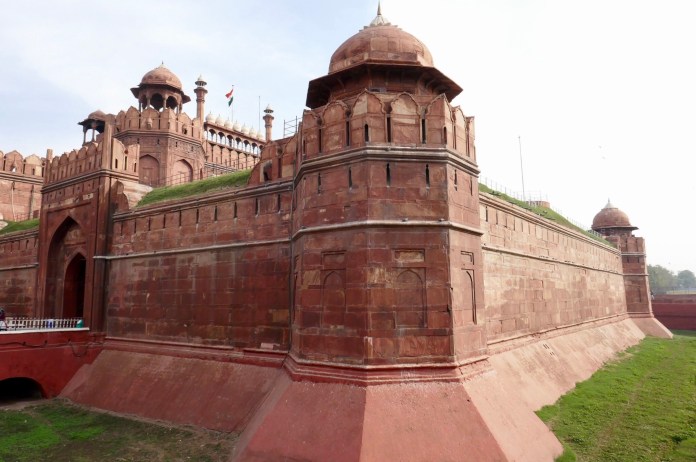
The Red fort was built by Shah Johan as a military base, administration centre for his empire, audience halls, and pleasure palaces (3). It’s big! The red sandstone fort and walls, are sculpted with designs, but it’s colour is rich and warm, the zeitgeist combined a statement of power with definite artistic sensibility, which tells you a lot about the character of Shah Jahan. Inside the fort is a huge flat area, with the high-points for me, being; the splendid cupolas forming the roof of the personal mosque of the Mughals, and the many water features ( dry now) culminating in the water pavilion and long rectangular shallow pools that lap the edge of the buildings. The audience pavilions are vast and open, with mighty carved pillars, in their centre sits a throne where the emperor would listen to the courtiers and people seeking his judgement in civil cases. The greatest of these was the magnificent Peacock Throne, later stolen by the Persians, and which still remains in Iran. Ever since then, any Shah of Iran always sat upon the Peacock Throne until Iran became an Islamic republic in the 1980s. The Indian Archeological survey occupies one large building, its full of Mughal artefacts, including the scimitar owned by Aurangzeb. Aurangzeb was Shah Jahan’s least favourite son, hence the serious falling out that lead to his long imprisonment when Aurangzeb butchered his way to the throne. This was pretty much the way, any princeling including Shah Jahan, got to be top of the family tree. There are Mughal paintings, with the silvery sheen over bright colours, the portraiture nearly always in detailed profiles, and displaying the themes of courtly life; their hunting, riding, and battling of rogue elephants as one does. There is also the Museum of Indian independence, this is the Indian view of their centuries of struggles to get rid of invaders, particularly the English. Their are biographies of the many players, including Dyer ( a British general who massacred thousands in Bengal in the 1900s), Ghandiji ( we say Ghandi ), Nehru, Tagore, Bose, but oddly enough, no mention of Al Jinnah the architect of Pakistan, but a big participant in the Congress Party before splitting off to focus on Muslim as opposed to Hindu interests in the independence movement.

After all this walking and reading and photographing of just about everything, we decided to leave. We could not face the road again, and in fact we were decidedly vague about how to get back to the old Delhi metro station but the decider was contemplating any attempt at crossing that road again. We took a Rick shaw, after negotiating a price, and were driven safely back to Karol Barg. You see so much from the back of a rickshaw, an unfortunate percentage of which is terrifying.IMG_1913IMG_1916IMG_1935IMG_1936

Standard

It is Monday the 13th of February, and our first day in India; Delhi to be precise. We left Melbourne at 1 am, flying to Singapore, then the final leg to Delhi; all with Singapore Airlines. I pushed my bag into an overhead locker, and out popped my water bottle which hit a Sikh on the head! Luckily the padding of his blue turban was sufficient to protect him and I checked that by patting him on the head a few times just to make sure. He took these high jinks in good spirits.
We arrived at Delhi International Airport at 11:30 and then spent an hour and a half in a queue of about a dozen people, as we snaked our way ( at the velocity of a python suffering a particularly vicious cold snap) to the official who was checking our E visas. E ( for electronic) visas are meant to be quicker and simpler, “meant to be” and what “is”, are two very different things. Anyhow, we finally got through to the next section. Part of the problem were idiot tourists who repeatedly applied their fingertips and fingernails to the biometric scanners which just spat it!
A taxi had already been booked for us by Intrepid, and we met a young man, who introduced us to our driver. The trip in was a cross between a really savage game of rally x and formula 1 racing but with far fewer rules. The white lines are used to line up the middle of the car bonnets, traffic signals are flashy decorations, motor cyclists cascade around the road. Not to forget the gaily coloured green and yellow rickshaws which have the engine capacity of a tonka truck, but driven with an attitude of foolhardy aggression often seen in spitfire pilots during the Battle of Britain.

We arrived at the Perfect Hotel, yes that’s its name, after negotiating a busy market. Imagine driving a car, its horn singing out, through the Victoria Market through distracted shoppers and well, you get the idea. The room we have is spacious and comfortable, sporting a huge, heavy, darkly timbered wardrobe, a five seater lounge and comfortable bed, I hope. We repacked day bags as we are in a bit of a rush; we had previously booked a street food tour with Urban Adventures, an offshoot of Intrepid, needing to meet our guide by 4pm at gate 4 of Vishwidhalaya Station. We walked the short distance through the market, to the Karol Bagh Metro Station, taking the train to there. There are always a lot of people rushing around; Delhi’s inhabitants seem to have mastered the art of semi random motion and velocity, just bouncing off each other with minimal damage whether as pedestrians or drivers. 

Richa is the name of the charming young woman who guided us on the street food tour. After introductions in her impeccable english, we began by boarding a rickshaw outside the station. Another older driver was so incensed about missing our fare that he abused our driver vociferously, then tried to strangle him. Business is tough in Delhi. I can only admire their commitment to robust commercial enterprise.
We were driven along the bumpy roads to the urban area near Delhi University where some of the best street food is available. It’s cheap accomodation and food for students who live there. The streets narrow, buildings vertical looming over the roads, the paths are often broken but there is no rush at least for us on this tour.. Rickshaws offer abundant open air, no suspension, and a level of physical protection equivalent to a whicker basket. We chatted as we walked between food venues. The varied a great deal, from small roofed sellers with no seats, to student cafes with young people singing Beetle songs with a ukulele as accompaniment, to ancient establishments alive with the sounds of enthusiastic Hindi, the penultimate venue was a cafe cooking here in Delhi for a hundred years.  

The meals were all delicious, ten courses in all. There were paneer and chicken schwarmas, semolina cakes with yoghurt, fried potatoes coated in clarified butter, a kulfi ice cream on a stick, and all sorts of other yummy things. Her list is below.

We talked about many interesting topics; racism as it exists in our two countries, women and marriage in India, photography and the history of Delhi especially the Mughals contribution to Shajahanabad, that’s Old Delhi.
The evening concluded with a metro trip back to our hotel. Wow, I thought the earlier crowds were impressive, but now, the trains and stations were packed. When the carriage doors open there is rush to get out intermeshed with the equally violent surge to get in. I pity the poor buggers at the tail end of the exiting crowd, their arms waving above their heads, too cramped to shove anyone, and still pushing desperately to get out. Once onboard, it’s important to plan your exit, sliding your way as near the door as arrival becomes imminent, to have any chance of exiting at your desired station. 

We had Chai up on the Rooftop bar of the hotel. It’s decor, a splendid fusion of Indian tropes. There are standing Coloured Rajas, sitting Buddha blobs , stuccos of technicolor Shivas swirling about, and a fondness for dark timber furniture. The sky is a dark celeste blue with Venus shining above Delhi, the sounds a combination of all those nutty drivers attached to their car horns and the yelping of street dogs all interrupting the night.

Another successful day!

Uncategorized

Day 1 India – foodies go to Delhi

Gallery