
Jennifer, Grace, George, Ray and I are sitting in the courtyard of the Jagat Villas where we have been staying. We are sipping piping hot Marsala Chai. It is cool now, a slight breeze, abundant shade and birds are singing happily in the trees above us. The sky has been cleared of air pollution by the breeze and has been revealed as a magnificent blue, not even a cloud is present.
It has been a very interesting day. After breakfast we were taken on a tour of a village and some craft workshops 25km outside of Jodhpur. The children are all at school today, so only older adults are working or standing around the dusty courts of the farms. The lady of the house made chappatis for us to sample. They grow the millet on their farm. She grinds it all manually, on a heavy, compact mill, it spins around almost effortlessly but grinding enough millet for a meal still takes half an hour! And the job has only just begun! In their courtyard were two large flat plates on which wheat and lentils were air drying out in the sunlight. She added water to the ground up millet, expertly pressed it into flat chappatis, and placed each one of them onto a pan sitting on a small fire. In a minute or so, they were cooked. We asked about their life and as we drove around the area, we saw women walking with masses of firewood bundled up then balanced on their heads, other women were digging as a group on new agricultural ground, and we saw men walking along the narrow road in their white shirts, dhotis, and coloured turbans. As we hung out the back of the mathindra 4WD , there were ladies in flowing saris and kids nestled on motor bikes who waved at us and shouted “hello, hello”.
Then suddenly we would stop, there in the scrub to one side were wild antelope. These graceful troops watched us, then turned back bending their necks down to enjoy the spare grass and then with a casual disinterest to their watchers on the road, they trotted away and out of sight.
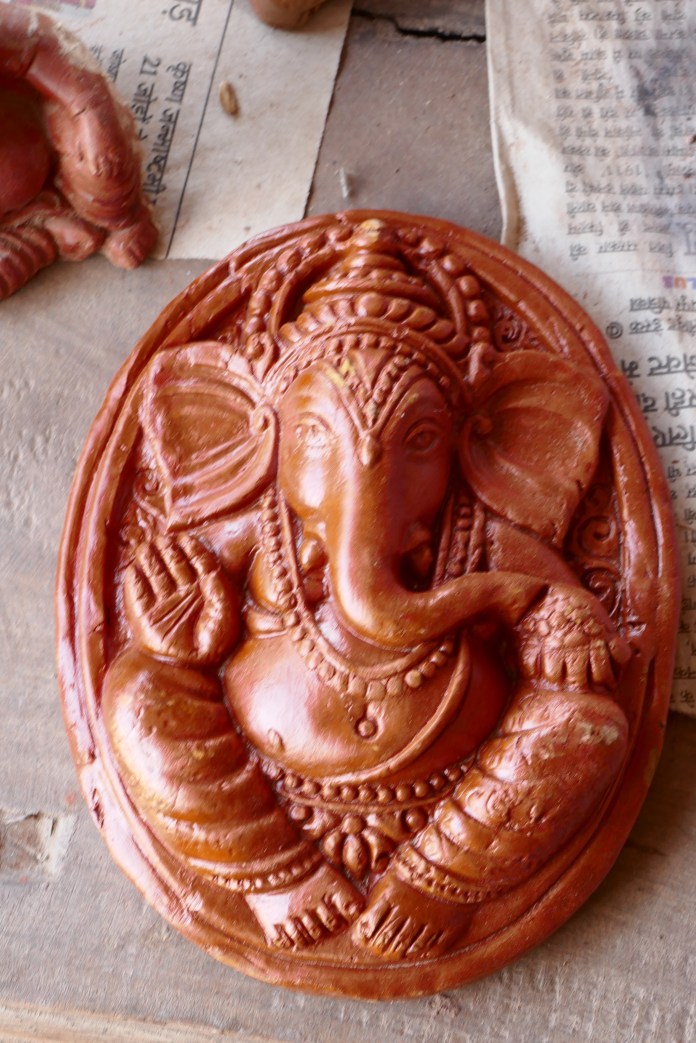
We visited Lake Gada, and then some craft workshops: a potter, and a weaver. I bought a few ceramics.
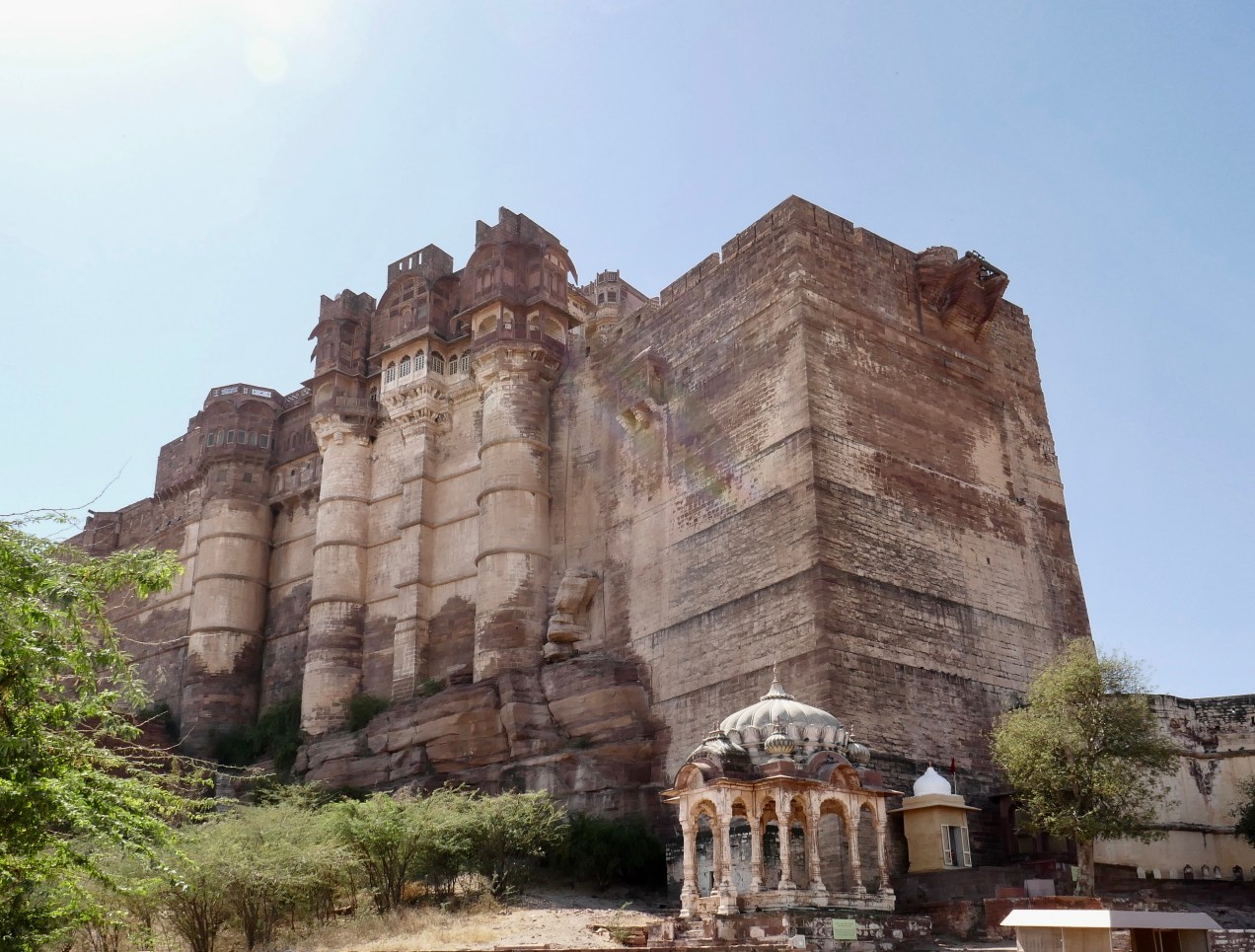
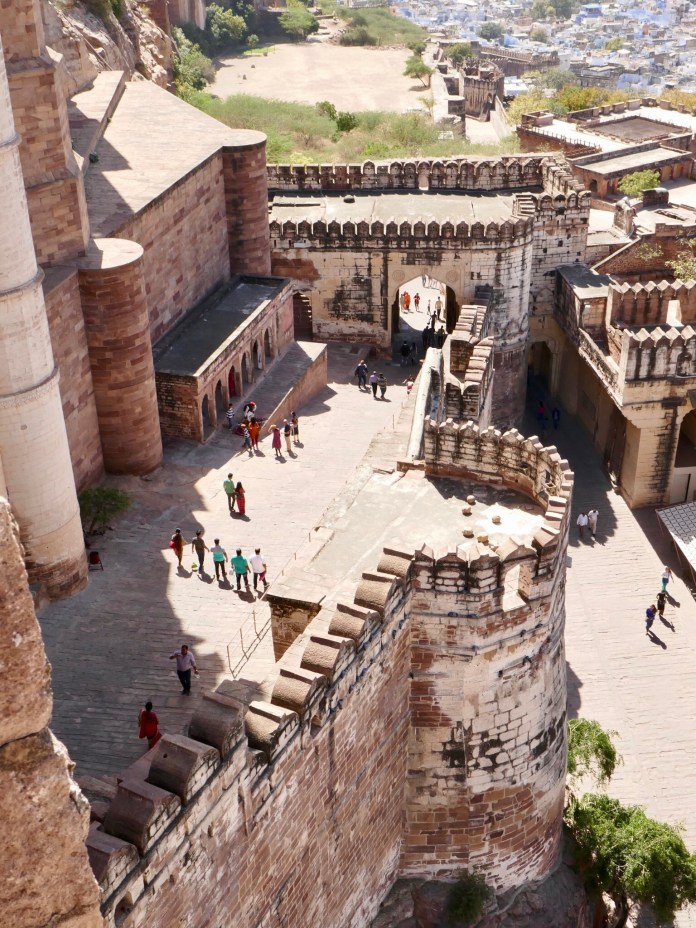
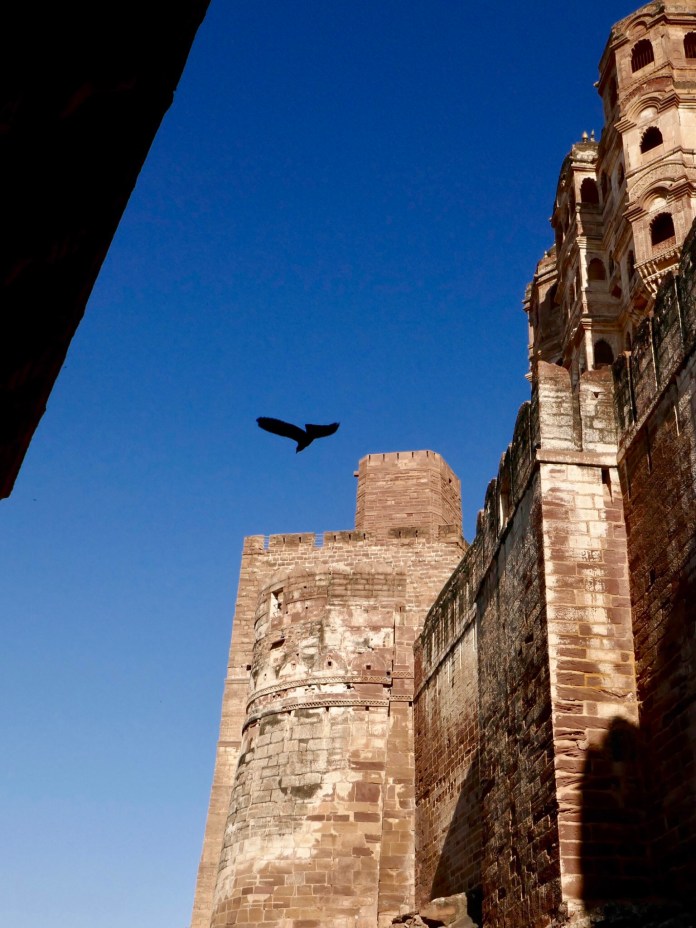
We were driven back to Jodhpur, and dropped off at the entry gate for the fort – Mehrangarh Fort. It is a massive fort, with tall walls and bastions, still armed with cannon. These cannon look out over the city of Jodhpur. The walkways are wide, the slopes and approaches to negotiate are all gentle, and high above us are the ornately carved balconies and wall faces of the palace within the fort. We explored the museums of the fort, highlights for us included; a sword inscribed as belonging to Emperor Akbar , it is an evil, curved scimitar with an inlaid pommel of precious stone. The handgrip is surprisingly small but none the less, this sword is a beautiful piece of art and engineering. It underlines the fact that 16th century Mughals knew the business of war very well indeed. There are palanquins, howdah, matchlocks, fine metalwork and much more to see. A palanquin is a carriage for court women but it’s not on wheels but instead it’s carried by four men. A howdah is a carriage as well of a sort, but it lies atop an elephant. One of these howdah was a gift from Shah Jahan to the maharajah of that time. There were samples of coins minted under the reigns of all the Mughal emperors, they are in excellent condition and inscribed in flowing Arabic calligraphy, indeed they are works of art in their own right. There were coins of the maharajahs with small biographies beside each coin.
We walked around the streets of the fort, admiring the striking fusion of palace architecture above with ruthlessly practical military architecture below. At the main gate, there are the imprints of cannonballs striking the stonework in the early 19th century.
We exited the fort, and negotiated the price for our trip back to the villas. It can get heated during the negotiation, but once it’s settled, everyone is all smiles. No ill will at all, as he drove along singing the praises of the Australian cricket team.
 brucebarker2016