

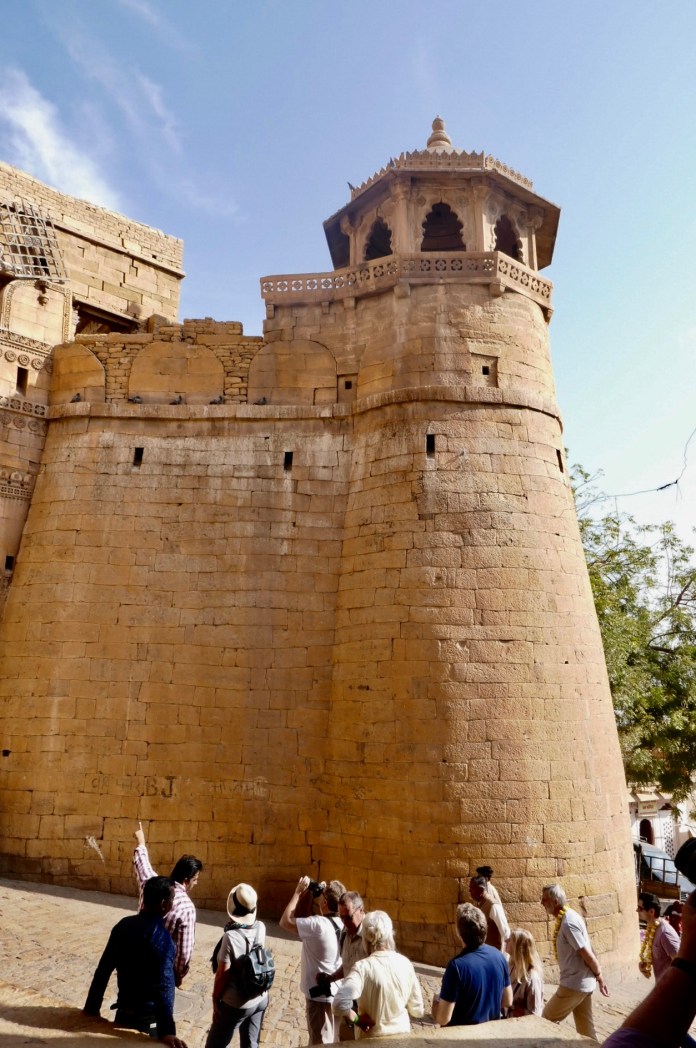
 Jennifer and I are sitting in chairs at the rooftop bar at Deepak Hotel. We are in room 10, and it’s a sharp climb on the stairs to the dining rooftop area. We have just ordered a pot of Marsala Chai. Today is a free day, to do as we wish. After breakfast, we spent the next two hours just walking around the fort and township adjacent to the fort. The streets were built according to a narrow template, to frustrate invaders but particularly to provide more shade in the summer and abate the awful winds. We climbed to some high points today and indeed the wind is very strong out of the protection of the buildings.
The buildings in the fort are at least two stories, their steps and staircases are steeply set sandstone blocks, touts lie or sit outside shops trying to get our attention, women in saris sweep streets and push barrows of litter while other women talk to their husbands standing in the shadows of the doorways.
The buildings have ornate balconies, there is incredibly fine and detailed stone carving on nearly every wall and feature, and the overall yellow colour of the stone is variegated by gold and brown tones. There are motorbikes parked on every street, small shops with the interiors in cool darkness, their vendors studying news papers. Gaily clad children at knee height, run along the streets, calling out “hello, hello” as they speed by. Tourists stop and gaze at the architecture, or look at the carvings or paintings on display tables outside the shops, only to jump forwards when a motor scooter or tuk tuk needs the road, beeping crazily as they skitter along the streets.
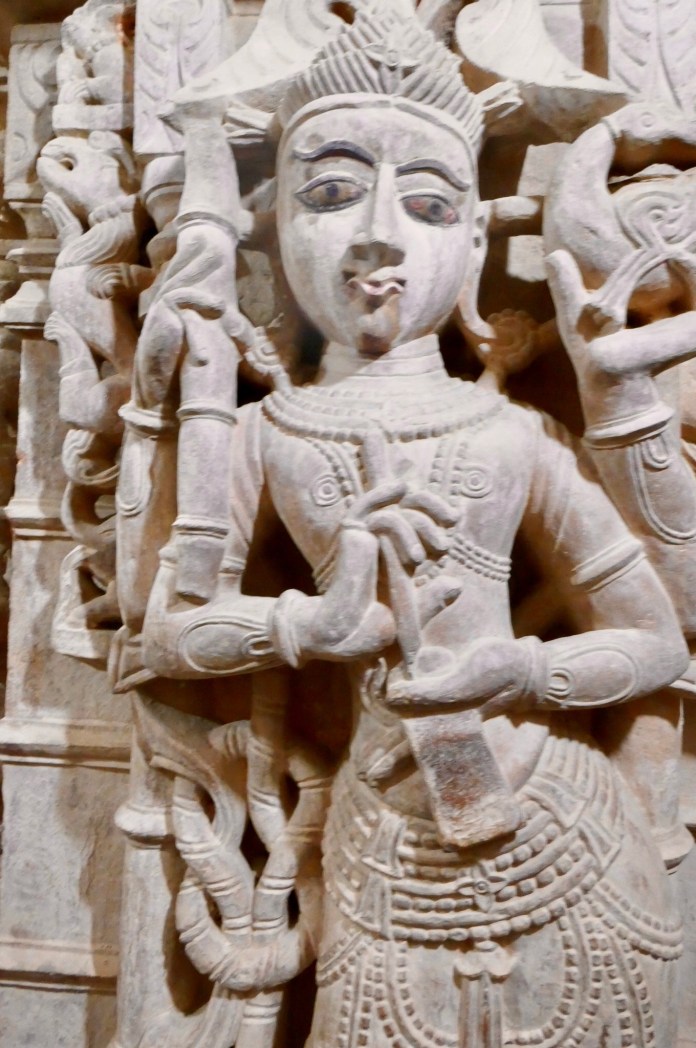
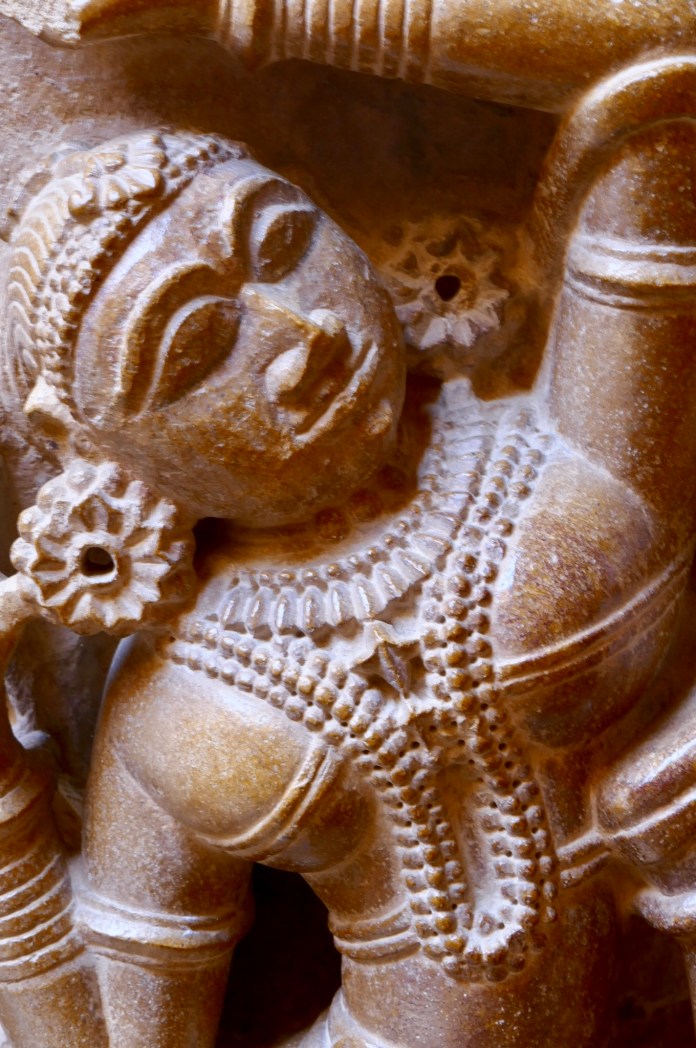
We walked back to the Hotel, to meet our other group members for a mass raid on the Jain temples. From 11 am, all the temples are open and available to walk through for 200 rupees. There are five temples, and temples within temples. Steep steps, bob the head to avoid striking out on the low lintels typical of many buildings here in Jaisalmer, and enter the small temple interior. The supporting pillars are magnificently and lavishly carved sandstone, with stories and characters from the shared Jain and Hindu tradition. There are apsaras, kings, priests, monks, gods, and the Jain pantheon, and many others all portrayed alive in stone. You see more of them by walking the square stone corridors , the stone is grey to brown to red, the textures vary from glistening smoothness to an almost rough surface, and in all cases they are executed with precision and a very clear artistic direction, each an initial artwork. These temples were not built by amateurs but by professional artists with the support of time and money from the Jain community. These temples display not just a profound and richly populated religion but also the financial clout of its believers. Jains were and are consummate traders and businessman of necessity as their beliefs tenets excluded them from many other careers.
Afterwards we returned to the cooperative where we bought the two scarves yesterday, to check out another scarf. Thankfully, the owner was more than happy to package up the stuff we wanted to send back to Oz, and post it on the next day. Api vouches for him and that’s good enough for me. We spent an hour there, for many Indians selling and buying is as much an opportunity to philosophise as make money.
We walked through the town, to Gaidar lake. The lake buildings were built in 1356. There is a splendid ghat, a gatehouse with steps all the way to the water. There are four seperate pavilions in the lake, these are all stone structures and provide a destination for the many boaters, rowing haphazardly on this beautiful lake. We met Nan and her mother Jiang, on the verandah under a banyan tree, then walked with them around the north end of the Lake before turning back to return to he fort. We stopped on the way to buy some supplies for tomorrow’s breakfast and lunch. The vendor was very busy, with so many customers waiting to buy, we thought we were in for a wait but the vendor asked us what we wanted. The other customers thought it was terribly funny when we protested and said we would wait. In our take away are dhal pakora, a vegetable and currie pakora and a samosa for each of us ( 180 rupees all up). We bought some fresh fruit at the market nestled against the fort wall, and so were at last, well and truly provisioned for the trip to Jodhpur.
 brucebarker2016