
What a wonderful night. I lay on my camp bed, warm under the violet, Rajasthan quilt, looking directly up into the night sky. Peter had pointed out many of the northern constellations to Jennifer and I before preparing for bed. Cassiopeia, Polaris, are some of magical words and places we discussed as he pointed them out to us. Though I have spent time in the northern hemisphere before this, this was the first time light pollution, atmospheric pollution, or prolonged daylight did not conspire to prevent this experience.
Every time I woke up overnight, I looked up, a cavalcade of constellations followed one after the other. In particular, I saw the Big Dipper at about 1 am. Each time, I drifted off to sleep easily enough , and finally woke refreshed. Toilet facilities are a tree and sand. After a simple breakfast, I asked Api how to say thank you. I tried it out on one the camel handlers. Api was appalled when I said he was Taliban. The other guides went quiet. Thank you is not pronounced Taly ban but doe no Vaad. I tried this out a few times without any further potential international incidents.
We climbed onto the dunes for a final lingering look across them, and there behind us one of the guides was walking in the sand, carrying a round steel tray with two hot chais for us. Very thoughtful!
Jennifer was bruised on the camel trek, by the steel pommel which is the hand hold on the saddle so she elected to return by jeep and not have another camel ride. So as the others headed off into the sunrise, with Bubbles, King Kong, Barbie, and the other camels carrying them over the sand, we trotted along behind. Their speed looks slow, and even on the camel you feel as if you are getting nowhere fast but nothing can be further from the truth. We walked behind them, and the camels quickly outpaced us with their enormous stride, and dead sure footing.
We climbed into the sturdy little Mahindra jeep.. The doorways are plastic and curl up and forwards to attach by Velcro straps behind the front pillar. The young driver, did a quick namaste and prayer, then off we went. We travelled through a village, we saw a bus with 12 students on top. Even though it is Saturday, the kids are at school. The village houses all looked solidly built, with bricks made locally. Stones were jammed into some windows to keep the houses warm at night over winter. It can get as low minus three overnight in winter. Cows wandered on the roads, camels grazed beside it munching acacias as we drove along the dusty road, me clutching the steel hand rail in front of me.
Soon we will be having ing lunch, and doing a walking guided tour of Jaisalmer.
//////////
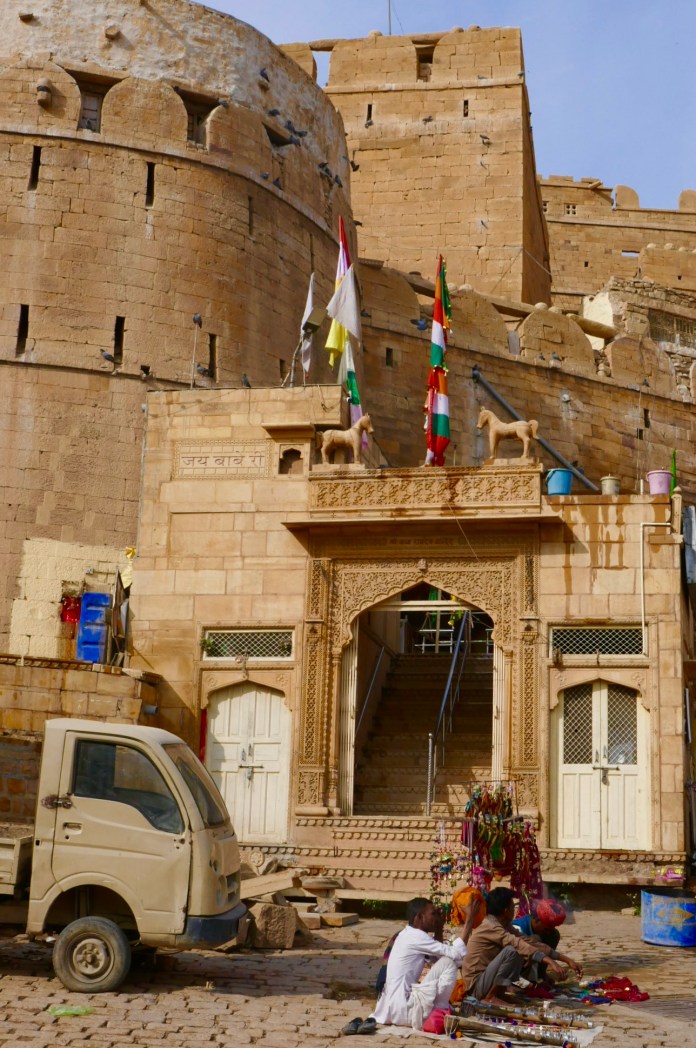
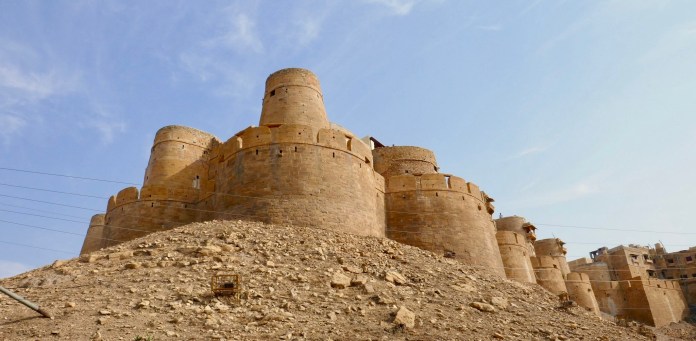
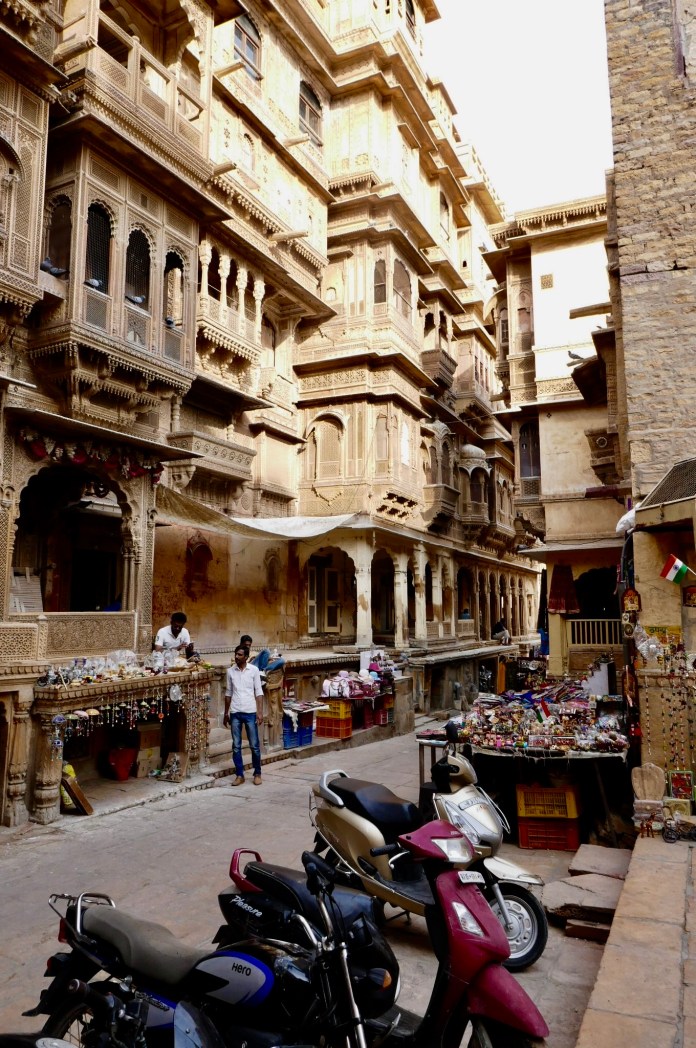
We all enjoyed a beautiful lunch at an upstairs restaurant called Killa Corner. Jennifer and I sharing a kofta vegetable dish. Then it was quickly back to the hotel to meet our guide for the afternoon. A local of many generations who had many interesting stories and facts about Jaisalmer. Fort Jaisalmer is best known as the Golden fort due to the beautiful yellow sandstone exclusively used here and in the surrounding township. Jaisalmer is 75 kilometres from Pakistan, and there is minimal cross border trade. Until the formation of Pakistan and the division of India, Jaisalmer had been a prosperous city based on one of the trunk lines from the Silk Road from China to Europe. There were Muslim, Hindu and Jain traders, Buddhist monks, mercenaries and adventurers of all sorts who frequented Jaisalmer. It was really wealthy before the sea routes opened up to Europe, seriously affecting the amount of trade going by land. There are five Jain temples built solely for the visiting Jain traders. There are no Jains living in Jaisalmer but every year there is a festival and Jains come to celebrate in the temples. There are very few Jains in India today. Jains like Buddhists are an off shoot of Hinduism, and they are very strict about their vegetarian diet ( no root vegetables though), avoiding any animal products such as leather and if very strict, never shave or even wear any clothes.
The Golden Fort has been attacked three time in all the years since it was first built. The fort has some advantages both natural and man made, that would have always made it a challenging military target. There are over 90 bastions, armed with cannon on the perimeter, at the base of the wall are loose stone and gravel making it difficult to use seige engines and the four gates of the fort are all approached along winding routes which made it impossible to use elephants to ram the great doors. The intense heat of summer, up and over 50degrees centigrade made it physically exhausting to even wait out the city. There is little water outside the fort itself which has reliable if not generous wells inside it.
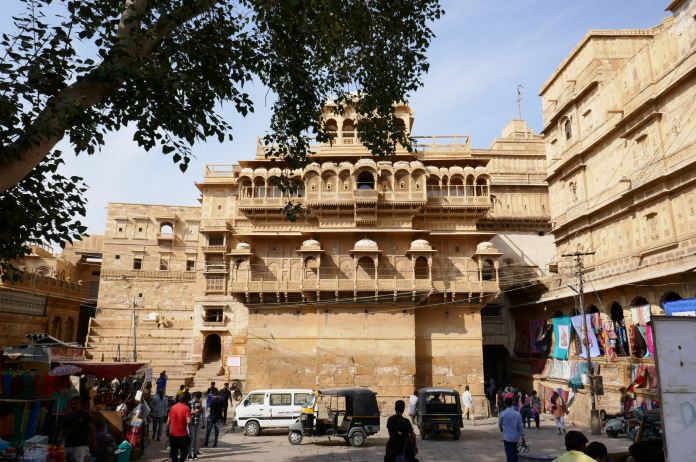
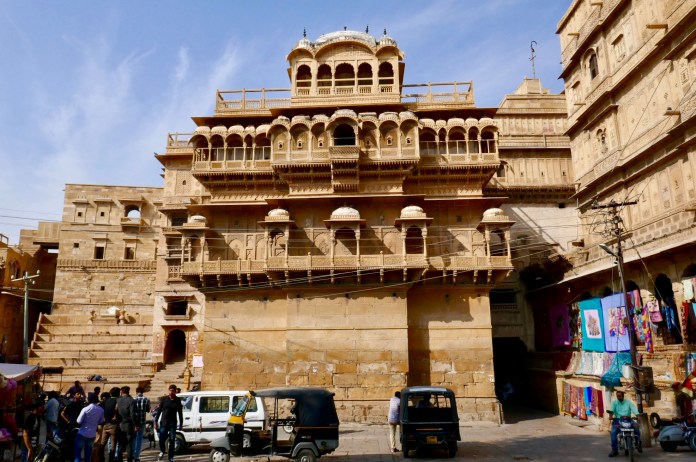
On the tour we visited one of the bastions and learned about its defences. Then visited the Twin palaces of the Maharajah and Maharrana, now no longer used by the former royal family, its seven storeys now badly corroded by damp and termites. Beside the entrance to the palace are a series of stone tiers with a white throne atop. This is where the Maharajh and the local Brahmans, perform a yearly festival. We visited the Prime Ministers house which was built by the then first minister in the 1880s by two brothers. The house has quirky features that were the result of a teasing rivalry between the two men. In one corner of a balcony there are apsaras ( dancing girls) and in the other, some carved musicians. The patterns on or above a window are different on the right compared to left side of the house. By the way, these especially ornate houses, are called Hevelli. The sandstone is intricately carved at the stone masons, then brought to the house site and assembled and then mortared in place. It remains a demanding skill but we saw two houses being built using the same techniques as hundreds of years ago. All houses must be built with the yellow sandstone available locally. There is no red sandstone here and you are not allowed to build with it in any case.The Prime Ministers house is still owned by the same family who are now trying to restore it. They finance this by selling camel bone products, we bought a Namaste: a namaste is a carved hand in two parts with Ganesh, god of good fortune in one half and Lakshmi, goddess of wealth and spouse of Vishnu in the other half.
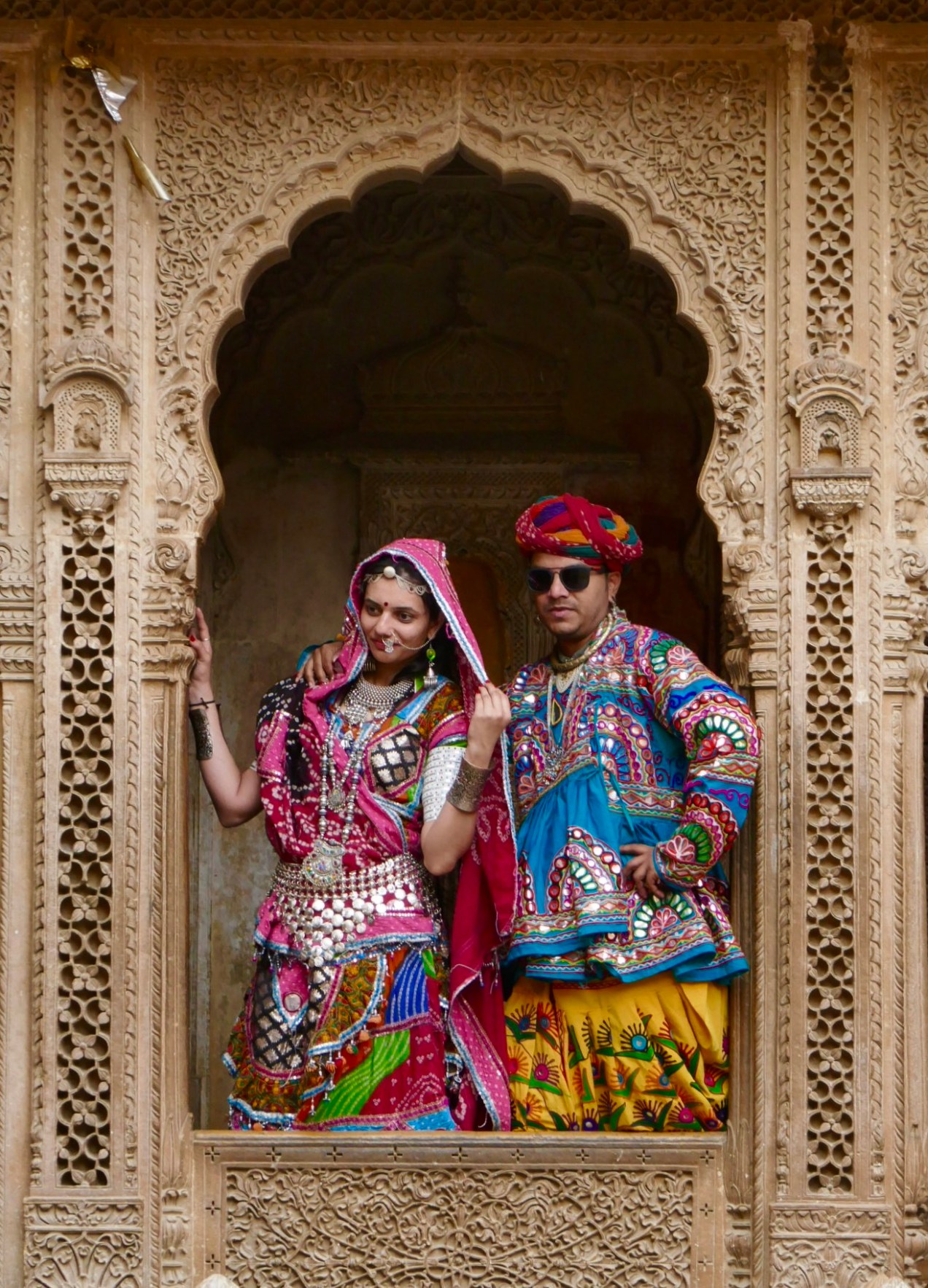
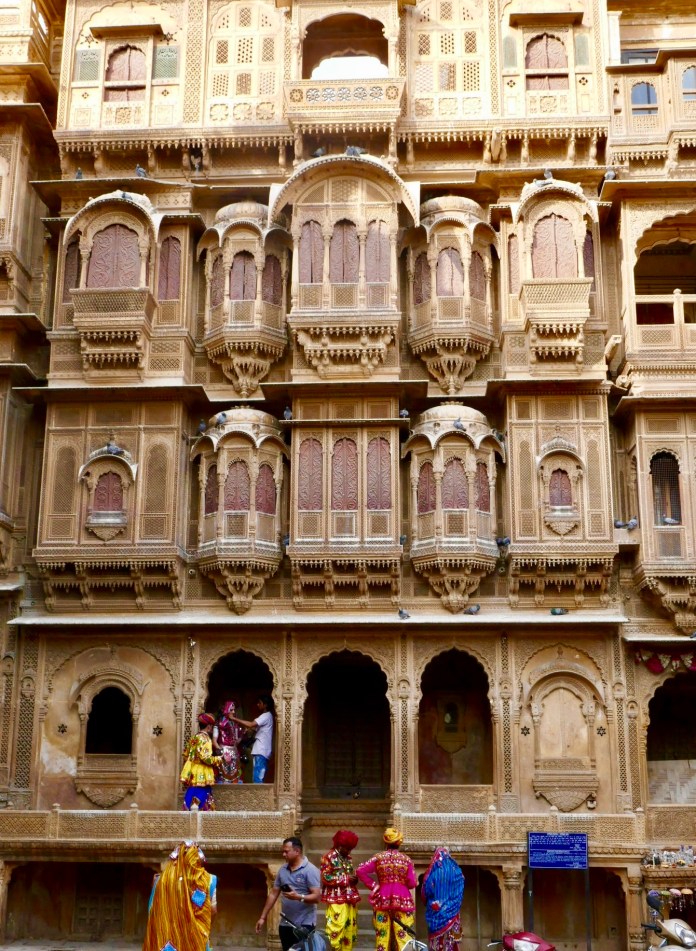
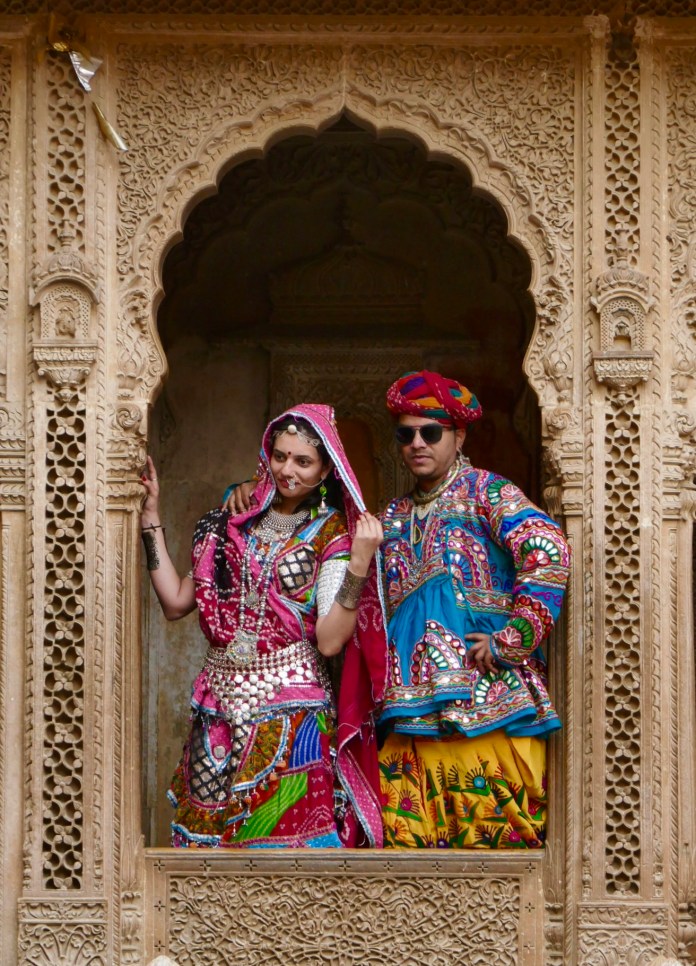
We visited a hevelli buIlt by a once prosperous Jain trading family, who abandoned it many years ago. Nowadays it is owned by the government, and Indian tourists dress up in garish Bollywood clothes available to hire in a courtyard opposite the house, and take photos of themselves. Seriously weird stuff!
We visited a rural cooperative, set up by the government of India, to enable local people to compete with the businesses that have moved into Jaisalmer in recent years for the tourist trade but sell goods made anywhere but locally. We had a long but interesting presentation on fabrics, including cashmere versus pashmina. We bought two scarves, a men’s one made of pashmina and a scarf of ibex wool for Jennifer in a dazzling turquoise.
We had a marvellous Indian meal at a rooftop hotel in Jaisalmer, and enjoyed a surprisingly good Indian white wine. On the way back to the hotel, we passed three weddings. Noisy, fun affairs with the bridegroom resplendent in purple and silvery brocade and a brightly coloured turban, he atop a festooned white horse. All around him danced his mother and sisters, in dazzling rich red saris with gold trim. Lots of hand waving and all in time with the drummers, pounding loudly on their instruments. The other guests milled around or sat, the men with orange scarves over western business suits and wearing red turbans, before they all headed off along the street to continue the wedding.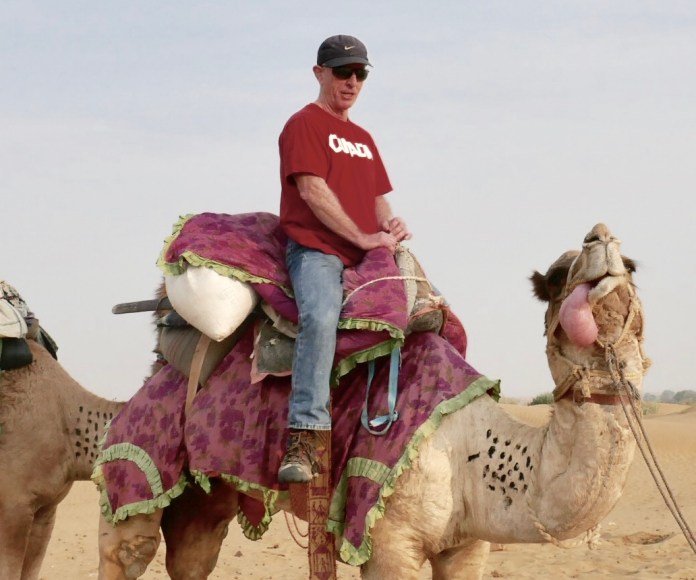
 brucebarker2016