
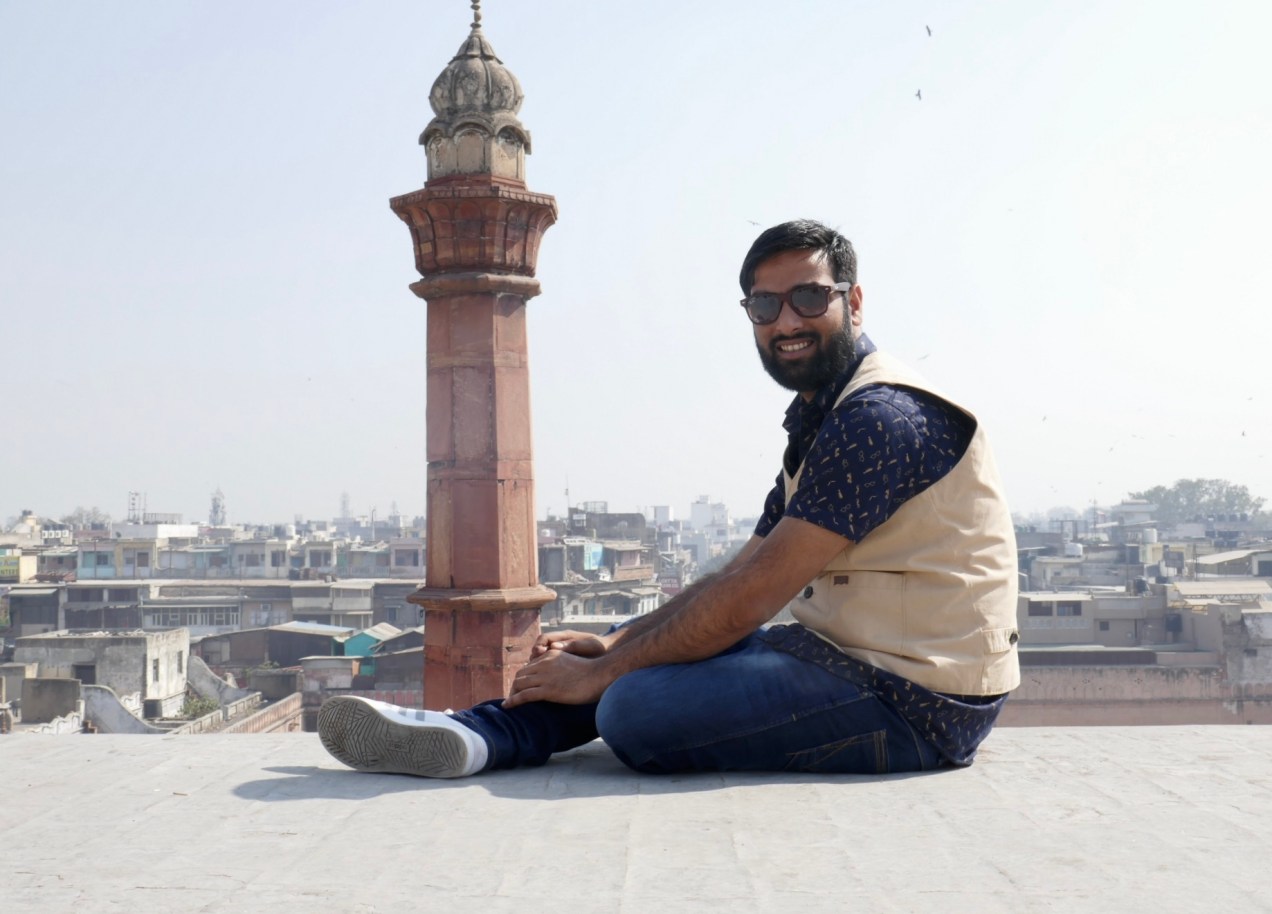
It is now just after five o’clock and we are taking the weight off our feet, after spending all day walking. We met Adi, pronounced as in Adidas, outside a hotel only a short walk from Hotel Perfect. While we were waiting a host of rickshaw entrepreneurs came over to talk. One especially innovative and imaginative example, said he was from Tasmania. What part we asked, and he confidently said Brisbane. We became suspicious, but he did know Tasmania was cold so that allayed those suspicions somewhat.
Adi is a tall Muslim man from central India who is as fit as he is enthusiastic. We walked to the station and travelled as two legged sardines, to Chandni Chowk where we walked through narrow alleys to emerge in Old Delhi. Bustling with people, cars, motorbikes, bullocks pulling carts, men on bicycles piled up with goods including one with five huge gas containers balanced around his bike like mines. A collision with him, would demolish two city blocks. We visited a special, very holy Sikh temple, where one of the last gurus was assassinated by one of Aurungzebs minions. Aurangzeb was the last of the truly great Mughal emperors, a list which includes his father Shah Johan, as well as Akbar, Babur and Humayan. Unlike most of them, he was a devout Muslim, who was very strict and intolerant of Hinduism much less Sikhism, and did his best to wipe it out. All he succeeded in doing was converting a peaceful dogma of tolerance and compassion, into a militarised religion, that gave all the later Mughals and the English considerable headaches.
This Sikh temple had many visitors. We sat down inside the street entrance, removed our shoes and socks which were kept in a storage room to collect later. Adi put some scarves on our heads, not just Jennifer, but me too. I had a very appealing pink scarf. We waded through water at the base of a flight of steps then entered the true holy temple area. Some appellants at our sides, dropped to their knees at the door, touching their foreheads to the carpet, then entered, repeatedly bowing their heads and hands. Others who were already there sat on the carpet inside, they were talking and listening to the music played and sung by three Holy men. Their voices were pleasant, the song rhythmical. Gold symbols of Sikhism stood before the alter. The alter consisted of a holy relic, the arm of the guru murdered there all those years ago, thankfully now inside a box that was covered in flowers and orange and yellow garlands. Above it was a golden canopy, then a rich red curtain draped above that. It is serene and resplendent.
After exiting, we visited three cafes, the first is in a very narrow dingy lane, that goes back to the time of Shah Jahan who ordered the building of Old Delhi, he called it Shahjahanabad. He went on to build the Taj Mahal for his wife Mumtaz. Well this lane, with its poor light, and shallow drains is not the Taj Mahal but it is the best place for Chai. Tea powder, water, sugar are boiled up briskly and repeatedly in a pan over a violent burning gas jet, then cinnamon and more sugar, and milk are added, then a few more boils up over the flame, then it’s poured through a strainer into paper cups. Some semolina biscuits were available to soak up the rich flavours. The chai was delicious and hot. The maestro, is a small, elderly man but he has one of those faces where it’s hard to judge Age. In his grey jumper, with a grey cap on his head, he will spend all day making Chai.
We visited Padarthe Wala. Now this place has been operating since 1875, and changes slowly, the laminex tables from twenty years ago, still service the current diners. Some of these diners have included the big names of Bollywood, and photos of them tucking into Keemas, cover one corner of the walls. Keemas of all types, we has one with potato, one with mixed vegetables, one with paneer. The contents inside fried Indian bread, a keema. They provide a tray of curries which you can dip the keema into. The banana curry was especially yummy.
We had a samosa at another cafe and Jebi. The samosa was mostly peas, not potato, and I freely admit I prefer it to the standard one. The Jebi is shredded semolina coated, dripping with sugar: yummy but evil.
We visited the spice market in Old Delhi. Shop after shop, had banks of trays and bowls with brightly coloured and pungent spices. The men sat or stood beside balance scales, a design as ancient as all Asian trade. Everywhere the susurration of voices were engaged in languages of trade, of buying and selling. We walked behind and above the market, up three flights of narrow stairs, to the roof, to look down not only on the market but the magnificent mosque adjacent to it. As I descended the steep steps, I was frequently pressed to the right as men came quickly up them carrying on their heads and shoulders 30 to 40kilogram bags of rice, never pausing for breath.
After a wonderful two hours Adi left us to our own devices. We could see the Red fort from where we had walked. So off we trotted, but the major hurdle was at the end, where streams of traffic, paid zero notice to pedestrian crossings, or any form of traffic direction that might pause their headlong rushes along Delhi’s streets. Eventually we were across, and wondered if we get back over it again, as it was not even peak hour!
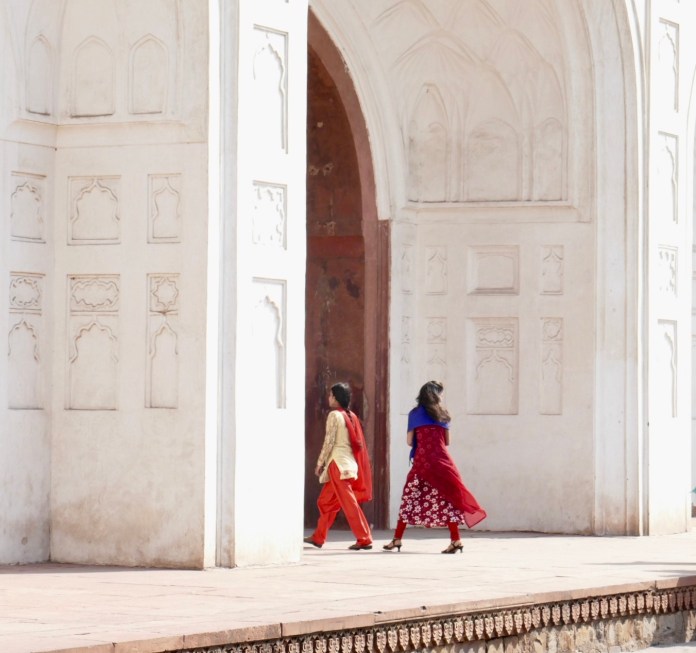
The Red fort was built by Shah Johan as a military base, administration centre for his empire, audience halls, and pleasure palaces (3). It’s big! The red sandstone fort and walls, are sculpted with designs, but it’s colour is rich and warm, the zeitgeist combined a statement of power with definite artistic sensibility, which tells you a lot about the character of Shah Jahan. Inside the fort is a huge flat area, with the high-points for me, being; the splendid cupolas forming the roof of the personal mosque of the Mughals, and the many water features ( dry now) culminating in the water pavilion and long rectangular shallow pools that lap the edge of the buildings. The audience pavilions are vast and open, with mighty carved pillars, in their centre sits a throne where the emperor would listen to the courtiers and people seeking his judgement in civil cases. The greatest of these was the magnificent Peacock Throne, later stolen by the Persians, and which still remains in Iran. Ever since then, any Shah of Iran always sat upon the Peacock Throne until Iran became an Islamic republic in the 1980s. The Indian Archeological survey occupies one large building, its full of Mughal artefacts, including the scimitar owned by Aurangzeb. Aurangzeb was Shah Jahan’s least favourite son, hence the serious falling out that lead to his long imprisonment when Aurangzeb butchered his way to the throne. This was pretty much the way, any princeling including Shah Jahan, got to be top of the family tree. There are Mughal paintings, with the silvery sheen over bright colours, the portraiture nearly always in detailed profiles, and displaying the themes of courtly life; their hunting, riding, and battling of rogue elephants as one does. There is also the Museum of Indian independence, this is the Indian view of their centuries of struggles to get rid of invaders, particularly the English. Their are biographies of the many players, including Dyer ( a British general who massacred thousands in Bengal in the 1900s), Ghandiji ( we say Ghandi ), Nehru, Tagore, Bose, but oddly enough, no mention of Al Jinnah the architect of Pakistan, but a big participant in the Congress Party before splitting off to focus on Muslim as opposed to Hindu interests in the independence movement.
After all this walking and reading and photographing of just about everything, we decided to leave. We could not face the road again, and in fact we were decidedly vague about how to get back to the old Delhi metro station but the decider was contemplating any attempt at crossing that road again. We took a Rick shaw, after negotiating a price, and were driven safely back to Karol Barg. You see so much from the back of a rickshaw, an unfortunate percentage of which is terrifying.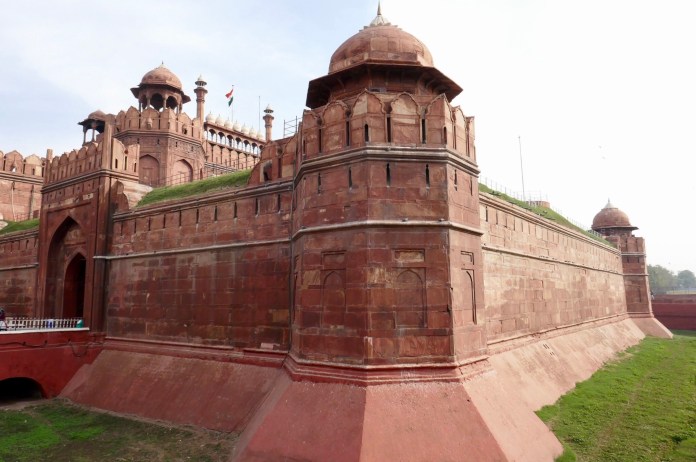


 brucebarker2016