
Jennifer and I have just had a light lunch at Karan Villas, a well appointed multilevel hotel near to the road that leads to the East Gate of the Taj Mahal.
Last night we had the pleasure of seeing and hearing a traditional dance and drum group, it consists of local villagers, all men, and began with a huge drum beating the time then a standing single male singer. He had a lovely voice, his right hand upraised as he sang. The others sat on a large orange mat, soon they were all singing, and some tapped on smaller drums as well. Behind them, the sky was dark, the only illumination a fire in a steel container burning sandalwood. Then the sky lit up with lightning, repeatedly dancing from cloud to cloud. Eventually, after the concert, it rained but at the time, there were only a few drops. In the second half, two dancers stepped onto the concrete square in front of us, and danced and danced. They were having so much fun, we all joined in, even me. Afterwards we enjoyed a terrific dinner in the palatial dining area of Ahbenari Niwas.
The drive to Agra is about three hours, and after a short section from the village to the main highway, the rest of the journey proceeds swiftly despite frequent tolls, to the outskirts of Agra where, as always in Indian cities, the pace slows considerably. The edge of the city, is crowded, noisy, with constantly beeping horns, motorbikes and cars and buses all whirring around each other in a crazy maelstrom. The shops are in groups of five, they each have a steel roller door, and some doors are closed. Maybe there is no shop there or maybe it opens later. There are shops for mobile phones, produce, and all sorts of goods. Tuk Tuks are parked haphazardly near the dirt beside the road, and a green petrol ” bowser” on wheels is used to fill them. Many of the shops have shade cloths, some of these rectangular sails are supported by twin wooden poles, leaning forward and askew, some are tied to electric cables that happen to hang low in front of the shops. Some older men wear dhotis and dark vests, other younger men and teenagers wear more western style dress, they all stand around, talk and barter oblivious to our minibus travelling near them.
We got to the hotel at 11.45 am.
“////////
After a mediocre lunch at the hotel, we all boarded a minibus for the East Gate of the Taj Mahal. The Taj Mahal was built as a tomb for his dearest wife by Shah Jahan. Mumtaz died after giving birth to their fourteenth child. They are both buried here, not in the middle of the main mausoleum where two tombs are found but together deep in the building.
After you arrive at the drop off point, an electric minibus takes you the security gate. There you enter a queue either male or female. You can take only a camera with you. Anything else can be, and is, often confiscated. The powers that be are very nervous of a terrorist attacking here. There are machine gun wielding soldiers, at gates, and on watch at vantage points on the reserve. Many of them look nervous in their green uniforms. The Indian women dress in their best, most colourful saris and look terrific, people from many countries are in the same queue as me speaking Korean, French and German to their friends or guides. After being frisked, any camera bags are scanned, and now you have entered. The East gate proper is a tall, red building with a great arch and giant bronze doors. When I walked through the gate, the arch towering above me, I suddenly saw the startlingly white silhouette of the Taj Mahal.
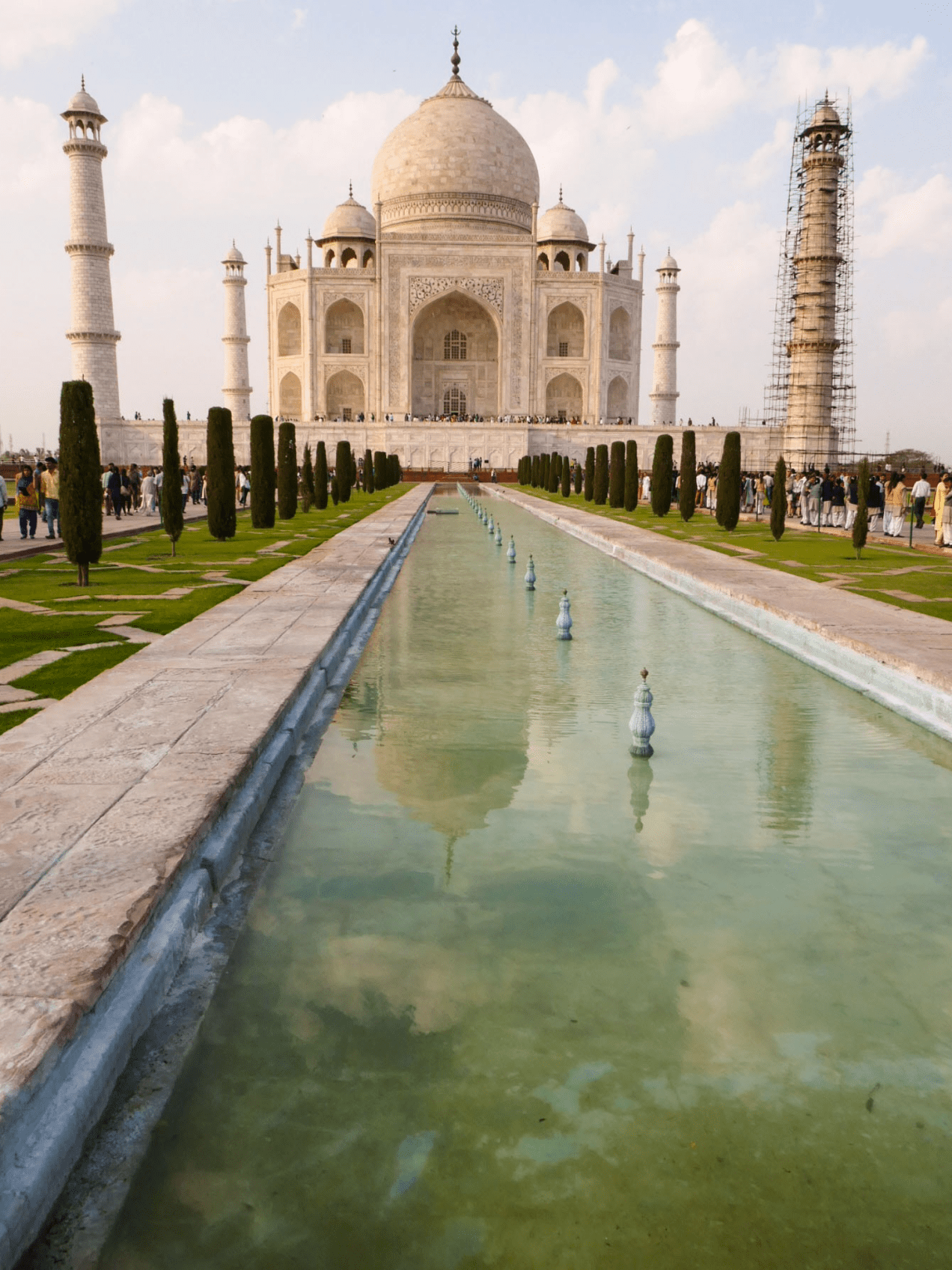
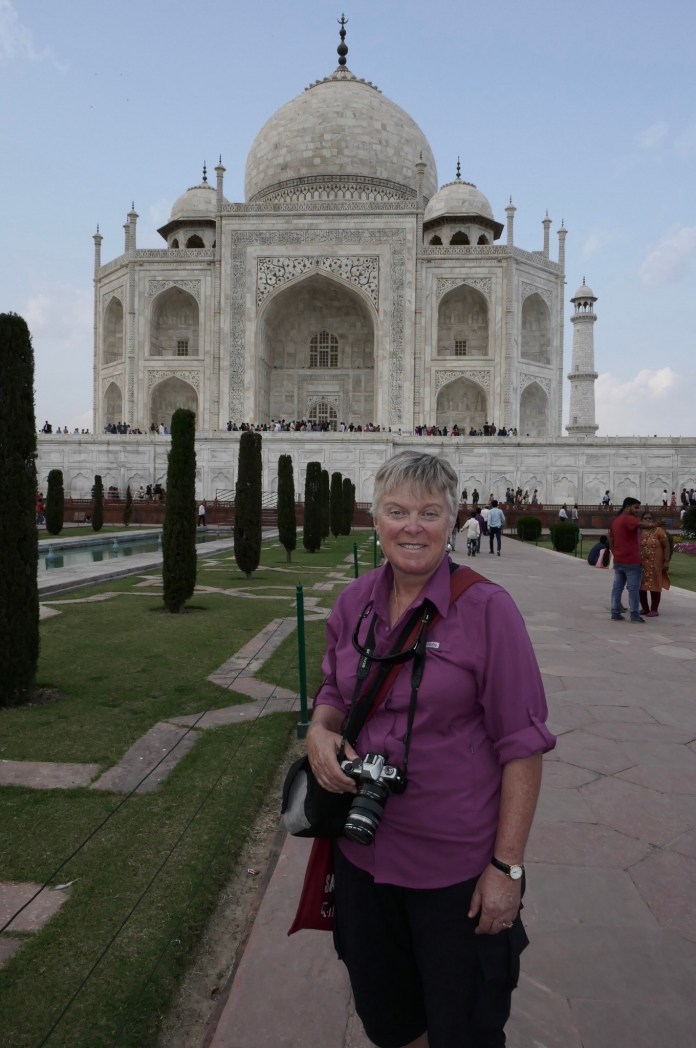
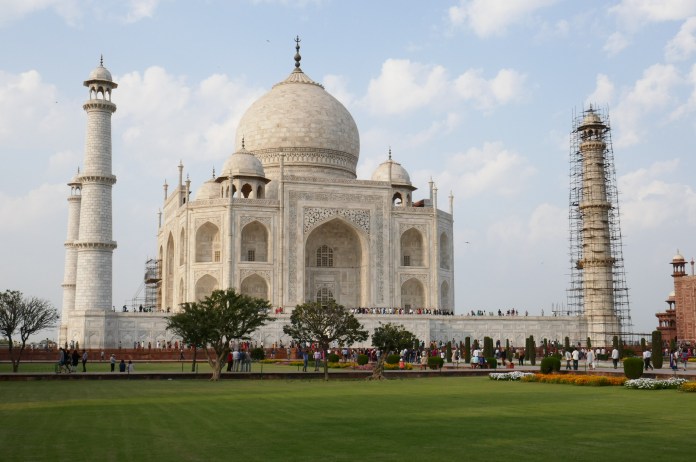
It’s big, it’s white and it’s perfect. The domes are works of art, curving gracefully up wards to the cupolas above. The white marble is being cleaned and rejuvenated and the majority of the surface has been completed. The minarets are strikingly white in the afternoon light, the individual marble pieces ascending to the high towers. The doors at each level are all clearly visible. The main building has great arched recesses, with a repeating relief carved from the marble of flowers, grouped as if in a vase each stem and flower splayed gently leaving a solitary central vertical stalk and flower. There is Arabic writing from the Koran on the pillars aside the great doors and across the immense lintel. As the sun set, these dark writings suddenly became silvery and shone out the prophets message. The main mausoleum is relatively small, but exquisite, inlaid precious stones are used to form another repeating pattern of coloured flowers and leaves. There is a marble mesh between the pseudo tombs and the visitors. This mesh is white and translucent an artifice of sublime skill. Ample but dappled, soft, light enters through the marble carved mesh that forms giant windows at two levels,
You exit the building, then walk upon a vast square of marble flooring, raised up above the water features and gardens of the Taj Mahal. The Yamuna River drifts past, the fort to the north, where Shah Jahan’s prison windows allowed him to look at his splendid legacy for the many years of his captivity by his son, Aurangzeb.
We walked along the walls, through and amongst the trees and gardens. Every few moments, I stopped and saw the Taj Mahal from a new perspective. It is really the most perfect building ever made. We visited the mosque adjacent to the Taj Mahal. It is an impressive building and would be even more so but for being next door to the Taj Mahal. The gardens are peaceful, providing a relaxing retreat in busy Agra, and are not crowded as is the main approach to the building where jostling and shameless photobombing are the rule!
We visited the small museum, admired some tiny Mughal paintings, and some much larger technical drawings of the Taj Mahal. Farmans of Shah Jahan or at least photocopies, are on display including one authorising the gathering of precious stone and marble for the building of the Taj Mahal. Jennifer and I wandered around the site then sat on one walkway edge just gazing at the structure and watching the Brahmany kites circle the cupola and domes.
We left at 6:3o pm and went for dinner in Agra. We shared three meals, and particularly enjoyed the Chicken Malai Tikka and the palak paneer. We ate our meals on the verandah of the restaurant, a flight of stairs above the road. However the sound of street noise, the cars and traffic sounds of busy India never stopped. So Jennifer and I drank our Indian white wine (a Sula Sauvignon Blanc), listened to the Sitar and tabla players that were almost drowned out by the street noise and talked and laughed with our fellow travellers.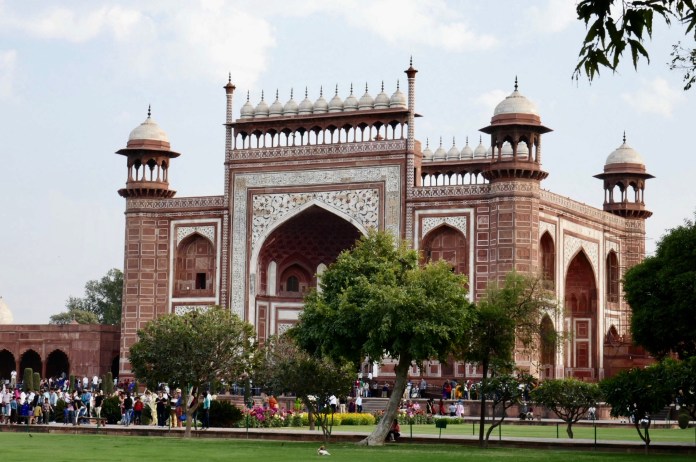
 brucebarker2016